
[Hangzhou West Lake Travel Guide] We've compiled information on West Lake ticket reservations, attraction introductions, and travel routes for you!
The West Lake Scenic Area covers a total area of 49 square kilometers, with 245 hectares of parkland and green space. West Lake has a circumference of 15 kilometers, an area of 5.6 square kilometers, a north-south length of 3.3 kilometers, an east-west width of 2.8 kilometers, and an average depth of 1.5 meters. The Su Causeway and Bai Causewa…
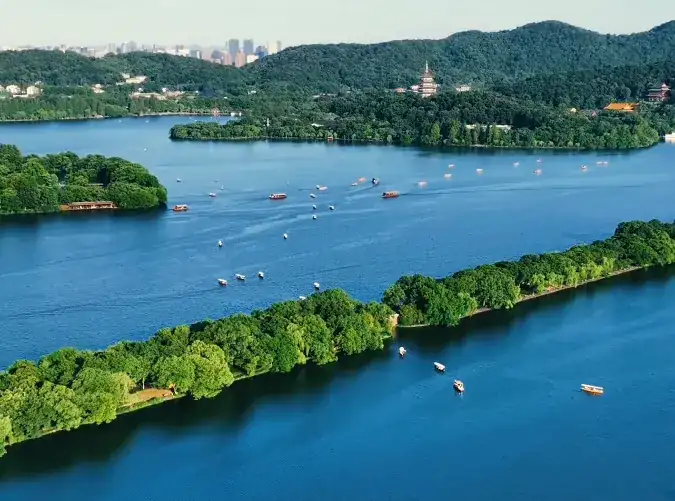
The West Lake Scenic Area covers a total area of 49 square kilometers, with 245 hectares of parkland and green space. West Lake has a circumference of 15 kilometers, an area of 5.6 square kilometers, a north-south length of 3.3 kilometers, an east-west width of 2.8 kilometers, and an average depth of 1.5 meters. The Su Causeway and Bai Causeway divide West Lake into the Outer Lake, Inner Lake, Yue Lake, West Inner Lake, and Little South Lake. The 1-kilometer-long green corridor—Lakeside Park—serves as a window into West Lake.
Further Reading: [Zhejiang Province Attractions] 2025 List and Distribution Map of 22 Latest 5A-Level Scenic Spots in Zhejiang
The West Lake Scenic Area boasts stunning landscapes and breathtaking scenery, with numerous scenic spots and historical sites. Among its many renowned attractions are the "Ten Scenes of West Lake," the "Eight Scenes of Qiantang," and the "Twenty-Four Scenes of Hangzhou." However, due to historical changes, especially the comprehensive renovation and construction after the founding of the People's Republic of China, the number has far exceeded these figures. As of the end of 1984, there were 65 scenic spots and historical sites; among them, 38 were listed as national, provincial, or municipal key cultural relics protection units.
The scenery of West Lake is ever-changing throughout the four seasons. In the warm spring, from the Lesser Cold to Grain Rain, a new flower blooms every five days along the shores of West Lake. Starting with the plum blossoms that herald spring, camellias, magnolias, crabapples, orchids, peach blossoms, peonies… At this time, the mountains surrounding West Lake are draped in green spring attire; Gushan, Wushan, Yuhuangshan, Longjing, Jiuxi and Shibajian… all become a verdant world. Strolling along the willow-lined banks of the Su Causeway in spring, amidst the chirping of orioles and swallows, is truly enchanting.
West Lake ticket information
Leifeng Pagoda: 40 yuan/person; Yue Fei Temple: 25 yuan/person; Hangzhou Zoo: 20 yuan/person; Hangzhou Botanical Garden: 10 yuan/person. Three Pools Mirroring the Moon is located in the center of West Lake and requires a boat trip to reach it; the boat ticket plus the entrance fee to the attractions is 70 yuan/person.
West Lake Travel Guide
One-day tour itinerary:Starting from the park pier, first go to Liulang Wenying, then take a boat to Santan Yinyue, then to Huagang Guanyu, then to Nanping Wanzhong, then to Leifeng Xizhao, then to Su Causeway Chunxiao, then to Shuangfeng Chayun, then to Quyuan Fenghe, passing by Yue Temple, then to Pinghu Qiuyue, and finally to Duanqiao Canxue.
In the evening, you can watch the Impression West Lake show, "The Most Memorable is Hangzhou".
"The Most Memorable is Hangzhou" is a large-scale water-based performance located on Yuehu Lake in Hangzhou's West Lake. Using water as its stage, mountains as its scenery, and the sky as its backdrop, it interprets classic stage art in an innovative way. It blends vocal music, dance, opera and other artistic elements with the ink of thousands of years of Chinese culture, and innovatively interprets classic Chinese and foreign songs such as "Spring River Flower Moon Night", "High Mountains and Flowing Water", "Butterfly Lovers", "Swan Lake" and "Dream Paradise". It showcases the traditional Chinese culture rooted in poetry, opera, music, dance and Tai Chi with a global expression, highlighting the understanding of "Jiangnan characteristics, Chinese style and global harmony".
✅️Ticket booking: Klook | Trip
By boat:
Public ferry: Operating hours are 08:30-15:30, and the ticket price is 68 yuan per stop.
Foreign Affairs Ship: Opening hours are 09:00-17:30, ticket price is 50 yuan. The pier has two parks, Xueshi Bridge, Huagang Guanyu, Yongjin Gate, Kuahong Bridge, and Children's Palace. You can disembark at the same location.
sightseeing bus:
Green sightseeing vehicle:The fare is 10 yuan per stop, and 20 yuan per stop for the wooden antique-style vehicle. The route is from the Children's Palace, Yongjin Gate, Leifeng Pagoda, Yue Temple, and Children's Palace, then runs clockwise around West Lake.
Lakeside sightseeing electric cart:The bus operates on a "hail and board" basis, with no fixed ticket office. The round-the-lake fare is 40 yuan per person; the section fare is 10 yuan per person; and the charter fee is 390 yuan per hour. Operating hours are 8:30-17:00 and 8:30-21:00.
Tour route:
Yongjin Gate – Liulang Wenying Park – Roman Square – Tang Yun Art Museum – Changqiao Park – Leifeng Pagoda – Su Causeway – Kuahong Bridge (Yue Temple) – Wu Song Tomb – Xiling Bridge – Pinghu Qiuyue – (Broken Bridge) Children's Palace – New Hubin Scenic Area – Yongjin Gate, the loop around the lake takes about 70 minutes (may vary depending on actual road conditions).
Ten Scenes of West Lake
(I) Spring Dawn on the Su Causeway
During the Yuan You era of the Song Dynasty, Su Shi dredged West Lake, using mud from the river to create a long causeway running from south to north. He planted flowers and willows along the causeway and built six bridges to facilitate navigation. "The six bridges span the Milky Way, connecting the northern mountains with the southern screen." Later generations called it Su Gong Causeway, or simply Su Causeway. During the Southern Song Dynasty, nine pavilions were built along the causeway, and it was continuously expanded and heightened. Many fine horses passed by, making it the most popular spot for travelers around the lake. People at the time said it was beautiful in all seasons, but especially so in the spring dawn. Later, the causeway gradually deteriorated. In the early Zhengde period of the Ming Dynasty, Prefect Yang Mengying dredged the causeway again, using mud from the river to repair the surface and planting willows.
During his southern tour, Emperor Kangxi of the Qing Dynasty inscribed the words "Spring Dawn on the Su Causeway" and built a pavilion at the southern end of Wangshan Bridge, also erecting a stone plaque. During the Yongzheng era, finding the pavilion too cramped and lacking in grandeur, he rebuilt the Cenlou Pavilion and constructed the Shuxia Pavilion behind it. Every spring, at dawn, petals drifted through the mist, dipping into the water, creating a breathtaking scene; at dusk, the sun shone through the light smoke, accompanied by a gentle breeze. It was a time of constant enchantment. By the late Qing Dynasty, the pavilion had crumbled, the willows had been cut down, and mulberry trees had been planted everywhere, no longer possessing the magnificent scene of "orioles singing, flowers blooming, flutes and drums playing, and painted boats moored." It wasn't until after the founding of the People's Republic of China that the causeway was repaired, the bridge railings were restored, peach and willow trees were planted along the causeway, and the imperial stele was re-erected. Thus, Spring Dawn on the Su Causeway, once considered the foremost of the "Ten Scenes of West Lake," gradually regained its former glory.
(II) Twin Peaks Piercing the Clouds
Located west of Xingchun Bridge, between the South Peak and North Peak, this location offers a panoramic view of the rugged peaks rising opposite each other, their twin summits like pens piercing the sky; closer at hand, one can enjoy the misty forests, the hazy rain accompanied by the sound of wind chimes. This is the best vantage point to appreciate the "two peaks piercing the clouds" aesthetic admired by the Song Dynasty poets. The Yuan Dynasty poets also referred to it as "two peaks amidst white clouds." During the early Qing Dynasty, when Emperor Kangxi toured the south, he changed "two" to "twin," and had his imperial inscription "Twin Peaks Piercing the Clouds" engraved on a stone tablet and placed in a pavilion here. On fine days in spring and autumn, leaning against the pavilion and gazing around, one would see auspicious clouds rolling and verdant screens reflecting the sky, and perhaps feel a desire to see through the mysteries of the world and return to the winds! In the late Qing Dynasty, the pavilion was destroyed and the stele collapsed, lost to the weeds.
In the early years of the Republic of China, Lingyin Road was completed, and the stele was moved to its current location on the north side of the road, with a pavilion built to protect it. Because this was a necessary route for pilgrims to Lingyin Temple, many tourists lingered here. Since the founding of the People's Republic of China, the surrounding area has flourished with flowers and trees. Longjing Road and Lingyin Road have been renovated and expanded, making it increasingly convenient to visit the two peaks, and the scenic environment has greatly improved. Unfortunately, the ancient pagoda on the peak has been destroyed and not yet restored. Although the trees are lush, their towering height obstructs the view, making it difficult to see the blue sky and white clouds, thus slightly diminishing the scenic charm.
(III) Listening to Orioles in the Willows
During the Southern Song Dynasty, there was a garden called Jujing Garden between the city walls of Qingbo Gate and Yongjin Gate. Emperor Xiaozong once visited this garden to rest after Emperor Gaozong abdicated. Within the garden was Tingzi Bay, a place with many inlets. Because of the many weeping willows that swayed in the wind like waves, it was named Liulang Port (Willow Wave Port). The saying goes, "Smoke boats drift across the willow-lined bay, clouds and mountains appear and disappear among the willows." In spring, orioles sang among the trees, leading to the Song Dynasty painting titled "Listening to Orioles in the Willow Waves." After the Southern Song Dynasty, this area gradually fell into disrepair. In the early Qing Dynasty, Emperor Kangxi personally inscribed the plaque "Listening to Orioles in the Willow Waves." Because Liulang Port was located in a cramped area, a pavilion and stele were built on the site of the former Lingzhi Temple and Xianying Temple in the former garden of King Qian of Wuyue to its south, and the inscription was hung on a stone tablet. Next to it is the Qianwang Temple and Biaozhong Temple, which were moved from Longshan during the Jiajing period of the Ming Dynasty. This place, backed by city walls and facing a square pond, is filled with swaying willow branches and shimmering green waves. The occasional warbling of orioles echoed the songs of musicians on the painted boats on the lake, a truly refined and delightful experience. By the late Qing Dynasty, the surrounding area was dotted with Hui Muslim tombs (these tombs dated back to the Yuan Dynasty, but gradually increased in number). Although the weeping willows remained graceful, the landscape gradually fell into disrepair. During the Republic of China era, the city walls were demolished, unifying the city and the lake, creating a unique and beautiful scene. However, with the outbreak of the War of Resistance against Japan, the Japanese invaders plundered Hangzhou, cutting down willows, driving away orioles, and grazing horses, turning the lakeside area almost back into a desolate graveyard!
After the founding of the People's Republic of China, the tombs were relocated after discussions among the Hui people. The area was transformed into Liulang Wenying Park, with willows planted along the embankment, and a memorial pavilion rebuilt on the large lawn to the southwest of the original site. In spring, the willows rippled in the water, birds sang, boats swayed on the lake, and laughter and songs filled the air, presenting a scene of prosperity once again. Entering the new century, the surrounding environment was further improved, and its charm and atmosphere seem to surpass even that of the early Qing Dynasty.
(iv) Viewing Fish at Flower Harbor
During the Southern Song Dynasty, between the Suolan and Wangshan Bridges on the Su Causeway, there was a villa belonging to the eunuch Lu Yunsheng. The scenery was exceptionally beautiful, and it was called Lu Garden. A winding stream flowed around it, including Flower Harbor, which originated from Huajia Mountain. Lu dug a pond, paved it with stones, and channeled lake water into it, raising dozens of species of fish. People flocked to watch, a scene known as "Viewing Fish at Flower Harbor." A Song Dynasty painting titled "Viewing Fish at Flower Harbor" likely depicts this place. By the end of the Southern Song Dynasty, Lu Garden had fallen into disrepair. The Kangxi Emperor of the Qing Dynasty personally inscribed "Viewing Fish at Flower Harbor," and a pavilion and calligraphy building were built near Dingxiang Bridge, the entrance to Santai Mountain between Yingbo and Suolan Bridges, to have the inscription carved and plaques hung. A square pond was also dredged, and various colorful fish were raised within it, thus creating "Viewing Fish at Flower Harbor," one of the Ten Scenes of West Lake.
The pond water was crystal clear, and the fish frolicked happily. Behind the pavilion, a tall hall, winding corridors, rockeries, and flower-lined paths were built, truly making it a scenic wonder of Hunan. Contemporaries praised it with the lines, "The spring waves are warm over the six bridges, peach blossoms fall and mandarin fish are plump." In the late Qing Dynasty, many literati and merchants built villas in the surrounding area, causing the waterways to shift and the pavilions to collapse, creating a scene of ostentatious disrespect. After the founding of the People's Republic of China, this area was transformed into a large park, called Xishan Park or Huagang Park. Near the Su Causeway on the original site, a new imperial stele was erected, and a stone pond was created to house fish, truly living up to its name. In the early 21st century, the southern section of West Lake and Yanggong Causeway were renovated, and the waters of various ponds in Hunan flowed freely through the park into the outer West Lake, restoring the bustling atmosphere of its former glory.
(V) Lotus in the Breeze at Quyuan Garden
During the Song Dynasty, near the Nine-Mile Pine Tree northwest of Jinsha Port, there once stood a winding courtyard (曲院), a place where water from Jinsha Port was used to brew official wine. The area was abundant with lotus flowers, and in summer, a gentle breeze carried the fragrance of lotus and the aroma of the brewing agent, offering respite from the heat. Thus, Song Dynasty poets and painters created works titled "Lotus Breeze at the Winding Courtyard" (曲院荷风). After the Song Dynasty, the waterway gradually shifted westward, and without water for brewing or the fragrance of lotus blossoms, the name no longer applied. In the early Qing Dynasty, the waterway was channeled north of the Rainbow Bridge on the Su Causeway, and stones were piled up to create a winding path. A pavilion was built to display the plaque inscribed with Emperor Kangxi's calligraphy, "Lotus Breeze at the Winding Courtyard" (曲院风荷), and a stone tablet was erected. Kangxi changed "Winding Courtyard" (曲院) to "Winding Courtyard" (曲院), which accurately reflects the original name. "Wind and Lotus" (风荷) certainly possesses a more poetic and artistic quality than the more literal "Lotus Breeze" (荷风). Therefore, "Lotus Breeze at the Winding Courtyard" (曲院风荷) has been the fixed name among the Ten Scenes of West Lake ever since.
Later, a three-bay open hall, the Yingxun Pavilion, and the Wangchun Tower were built to the east, while a covered walkway and double corridors were added to the west, inlaid with calligraphy bestowed upon officials during the Southern Inspection Tour. In spring and summer, when the flowers bloom, fragrant breezes waft through the air, the water is calm, and the green canopy and red blossoms create a picturesque scene by the lake. During the Tongzhi reign, it suffered extensive damage from war. Although it was later repaired, it never regained its former glory. After the Republic of China era, surrounding buildings were gradually encroached upon, and by the 1950s, only a stele pavilion and a pond remained. In recent years, the side adjacent to Yanggong Causeway has been expanded into a garden, with pavilions, flowers, and waterways, transforming it into a large park named "Quyuan Fenghe" (Lotus in the Breeze at the Curved Courtyard). The original stele pavilion has been restored to its former glory, with its elegant windows offering panoramic views, making it a place to linger once again!
(VI) Autumn Moon over the Calm Lake
During the Song Dynasty, people enjoyed moon-viewing, drinking, composing songs, and reciting poems along the Su Causeway and Bai Causeway on autumn nights. One poem praised this scene: "The cold moon shines on the still, frozen spring; where do the boats drift as they return? White duckweed and red reeds in the west wind; a vast expanse of autumn lake reflects the same color." The autumn waters of West Lake are especially clear, and the autumn moon shines even brighter, creating a unique and beautiful scene. This scene was praised as "Autumn Moon over the Calm Lake," and many Song Dynasty painters and poets used it in their paintings and poems. Zhu Mu, in his *Fangyu Shenglan*, ranked it first among the "Ten Scenes of West Lake." At the end of the Ming Dynasty, a pavilion called Wanghu Pavilion was built at the intersection of Gushan Road, offering a panoramic view of the lake, but it later collapsed. During the reign of Emperor Kangxi of the Qing Dynasty, the pavilion was rebuilt, with a stone platform in front and water on three sides. An imperial plaque reading "Autumn Moon over the Calm Lake" hangs above the pavilion, and a waterside pavilion, winding railings, and painted balustrades are built beside it. Every clear autumn night, when the water has just receded and the bright moon shines in the sky, the vast expanse of water is a seamless blue, as if one were in a jade palace, no longer knowing whether one is in the human world or what year it is!
During the Republic of China era, the Baigong Road from Shengyin Gate to the north end of Xiling Bridge was built. The pavilion was located at the intersection of this road and Gushan East Road. Flowers and trees were planted extensively on its east, west, and north sides, evolving into Pinghu Qiuyue Park. After the 1950s, the western wall was demolished, connecting with Luoyuan Garden. Later, due to road widening, some buildings on the north side were demolished, leaving only one building, one pavilion, one stone platform, and one winding railing of this scenic spot. However, the elegant charm of boating on the river, climbing the pavilion, or standing on the water, gazing at the vast expanse of shimmering water and the moon's reflection, still remains! In recent years, every Mid-Autumn Festival, elites from all walks of life in Hangzhou gather here to brew tea, appreciate the moon, and chat happily, which has almost become a new custom in Hangzhou.
(VII) Evening Bell at Nanping
A painting titled "Evening Bell at Nanping" was created by a Song Dynasty artist and included as one of the "Ten Scenes of West Lake." This is because near Nanping Mountain are Jingci Temple and Xingjiao Temple (built by the King of Wuyue, destroyed at the end of the Yuan Dynasty, later becoming Xiaoyoutian Garden). Whenever the temple bells were first rung, the entire valley echoed, only ceasing after a long time. Because the mountain is high and has many hollows, the sound travels exceptionally far, hence the name "Evening Bell at Nanping." When Emperor Kangxi of the Qing Dynasty toured Hangzhou and inscribed the Ten Scenes of West Lake, the air was clear and the sounds of nature were still when the bells suddenly rang out, their sound stopping the clouds in their tracks, prompting deep reflection. Therefore, he changed "evening" to "dawn" in this scene, inscribing the plaque "Dawn Bell at Nanping," which was hung in the newly built library in front of Jingci Temple. A stone inscription was also carved north of Wangong Pond, and a pavilion was built to house the stele. However, poets and painters throughout history have admired the imagery of the evening bells ringing in the dark halls of Buddhist temples, as seen in lines such as "The sound of the bell echoes deep in the evening smoke," "Let the mountain monks strike it with the moonlight," "The sound of the bell comes from the distant evening clouds," and "The sound of the bell at Nanpu comes with the rain, and the fishing lights of the whole village emerge from the forest." Therefore, despite the imperial edict, the people of Hangzhou still refer to it as "Nanping Evening Bell" to this day.
It's worth mentioning that Li Wei's *West Lake Gazetteer*, compiled during the Yongzheng era, provided a detailed account of Kangxi's change of "wan" (晚, evening) to "xiao" (晓, dawn), but the *West Lake Gazetteer Compilation*, compiled during the Qianlong era, was vague on this matter. Qianlong's poem, "Jingci Temple is shrouded in shadow facing Nanping, the intermittent sounds of the Pulao Temple enter the night. I recall mooring outside Suzhou, hearing it at Hanshan Temple at the third watch," directly contradicts his ancestor's account. The current imperial plaque also uses the character "wan," indicating that by at least the Qianlong era, someone had already switched the character "xiao," though details are not recorded. Although the plaque was later destroyed, the inscribed stele remained on the left side of the temple gate. For symmetry, a pavilion was also built on the right side of the temple, displaying Qianlong's poems. From the mid-20th century onwards, the two pavilions in front of the temple remained unchanged, unaffected by the road expansion. However, the temple bell's sound has almost completely ceased; though the scenic beauty remains, it is now merely a hollow name. In recent years, on auspicious days, the sound of bells can be heard occasionally, which is better than nothing and can serve as a slight embellishment to the "Nanping Evening Bell" scene.
(VIII) Three Pools Mirroring the Moon
When Su Shi served as governor of Hangzhou during the Song Dynasty, he dredged West Lake and erected three pagodas in the middle of the lake as landmarks, ordering that the area around the pagodas not be submerged. The pagodas, shaped like bottles, floated on the water and were located south of the pavilion in the center of the lake. They were destroyed during the Chenghua period of the Ming Dynasty. During the Wanli period, the lake was dredged again, and mud from the lake was used to create a embankment around the pool at the present-day Three Pools Mirroring the Moon scenic spot, forming a release pond and creating a lake within a lake. Three pagodas were then placed outside the pond, their reflections mirroring the moonlight, thus fulfilling the name "Three Pools Mirroring the Moon." During the Kangxi period of the Qing Dynasty, pavilions were built over the pond, with an imperial inscription of "Three Pools Mirroring the Moon" hanging above them. A stele pavilion was also built to the north of the pond. High pavilions and winding stone bridges were also constructed. The clear, bright waters and the floating pagoda shadows offered a tranquil escape, allowing one to cleanse their mind and dispel worldly worries, whether boating on the lake or strolling leisurely on the pond.
In the mid-Qing Dynasty, the pond still boasted structures such as "Fish Pond Autumn Hibiscus," Yingcui Pavilion, and Yongming Zen Temple. A plaque overlooking the lake read "Little Yingzhou," a name inherited from the old Wenshui Pavilion south of Yongjin Gate. During the Tongzhi and Guangxu periods, Peng Yulin built the Tuixing Temple here, planted trees and flowers, paved paths, and constructed ponds, giving the pond a vibrant appearance. At night, the clear reflections shimmered in the water, like jade bathed in ice, captivating the soul! After liberation, the pond was cleaned of its clutter and embellishments, with the addition of rest areas and a boat dock, making it a must-visit spot for tourists. In recent years, the weathered pavilions have been restored to their original state. Amidst the swaying green shadows, their beauty is even more striking. On a full moon night, a boat trip on the pond evokes the lines, "The pond's blue water reflects the sky, the cold moon shines brightly in the middle of the night. It reveals the true face of Chang'e, her beauty surpassing even the fairy maiden on the Jade Terrace," a sentiment that will stir the heart and make one dance with joy.
(ix) Leifeng Pagoda at Sunset
The mountain north of Jingci Temple is named Leifeng, a branch of Nanping Mountain. During the Wu-Yue period, Princess Huang, wife of King Qian Chu, built a pagoda on it, named Leifeng Pagoda, also known as Huangfei Pagoda. The pagoda has double eaves and flying beams, with windows that open wide. Originally it had seven stories, but later, according to feng shui principles, only five stories remained. The underground palace of the pagoda contains a Buddha's hair bun, and the bricks of the pagoda contain the text of the Avatamsaka Sutra. The Song Dynasty poet Wang Xiao's poem, "The pagoda's shadow just fades as the sun sets, voices from beyond the wall seem near Ganyuan," vividly depicts the surrounding scenery. A Song Dynasty painter also created a painting titled "Leifeng at Sunset." The Yuan Dynasty poet Yin Tinggao's seven-character quatrain, "Smoke and light, mountain colors, faint and hazy, a thousand-foot pagoda stands alone in the sky. Painted boats on the lake are almost all gone, the lonely peak still bears the red of the setting sun," is undoubtedly the most fitting description of the "Leifeng at Sunset." During the Jiajing period of the Ming Dynasty, Japanese pirates invaded, suspecting an ambush in the pagoda, and set it on fire, destroying all the eaves and steps, leaving it standing bare and red. However, looking around from the lake, "Baochu is like a beautiful woman, and Leifeng is like an old monk," which is quite unusual.
The Ming Dynasty poem, "The Leifeng Pagoda lies dilapidated, only serving tourists in the setting sun," is remarkably similar to the sentiment expressed in a Song Dynasty painting. When Emperor Kangxi of the Qing Dynasty inscribed the Ten Scenes, he changed "Sunset Glow" to "Western Glow," and built a pavilion on the west side of the peak to display the plaque "Leifeng Western Glow," erecting a stele behind the pavilion. However, people at the time, inspired by the poem "The pagoda understands the tourists' feelings, holding a golden ray of the setting sun," still named the Ten Scenes "Leifeng Sunset Glow," not changing "Western" to "Sunset." In 1924, the pagoda collapsed, leaving only ruins. The loss of one of the Ten Scenes saddened the world. Calls to rebuild the pagoda and recreate the Ten Scenes persisted for decades. At the end of the last century, under the premise of excavating the underground palace and protecting the ancient relics of the pagoda's foundation, the seven-story Leifeng Pagoda was recreated in Nanping, finally restoring all ten scenes to their complete form. Today, every evening at sunset, when the golden pagoda and the surrounding mountains and trees are reflected in the lake, it resembles a newly opened golden mirror or a falling fiery pearl—a sight even more breathtaking than the crimson sunset over Chicheng. Climbing the steps to the top of the pagoda, one can gaze upon the entire panorama of West Lake, a sight that stirs the heart and leaves one utterly captivated!
(X) Broken Bridge and Lingering Snow
At the eastern end of Baisha Causeway stands the Broken Bridge, also known as Duanjia Bridge, and during the Song Dynasty, it was also called Baoyou Bridge. The Song Dynasty painter Chen Qingbo painted a picture titled "Broken Bridge in Lingering Snow," while the poet Wang Xiao inscribed it "Lingering Snow on Duan Bridge." Later generations debated whether "broken" meant the road ended there, or "Duan" meant a family surnamed Duan lived there. However, there is no consensus, and it is difficult to clarify, but today it is mostly referred to as the Broken Bridge. The "lingering snow" does not refer to the snow accumulated on the bridge itself, but rather to the snow accumulated on the pavilions and plum trees of Geling and Gushan when viewed from the bridge. This is evidenced by the Yuan Dynasty poet's lines about "Broken Bridge in Lingering Snow": "Jade-waisted peaks hang wide to the sky, golden-ridged pavilions and terraces line the banks in a hazy mist," and "The clear sky of Gushan is nowhere to be found, laughing, I point to the plum blossoms separated by the cold green." In the early Qing Dynasty, Emperor Kangxi visited this place. The earth was warm and the spring snow had not yet melted. The distant pavilions and terraces were covered with jade-like snow, and he was delighted by the poetic scene, saying that it was incomparable to the "snow on Ba Bridge" of ancient Chang'an. Auspicious snow is a sign of a good harvest, and the ancients always regarded the accumulation of snow as a sign of good fortune for agriculture. Therefore, he specially ordered the plaque with the inscription "Broken Bridge and Lingering Snow" written by the emperor to be hung on the pavilion built on the bridge.
Although the pavilion was later destroyed, the imperial inscription on the plaque was still faintly discernible in the early years of the Republic of China. During the reconstruction of Gushan Road, the bridge surface was replaced with a slope instead of stone steps, and it was eventually completely demolished. The Imperial Stele Pavilion at the intersection of Beishan Road to the north of the bridge, though weathered by time, still retains traces of its original form. The imperial stele remains unchanged, with only minor alterations to the surrounding railings, flowers, and the pavilion's structure. Because the famous legend of the White Snake involves many chapters about the broken bridge, it is always crowded with tourists, not solely due to the strong west wind. However, whenever the six-petaled snowflakes fly, a gentle breeze approaches, and the cold rocks and deep valleys still retain their last rays of light, with only a sliver of white remaining on the pagoda peaks, the fear of shattering the jade-like beauty when lightly stepping onto the painted bridge is quite poignant. If one stands here quietly at dawn, watching the red sun rise higher, one might think, "When will the ice melt, adding spring waves to carry the painted oars?"
West Lake Food Recommendations
West Lake Vinegar Fish, Longjing Shrimp, Dongpo Pork, Song Sao Fish Soup, etc.
West Lake Transportation Routes
subway:Both Longxiangqiao Station and Fengqilu Station on Metro Line 1 are very close to West Lake. From Longxiangqiao Station, you'll be close to Hubin Yintai and the West Lake Musical Fountain; from Fengqilu Station, you'll be close to Broken Bridge and Beishan Street.
Public transport:There are many bus routes around West Lake Scenic Area. For example, routes 51 and 52 are bus lines that circle West Lake and pass by many scenic spots. Route 51 passes through Wushan Bus Station, Qingbo Gate, Nanshan Road Wansongling Road Intersection, Changqiao, Jing Temple, Su Causeway, Yuhu Bay, Air Force Sanatorium, Dingjiashan, Guozhuang, Hangzhou Flower Nursery, Yue Temple, Xinxin Hotel, Geling, outside Qiantang Gate, Xiaocheqiao, Dongpo Road Pinghai Road Intersection, First Park, Yongjin Gate, Hefang Street Lotus Pond, and Wushan Bus Station. Route 52 passes through Huanglong Tourist Distribution Center, Zhejiang University Affiliated High School, Shuguang Apartment, Hangzhou Flower Nursery, Guozhuang, and other stops. There is also Route Y9, a high-rise sightseeing bus that circles West Lake, starting and ending at Hangzhou Tourist Distribution Center (Huanglong), passing through scenic spots such as Yue Temple, Hubin Park, Qianwang Temple, Jing Temple, Su Causeway, Guozhuang, and Hangzhou Flower Nursery. The fare is 5 yuan per person for the entire journey.
Klook recommends: Hangzhou West Lake Cruise + Leifeng Pagoda + Su Causeway + Flower Harbor Viewing Fish Classic Half-Day Tour (Morning/Afternoon Sessions Available)
Travel information can change. Check current opening hours, reservations and entry requirements before you travel.

Traveller discussion
Start the conversation with a helpful tip or a question.