
[Kaiyuan Temple] Four Must-See Spots at Kaiyuan Temple in Quanzhou - Save This Article
Kaiyuan Temple in Quanzhou is a rare temple in Fujian Province. It is not only a national key temple and a national key cultural relics protection unit, but also one of Quanzhou's 22 World Heritage sites. Further reading: [Quanzhou Tourism] The most comprehensive guide to Quanzhou attractions, including transportation, accommodation, routes, and f…
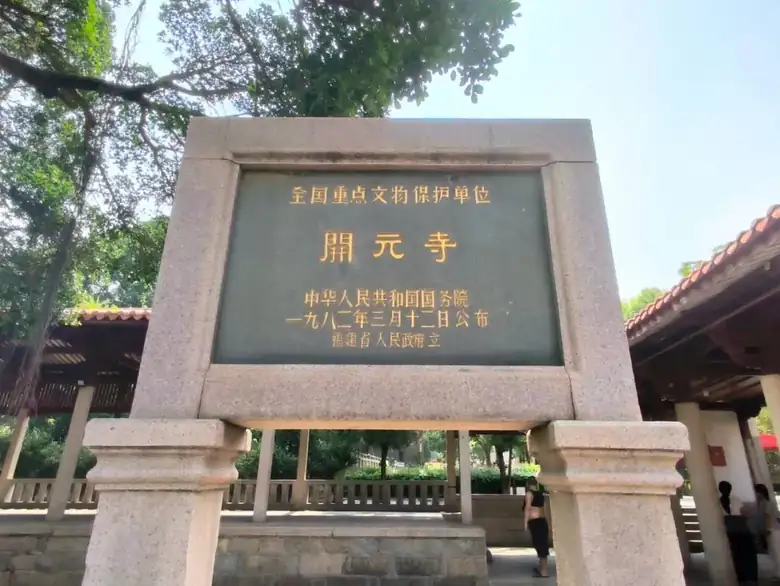
Kaiyuan Temple in Quanzhou is a very rare temple in Fujian. It is not only a national key temple, but also a national key cultural relics protection unit, and one of the 22 World Heritage sites in Quanzhou.
Further Reading: [Quanzhou Tourism] The Most Comprehensive Guide to Quanzhou Attractions, Including Transportation, Accommodation, Routes, and Food!
When I revisited the area recently, I overheard a family arguing about whether to hire a tour guide. Apparently, the three of them hadn't done their research and didn't know how to enjoy the trip, while the elderly person was worried about the cost of a tour guide.
This is actually a very real problem when traveling to temples. I happen to know a bit about Kaiyuan Temple in Quanzhou, so I'll summarize this article as a "guide".
✅️Tour guide + commentary: Trip
Opening Hours
Starting October 27, 2025, the opening hours of Quanzhou Kaiyuan Temple will be adjusted.
Adjusted to daily: 6:30-17:00
The temple closes at 17:40.
Visitors and worshippers are kindly requested to plan their visit to the temple accordingly.
Transportation to Kaiyuan Temple
Quanzhou Kaiyuan Temple is easily accessible by public transportation. You can take a bus or a shared bicycle (the fare is only 2 yuan). You can take bus routes 2, 2 night bus, 40, 601, 602, etc. to Kaiyuan Temple Station and walk from there. For a closer visit, you can also choose to walk or use a shared bicycle.
Kaiyuan Temple sightseeing route
Enter through the West Gate: 1. Sutra Repository; 2. Ganlu Ordination Platform; 3. Mahavira Hall; 4. Worship Courtyard; 5. Zhenguo Pagoda; 8. Master Hongyi Memorial Hall (we didn't actually go in, but there's a "Zen" character at the entrance, which is great for taking pictures); 6. Mountain Gate; 7. Renshou Pagoda.
Kaiyuan TempleFour Must-See Highlights
First, the three great legends of Kaiyuan Temple in Quanzhou;
Secondly, the status of Kaiyuan Temple in Quanzhou;
Thirdly, important cultural relics within the temple;
Fourthly, the East and West Towers side stories
I suggest those who are interested bookmark this page, and those who have been there are welcome to add any omissions.
The Origin and Revitalization of Kaiyuan Temple in Quanzhou
Three auspicious omens legends
Walking into Kaiyuan Temple from West Street, you can see the "Purple Cloud" plaque in the Hall of Heavenly Kings, as well as the inscriptions "Mulberry Lotus Law Boundary" and "Peach Lotus Auspicious Omens" on the walls on both sides.
These are respectively related to three auspicious legends about the temple's origin and revival.
The history of Quanzhou Kaiyuan Temple can be traced back to the second year of the Chuigong era of the Tang Dynasty (686 AD). It is said that Huang Shougong, a mulberry farmer, dreamed of white lotuses blooming in his mulberry trees, so he donated land to build a temple, which was initially named Lotus Temple.
When the temple was built, an auspicious sign appeared: "purple clouds covered the ground, and no grass grew." Therefore, it was also called Ziyun Temple (Purple Cloud Temple).
Therefore, in this temple you can also see the three large characters "Ziyun Ping" in clerical script on the screen wall, which were written by Chen Yuwang, a calligrapher from Quanzhou in the Ming Dynasty.
Ziyunping was first built in the fourth year of the Wanli reign of the Ming Dynasty (1576) and rebuilt in the fourth year of the Tianqi reign (1624), so it has a history of more than 400 years.
The main hall, with its double-eaved hip roof and nine bays, bears the plaque "Sang Lian Fa Jie," making it a unique symbol of Quanzhou Kaiyuan Temple.
Because it is in the Wei stele style, some people still cannot understand it. Here, "灋" is interchangeable with "法" and can also be pronounced as "fa".
In addition, the mulberry trees at Kaiyuan Temple are over 1,300 years old, making them the oldest in China, and they remain evergreen throughout the year.
It even bore mulberries at the beginning of last year, making it a veritable "immortal tree".
To express gratitude for Huang Shougong's donation of the land, a separate "Tan Yue Shrine" was built next to the Sutra Repository to commemorate him.
As for "Taolian Yingrui", it refers to September 1924, when eminent monks such as Yuanying returned from overseas to spread Buddhism and wanted to rebuild Kaiyuan Temple.
As a result, just a few days after construction began, the peach trees unexpectedly budded and blossomed out of season... So, Yuan Ying inscribed the words "Peach and Lotus Bring Auspiciousness".
Royal Temple
Imperial-bestowed Buddha statue + specially approved Nectar Ordination Platform
In the 26th year of the Kaiyuan era of the Tang Dynasty, Emperor Xuanzong of Tang promoted the policy of "one Kaiyuan Temple in one prefecture," which is why there are so many Kaiyuan Temples throughout the country.
As a result, Quanzhou Ziyun Temple was transformed into Quanzhou Kaiyuan Temple, becoming a "royal temple".
I've seen many travel bloggers introduce Quanzhou Kaiyuan Temple as "Da Kaiyuan Temple" (Greater Kaiyuan Temple), claiming it's the largest temple in Fujian. This is clearly incorrect.
At its peak, Quanzhou Kaiyuan Temple was about three times the size it is now. It's hard to verify whether it was the largest back then, but it was definitely not the largest now. For example, Fuzhou Qishan Wanfo Temple was much larger.
In fact, the name "Da Kaiyuan Temple" is more related to its historical status, especially since Quanzhou was a world maritime trade center during the Song and Yuan dynasties, so the imperial court would naturally "favor" it.
For example, the imperial decree of Kublai Khan, the Yuan Dynasty emperor, that the temple was named "Da Kaiyuan Wanshou Chan Temple" has become a living signboard for the Kaiyuan Temple in Quanzhou today.
Also, there are the four characters "Imperial Gift of Buddha Statue" below the main hall of the temple. I wonder how many people have noticed them?
The Kaiyuan Temple in Quanzhou enshrines the Five Buddhas, a typical feature of Esoteric Buddhism: the central Buddha is the Vairocana Buddha, also known as the Great Sun Buddha, bestowed by the emperor.
Later, Wang Shengui, one of the "Three Kings of Fujian", added the statues of Akshobhya Buddha in the East, Amitabha Buddha in the West, Ratnasambhava Buddha in the South, and Amoghasiddhi Buddha in the North.
The Hall of Heavenly Kings is flanked by Vajrapani and Narayana, figures characteristic of Esoteric Buddhism. Those who have read "Investiture of the Gods" are accustomed to calling them the "Hum and Ha Generals".
Interestingly, behind the main hall is the Ganlu Ordination Platform, which has distinct characteristics of the Vinaya School of Buddhism. This is precisely what makes Quanzhou's diverse culture so appealing.
In ancient times, the ordination platform required special approval from the imperial court, further confirming the status of Quanzhou Kaiyuan Temple.
Among the three major ordination platforms in China (Jietai Temple Ordination Platform in Beijing, Zhaoqing Temple Ordination Platform in Hangzhou, and Ganlu Ordination Platform), Ganlu Ordination Platform is not only the best preserved, but its Sumeru-style stone platform is a remnant from the Song Dynasty (built in 1019), while the wooden structure was rebuilt in the Bingwu year of the Kangxi reign (1666), making it extremely precious!
As for the plaque inscribed with "Pure Dharma Body" on the front beam, it was written by Hong Chengjun (the third younger brother of Hong Chengchou, the first Han Chinese prime minister of the Qing Dynasty, who surrendered to the Ming Dynasty).
A treasure trove of artifacts: rare Hindu relics, including 24 exquisite flying apsaras.
Like most temples, Quanzhou Kaiyuan Temple has been rebuilt and renovated many times throughout history, thus accumulating a number of unique cultural relics.
The existing buildings were mainly constructed in 1637 (the tenth year of the Chongzhen reign of the Ming Dynasty) under the supervision of Zheng Chenggong's father, Zheng Zhilong.
The most famous of these is the Mahavira Hall—also known as the "Hall of a Hundred Pillars," which has three unique features:
First, it was a case of "stealing the beams and replacing the pillars." Although it was named the Hall of a Hundred Pillars, only 84 pillars were actually used to save space for worshipping Buddha.
The Hall of a Hundred Pillars at Kaiyuan Temple in Quanzhou is very famous. Not only did Guo Moruo visit it in 1962 and write a poem there, but Cambodian national father Norodom Sihanouk also visited it twice.
Guo Moruo's poem was even engraved on a stone tablet and covered with an "umbrella," which is difficult to comment on here...
Secondly, it is the only Hindu stone pillar relic owned by a temple in China.
When the main hall was rebuilt, some stone components from the Hindu temple that had been destroyed in the war were moved over. The most famous of these are the two stone pillars in the rear hall, which are engraved with patterns from ancient Hindu mythology, as well as some traditional Chinese floral patterns.
With the increasing number of tourists visiting Quanzhou, it has been "protected" with a glass cover.
If you look closely, you can also see 73 Hindu sphinxes carved in blue stone on the platform in front of the main hall.
Thirdly, the 24 flying apsara musician brackets in the main hall are masterpieces of Ming Dynasty wooden architecture.
When Master Yuan Ying oversaw the reconstruction in the 1920s, the building was restored, allowing us to appreciate the wisdom of our ancestors today.
Also worth mentioning are the couplets on the pillars that read "This place was once known as the Buddhist Kingdom, and the streets are full of saints." One of them is under the "Imperial Edict for the Great Kaiyuan Longevity Zen Temple" in the Hall of Heavenly Kings, and the other is at the empty gate of the Mahavira Hall.
This quote was written by Zhu Xi, while the couplet on the pillars of the Hall of Heavenly Kings was written by Master Hongyi. There are notes next to it: "This couplet used to be on the temple gate" and "Written by Master Yiyin in the spring of the year Wuyin".
The monk Yiyin is Master Hongyi, which suggests that the book was written in 1938.
In fact, there are many other pillar couplets similar to those written by the master at Kaiyuan Temple in Quanzhou.
For example, a casual snapshot I take turns becoming a masterpiece. If you're interested, explore more and you're sure to be pleasantly surprised.
In addition, in the 1970s, Quanzhou gathered many old objects at Kaiyuan Temple in order to protect cultural relics, which unintentionally became a must-see attraction today.
For example, near the West Pagoda, there is a stone inscription that reads "Number One Among Ten Thousand Mountains".
The author was Huang Zhilin, a Jinshi (successful candidate in the highest imperial examination) from Jinjiang in the early Qing Dynasty who rose to the position of Left Provincial Administration Commissioner of Huguang. He imitated Mi Fu's "First Mountain" and added the character "Wan" (ten thousand), originally placing it at the entrance of Dongyue Temple in Quanzhou.
The Qilin Wall is an old relic from the Quanzhou City God Temple.
Since officials in the Ming and Qing dynasties would always visit the City God Temple upon taking office, it is conceivable that this Qilin Wall was no ordinary object.
As for the artificial hill next to the East Pagoda, it was not built haphazardly. Many of the structures were relocated from ancient private gardens in Quanzhou, such as the Su Family Garden in the south of the city.
In addition, Kaiyuan Temple also houses the Shuilu Chan Temple (which was once the administrative office of the Southern Song Dynasty's Southern Outer Zongzheng Division, and was moved to the west side of Kaiyuan Temple during the Jiajing period of the Ming Dynasty), the Hongyi Master Memorial Hall, and the Quanzhou Bay Ancient Ship Exhibition Hall.
East and West Towers
China's "Four Famous Pagodas": Quanzhou Spirit and Nostalgia
The East and West Pagodas have stood for a thousand years and survived numerous strong earthquakes, becoming a symbol of the Quanzhou people's spirit of hard work, perseverance, and resilience.
Yu Guangzhong's line, "How many springs have the coral trees bloomed? How many years have the East and West Pagodas gazed at each other?" has made the East and West Pagodas a symbol of homesickness for many Quanzhou natives who have left their hometowns.
The sudden emergence of Black Wukong has propelled the East and West Pagodas out of their traditional national status, and even now, travel photography businesses are offering the Golden Cudgel as a prop...
There is a lot of information about the East Pagoda Zhenguo Pagoda and the West Pagoda Renshou Pagoda online, and many people are familiar with them, so I will only add three points here:
Firstly, the East Pagoda was once considered one of the "Four Famous Pagodas".
Those who wrote the letter may remember that four stamps entitled "Ancient Pagodas of China" were issued in the 1990s.
The four pagodas are: the Big Wild Goose Pagoda in Xi'an, the Zhenguo Pagoda of Kaiyuan Temple in Quanzhou, the Liuhe Pagoda in Hangzhou, and the Youguo Temple Pagoda in Kaifeng.
Secondly, there is the "Reassurance Stone" next to the West Pagoda, where the dot of the character "心" (heart) is located below the character.
There are different accounts regarding its origin! One account aligns with the history of the East and West Pagodas, so it's worth considering.
During the Tang Dynasty, the East and West Pagodas were wooden pagodas, which were prone to attracting lightning and fires. Later, brick pagodas were tried, but they were not feasible due to load-bearing issues. Therefore, during the Southern Song Dynasty, the idea of building stone pagodas was conceived.
The ancient wooden construction techniques were superb, but the stone construction was somewhat weak. In addition, the foundation of the West Pagoda was lower than that of the East Pagoda, so the monks in charge of the design and construction built the West Pagoda first as a "model".
Finally, after nearly 10 years of construction, the West Pagoda was completed. It was sturdy and reliable! A special "heart" character was carved on the stone, and it was named "Reassuring Stone".
Then he was able to focus on building the East Tower, which took another 12 years to complete.
Today, the "Peace of Mind Stone" is imbued with the Zen meaning of "When you pick it up, all things arise; when you put it down, nothing happens."
Thirdly, the location of the Monkey Walker statue.
The East and West Pagodas together have 160 reliefs. The East Pagoda depicts the Saha world of the East, which, in layman's terms, is about the hardships one must endure to become a Buddha. The West Pagoda, on the other hand, depicts the Western Paradise, showing what the West is really like.
The Monkey King statue, which became an internet sensation due to its depiction of the Black Monkey King, is located on the fourth floor of the West Tower. Kaiyuan Temple has even thoughtfully placed an enlarged version of it in the square for tourists to take photos.
Actually, the exact location is easy to find, as shown in the picture below. Standing in the square and looking into the distance, you can see it at a glance.
If you've read "Hanshan Asks Shide" and are inspired by its open-mindedness and carefree spirit, you can visit the "Two Immortals of Harmony"—Hanshan and Shide—on the south side of the second floor of the East Pagoda.
Finally, it's worth noting that the 26th day of the twelfth lunar month is the Kaiyuan Temple's Buddhist pilgrimage day (circumambulation of the Buddha). Just hearing the name gives you an idea of how grand and lively it is, especially the "tail-offering" ceremony on the 26th. So if you're planning a trip to Kaiyuan Temple in Quanzhou, consider going on the evening of the 25th to experience it; you're sure to have a special experience.
Travel information can change. Check current opening hours, reservations and entry requirements before you travel.

Traveller discussion
Start the conversation with a helpful tip or a question.