
Fragrant Hills Park, Beijing: Guide to Viewing Autumn Foliage
Fragrant Hills' red leaves are a world-renowned autumn spectacle, attracting numerous tourists and Beijing residents every autumn to climb and admire the autumn foliage. Located in the northwest of Beijing, Fragrant Hills has a broad and narrow definition. In a broad sense, it refers to the mountainous area between the Fifth and Sixth Ring Roads i…
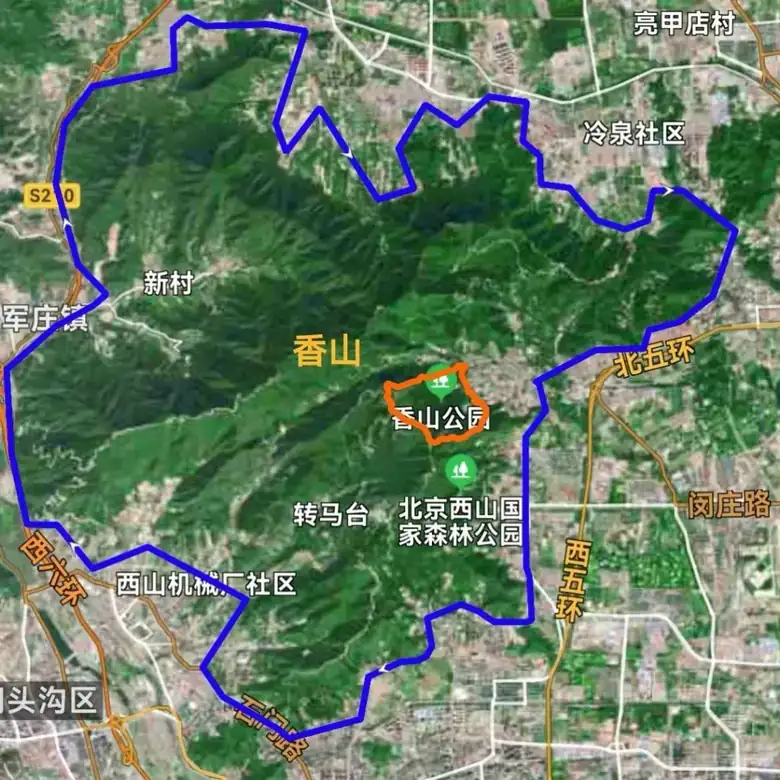
The red leaves of Fragrant Hills are a world-renowned autumn spectacle, attracting numerous tourists and Beijing residents every autumn to climb and enjoy the autumn scenery. Fragrant Hills is located in the northwest of Beijing, and its geographical definition has both broad and narrow interpretations. In a broad sense, Fragrant Hills refers to the mountainous area between the Northwest Fifth and Sixth Ring Roads; in a narrow sense, it refers only to Fragrant Hills Park.
Introduction to Fragrant Hills Park
Fragrant Hills Park, also known as Jingyi Garden, was first built in the 26th year of the Jin Dynasty's Dading era, boasting a history of nearly 900 years. It is a royal garden characterized by its mountainous and forest features. The park covers 188 hectares, with rugged terrain and lush greenery. At the summit of its main peak is a massive, breast-shaped rock resembling an incense burner. At dawn and dusk, it is shrouded in mist, appearing from afar like wisps of smoke rising from the burner, hence the name Incense Burner Mountain, or simply Fragrant Hills. Incense Burner Peak, at 575 meters above sea level, is known colloquially as "Ghost's Sorrow" due to its steepness and difficulty of climbing.
One of the famous "Three Mountains and Five Gardens" of the Qing Dynasty was Jingyi Garden in Xiangshan. Jingyi Garden once had twenty-eight scenic spots: Qinzheng Hall, Lizhu Tower, Luyun Boat, Xulang Studio, Yingluo Rock, Cuiwei Pavilion, Qingweiliao, Reindeer Slope, Toad Peak, Qiyun Tower, Zhilehao, Xiangshan Temple, Tingfa Pine, Laiqing Pavilion, Lishuang Pavilion, Xiangyan Chamber, Xiabiao Step, Yuru Spring, Xuanqiu Forest, Yuxiang Pavilion, Furong Plain, Xiyang'a, Qiyue Cliff, Chongcui Yan, Xiangwu Cave, Yuhua Xiu, Senyu Hu, and Geyun Bell.
Address: Biyun Temple Road, Haidian District, Beijing, China(map)
Official website:http://www.xiangshan-park.cn/cn/
Further Reading: [Beijing Travel Guide] Must-see attractions, accommodations, food, and costs
Fragrant Hills Park Tickets and Opening Hours
Ticket price:Peak season (April-November): 10 yuan/person; Off-season (December-March): 5 yuan/person
cableway:One-way: 50 yuan/person; Round-trip: 80 yuan/person
Opening hours:6:00-18:30 (Peak Season), 6:00-18:00 (Off-Season)
During the Red Leaf Festival: Visitor flow control measures may be implemented, and it is recommended to book tickets in advance through the "Xiangshan Park" WeChat official account.
Travel time to Fragrant Hills Park
The leaves of Fragrant Hills are at their most beautiful after the first frost in October, with the best viewing period being from late October to early November.
The main area of Fragrant Hills Park is on the sunny east side, so the best time to view the autumn leaves is on a sunny morning, and no later than 2:00 PM, otherwise the light will be insufficient and affect the visit experience.
Predicted viewing time for autumn leaves at Xiangshan Park in 2026
Based on recent climate trends, the best viewing period is expected to be from October 20th to November 10th. For specific updates on the color change progress, please follow the "Red Leaf Index" published on the official WeChat account of Xiangshan Park.
The color change pattern of red leaves: The red leaves of Fragrant Hills are mainly from smoke trees, and the color change is affected by air temperature and temperature difference.
Early red stage (mid-October): Approximately 30% of the leaves turn red, with a rich interplay of green and red colors.
Peak Bloom (Late October to Early November): 60%-90% of the leaves turn red, creating a vibrant, fiery red carpet across the mountains and fields, making it the best time to view the blooms.
Falling leaves (mid-November): Red leaves begin to fall, carpeting the ground with vibrant red foliage, creating a unique and charming scene.
Xiangshan Park Transportation
When visiting Fragrant Hills, you can choose to travel by public transportation, driving/taking a taxi, or cycling.
1. Public Transportation
Take bus routes 563, 932, or the West Suburbs Line to Xiangshan Station; alternatively, take bus routes 318, 360, 360 Express, 505, or 698 to the Southwest Gate of the National Botanical Garden, then walk west along Xiangshan South Road and Yikesong Road for about 1 kilometer to the East or North Gate of Xiangshan Park.
2. By car
Parking is available at the East and North gates of Fragrant Hills Park, but it's quite expensive, and parking spaces are hard to find after 8:00 AM. Traffic control measures are in place at Fragrant Hills during public holidays and the Red Leaf Festival, so driving is not recommended.
3. Cycling
Fragrant Hills is relatively close to the city center, so cycling is a good option. If you choose to use a shared bicycle, Fragrant Hills is outside the designated operating area, and traffic restrictions apply on weekends and holidays. It's recommended to park your bike near Xiangquan Roundabout within the Fifth Ring Road.
Fragrant Hills Park Autumn Viewing Route
Speaking of the red leaves of Fragrant Hills, many people's emotions are probably still running high. They come full of excitement, only to find that besides the crowds, they can hardly see any red leaves. First, this is due to some misunderstandings about the red leaves of Fragrant Hills. Although there are red leaves in Fragrant Hills Park, the most spectacular red leaves are in the vast mountains outside the park. Second, ultimately, it's because they didn't choose the right route. Many people, after entering Fragrant Hills Park, like to head straight for Incense Burner Peak. There are only a few main hiking trails, so it's naturally difficult to avoid the surging crowds.
Actually, the autumn leaves in Fragrant Hills Park are mainly distributed in the southern area. You don't necessarily have to climb the crowded Incense Burner Peak. A better viewing route is along the two mountain paths in the south. Here are some suggested routes:East Gate/North Gate - Qin Zheng Hall - Shuangqing Villa - Xiangshan Temple - Hongguang Temple Ruins - Southern Mountain Road - Qingweiliao - Jingcui Lake - East Gate/North Gate。
Fragrant Hills Park attractions
This route is not only less crowded, but also offers a wide view, allowing you to see the red leaves covering the mountains from different angles. There are also many cultural attractions along the way, such as Qinzheng Hall, Shuangqing Villa, Xiangshan Temple, Qingweiliao, and Jingcui Lake, which are worth visiting. The cultural relics and natural autumn colors complement each other, making this the true meaning of appreciating autumn in Xiangshan.
Qin Zheng Hall
Originally built in 1745 (the tenth year of the Qianlong Emperor's reign), the Qin Zheng Hall served as the venue for Qing emperors to conduct state affairs and receive court officials during their stays at the Jingyi Garden in Fragrant Hills. It was the first of the twenty-eight scenic spots in the garden. The original Qin Zheng Hall was burned down by the Anglo-French allied forces in 1860 (the tenth year of the Xianfeng Emperor's reign), leaving only the foundation. The park rebuilt it on the original site in 2002, and the reconstruction was completed in July 2003. The Qin Zheng Hall is the most iconic building in Fragrant Hills Park with its royal features, and the plaque outside the hall was inscribed by the Qianlong Emperor himself.
Shuangqing Villa
Located halfway up the southern slope of Fragrant Hills, the name "Shuangqing" was given by Emperor Qianlong of the Qing Dynasty based on the two clear springs within the courtyard. In 1920, educator Xiong Xiling established the "Orphanage" in Fragrant Hills and converted this place into a private residence, renaming it Shuangqing Villa.
Xiangshan Temple
Located above Shuangqing Villa, the temple was originally built in the 26th year of the Jin Dynasty's Dading era. Formerly known as Yong'an Temple or Ganlu Temple, it was the largest and most historically significant temple in the Xishan area, and one of the eight major water temples of Xishan (the other seven being Shengshui Temple, Jinshui Temple, Qingshui Temple, Tanshui Temple, Quanshui Temple, Shuangshui Temple, and Lingshui Temple, which were eight imperial palaces built by Emperor Zhangzong of Jin, Wanyan Jing. Because the area was rich in water resources, they were all named after water temples, hence the name "Eight Major Water Temples of Xishan"). It was expanded and renovated during the Yuan, Ming, and Qing dynasties. This ancient temple, of extremely high cultural and artistic value, was looted twice, once by the Anglo-French Allied Forces and the other two by the Eight-Nation Alliance. Only the stone screen, stone pillars, stone steps, and stone foundations in front of the main hall remain. Only the Sal tree poem stele, the Listening to the Dharma Pine, and the Zhilehao moat in front of the temple are still well preserved. The stone screen is carved as follows: On the east side, the Diamond Sutra is in the center; on the left is the Heart Sutra; on the right is the Avalokitesvara Sutra; on the west side, there are images of the Dipankara Buddha, Avalokitesvara, and Samantabhadra, all inscribed by Emperor Qianlong, along with his imperial eulogy. The couplet on the stone screen reads: "Wisdom shines brightly, encompassing the Six Perfections; the fragrance of the lotus in the heart extends far and wide, proclaiming the Three Vehicles."
Green Unfinished
The Qingweiliao Viewing Pavilion, situated on a slope on the east side of the park, offers a superb panoramic view of the entire Fragrant Hills Park. From Qingweiliao, one can gaze upon the Fragrant Hills Temple, nestled halfway up the mountain; its arched walls and towering halls blend seamlessly, resembling a seated Buddha statue. The glazed pagoda to the north, surrounded by majestic mountains, appears particularly exquisite, while the distant Incense Burner Peak evokes a sense of unapproachable grandeur.
Jingcui Lake
Jingcui LakeLocated south of the East Gate and the Hall of Diligent Governance, beside the lake, stands the Cuiwei Pavilion, one of the twenty-eight scenic spots of Jingyi Garden. Originally built in the tenth year of the Qianlong Emperor's reign (1745), it is named "Cuiwei" because of its location amidst ancient trees, lush greenery, ravines, and rocky cliffs, and its proximity to famous scenic spots such as Laiqing Pavilion, Toad Peak, and Qingyin Pavilion. The area is densely wooded, and the Qianlong Emperor once described this scene as "a thousand chapters of green shade in summer, with birdsong echoing above and below."
Biyun Temple
Biyun Temple is located in the valley of Jubao Mountain on the north side of Xiangshan Park. It is the most beautiful temple in the Western Hills of Beijing and has a history of nearly 700 years.
The temple is built in layers along the mountainside, with a compact layout and a tranquil environment. It was first built in the second year of the Zhishun reign of the Yuan Dynasty (1331) and was originally named "Biyun Nunnery". It was expanded many times during the Ming and Qing Dynasties. In particular, it served as a royal temple and palace during the Qing Dynasty, thus forming its current layout. It is solemn and full of ancient charm, showing the grandeur of a royal garden.
In his article "Buddhist Architecture in China," the renowned architect Liang Sicheng described Biyun Temple as "another typical example of an imperial-built temple."
The temple buildings are symmetrically distributed along a north-south central axis and are divided into three main parts: the main hall complex in the central axis, the water spring courtyard complex, and the Arhat Hall complex. The main hall complex in the central axis houses the cenotaph of a great man, namely the Sun Yat-sen Memorial Hall.
Tips
Address: No. 40, Maimai Street, Haidian District, Beijing (inside Xiangshan Park)
Opening hours: April 1st - November 15th: 8:00-17:30, last entry at 17:00
Tickets: Individual ticket 10 yuan, combined ticket for Xiangshan Park and Biyuan Temple 15 yuan
Reminder: Closed on Mondays, don't make a wasted trip!
Sun Yat-sen Memorial Hall
Besides Shuangqing Villa, another must-see in Xiangshan Park is the Sun Yat-sen Memorial Hall. As you enter Biyun Temple and climb the white marble steps behind the mountain, the Sun Yat-sen Memorial Hall will stand before you.
On March 12, 1925, Dr. Sun Yat-sen passed away in Beijing. His body was temporarily moved to the Puming Miaojue Hall of Biyun Temple. Subsequently, in order to commemorate Dr. Sun Yat-sen, the "Sun Yat-sen Memorial Hall" was established in the Puming Miaojue Hall, and the "Sun Yat-sen Cenotaph" was erected on the Vajra Throne Pagoda.
△ Climbing the steps and passing the archway, you will see the Sun Yat-sen Memorial Hall. In the main hall of the memorial hall, there is a horizontal plaque that was personally written by Madame Soong Ching-ling, the wife of Dr. Sun Yat-sen.
Inside the main hall stands a white marble statue of Dr. Sun Yat-sen, dressed in a long gown, holding a scroll, sitting quietly gazing into the distance. The walls on either side of the hall are inlaid with white marble inscriptions of Dr. Sun Yat-sen's "Letter to the Soviet Union."
The main hall of the memorial hall has exhibition rooms on both sides. The first exhibition hall is divided into six parts: Seeking Education and Setting Goals, Dedicating Oneself to Revolution, Overthrowing the Imperial System, Founding the Republic of China, Opposing Yuan Shikai and Protecting the Constitution, and The Great Turning Point. The second exhibition hall is divided into five parts: Going North While Ill, Passing Away in Beijing, Temporarily Resting in Fragrant Hills, Moving the Remains South, and Remembering the Great Man. The two exhibition rooms reflect the magnificent life of Dr. Sun Yat-sen.
On October 1, 1977, the Sun Yat-sen Memorial Hall was officially opened to the public. Tens of thousands of people from all walks of life came to pay tribute to Mr. Sun Yat-sen, and it also became a major attraction of the Biyun Temple in Xiangshan.
Tips
Address: Inside Biyun Temple, Xiangshan Park, No. 40 Maimai Street, Haidian District, Beijing
Opening hours: April to June: 6:00 AM – 6:30 PM
Admission: 10 yuan for adults
Tip: Biyun Temple is most beautiful at sunset, especially on the hillside behind the "Sun Yat-sen's Cenotaph," where you can overlook the forest surrounding the temple.
Fragrant Hills Park Supply
The shops inside Fragrant Hills Park are relatively expensive, and climbing the mountain is physically demanding, so it is recommended to prepare your own snacks and drinking water in advance.
Precautions
1. Temperatures are lower in the mornings and evenings after autumn begins, so please keep warm.
2. The full-price ticket for Fragrant Hills Park is 10 yuan, and the Beijing Parks Annual Pass can be used. During the Red Leaf Festival, Fragrant Hills Park is crowded and prone to traffic congestion, so it is recommended to plan your trip in advance and consider leaving early and returning late.[Ticket Booking]
3. When appreciating autumn scenery, try to choose a sunny day with bright sunshine, as this will allow you to take better photos.
4. Fragrant Hills Park is a mountainous area, so it is best to wear sneakers or hiking boots.
Xiangshan Park Lazy Pack
→One-day tour of Fragrant Hills Park, Beijing [One group per family ◆ Includes entrance fee/door-to-door pick-up and drop-off]
Common Questions about Viewing Red Leaves in Fragrant Hills
Q: When are the autumn leaves in Fragrant Hills at their reddest?
A: The best time to view the leaves is usually from late October to early November. Please check the official Xiangshan Park website for the autumn foliage index for details.
Q: How much are the tickets to Fragrant Hills?
A: 10 yuan in peak season, 5 yuan in off-season. Cable car: 50 yuan one way, 80 yuan round trip.
Q: How long does it take to climb Fragrant Hills?
A: The cable car ride takes about 2 hours round trip, while hiking to the summit takes about 3-4 hours. Those with good physical fitness can choose to hike the entire route.
Q: Are there many people at the Fragrant Hills Red Leaf Festival?
A: It's very crowded, especially on weekends. I strongly recommend going on a weekday or entering as soon as the park opens at 6 a.m.
Q: How do I get to Fragrant Hills by public transportation?
A: The Xiangshan Station on the Western Suburban Line of the subway is directly accessible. During the Red Leaf Festival, public transportation is recommended to avoid traffic restrictions.
Travel information can change. Check current opening hours, reservations and entry requirements before you travel.

Traveller discussion
Start the conversation with a helpful tip or a question.