
Jiangsu
JiangsuCity OverviewJiangsu is a unique entity that requires you to set aside preconceptions about administrative boundaries. As a province of China, it is not merely a neatly divided piece of administrative territory, but a civilisational
Jiangsu
City Overview
Jiangsu is a unique entity that requires you to set aside preconceptions about administrative boundaries. As a province of China, it is not merely a neatly divided piece of administrative territory, but a civilisational epic written over millennia by rivers, lakes, and seas. Situated in the centre of China's eastern coastal region, it encompasses the Yangtze and Huaihe river systems and cradles China's third largest freshwater lake, Lake Tai, and its fourth largest, Lake Hongze. Its 107,200 square kilometres are criss‑crossed by a dense network of waterways, creating a lush water town landscape, with plains accounting for over 86% of its area—making it the flattest province in China. At the end of 2023, over 85.26 million people lived here, generating a GDP of 12.8 trillion yuan, with economic density and per‑capita GDP consistently ranking first among all Chinese provinces.
Administratively, Jiangsu is one of the 23 provinces of the People's Republic of China, with its capital at Nanjing, the "ancient capital of six dynasties." But the name "Jiangsu" itself hints at its internal dual‑core structure—it is derived from the first characters of the early Qing‑dynasty "Jiangning Prefecture" (present‑day Nanjing) and "Suzhou Prefecture." This dual‑core pattern persists today and has evolved into a hierarchical, functionally complementary provincial urban matrix. The capital, Nanjing, sits in the southwest, guarding the confluence of the Yangtze River and the Tianjin‑Pukou Railway; it serves as the province's political, scientific, educational, and historical‑cultural centre, with influence radiating into eastern Anhui and acting as the forward hub for the Yangtze River Delta's connection to the central and western regions. The true "engine" of the provincial economy is Suzhou in southern Jiangsu. This city, world‑famous for its classical gardens, has built a world‑class advanced manufacturing base through its powerful county‑level cities such as Kunshan and Zhangjiagang, and the Suzhou Industrial Park (a China-Singapore cooperation project), with its total economic output consistently surpassing that of the provincial capital. Wuxi excels in its endogenous private economy and the Internet of Things industry, while Changzhou has emerged as a force in the new energy sector; together, they form the prosperous "Suzhou‑Wuxi‑Changzhou" metropolitan area. Nantong, which straddles the Yangtze, is known as "China's first modern city" and is accelerating its integration with Shanghai through cross‑river passages, positioning itself as a gateway on Shanghai's northern wing. North of the Yangtze, Yangzhou and Zhenjiang stand on opposite banks, guarding the crossroads of the Grand Canal and the Yangtze, carrying the thousand‑year‑old memory of canal transport, as captured in the line "Between Jingkou and Guazhou lies but a river's breadth." Further north, Huai'an was once the "Capital of the Grand Canal" and the seat of the River Conservancy Viceroy; Lianyungang is the eastern bridgehead of the New Eurasian Land Bridge, providing the inland hinterland with its most convenient seaport. In Jiangsu, you will not find a single city that monopolises everything; each city contributes its own economic piece and historical layer to the provincial mosaic.
Historical Context
The history of Jiangsu is a long scroll woven from the natural history of silt deposition and the social history of southward civilisational migration. Although large areas of this land were still submerged beneath the sea hundreds of thousands of years ago, the dawn of civilisation began to shine here in ancient times.
Prehistoric Civilisation and the Founding of Wu and Yue (c. 5000 BCE – 3rd century BCE)
Scattered remains of primitive settlements are found along the lower reaches of the Huaihe and Yangtze rivers. The Shunshanji site in Sihong pushes the history of prehistoric settlements in Jiangsu back some 8,000 years. By the Shang and Zhou dynasties, the "Huaiyi" (Huai barbarians) as seen by the Central Plains people, and the Gouwu and Yuyue in the south of the Yangtze, began to appear on the historical stage. In the 11th century BCE, Taibo and Zhongyong, sons of King Tai of Zhou, fled to Wu and established the Gouwu Kingdom at Meili in present‑day Wuxi, bringing advanced Central Plains farming techniques and initiating the civilising process of the Jiangnan region. In the late Spring and Autumn period, King Helü of Wu moved his capital to Gusu (present‑day Suzhou), where Wu Zixu "surveyed the land, tested the waters, and modelled heaven and earth" to build a city whose site has remained unchanged to this day. Wu's northward expansion and the excavation of the Hangou Canal connecting the Yangtze and Huaihe rivers not only left behind the legends of Tiger Hill and Sword Pool but also laid the earliest prototype of the Grand Canal.
The Jiangnan of the Six Dynasties and the Southward Exodus of the Aristocracy (3rd – 6th centuries CE)
This was the glorious era when Nanjing became the political centre of China. In 229 CE, Sun Quan established his capital at Jianye (present‑day Nanjing), making Nanjing the capital of a regional regime for the first time. Later, after the fall of the Western Jin, the Central Plains aristocracy "crossed south with their robes and hats," and the Eastern Jin and the Southern Dynasties—Song, Qi, Liang, and Chen—successively made Jiankang their capital. For over 360 years, Jiankang had a population of over one million, making it the largest city in the world at that time. By the Qinhuai River, at the entrance of Wuyi Lane, the Wang and Xie families were prominent; during the reign of Emperor Wu of Liang, temples were everywhere, and Du Mu's line—"Four hundred and eighty temples of the Southern Dynasties, how many towers and pavilions stand in the mist and rain?"—captures the silhouette of that Buddhist paradise. At this time, advanced techniques in smelting and paper‑making from the north flowed south, and the prosperity of Jiangnan completely reversed the economic pattern of "heavy north, light south" in China.
The Canal Era and the Grand Transport Hub (7th – mid‑19th century CE)
Emperor Yang of Sui excavated the Grand Canal, linking the Haihe, Yellow, Huaihe, Yangtze, and Qiantang river systems. With Jiangsu at the core of the canal's north‑south axis, it became the aorta of the Chinese economy. In the Tang dynasty, Yangzhou, located at the intersection of the Yangtze River and the Grand Canal, was "the wealthiest under heaven, and the saying 'Yangzhou first, Yizhou second' was current." In the Ming and Qing dynasties, the court relied on Jiangnan rice to supply the capital. Huai'an, as the confluence of the Yellow, Huaihe, and Grand Canal rivers, hosted the "Office of the Grain Transport Viceroy" and became the national command centre for grain transport; Suzhou, with its silk weaving and commerce, became the famous "Eastern Water City" and "the most prosperous place in the empire." The Grand Canal linked the silk of southern Jiangsu with the salt of Huaiyang, embedding southern, central, and northern Jiangsu into the lifeblood of the nation.
Modern Transition and Industrial Salvation (late 19th century – 1949)
As the canal declined and maritime transport rose, Jiangnan embarked on its earliest modern transition. In 1895, the top scholar Zhang Jian founded the Dasheng Cotton Mill in his hometown of Nantong, advocating "education as the father, industry as the mother," and built Nantong into "China's first modern city," setting a model for modern urban construction. In the same period, Nanjing, having suffered repeated wars as the Taiping Heavenly Kingdom's capital, became the capital of the Republic of China in 1927, launching a modern urban plan under the Capital Plan. In 1928, the National Central University was established as the highest institution of learning in the Republic. Yangzhou, a commercial capital of the canal era, temporarily declined due to railway rerouting, but the opening of the eastern section of the Longhai Railway led to the rise of Lianyungang as a modern seaport.
Contemporary Industrialisation and Reform and Opening Up (1949–present)
After 1949, Nanjing and Wuxi quickly revived heavy machinery and light textile industries during the First Five‑Year Plan. In 1968, the Nanjing Yangtze River Bridge was completed—the first double‑deck road‑rail bridge designed and built by China itself, hailed as the "Bridge of Pride." The real transformation came after reform and opening up. In 1984, Lianyungang and Nantong were listed among the first coastal open cities. Township enterprises in southern Jiangsu emerged as a force, creating the "Sunan Model" of "leaving the land but not the village, entering the factory but not the city." In 1994, the Chinese and Singaporean governments launched the Suzhou Industrial Park in the east of Suzhou, which has since become one of the most open and best‑developed development zones in China. Since the turn of the 21st century, cross‑river passages have mushroomed; the once‑formidable Yangtze is now crossed by dozens of bridges and tunnels in Jiangsu, rapidly closing the development gap between north and south. Never before has a single era brought the two sides of the great river so closely together.
Cultural Heritage
Jiangsu is "decentralised," not only in its economic structure but also deeply embedded in its cultural genes. Within a single province, the Yangtze and Huaihe rivers divide the territory into three major dialect regions—Central Plains Mandarin, Jianghuai Mandarin, and Wu Chinese—creating three distinct cultural temperaments: the heroic style of Chu and Han, the elegance of Huaiyang, and the soft, melodious tones of Wu.
Dialect Distribution and Characteristics
This is perhaps the most visible manifestation of Jiangsu's internal diversity. South of the Yangtze and east of Zhenjiang (excluding the urban area of Nanjing) is the domain of Wu Chinese, with Suzhou dialect representing the classical Wu, known for its "soft, sticky, and melodious" quality and its full set of voiced initials. Nanjing, Zhenjiang, Yangzhou, Huai'an, Yancheng, and other areas speak the Hongchao subgroup of Jianghuai Mandarin, with undulating tones; this was the basis of Ming‑dynasty Mandarin and, being located at a north‑south crossroads, is quite inclusive. The northernmost areas—Xuzhou and Ganyu in Lianyungang—belong to Central Plains Mandarin, sharing a lineage with the dialects of Shandong and Henan, with straightforward, hearty tones. The distribution of these three dialects precisely delineates the geographical boundary of Jiangsu's culture—"heroic in the north, refined in the south."
Folk Traditions
Jiangsu's folk customs are customs of water. During the Spring Festival, the Nanjing Qinhuai Lantern Festival lights up the night, with painted boats gliding on the Qinhuai River, a tradition that has continued since the Six Dynasties; Suzhou people go to Shantang Street to "Bump into the Immortals," jostling in crowds to absorb good fortune. The Qintong Boat Festival in Taizhou, held on the day after Qingming every year, gathers hundreds of boats from surrounding villages on Qintong Lake; the bamboo poles stand like a forest and the boats race each other, earning the praise of scholars as a "grand spectacle of folk culture and a panorama of water‑town charm." In traditional wedding and funeral customs—from the "wedding lament" of Gaoyou to the "nine‑day celebration" of Rugao—there is an extreme attention to ritual propriety. In folk belief, Jiangsu displays a polytheistic character: alongside common Buddhist and Daoist beliefs, coastal fishermen worship Mazu, inland boatmen revere the River God Jinlong Sidawang, and city god temples burn with incense throughout the region.
Artistic Traditions
Jiangsu is a grand synthesis of classical Chinese aesthetics. In opera, Kunqu, which originated in the Kunshan area in the late Yuan and early Ming dynasties, is known for its elegant lyrics and graceful melodies; it is regarded as the "ancestor of a hundred operas" and was inscribed in 2001 on UNESCO's first list of Masterpieces of the Oral and Intangible Heritage of Humanity. In addition, local genres such as Yangzhou opera, Wuxi opera, Huai opera, and Jiangsu Bangzi flourish, and Yangzhou's qingqu (folk songs) is a rich source of folk melodies; the song Jasmine Flower went global from here. In painting and calligraphy, the Wu School centred on Suzhou led the way in the Ming dynasty, with the "Four Masters of Ming" (Shen Zhou, Wen Zhengming, Tang Yin, and Qiu Ying) opening new realms of literati painting. In modern times, the "New Jinling School" led by Fu Baoshi used brush and ink to depict new landscapes. The arts and crafts are peerless: Suzhou embroidery, with its fine, elegant, and refined quality, ranks among China's four great embroideries; Suzhou‑style Ming furniture, simple and pure, is regarded as the peak of Chinese furniture history; and the purple‑clay teapots from Dingshu Town, Yixing, have long been treasured as scholar's desk accessories.
Intangible Cultural Heritage
Jiangsu is one of the provinces richest in intangible cultural heritage resources. In addition to Kunqu, guqin (Yushan, Guangling, and other schools), and Suzhou embroidery, Nanjing Yunjin (Cloud Brocade), inscribed on the UNESCO Representative List of the Intangible Cultural Heritage of Humanity, is still woven by craftsmen on the large‑flower‑loom wooden frame, with two people working together to produce only 5–6 centimetres per day—"an inch of brocade, an inch of gold." Suzhou Song brocade, Yangzhou block printing, Jintan paper‑cutting, Nantong blue calico dyeing, Zhenjiang vinegar brewing, and Huaiyang cooking techniques—each intangible heritage item is not just a craft but the living philosophy of a region.
Architecture and Urban Landscape
Walking through Jiangsu, you see the layered accumulation of thousands of years of architectural wisdom. Here, you find both the white walls and black tiles of the Jiangnan water towns and the magnificent Sino‑Western fusion of the Republican‑era metropolis. The scale is modest, revealing an understated, gentle warmth.
Traditional Architectural Styles
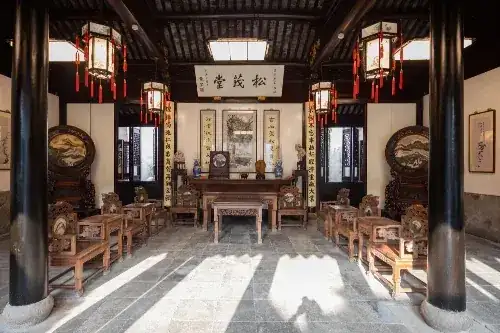
The core of Jiangsu's traditional architecture is "born of water." Southern Jiangsu is a typical example of the Jiangnan water town, with dwellings facing the river and streets in front, rivers behind. The fire‑prevention gables are stepped and tiered, with plain "Guanyin hoods" or elegant "horse‑head walls" adorning the top. Suzhou gardens are the epitome of Jiangsu's traditional architectural philosophy—they do not pursue monumental symmetry but use techniques such as "borrowing scenery," "framing scenery," and "leaking scenery" to create mountain forests and ravines within a tiny space. It must be emphasised that Suzhou gardens are not a single building but an ensemble of dozens of gardens—Zhuozheng Yuan, Liuyuan, Wangshi Yuan, Canglang Ting, and others—representing the highest artistic achievement of China's private gardens. In central Jiangsu, Yangzhou's architecture combines the solidity of northern official style with the elegance of southern Jiangsu dwellings; the "Four‑Season Rockeries" in Ge Garden exhibit unique stonework art.
Modern and Contemporary Architecture
With the opening of Shanghai as a treaty port at the end of the 19th century and the establishment of Nanjing as the national capital in the early 20th century, Jiangsu experienced a wave of Sino‑Western architectural fusion. Along Changjiang Road and Yihe Road in Nanjing, a large number of Republican‑era mansions and embassy buildings are preserved, with grey brick walls and shady plane trees, where eclectic styles coexist with Chinese palace‑style roofs. The Nanjing Museum (formerly the National Central Museum) is an example of the Liao‑dynasty palace‑style grand roof combined with modern function. In Wuxi's Rong Lane and along Nantong's Hao River, the former residences of industrial pioneers mix colonial‑style verandas with Chinese courtyards, reflecting the aesthetic aspirations of national capital at its most glorious.
Urban Fabric
The urban fabric of Jiangsu is like a double‑faced embroidery. In the old city areas, the unique "river‑road‑house" spatial pattern is often preserved. Suzhou's old city, for example, still strictly follows the land‑and‑water dual‑chessboard layout of the Song‑dynasty Pingjiang Map; the waterways and land routes run parallel, and the Pingjiang Road historical district is a prime example—the flagstone road winds along the river, and the life of the original inhabitants has never been interrupted. Nanjing's Ming city wall, over 35 kilometres in total, though no longer enclosing the entire city, still winds among the high‑rise buildings, forming a magical linear museum where mountains, water, city, and forest merge. Yangzhou's old city is characterised as a "lane city": hundreds of ancient lanes of varying lengths, like capillaries, conceal the mansions of salt merchants and the ordinary life of commoners.
Distinctive Neighbourhoods
Today, historical neighbourhoods in Jiangsu are no longer sealed museums. The Confucius Temple–Qinhuai River Scenic Area in Nanjing recreates the nightly life of oars and lanterns; Suzhou's Pingjiang Road and Shantang Street show a balance between authentic living and creative commercialism; Yangzhou's Dongguan Street is a model of a Ming‑Qing ancient street revived with commercial vitality; Wuxi's Qingming Bridge Ancient Canal area grafts industrial heritage with Jiangnan water‑lane culture—at night, the lights blend with the canal's ripples, revealing the long, deep history of the ancient waterway.
Culinary Culture
Jiangsu is one of the provinces in China where culinary culture is most refined. People often say "eating in Guangzhou, flavour in Sichuan," but true gourmets will offer their discerning palates to Jiangsu. Jiangsu cuisine is broadly divided into four local styles, but in taste it generally follows the principle of "clear, fresh, and balanced, with moderate salt and sweet, thick and thin." It emphasises knife skills, heat control, and the primacy of ingredients.
Huaiyang Cuisine: The National Banquet Standard
Centred on Yangzhou and Huai'an, Huaiyang cuisine is the crown of Jiangsu's culinary traditions and the benchmark for the national banquet of the People's Republic of China. Its characteristics are rigorous ingredient selection, craftsmanship adapted to the material; fine preparation and elegant style; and the pursuit of original flavours, clear, fresh, and balanced. One bite reveals the chef's knife skills: in stewed shredded dried tofu, a single block of dried tofu is sliced into 28 sheets and then cut into fine shreds, simmered in chicken broth over alternating high and low heat—not a drop of oil is visible, yet it is exquisitely savoury. Wensi tofu is the ultimate: tender tofu is cut into tens of thousands of silvery threads floating in clear soup, a delight for both the eyes and the sense of texture. Stewed crab roe lion’s head meatballs are rich but not greasy, with the fresh flavour of crab roe melting on the tongue. Other classics, such as soft‑fried eel and crystal pork jelly, are all representatives of the "skill dish."
Suzhou Cuisine and Jinling Cuisine
Suzhou people's devotion to seasonal ingredients is almost obsessive. In spring, they must use fresh bamboo shoots, fresh meat, and shepherd's purse to make a "yan du xian" (salt‑cured and fresh meat stew); in early summer, three‑shrimp noodles appear, using only egg‑bearing river shrimp, with the shrimp meat, roe, and coral peeled separately; when autumn winds blow, a bowl of sweet osmanthus water with fox nuts is the true taste of heaven. The classic squirrel mandarin fish, with its criss‑cross cuts deep‑fried, head raised and tail up, drizzled with sizzling sweet‑and‑sour tomato sauce, resembles a chirping squirrel. Nanjing, as a capital city, has a cuisine that is both noble and wild. Nanjing people are duck lovers—salted duck, pressed duck, roasted duck—"no duck can swim across the Yangtze alive" is no joke. A bowl of duck‑blood vermicelli soup, with dark red duck blood, green coriander, and translucent vermicelli floating in the milky broth, is Nanjing's most down‑to‑earth comfort food.
Classic Snacks and Regional Character
Jiangsu's morning tea culture is unique. In Yangzhou, people begin the day with "skin full of water"—a pot of Luyangchun tea, a plate of hot dried tofu shreds, plus crab‑roe soup dumplings, three‑treasure buns, and emerald shaomai. The bustling tea houses are the comfort of the common people. This food custom reflects the Jiangsu people's—especially those in central and southern Jiangsu—meticulous attention to the quality of life. Even in snacks, Jiangsu people value "exquisiteness": Nanjing's Eight Delicacies of Qinhuai, the crispiness of Huangqiao sesame cakes, the sweet‑savoury flavour of Wuxi steamed buns (famous for their sweetness), and the layered crispness of Changzhou's sesame cakes.
The character behind Jiangsu cuisine is gentleness and hidden depth. Just like the cabbage cooked in plain water—plain as it looks, it is infused with the rich, mellow flavour of repeatedly refined stock. This ultimate pursuit of "plainness" reflects the Jiangsu people's unhurried, outwardly gentle but inwardly resilient regional temperament.
Modern and Contemporary Development
If China were a mega‑corporation, Jiangsu would be one of its most understatedly pragmatic and efficient core divisions. Its modern rise is a story of breakthrough, from the decline of the canal to embracing the ocean, and then to reconfiguring the interior.
From Canal to Railway and Port
In the late Qing, the Grand Canal silted up and grain transport was abolished; traditional canal cities such as Yangzhou and Huai'an fell silent. Meanwhile, in 1899, Nanjing officially opened its port at Xiaguan, and the Shanghai‑Nanjing and Tianjin‑Pukou railways were opened successively, shifting Jiangsu's economic centre to the railway cities. Zhang Jian's practice in Nantong was not merely a city renovation but a full‑chain industrial experiment centred on textiles, laying the foundation for Jiangsu's modern light textile industry.
The Sunan Model and the Rise of Township Enterprises
In the early years of the People's Republic, Nanjing was positioned as a major heavy‑industrial base, with state‑owned enterprises such as the Nanjing Automobile Works and Nanjing Radio Factory establishing initial systems for chemical fibres, electronic tubes, and automobile manufacturing. But Jiangsu's truly endogenous strength exploded in the 1980s with the wave of township enterprises. In Suzhou, Wuxi, Changzhou, and other areas, because of their proximity to Shanghai, large numbers of skilled workers came to the townships on weekends to guide production. These "Sunday engineers" gave rise to textile, machinery, and electronics factories throughout the countryside. This "primarily collective-economy-based and market-oriented" model enabled Jiangsu to complete its initial industrialisation within a decade and cultivated a pragmatic, cohesive tradition of county‑level economies.
Export‑Oriented Economy and the Singapore Industrial Park
In the 1990s, with the development and opening of Pudong, Jiangsu quickly turned to an export‑oriented economy. In 1994, a landmark development project was launched in the east of Suzhou—the China‑Singapore Suzhou Industrial Park. It introduced Singapore's "one blueprint to the end" planning and management experience and transformed a stretch of rice paddies and water bamboo fields into a modern city with over 100 Fortune 500 companies and a dense cluster of high‑tech industries. At the same time, counties such as Kunshan, through self‑funded development zones and deep industrial chain integration, created the world's largest production base for laptops and components, at one time accounting for nearly one‑third of global production, forming an information technology industrial cluster with global influence.
Jiangsu's "Inner Strength" and Current Positioning
Today, Jiangsu faces not the question of "having or not having," but the challenge of upgrading its industries towards the high end and addressing the uneven development within the province. Jiangsu now has China's largest and highest‑quality manufacturing cluster, with clear intra‑provincial specialisation: Suzhou in biomedicine and nanotechnology, Wuxi in the Internet of Things, Changzhou in new energy, Nantong in shipbuilding and marine engineering, Taizhou in biomedicine, and Lianyungang in petrochemicals. Jiangsu is also a major foreign‑trade province, with its ports handling a significant share of national import‑export volume. Today, the state has entrusted Jiangsu with the mission of "building a two‑way open hub with global appeal." It is not only an indispensable node in global supply chains but also, through promoting the integration of the Yangtze River Delta and improving cross‑river transport, seeks to unlock the vast potential of northern Jiangsu's urban space as a driver of future growth. Its present is a long‑distance race to rebuild a world‑class manufacturing base through technological self‑reliance and self‑strengthening.
Transportation and Travel
Traveling in Jiangsu often gives one the illusion: having crossed the dialectal and culinary divide, only a few dozen minutes have passed in reality. This region boasts one of the densest integrated transport networks in China and the world, efficiently stitching together the various "decentralised" parts.
Inter‑Regional Transport Backbone
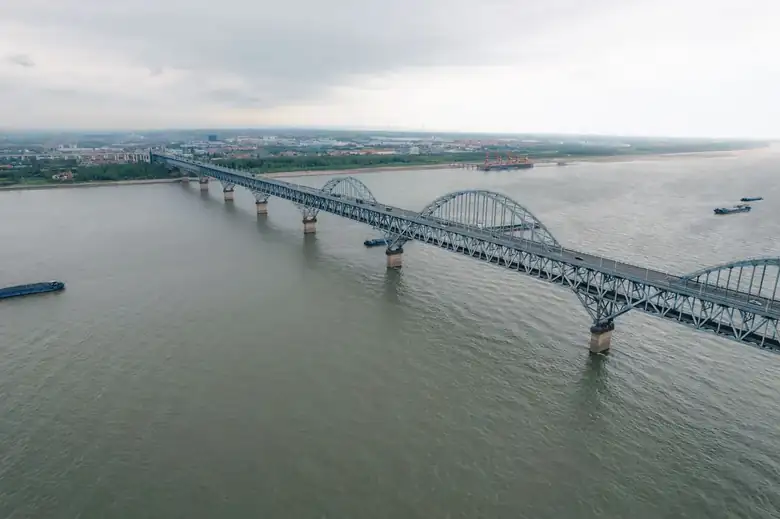
Jiangsu's provincial transport is centred on Nanjing, but unlike in single‑centre provinces, there is no need to "go through the capital." The Beijing‑Shanghai high‑speed railway and the Shanghai‑Nanjing intercity railway run parallel along the south bank of the Yangtze, linking Nanjing, Zhenjiang, Changzhou, Wuxi, and Suzhou with Shanghai in a half‑hour to one‑hour ultra‑high‑frequency intercity corridor. On this line, people think more in terms of "urban rail" than "inter‑city trains." With the successive opening of the Lianyungang‑Huai'an‑Yangzhou‑Zhenjiang railway, the Yancheng‑Nantong high‑speed railway, and the Xuzhou‑Suqian‑Huai'an‑Yancheng railway, whether you are in Huai'an or Yancheng, you can travel north to Lianyungang or south to Shanghai and return the same day. The expressway network is equally dense, with the G2 Beijing‑Shanghai and G15 Shenyang‑Haikou arteries running north‑south, plus a developed system of cross‑river passages: the Jiangyin Bridge, Sutong Bridge, Chongqi Bridge, and the newest Wufengshan Yangtze River Bridge—the "difficulty of crossing the river," which once troubled travellers, is now history.
Aviation and Water Transport
Within Jiangsu's relatively small area, a remarkable nine civil airports are densely packed here. Nanjing Lukou International Airport is the provincial gateway, with intercontinental flights to five continents. Sunan Shuofang International Airport handles the huge business traffic of Suzhou and Wuxi. The inauguration of Lianyungang's new airport , Huaguoshan International Airport has strengthened the air corridor at the eastern end of the New Eurasian Land Bridge. Notably, almost every prefecture‑level city in Jiangsu has or plans to build general aviation facilities; regional and general aviation will be the major growth area in Jiangsu's transport over the next decade. And do not forget the golden waterway that runs through Jiangsu for more than 400 kilometres—the Yangtze River, the busiest inland waterway in the world. The deep‑water container terminals of Taicang Port and Nanjing Port ship "Made in Jiangsu" products to the world day and night.
Unique Travel Experiences
Traveling in Jiangsu is a slice through history. If you take the high‑speed train across the Dashengguan Yangtze River Bridge in Nanjing, you will pass alongside the old steel Nanjing Yangtze River Bridge—a meeting of eras. Beneath your feet, some sections of the track coincide with the route of the Jiangnan Railway laid 160 years ago. If you prefer a slower pace, you can take a boat along the Suzhou section of the Grand Canal or the Qingming Bridge section in Wuxi, watching barges slowly push through the green waters of the narrow ancient waterway. More remarkable are the multiple ways to cross the Yangtze: you can ride a ferry at Zhenjiang like the ancients, take a taxi across the Sutong Bridge, or take Shanghai Metro Line 11 westwards and, before you know it, arrive at Huaqiao in Kunshan, Suzhou—the first inter‑provincial metro line in China, blurring not only provincial boundaries but also city limits.
Travel Tips
Traveling in Jiangsu is essentially a dual focus on the "Jiangnan imagination" and "Chinese modernity." You need some patience to peel back its seemingly plain exterior and touch its refined and expansive interior.
Best Travel Seasons
Jiangsu has four distinct seasons; spring (March–May) and autumn (September–November) are undoubtedly the best. In the third lunar month, the Qionghua flowers begin to bloom on Slender West Lake in Yangzhou, and the cherry blossoms along Jiming Temple Road in Nanjing are like clouds and rosy clouds—it is the perfect time for "going down to Yangzhou in the misty third month." In late autumn, the Zhongshan Scenic Area in Nanjing is ablaze with colour, and the stone‑animal avenue of the Ming Xiaoling Mausoleum is covered in golden leaves; the red maples of Suzhou's Tianping Mountain against the white walls and black tiles create a striking visual impact. Winter in Jiangsu is cold, but the Nanjing Confucius Temple and Qinhuai Riverside Lantern Festival during the Spring Festival offer an intensely human warmth on chilly nights. In summer, the coast of Lianyungang in northern Jiangsu is a summer retreat, but southern Jiangsu may experience the plum‑rain season; visitors should bring rain gear, but this is also an opportunity to wander through ancient towns in the rain and experience the misty charm of Jiangnan.
Must‑Visit Attractions and Experiences
For such a large province spanning north and south, picking five "must‑sees" is extremely difficult, but there are a few irreplaceable soul‑places:
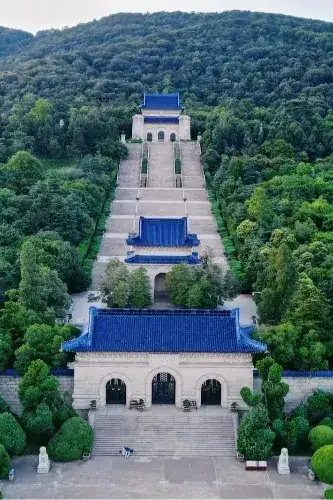
1. Nanjing's Purple Mountain and Qinhuai River Area: Rent a bicycle and go deep into the forest of Zhongshan, ascend the 392 steps of the Sun Yat‑sen Mausoleum to feel the Republican‑era aura of a mountain and a city. At night, take a painted boat on the Qinhuai River; the faint sound of silk and bamboo from the shore will let you experience the flow of Jinling's royal spirit.
2. Suzhou's Old City and Garden Experience: Do not try to visit all the gardens—choose just two: the classic Jiangnan courtyard of the Humble Administrator’s Garden (Zhuozheng Yuan) and the Lingering Garden (Liuyuan), known for its miniature rockeries. During the day, listen to storytelling and ballad singing on Pingjiang Road; at night, watch the light show of the "big pants" (Gate of the Orient) on Jinji Lake, experiencing the tension and fusion of Suzhou.
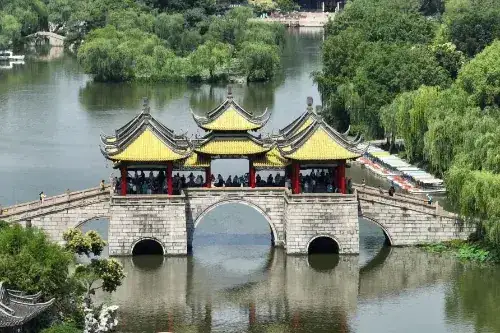
3. Yangzhou Morning Tea and Slender West Lake: You must be willing to give up sleeping in. At Fuchun or Yechun Teahouse, enjoy a full "skin full of water" morning tea—Jiangsu's most solemn life ritual. Then take a stroll along the ten‑li corridor of Slender West Lake; every step at the Twenty‑Four Bridge or Five‑Pavilion Bridge is a step into Tang poetry.
4. Lianyungang's Lian Island: Only by standing on the northern Jiangsu coast do you realise the completeness of Jiangsu. This is the province's only sandy beach resort, Lian Island's Dasha Bay. Though the water quality cannot compare with tropical islands, the vastness of mountains meeting the sea is the charm of the eastern bridgehead of the New Eurasian Land Bridge.
5. An Overnight Stay at a Canal City: Take a night cruise on the ancient canal from Qingming Bridge in Wuxi, or linger at Zhenjiang's Xijin Ferry at dusk. Standing by the canal, you will understand that without that ancient north‑south waterway, today's Jiangsu would not exist.
Practical Tips and Precautions
Use "high‑speed rail + intercity" to connect the cities of southern Jiangsu; in northern Jiangsu, self‑driving is better, with wide, flat expressways. Jiangsu's public services are relatively well developed, but electronic payment is extremely widespread; cash is rarely used, so you should link your bank card to the local payment ecosystem. Special note on dining: if you do not have a sweet tooth, when ordering in Wuxi or Suzhou, be sure to tell the waiter "less sugar or no sugar"—"no sugar" here is like "no chilli" in Sichuan, a courtesy to visitors. When visiting the Memorial Hall of the Victims of the Nanjing Massacre, dress respectfully and refrain from loud talk. Jiangsu people are reasonable and polite; using appropriate polite language in conversation will earn you more goodwill. Keeping a little of that unhurried rhythm, like the locals, may be the key to glimpsing the secret of this region's centuries of prosperity and abundance.
Travel information can change. Check current opening hours, reservations and entry requirements before you travel.
Traveller discussion
Start the conversation with a helpful tip or a question.