
Guangxi
GuangxiGuangxi OverviewThe Guangxi Zhuang Autonomous Region, abbreviated as "Gui," is situated along China's southern coast, between latitudes 20°54′ and 26°24′ N and longitudes 104°28′ and 112°04′ E. It borders Guangdong Province to the ea
Guangxi
Guangxi Overview
The Guangxi Zhuang Autonomous Region, abbreviated as "Gui," is situated along China's southern coast, between latitudes 20°54′ and 26°24′ N and longitudes 104°28′ and 112°04′ E. It borders Guangdong Province to the east, the Beibu Gulf and Hainan Province to the south, Yunnan Province to the west, Hunan Province to the northeast, Guizhou Province to the northwest, and the Socialist Republic of Vietnam to the southwest. With a land border of 637 kilometres and a mainland coastline of approximately 1,628.7 kilometres, Guangxi is China's only coastal autonomous region and the most convenient seaward passage for the southwestern region.
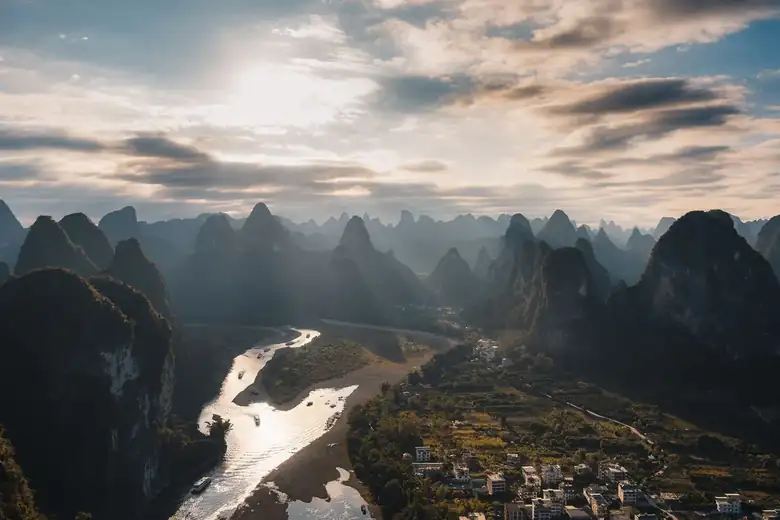
The overall terrain of Guangxi slopes downward from northwest to southeast, forming a basin‑like topography with mountains surrounding the perimeter and lower elevations in the centre—hence the name "Guangxi Basin." Mountains and hills are widespread, covering more than 70% of the total land area, while plains are relatively small and scattered. The northwestern part, on the edge of the Yunnan‑Guizhou Plateau, lies mostly above 1,000 metres with steep, rugged mountains; the central and southern regions are mainly hills and plains, serving as important agricultural and urban zones; and the southern coast consists of low‑lying coastal plains. Guangxi is exceptionally rich in karst topography, which covers nearly 38% of the region's total area, with spectacular peak forests, peak clusters, caves, and underground rivers creating a world‑famous landscape. Numerous rivers criss‑cross the region, belonging to four major river systems—the Pearl River, the Yangtze River, the coastal rivers of southern Guangxi, and the Red River. The Xi River system of the Pearl River basin is the dominant one, with major rivers including the Hongshui River, Zuojiang, Youjiang, Yongjiang, Yujiang, Xunjiang, and Guijiang. These waterways crisscross the land, are abundant in water, and are highly navigable. The Xiang and Li rivers are connected by the Lingqu Canal to the Yangtze River system, forming an important north‑south water transport route in ancient China.
Guangxi covers 237,600 square kilometres, approximately 2.5% of China's total area. As of the end of 2023, the permanent population was about 50.27 million, of which the Zhuang ethnic group accounts for about 32%, making it the provincial‑level administrative region with the largest concentration of Zhuang people in China. In addition, there are 11 indigenous ethnic groups, namely the Han, Yao, Miao, Dong, Mulao, Maonan, Hui, Jing, Yi, Shui, and Gelao—giving Guangxi one of the highest proportions of minority populations in the country. The regional capital is Nanning, and the region administers 14 prefecture‑level cities: Nanning, Liuzhou, Guilin, Wuzhou, Beihai, Fangchenggang, Qinzhou, Guigang, Yulin, Baise, Hezhou, Hechi, Laibin, and Chongzuo.
Guangxi's nickname "Eight Gui" has a long history, with the character "Gui" dating back to the Qin and Han dynasties. After the First Emperor of Qin unified Lingnan, he established Guilin Commandery, named for the natural scenery of thriving osmanthus trees in the area—hence Guangxi is also called "Gui." The Tang‑dynasty writer Han Yu wrote in his poem "Sending Governor Yan of Gui Prefecture, Using the Character 'Nan'" the famous line "The vast and dense eight gui, this land lies south of the Xiang," which is the earliest literary record of the term "Eight Gui." In folk tradition, there are both broad and narrow interpretations: one says that ancient Guangxi was rich in cinnamon, named for eight cinnamon‑producing areas; another says that "eight" in classical Chinese means "many," expressing the beauty of abundant osmanthus trees. Another nickname, "Gui Sea," also appears in classical literature, signifying that this land covered with osmanthus trees is as vast as the sea. The capital Nanning is known as the "Green City," with a green coverage rate of over 40%; its lush vegetation and fragrant flowers bloom through all four seasons, making it feel like a vast garden.
Historical Context
Human activity in Guangxi dates back some 800,000 years. The hand axes and other chipped stone tools from the early Palaeolithic discovered in the Bose Basin push the history of ancient humans in Guangxi far into the distant past. The Liujiang Man and Qilinshan Man fossils, dating from about 20,000 to 10,000 years ago, along with Neolithic sites such as Zengpiyan and Dingsishan, trace the long trajectory of the ancestors of Lingnan from gathering and fishing to primitive agriculture. Prior to the Qin dynasty, Guangxi was home to the Luoyue and Xi'ou branches of the Baiyue peoples, who maintained intermittent contact with Central Plains culture.
From the 26th to the 33rd year of the First Emperor of Qin (221–214 BCE), half a million Qin troops marched south to conquer the Baiyue, cutting the Lingqu Canal to connect the Xiang and Li rivers, thereby linking the Yangtze and Pearl river systems. This canal, about 36.5 kilometres long, is one of the earliest cross‑mountain canals in human history. Its ingenious designs—the plough‑share tip, large and small balances, and sluice gates—demonstrate extraordinary hydraulic engineering skill. The completion of the Lingqu Canal secured the Qin army's supply lines, and Lingnan was quickly incorporated into the Central Plains empire. The Qin established Guilin, Xiang, and Nanhai commanderies, with most of Guangxi under the jurisdiction of Guilin and Xiang commanderies; the Lingqu Canal in present‑day Xing'an became the vital passage through which Central Plains culture spread to Lingnan.
In the sixth year of the Yuanding reign of the Western Han (111 BCE), Emperor Wu of Han defeated the Nanyue Kingdom and established nine commanderies in Lingnan: Nanhai, Cangwu, Yulin, Hepu, Jiaozhi, Jiuzhen, Rinan, Zhuya, and Dan'er. Present‑day Guangxi was divided among Yulin, Cangwu, Hepu, and other commanderies. Hepu Port (now part of Beihai) was one of the starting ports of the Maritime Silk Road in the Han dynasty. Fleets laden with silk, porcelain, and gold sailed south from here, passing through the Beibu Gulf to Southeast Asia, South Asia, and even further west. The large quantities of glass, agate, amber, and other exotic treasures unearthed from the Hepu Han tomb complex silently attest to the prosperity of this maritime trade route two thousand years ago. In the late Eastern Han, Shi Xie, the governor of Jiaozhi, ruled over Lingnan and welcomed scholars migrating south from the Central Plains, bringing a certain degree of cultural and educational development to the Guangxi area.
The Tang and Song dynasties were key stages in Guangxi's socioeconomic development. In the third year of the Xiantong reign of the Tang (862), the Lingnan Circuit was divided into the Eastern and Western Lingnan Circuits, with most of Guangxi under the Western Lingnan Circuit—the embryonic form of "Guangxi" as an independent administrative division. In the Song dynasty, the Guangnan West Circuit was established, abbreviated as Guangxi Circuit, with its administrative seat at Gui Prefecture (present‑day Guilin), from which the name "Guangxi" was formally derived. During this period, Zhuang society transitioned from primitive tribes to feudal lordship, and the system of jimi prefectures was widely implemented, with local chiefs granted official titles and indirect rule by the central dynasty. The scale of tin and lead mining in Song‑dynasty Guangxi was enormous, and the smelting and casting industries around Hezhou and Wuzhou were famous throughout the realm. In the late Southern Song, Yuan forces attacked the Southern Song via Guangxi; the people and soldiers of Jingjiang Prefecture (present‑day Guilin) held out for three months and suffered brutal slaughter after the city fell—a tragic chapter recorded in the History of the Song and local gazetteers.
The Ming dynasty was a crucial turning point in Guangxi's history. During the Hongwu reign, the Guangxi Provincial Administration Commission was established, formalising the provincial administrative system, which, despite later adjustments, continued into the Qing dynasty. In the middle and late Ming, the western and southern parts of Guangxi long practised the chieftain system, with Zhuang chieftain families such as the Cen, Wei, and Mo ruling hereditarily, forming relatively independent military and administrative systems. During the Jiajing reign, Cen Meng, the chieftain of Tianzhou (present‑day Tianyang), rebelled; after the imperial court sent troops to suppress it, it began to "replace the chieftain system with appointed officials," gradually abolishing hereditary chieftain privileges and appointing officials directly by the court. This process continued for centuries and was largely completed only in the late Qing and early Republic, profoundly changing Guangxi's political structure and social order. After large‑scale implementation of the "replacement of chieftains with appointed officials" in the Yongzheng reign of the Qing, large numbers of Han migrants poured into the mountainous areas of western Guangxi, accelerating ethnic integration and land development.
Modern Guangxi was a stage of turbulent change. In 1851, Hong Xiuquan launched the Jintian Uprising in Guiping County (now part of Guigang City), sparking the Taiping Heavenly Kingdom movement. This peasant army, bound by the worship of the God of Heaven, swept across half of Jiangnan, profoundly shaking the foundations of Qing rule. In the late Qing, Wuzhou (1897), Nanning (1907), and Longzhou (1889) were successively opened as treaty ports, allowing foreign merchant ships to enter the interior of the Xijiang River. Guangxi's ties with the world market grew closer, with local products such as cassia bark, star anise oil, and sugar exported in large quantities, while foreign yarn and cloth flooded in, undermining traditional handicrafts. During the 1911 Revolution, Guangxi revolutionaries such as Ma Junwu and Liu Jue were active; in 1911, Guangxi declared independence from Qing rule. The New Guangxi Clique—Li Zongren, Bai Chongxi, and Huang Shaohong—rose from the 1920s, using Guangxi as a base to reorganise military and political affairs and build a model province, giving Guangxi a unique role in the political landscape of the Republic. During the War of Resistance, Guilin became one of the cultural centres of the rear area, attracting many cultural figures and patriotic groups; the Eighth Route Army Guilin Office played a key role in the Communist Party's secret operations. In December 1949, the People's Liberation Army liberated all of Guangxi, opening a new chapter. In March 1958, the Guangxi Zhuang Autonomous Region was formally established, with its capital in Nanning, implementing the system of ethnic regional autonomy.
Cultural Heritage
Guangxi's linguistic map is complex and orderly. Chinese dialects such as Cantonese (Baihua), Southwestern Mandarin (Guiliu dialect), Hakka, Pinghua, Xiang, and Min are distributed and intermingled across urban and rural areas, influencing one another. Cantonese is spoken in southeastern Guangxi and coastal areas—Wuzhou, Guigang, Yulin, Beihai, Qinzhou, and Fangchenggang—with phonological similarities to Guangdong Cantonese but its own distinctive flavour. Some scholars regard Wuzhou Cantonese as one of the sources of the Yue dialects because it retains many ancient Chinese features. Southwestern Mandarin is mainly spoken in northern and northwestern cities such as Guilin, Liuzhou, Hechi, and Baise, gradually forming during the Ming‑Qing migration waves and now the most widely spoken Chinese dialect in Guangxi by population. Pinghua is a Chinese dialect unique to Guangxi, divided into northern and southern branches; its phonological and lexical system preserves many characteristics of Middle Chinese and is often called a "living fossil" of language. Scholars believe the ancestors of Pinghua speakers were mostly garrison troops and settlers from the Central Plains and Jiangnan during the Tang and Song dynasties. In Nanning, the long‑term interaction between Cantonese and Pinghua has produced a unique "Nanning Baihua," whose phonetic system has both Cantonese roots and Pinghua imprints. The Zhuang are the largest minority group in China; the Zhuang language belongs to the Zhuang‑Tai branch of the Zhuang‑Dong (Kam‑Tai) language family within the Sino‑Tibetan phylum, divided into northern and southern dialect areas. In 1957, the State Council approved a romanised Zhuang writing system based on the Wuming pronunciation of the northern dialect. In the vast Zhuang‑concentrated areas, the Zhuang language remains an important language of daily communication and social life; many Zhuang people can freely use both Zhuang and local Chinese dialects.
Guangxi's folk traditions are as colourful as Zhuang brocade, with the rhythm of life following the seasons and festivals. The Zhuang "March 3rd" Song Festival is one of Guangxi's most emblematic folk celebrations. On the third day of the third lunar month, song stages are erected across the Zhuang countryside. Young men and women dress in their finest to attend, singing love songs to each other, tossing embroidered balls, competing in firecracker‑grabbing, playing bronze drums, and performing Zhuang opera—all in a lively atmosphere. This day is also the traditional Zhuang ancestral tomb‑sweeping festival; every household steams five‑colour glutinous rice, dyed black, red, yellow, purple, and white with natural juices from maple leaves, red orchid grass, turmeric, and purple vine, offering it to ancestors and sharing it with relatives and friends. In 2014, the "Zhuang March 3rd" was inscribed in the fourth batch of national intangible cultural heritage representative items; since 2016, Guangxi has made March 3rd a statutory holiday with two days off. The Yao Panwang Festival is held on the 16th day of the 10th lunar month to honour Pan Hu, the legendary ancestor of the Yao people. Dancers perform the long drum dance, leaping and twirling their drumsticks to imitate the heroic posture of the ancestor hunting. The Dong are renowned for their architecture and music; Dong Grand Songs are a form of polyphonic, conductor‑less, unaccompanied natural chorus that imitates the sounds of cicadas, birds, and babbling streams. In 2009, they were inscribed on the UNESCO Intangible Cultural Heritage of Humanity list. Dong village drum towers serve as centres for public meetings and festive gatherings, while wind‑and‑rain bridges combine transport, rest, and feng shui functions. The Chengyang Yongji Bridge and Linxi Drum Tower cluster in Sanjiang Dong Autonomous County are masterpieces of this architectural tradition. The Jing are the only minority group in China whose primary livelihood is marine fishing, concentrated on the islands of Wutou, Shanxin, and Wanwei off the coast of Dongxing, Fangchenggang. The Ha Festival is the Jing's grandest traditional festival, offering sacrifices to the sea god for safe voyages and bountiful catches. Young men and women play the single‑stringed zither, whose melancholy, deep tones sound like the sigh of a lonely boat at sea.
Guangxi's local opera and folk arts are deeply rooted in the soil, vivid and unique. Gui Opera is the most representative local opera genre in Guangxi. It was formed in the Qianlong reign of the Qing when Hunan Qi Opera was introduced to Guilin and merged with local folk tunes, using Guilin Mandarin in performance. Its style is delicate and restrained, with the singing dominated by the tanqiang mode, supplemented by gaoqiang, kunqiang, and chuiqiang. Classic plays include Picking up the Jade Bracelet and Beating the Golden Branch. Zhuang Opera is a unique theatrical form of the Zhuang people, divided into northern and southern schools. The northern school, formed in the mid‑Qing, is popular in Baise, Hechi, and other areas, sung in the northern Zhuang dialect with a high, impassioned style; the southern school emerged in the late Qing, popular in Chongzuo, Nanning, and other areas, sung in the southern Zhuang dialect with a gentle, lingering style, accompanied by instruments such as the horse‑bone huqin, local huqin, and suona. Caidiao is a native Guangxi folk opera, originating from the tea‑picking songs and lantern dances of northern Guangxi villages. Commonly known as tiaozi or nahehai, its performances are humorous and lively, full of song and dance, with the clown role being the most brilliant. Plays such as Wang San Shoots the Bird and Liu Sanjie are household names. The song culture of Liu Sanjie is a treasure of Guangxi folk literature; the legendary "singer immortal" is widely celebrated among the Zhuang, Han, Yao, and other ethnic groups, with Yizhou, Liuzhou, Guilin, and other places all claiming to be her hometown. The 1961 film Liu Sanjie was a sensation at home and abroad, making Liu Sanjie one of Guangxi's most important cultural symbols.
Guangxi's intangible cultural heritage shines brightly. Zhuang brocade weaving (Zhuangjin), together with Nanjing, Sichuan, and Song brocades, is known as one of China's four famous brocades. Woven with cotton warp and coloured silk weft, its patterns are often drawn from nature, with intricate geometric designs and strong yet harmonious colours, embodying the skill and emotion of Zhuang women. The firing technique of Qinzhou Nixing pottery has a history of over 1,300 years. Using the unique purple‑red clay from the Qin River banks, it undergoes dozens of processes—washing, refining, throwing, trimming, carving, and firing. The finished product, without glaze, has a metallic sheen; after surface polishing, it reveals a kiln‑transformation effect, ancient and elegant, highly collectible. In addition, intangible heritage items such as the Binyang Firecracker Dragon Festival, the Zhuang Frog Festival, the Miao series of slope gatherings, the Mulao Yifan Festival, the Maonan Feitao, the Tianlin Yao Bronze Drum Dance, and the Napo Zhuang folk songs dot the land like stars, forming a brilliant tapestry of multi‑ethnic coexistence.
Architecture and Urban Landscape
Guangxi's traditional architecture is influenced by geography, ethnic customs, and Central Plains culture, displaying distinctive regional features. The stilted house (ganlan‑style architecture) is the typical form of Zhuang traditional dwellings, commonly known as "high‑rack houses" or "malan," found mostly in the mountainous and hilly areas of western and northwestern Guangxi. The ground floor is left open for livestock and farm tools, while the upper floor is for living, supported by wooden pillars with wooden plank walls and grey tile or thatch roofs. The stairs are often removable and drawn up at night to guard against wild animals. This style is well adapted to Guangxi's hot, humid, and malarial climate, providing ventilation, moisture protection, and defence against insects and snakes—a building wisdom accumulated by the Zhuang ancestors in the southern environment. The stilted villages of the Longji area in Longsheng Various Ethnicities Autonomous County are built on the slopes, layered and integrated with the terraced landscape. In northern Guangxi, Han and Dong villages often feature courtyard houses with grey bricks and dark tiles, gabled roofs, and rising horse‑head walls. The courtyards are one or more courtyards deep, axially symmetrical, with inner courtyards for light and ventilation; door lintels and window lattices are often adorned with exquisite wood carvings of auspicious motifs—fortune, prosperity, longevity, happiness, fishermen, woodcutters, farmers, scholars, flowers, birds, and mythical beasts—expressing the owner's hopes for a good life. The well‑preserved Ming‑Qing residential clusters in Jiangtou Village, Lingchuan, and Old County Village, Yangshuo, with their finely crafted brick‑and‑wood structures, are vivid carriers of the architectural culture of the Hunan‑Guangxi corridor. Dong villages are particularly famous for their drum towers and wind‑and‑rain bridges. The drum tower is the iconic building of a Dong village, built without a single nail or rivet, with firwood pieces mortised together; the eaves curve upward and taper in layers, rising like a pagoda. Inside, a fire pit is the centre for village meetings, ancestor worship, hospitality, and entertainment. The wind‑and‑rain bridge spans streams and rivers, combining covered corridors with pavilions; the roof has multiple layers of flying eaves, and the sides have railings and benches, providing shelter from sun and rain while also serving as a village's feng shui guardian and social space. The Yongji Bridge in Chengyang Eight Villages, Sanjiang Dong Autonomous County, built in 1912, has five piers and four spans, a total length of 77 metres; the covered corridors and five pagoda‑style pavilions are entirely timber‑framed—a masterpiece of Chinese wooden architecture, listed as a national key cultural heritage site in 1982.
The evolution of modern and contemporary architecture reflects Guangxi's journey from closure to opening. After the opening of Wuzhou, Nanning, and Longzhou as treaty ports in the late Qing, qilou (arcade) buildings proliferated along the riverside commercial streets. This architectural form of "shops above, arcades below" and "shops in front, warehouses behind" originated in southern Europe and spread to Guangxi via Southeast Asia and Guangdong. The ground‑floor arcades provide continuous shelter for pedestrians from sun and rain, ideal for the hot, rainy southern climate. Wuzhou's Arcade City is the largest and best‑preserved arcade complex in Guangxi; the continuous blocks of arcades create a unique urban landscape. Beihai's Old Street (Zhuhai Road) arcades incorporate more Sino‑Western elements, with arched window arches, Roman columns, and sculpted pediments complementing traditional Chinese decorations, bearing witness to Beihai's prosperous days as a treaty port in modern times. During the Republic, the New Guangxi Clique built a number of modern public buildings in Nanning, Guilin, and Liuzhou. The old Guangxi Provincial Government site in Nanning, the Guangxi Provincial Art Museum in Guilin, and the East Gate Tower in Liuzhou all absorbed Western architectural volumes and facade treatments while using local materials and preserving the charm of classical Chinese architecture.
Contemporary Guangxi's urban landscape shows diverse trends. The capital Nanning, as an international regional city opening and cooperating with ASEAN, has a skyline stretching from Qingxiu Mountain to the ASEAN Business District. The iconic Nanning International Convention and Exhibition Centre is shaped like a blooming hibiscus flower, its twelve petals symbolising Guangxi's twelve indigenous ethnic groups—it has become an image card for the city and the region. The Guangxi Arts and Culture Centre, with its three curved buildings, resembles the karst peaks along the Li River, using modern structural language to interpret the local cultural context. Liuzhou, famous for its industry, is also graced by the hundred‑li Liujiang River winding around the city; karst remnants such as Panlong Mountain and Ma'an Mountain dot the city, and the riverside night scenery is praised as "a hundred‑li Liujiang, a hundred‑li gallery." Guilin strictly limits building heights to protect its mountain‑water skyline; the ancient city wall of the Jingjiang Prince City beneath Duxiu Peak and the modern water system of the Two Rivers and Four Lakes interweave, seeking a balance between modern urban expansion and the protection of natural and cultural heritage.
Guangxi's distinctive neighbourhoods each have their own charm. Nanning's Three Streets and Two Alleys historical district condenses the memory of Yongcheng; the bluestone streets of Jinshi Lane and Yinshi Lane wind and connect, and the restored Lingnan folk houses and arcades from the late Qing and early Republic have regained their former style. Cultural venues such as Deng Yingchao's birthplace, the Ou‑Luo Han‑style Ceramics Museum, and the Lijiang Academy are scattered among them. Guilin's Zhengyang East‑West Alleys, two lanes east and west of the Zhengyang Gate of the Jingjiang Prince City from the Ming‑Qing period, have been renovated while preserving the city‑wall ruins and traditional street fabric. Restaurants, guesthouses, and handicraft shops gather here, making it a window for visitors to experience Guilin's history and culture. Yangshuo's West Street is a marvel of cultural collision: in the 1980s, this street less than a kilometre long began attracting large numbers of Western backpackers. Cafés, bars, and Western restaurants sit side by side with Guilin rice‑noodle shops, and languages from around the world mingle among the bluestone pavements and grey‑tiled white walls, creating a relaxed atmosphere unique to Yangshuo.
Culinary Culture
Guangxi cuisine (Gui cuisine) occupies its own place in the Chinese culinary spectrum. Although not included among the eight great cuisines, it has carved out a distinctive identity through its unique flavours and rich ingredient combinations. Broadly speaking, Gui cuisine can be divided into four styles: northern, southeastern, western, and coastal. Influenced by geography and ethnic food traditions, the differences between counties and cities are significant and cannot be captured by a single flavour profile. If one must identify a core theme, Guangxi cuisine values original flavours, excels in mountain delicacies and freshwater delicacies, and balances sour, spicy, fresh, and fragrant tastes. Steaming, simmering, braising, stir‑frying, and poaching and slicing are preferred over deep‑frying.
The northern Guangxi style, centred on Guilin and Liuzhou, is heavily influenced by Hunan cuisine, with a preference for sour, spicy, savoury, and aromatic flavours, using chilli, fermented black beans, and fermented bean curd. This mountainous, watery region produces abundant bamboo shoots, mushrooms, wood ear, and other forest delicacies, while river fish and shrimp from the Li River system are also table favourites. The southeastern Guangxi style, centred on Wuzhou, Yulin, and Guigang, is a branch of Cantonese cuisine, emphasising the original flavour of ingredients and precise heat control, with a light, fresh taste. Blanching, steaming, and slow‑boiling soups are common; paper‑wrapped chicken, herbal jelly, and Wuzhou preserved meats are representative. The western Guangxi style, covering the Zhuang‑concentrated areas of Baise and Hechi, features abundant mountain ingredients and a bold, rustic cooking style, favouring smoking and pickling for preservation, and using sour bamboo shoots and sour chillies in dishes, with glutinous rice foods holding an important place. The coastal style, distributed among Beihai, Qinzhou, and Fangchenggang, is rich in seafood—sandworms, grouper, flower crabs, prawns, and oysters of excellent quality. Cooking seeks freshness, with blanching, steaming, and raw pickling as the main techniques; sand‑crab paste and fish sauce provide distinctive flavours.
Guangxi's rice‑noodle culture is highly developed; almost every city has its own representative noodle dish. Guilin rice noodles are the oldest and most widely spread Guangxi noodle dish, renowned for their white, tender, and smooth texture, fragrant and mellow braising liquid, and rich variety of toppings. The authentic Guilin rice‑noodle braising liquid is made by simmering pork and beef bones for a long time with star anise, cassia bark, cardamom, Sichuan pepper, sand ginger, liquorice, and other spices. It is poured over hot noodles, topped with crispy fried pork neck, braised beef, barbecued pork, fried soybeans, sour beans, sour bamboo shoots, peanuts, and spring onions. The traditional ritual is to eat the dry‑mixed noodles first, then drink the bone broth. Liuzhou snail noodle soup (luosifen) has become a nationwide internet sensation in recent years, though its origins can be traced to Liuzhou street‑side supper stalls in the late 1970s or early 1980s. Its soul lies in the snail broth—freshwater snails and pork marrow bones simmered for hours with sand ginger, star anise, cloves, cassia bark, cardamom, chilli, and other spices, so that the umami of the snails is fully infused into the soup. The sour bamboo shoots, after a unique fermentation, give off a highly recognisable pungent aroma that may make first‑timers frown but soon becomes addictive. The noodles, fried bean curd sticks, sour beans, wood ear, peanuts, and greens together create a bowl of layered, peak flavour. Nanning old‑friend noodles (laoyoufen) are said to have originated in the late Qing or early Republic, when an old friend cooked a bowl of sour‑spicy noodle soup for a sick friend. It is made by stir‑frying fermented black beans, garlic, sour bamboo shoots, and chopped chilli in a hot wok, then adding stock and fresh flat rice noodles with pork, pork liver, and pork intestines, quickly cooked. Sour, spicy, fresh, and aromatic, it is regarded by Nanning locals as the best remedy for hangovers and fatigue. In addition, there are Binyang sour noodles, Yulin beef brisket noodles, Quanzhou red‑oil noodles, Qinzhou pig‑trotters noodles, Beihai seafood noodles, and countless others—noodles form the underlying logic of Guangxi's food life.
Guangxi's tradition of sour foods is ancient and deep. The folk saying, "A hero cannot pass the beauty's gate, but even a beauty cannot pass the sour snack stall," expresses the Guangxi people's obsession with sour flavours. Sour snacks (suanye) are made by cutting or scoring fresh fruits and vegetables such as radish, papaya, mango, pineapple, cucumber, ginger, and plums, then pickling them for hours in a brine of rice vinegar, sugar, chilli, and salt. The result is sweet, sour, crisp, and spicy; sour‑snack stalls are found everywhere on the streets, a popular snack for cooling down and stimulating the appetite. Sour bamboo shoots, sour beans, pickled vegetables, and sour chillies are essential seasonings in almost every Guangxi kitchen, giving dishes a distinctive regional character.
The regional character behind Guangxi's cuisine is worth pondering. The widespread preference for sour and spicy flavours is closely related to the hot, humid southern climate: sourness stimulates the appetite and aids digestion, while spiciness induces sweating and dispels dampness and miasma. The flourishing of various rice noodles and sour snacks reflects a consistent pragmatism—simple, fast, filling, and cheap—and even the most ordinary ingredients can be transformed into endless flavours. The huge contrast between the sweetness of the coast and the salty spiciness of the mountains reminds us that the geographical and cultural diversity of Guangxi is far greater than we imagine. And the case of snail noodle soup, which conquered the whole country with its distinctive pungent odour, may also reveal a certain stubbornness and confidence in the Guangxi character—we do not pander, we do not explain; if you are willing to step in, you will naturally discover its wonders.
Modern and Contemporary Development
Guangxi's modern transformation began with the eastward advance of Western powers and the opening of treaty ports. In the second year of the Guangxu reign of the Qing (1876), the Sino‑British Chefoo Convention opened Beihai as a treaty port, and customs were formally established the following year. Foreign merchant ships began to enter the Beibu Gulf. In 1889, the Sino‑French Additional Commercial Convention, signed after the Sino‑French War, opened Longzhou as a commercial port—Guangxi's first land border trade port, where France established a consulate and connected via Zhennanguan (now Friendship Pass) to Tonkin in northern Vietnam. In 1897, Wuzhou was opened as a treaty port under the Sino‑British Additional Burma Convention; British, Japanese, and other trading houses moved in, and the Xijiang River shipping quickly flourished. Wuzhou once became Guangxi's largest inland river port and trade centre, accounting for more than 80% of Guangxi's total foreign trade. In 1907, Nanning took the initiative to open its own commercial port, becoming the last modern self-opened port in Guangxi.
During the Republic, the New Guangxi Clique, led by Li Zongren, Bai Chongxi, and Huang Shaohong, unified Guangxi in 1925 and put forward the slogan "Build Guangxi, Revive China," implementing a series of military, political, economic, and cultural reforms. In the 1930s, Guangxi implemented the "three‑self policy" (self‑defence, self‑government, self‑sufficiency), founded Guangxi University (established in Wuzhou in 1928 with Ma Junwu as its first president), set up modern industrial enterprises such as Guangxi Machinery Works, Guangxi Alcohol Works, and Guangxi Sulphuric Acid Works, and built the Hunan‑Guangxi Railway and the Guizhou‑Guangxi Railway sections—initially establishing Guangxi's modern industrial and transport framework. During the War of Resistance, Guilin became a famous "cultural city of the war of resistance" due to the influx of numerous cultural institutions.
After the founding of the People's Republic of China in 1949, Guangxi entered the track of socialist construction. In the 1950s, the state systematically planned industrial projects in Guangxi. Key enterprises such as Liuzhou Steel Works (1958), Liuzhou Engineering Machinery Works (1958), Nanning Metallurgical Mining Machinery Works, and Guilin Latex Works were successively established. The Hunan‑Guangxi and Guizhou‑Guangxi railways were gradually restored and connected; the Litang‑Zhanjiang Railway (opened in 1955) linked to Zhanjiang Port, providing the southwestern region with its nearest sea outlet. During the Third Front construction in the mid‑1960s, a number of defence and heavy‑industry projects were relocated to the mountains of northwestern and central Guangxi; Hechi, Yizhou, and Rong'an developed relatively independent military industrial systems, further enriching Guangxi's industrial structure. Liuzhou developed into the province's largest industrial city during this period, with a relatively complete industrial system covering steel, machinery, automobiles, and chemicals. The "Liuzhou Mini" micro‑cars it produced held a significant share of the national market. In the 1970s, Nanning Wuxu International Airport was completed and opened; Fangchenggang began construction, becoming an important node in southwestern China's seaward corridor.
Reform and opening up injected new vitality into Guangxi. In 1984, Beihai City (including Fangchenggang District) was listed among the first 14 coastal open cities in the country. In 1988, Wuzhou City and counties such as Yulin, Qinzhou, Cangwu, Hepu, and Fangcheng were included in the coastal economic open zone. In 1992, the central government made the strategic decision to "give full play to Guangxi's role as the seaward corridor for the southwest region." From the 1990s to the early 21st century, the Nanning‑Kunming Railway (fully opened in 1997) opened the shortest route from the southwestern inland hinterland to the Beibu Gulf; the Guihai Expressway ran north‑south through Guangxi; Guilin Liangjiang International Airport was completed and opened (1996). Guangxi's three‑dimensional transport network gradually took shape. In 2003, the China‑ASEAN Expo permanently settled in Nanning, and the first Expo was successfully held the following year, sharply raising Guangxi's status in China‑ASEAN cooperation. The "one axis, two wings" regional economic cooperation concept and the opening‑up and development of the Guangxi Beibu Gulf Economic Zone were elevated to national strategies. In 2008, the State Council approved the implementation of the Guangxi Beibu Gulf Economic Zone Development Plan, accelerating the integration of Nanning, Beihai, Qinzhou, and Fangchenggang. The cargo throughput of Beibu Gulf Port grew from about 50 million tonnes in 2006 to over 400 million tonnes in 2023, becoming an important comprehensive hub port in southern China.
Today, Guangxi's positioning is clear and multifaceted: an international passageway facing ASEAN, a new strategic pivot for the opening‑up and development of the southwest and central‑south regions, and an important gateway for the organic integration of the Belt and Road Initiative. In industry, Guangxi has formed pillar industry clusters in automobiles, machinery, electronic information, new metal materials, green chemicals, and high‑quality calcium carbonate. Liuzhou's annual automobile output often ranks among the top in China; Fangchenggang's steel base and Qinzhou's petrochemical industrial park have become major coastal heavy‑chemical centres. Sugar production accounts for more than 60% of the national total, earning Guangxi the title of China's "Sugar Capital." In terms of openness, the construction of the New Western Land‑Sea Corridor closely connects Beibu Gulf Port with inland provinces and cities such as Chongqing, Sichuan, Guizhou, and Yunnan; cross‑border China‑Vietnam freight trains continue to grow; and open platforms such as the China (Guangxi) Pilot Free Trade Zone, the ASEAN‑oriented financial open portal, and the China‑ASEAN Information Port are being promoted. In ecological terms, the brand value of "Guilin's landscape tops the world" and the gold‑standard reputation of "beautiful mountains, clear waters, and ecological beauty" make Guangxi irreplaceable in the country's ecological civilisation construction, bearing the important task of maintaining the ecological security of the Pearl River‑Xijiang River basin and building a major ecological barrier in southern China.
Transportation and Travel
Given its unique geographical position connecting South China, the Southwest, and ASEAN, Guangxi's transport strategic position is highly prominent; since ancient times, it has been a vital passage for the Central Plains to govern Lingnan and connect with the outside world. Today, Guangxi has preliminarily built a comprehensive transport network centred on the capital Nanning, covering the entire region and connecting neighbouring provinces and ASEAN countries.
Aviation is the fastest way to enter Guangxi. Nanning Wuxu International Airport is the largest air hub in the region, with a 4E rating. It has opened dense routes to major domestic cities such as Beijing, Shanghai, Guangzhou, Chengdu, and Kunming, as well as direct international routes to ASEAN cities such as Bangkok, Singapore, Kuala Lumpur, Phnom Penh, Ho Chi Minh City, and Jakarta—the number of ASEAN routes is among the highest in China. Guilin Liangjiang International Airport is Guangxi's second‑largest airport, primarily serving tourist traffic, with domestic and international routes connecting major Chinese tourist source cities and destinations in Southeast Asia, Japan, and South Korea. In addition, regional airports such as Liuzhou Bailian, Beihai Fucheng, Wuzhou Xijiang, Baise Bama, and Hechi Jinchengjiang are distributed throughout the region, basically providing civil aviation services to all cities.
Railways are an ideal way to travel through Guangxi. Guangxi was one of the earlier provinces to build and benefit from China's high‑speed rail network. Multiple high‑speed rail lines—Hengyang‑Liuzhou, Liuzhou‑Nanning, Nanning‑Guangzhou, Nanning‑Kunming, Guiyang‑Guangzhou, Nanning‑Beihai, Qinzhou‑Fangchenggang—are interwoven into a network. Thirteen of the 14 prefecture‑level cities are now connected by high‑speed rail or bullet trains. From Guangzhou, the high‑speed train to Nanning takes about 3 hours; from Guiyang to Guilin about 2 hours; from Kunming to Nanning about 4 hours; and from Changsha via Guilin to Nanning is also very convenient. Nanning East Station is the largest high‑speed rail station in Guangxi, together with the existing Nanning Station, forming the capital's rail hub. For travellers wishing to go deeper into Baise, Chongzuo, Fangchenggang, and other areas, high‑speed trains and bullet trains continue to extend south and west, greatly reducing intercity travel times. Guangxi also has a China‑Vietnam cross‑border railway, from Nanning via Pingxiang to Hanoi; cross‑border rail services have grown in recent years, offering business travellers and cross‑border tourists another in‑depth travel experience. In conventional rail, the Nanning‑Kunming, Guizhou‑Guangxi, Jiaozuo‑Liuzhou, and Litang‑Zhanjiang railways form a network for freight and slow travel. Many small mountain stations still retain the character of the mid‑20th century, making them treasures for rail fans and photographers.
Highway transport plays a capillary role in Guangxi. Centred on Nanning, national expressways such as G72 Quanzhou‑Nanning, G75 Lanzhou‑Haikou, G80 Guangzhou‑Kunming, G65 Baotou‑Maoming, and G7211 Nanning‑Youyiguan radiate out, connecting major cities and neighbouring provinces. Guangxi is mountainous, and sometimes the expressways run through karst peak forests, with picturesque scenery outside the window, making driving an extremely pleasant experience. However, in the mountains of western Guangxi or during the rainy season, sections of road may be prone to rockfalls and landslides, so caution is needed. The county and township road network reaches deep into Zhuang and Yao villages, with steadily improving road conditions; self‑driving is the best way to explore minority villages and terraced fields that are hard to reach by public transport.
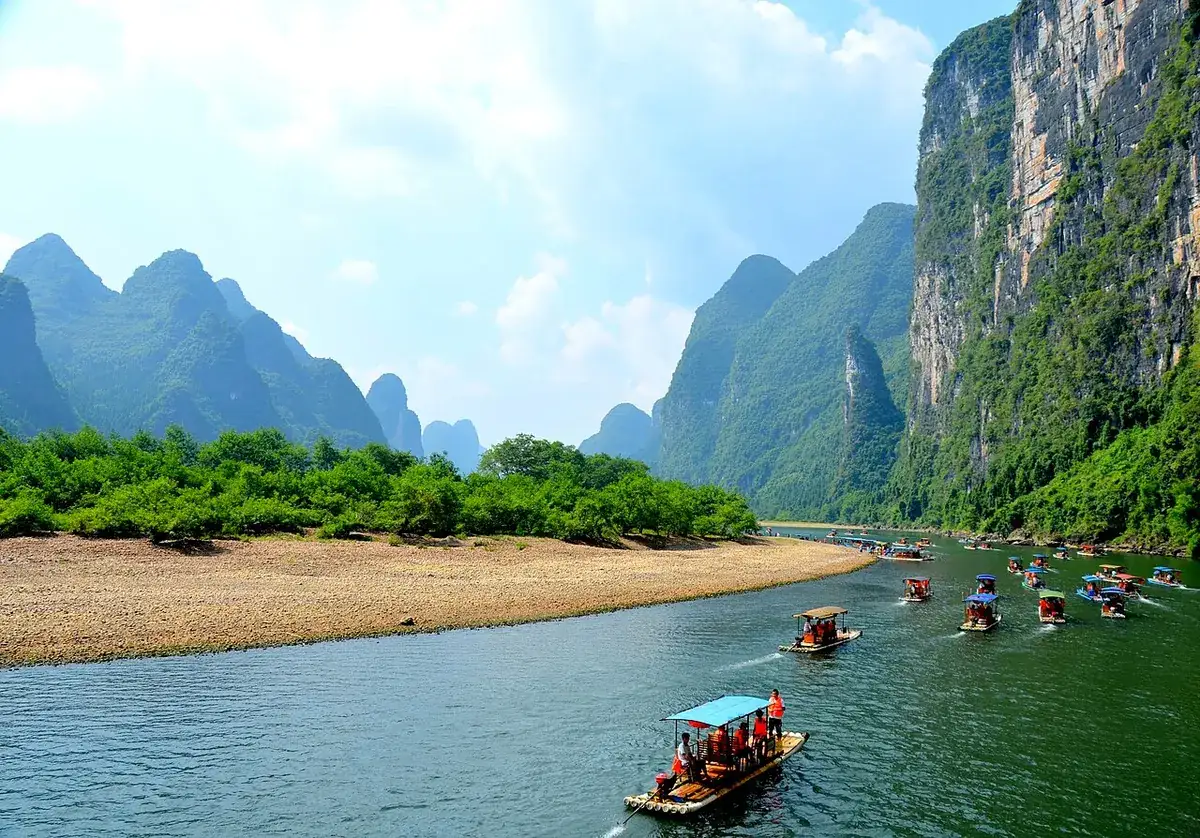
Water transport offers unique advantages and tourism appeal in Guangxi. Beibu Gulf Port (including the Fangchenggang, Qinzhou, and Beihai port areas) is an important deep‑water port on the southwestern coast of China and the core sea outlet of the New Western Land‑Sea Corridor. While this may not directly concern ordinary travellers, the coastal resort areas of port cities such as Beihai and Qinzhou are worth visiting. The main stream of the Xijiang River, part of the Pearl River system, runs east‑west through Guangxi; below Wuzhou it is navigable by thousand‑tonne vessels, but inland passenger transport has largely disappeared, replaced by tourist cruises and bamboo rafts on scenic routes such as the Li River, Yulong River, and Zuojiang River. Taking a bamboo raft from Guilin to Yangshuo along the most scenic section of the Li River—a four‑hour journey through karst peaks, reflections, and bamboo groves—is a world‑class landscape gallery and the most moving gift of Guangxi's waterways. A cruise on the Zuojiang River section of the Huashan rock art site allows you to gaze from the water at the ochre‑red rock paintings left by the Luoyue people on the cliffs over two thousand years ago, experiencing a mysterious journey through time.
For urban transport, Nanning's rail transit (metro) has several lines in operation, connecting railway stations, bus stations, commercial centres, and some scenic areas. Boarding with a mobile QR code is quick and convenient. Liuzhou has a well‑developed bus system with sufficient BRT capacity. Guilin's old city is small and compact; buses and bike‑sharing are good choices for getting around. Taxis and ride‑hailing services cover major cities well, but in remote mountain county towns, you may need to rely on motorcycle taxis or rural buses; planning ahead will help you prepare.
Travel Tips
The land of the Eight Gui has diverse scenery through the seasons, with flowers blooming and falling in their own time. Balancing climate comfort and landscape appeal, the period from April to November is the best time to travel through Guangxi. April to May is late spring and early summer: rainfall is abundant but the weather is not scorching, the Li River swells, and the misty beauty of Guilin in the rain resembles the ink‑wash landscapes of the Song‑dynasty painter Mi Youren; the Longji Rice Terraces are flooded, mirroring the sky and clouds. June to August is the golden season for the southern coast: the seawater temperatures of Beihai Silver Beach and Weizhou Island are suitable for swimming, but this is also typhoon season, so watch weather warnings before travelling. September to November is the most comfortable season of the year: the heat recedes, the autumn skies are clear, osmanthus flowers fill Guilin's air, the Longji Rice Terraces turn from green to gold, and the Leye Tiankeng cluster under clear skies is magnificently vast. December to March, the northern mountains may see freezing rain or snow; if you are hardy and determined, the winter scenery of Xing'an Mao'er Mountain and Ziyuan Bajiaozhai Scenic Area is quite appealing, but be prepared for the cold. During the Spring Festival and the "Zhuang March 3rd" festival, there are many folk activities, offering a window for experiencing ethnic culture, but also many tourists and tight accommodation; book well in advance.
Guangxi is vast, with many must‑see places. If you are visiting for the first time and have limited time, the following five types of experiences can form the core of your itinerary. First, the Li River landscape from Guilin to Yangshuo cannot be missed. Take a bamboo raft from Yangdi down to Xingping, then cycle or take a bus to Yangshuo; walking on the paths beside the Yulong River, with mountains like screens and fields of rice, is the most classic way to experience Guilin. Second, the Longji Rice Terraces are worth the journey. In the Longji mountains of Longsheng Various Ethnicities Autonomous County, terraces first reclaimed by the Zhuang and Yao ancestors in the Yuan dynasty rise from the river valley to the clouds along the mountain ridges. The scenery changes with the seasons: the flooded terraces in May, the golden terraces in September, and the snowy terraces in January are most beloved by photographers. Stay overnight in a wooden stilt house in Ping'an Zhuang Village or Jinkeng Dazhai; in the morning, open the window to a sea of clouds and terraces, and enjoy the organic bamboo rice and local chicken soup. Third, the Chengyang Eight Villages' Dong architecture and way of life offer another world. The drum towers for village meetings, the wind‑and‑rain bridges for rest, the sour fish and sour meat for hospitality—and when the polyphony of the Dong Grand Song rises from the top of the drum tower, time seems to slow down a few beats. Fourth, Beihai, as a southern coastal old city, offers fine sand and gentle waves on Silver Beach for swimming; Weizhou Island's volcanic landscape, coral reefs, and Catholic church can easily occupy a day or two; the Vietnamese overseas Chinese in Qiaogang Town bring Vietnamese coffee and rice rolls; in the old arcade streets, you can encounter the light and shadow of a hundred years ago. Fifth, to experience the Zhuang ethnic culture in depth, head to southwestern Guangxi. Chongzuo's Mingshi Pastoral area has the spacious clarity of a "little Guilin"—take a bamboo raft through the bamboo groves; Ningming's Huashan rock art, a World Heritage site, features ochre‑red human figures on the cliffs that have not faded for a thousand years—mysterious and stirring beyond words.
Practical tips for a smooth journey. Guangxi has established a relatively complete tourism public service system; major railway stations, airports, and 4A‑grade and above scenic spots generally have tourism information centres. Language is not an issue in urban areas, as Mandarin is widely spoken. In remote villages, elderly people of minority groups may only speak their own language or local dialects; a smile and gestures are always the best universal language. Guangxi's public security is generally good, but you should still take care of your personal belongings, especially in crowded places such as long‑distance bus stations, railway stations, and night markets. Currency exchange is convenient at Bank of China branches or star hotels in major cities such as Nanning, Guilin, and Beihai; Vietnamese dong can be exchanged at border ports such as Pingxiang and Dongxing, but in remote mountainous areas you will still need sufficient cash. Food hygiene in Guangxi continues to improve, but the tropical and subtropical climate makes food spoil more easily; choose cold dishes and salads from street stalls with caution, and carrying basic gastrointestinal medicine is a wise move for travellers in the south. Mosquitoes are active throughout most of Guangxi all year round; mosquito repellent and balm should be carried at all times, and when visiting mountain or rural areas, wear long sleeves and trousers to prevent mosquito bites and leeches.
A few final cautions: Guangxi is a multi‑ethnic region. When visiting minority villages or religious sites, please respect local customs—for example, remove your shoes when entering a Zhuang house; the fire pit in a Dong drum tower is sacred and must not be stepped over; do not photograph ritual ceremonies or close‑ups of elderly people without permission. The karst mountain weather is changeable—"ten li, different skies" is common—so rain gear is essential; even on a clear morning, a sudden downpour may strike in the afternoon. Raw poultry and tropical fruits are subject to customs quarantine; do not carry them across borders, especially when returning from Vietnam. The charm of Guangxi travel lies in its unhurried pace and its landscape and people permeating the background. Slow down, try to chat with the old lady selling rice noodles, wait by an unknown riverside for a sunset—this may touch the soul of this land more deeply than rushing from sight to sight.
Travel information can change. Check current opening hours, reservations and entry requirements before you travel.
Traveller discussion
Start the conversation with a helpful tip or a question.