
Wuhai
WuhaiWuhai is a prefecture-level city in the Inner Mongolia Autonomous Region, located on the upper reaches of the Yellow River. Bordered by the Gandel Mountains to the northeast, facing Shizuishan of Ningxia across the river to the south,
Wuhai
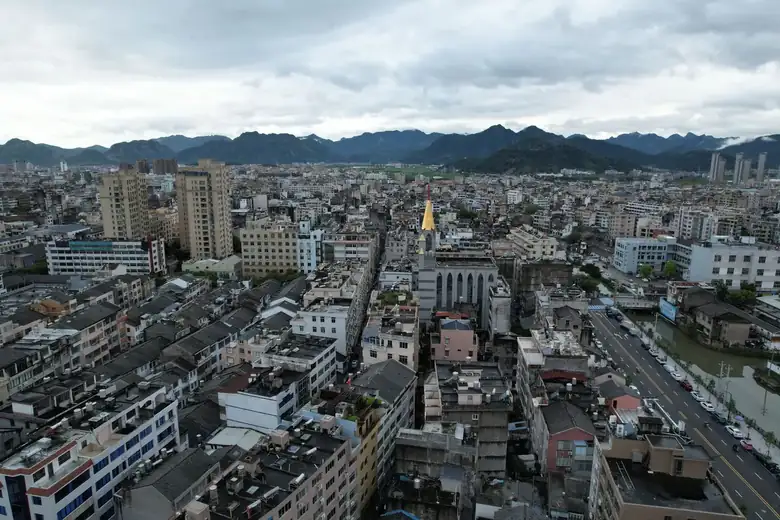
Wuhai is a prefecture-level city in the Inner Mongolia Autonomous Region, located on the upper reaches of the Yellow River. Bordered by the Gandel Mountains to the northeast, facing Shizuishan of Ningxia across the river to the south, and adjacent to Alxa League to the west, it covers a total area of 1,754 square kilometers. As of August 2025, Wuhai administers 3 districts. As of the end of 2024, the resident population was 557,300. On January 10, 1976, Wuda City and Haibowan City merged to form Wuhai. Known as the "Pearl of the Yellow River," the city is surrounded by mountains on three sides with the river flowing through the middle. Rich in mineral resources, especially coal, it is nicknamed the "Sea of Black Gold." The city is also known for grape cultivation and is an emerging industrial city in western Inner Mongolia. The Yellow River flows through the city, and the 118 km² Wuhai Lake connects with the Ulan Buh Desert. The city has national first-class protected plant Tetraena mongolica, ancient rock carvings, and Qin dynasty Great Wall ruins. In 2025, GDP was 54.075 billion yuan (approximately US$7.6 billion), down 4.3%.
Historical Evolution
In 127 BCE, Emperor Wu of Han defeated the Xiongnu and established the Shuofang Commandery, with Woye County set up in the present Haibowan area. Through the Northern and Southern Dynasties, the area was contested by various nomadic states including Later Zhao, Former Qin, and Later Qin. During the Tang dynasty, the area was under the Guannei Circuit. In the Western Xia period (1038–1227), Haibowan belonged to Lingzhou and Wuda to the Helan Mountain defense zone. During the Qing dynasty, the area was divided between the Ordos Right Wing Middle Banner (Haibowan) and the Alxa Banner (Wuda). In 1961, Wuda City and Haibowan City were established. In January 1976, they merged to form Wuhai, a municipality directly under the Inner Mongolia Autonomous Region.
Administrative Divisions
As of August 2025, Wuhai administers 3 districts: Haibowan, Wuda, and Hainan. The municipal government is at Xuefu Street, Binhe Subdistrict, Haibowan District.
Physical Geography
Location and Boundaries
Wuhai is in southwestern Inner Mongolia, on the Yellow River, at the western edge of the Ordos Plateau and southeastern edge of the Ulan Buh Desert, between 39°15′–39°52′N and 106°36′–107°05′E. It borders Ordos to the north and east, Alxa League to the west, and Shizuishan of Ningxia to the southwest. The Yellow River flows north-south through the city. The total area is 1,754 square kilometers.
Topography and Landforms
The terrain features "three mountains, two valleys, and one river." From east to west: Zhuozi Mountain, Gandel Mountain, and Wuhu Mountain—all northern extensions of the Helan Mountain range—run parallel north-south, forming two flat valleys between them. The Yellow River flows through the western valley of Gandel Mountain. The terrain is high on both sides and low in the middle, with four landform types: eroded mid-low mountains (40%), denuded hills (20%), alluvial fans (30%), and Yellow River terraces (10%).
Climate
Wuhai has a typical continental climate with cold, dry winters; hot summers; and large diurnal temperature ranges. The average annual temperature is 9.6°C (extreme maximum 40.2°C, extreme minimum −36.6°C). Annual sunshine is 3,138.6 hours, with a frost-free period of 156–165 days. Annual precipitation is 159.8 mm, with evaporation of 3,289 mm. Average wind speed is 2.9 m/s.
Hydrology
Surface runoff is generally higher in hilly areas (3–5 mm) than in plains and mountains. The Yellow River flows 105 km through the city with an average width of 250–500 m, depth of 2.5–11.6 m, and average annual runoff of 26.9 billion cubic meters. Groundwater sustainable extraction is 112 million cubic meters.
Natural Resources
Water Resources
The Yellow River provides the primary water source, with groundwater reserves of 112 million cubic meters that naturally complement the river system.
Land Resources
Mountains and hills cover about two-thirds of the total area. The city has 6 soil types, 11 subtypes, and 157 soil varieties, with gray desert soil (21.98%) and brown calcareous soil (23.34%) being the most common.
Plant Resources
Wuhai has 279 species of wild plants across 69 families and 181 genera. Medicinal plants include licorice, cistanche, ephedra, and dogbane. The city has national second-class protected species including Tetraena mongolica, Helianthemum, and Populus euphratica. Natural forest covers 300,000 mu, mainly shrub species.
Mineral Resources
Wuhai has 37 mineral varieties across 82 locations, with proven reserves for 25 types. Major reserves include coal (2.7 billion tons), iron ore (7.57 million tons), refractory clay (369.4 million tons), limestone (356.42 million tons for flux, 18.333 billion tons for cement), and gypsum (13.04 million tons). There are 8 large, 21 medium, and 25 small deposits.
Population
As of the end of 2024, the resident population was 557,300, with an urbanization rate of 96.88%. The city has 40 ethnic groups including Mongolian, Han, Hui, and Manchu.
Politics
Economy
Overview
In 2024, GDP was 59.557 billion yuan (approximately US$8.4 billion), up 4.1%. The industrial structure was 1.4:50.0:48.6 (primary:secondary:tertiary). Per capita GDP was 106,352 yuan (approximately US$14,980). General public budget revenue was 8.589 billion yuan. Fixed asset investment decreased 35.8%.
Primary Industry
Total crop sown area was 7,131.33 hectares (up 7.6%), with grain output of 48,400 tons (up 14.7%).
Secondary Industry
Above-scale industrial added value grew 6.1%, with manufacturing up 16.6% and power/heat/gas up 9.5%. Coal mining declined 1.4%, while chemical manufacturing grew 27.6%. Above-scale industrial revenue was 151.472 billion yuan (down 5.7%).
Tertiary Industry
Total retail sales of consumer goods grew 2.9%, with new energy vehicle sales up 72.8%. Total import-export was 1.242 billion yuan. Financial institution deposits reached 133.934 billion yuan and loans 66.975 billion yuan. Insurance premium income was 2.944 billion yuan.
Social Affairs
Science and Technology
In 2024, 721 patents were granted, with 354 valid invention patents (6.35 per 10,000 population, up 30.6%).
Education
Wuhai has 1 higher vocational college, 2 secondary vocational schools, 6 high schools, 14 junior high schools, 20 primary schools, and 51 kindergartens.
Culture
The city has 9 municipal public libraries, 22 district-level libraries (1.754 million volumes total), and 7 museums with 8,092 cultural relic sets. Radio and TV coverage both exceed 99.8%.
Healthcare
Wuhai has 319 health institutions including 27 hospitals, with 3,577 beds and 5,792 health personnel.
Sports
The city has 56 sports venues with 1.6947 million m² of sports area (3.04 m² per capita), 108 football fields, and 75 community fitness centers.
Social Security
Enterprise pension insurance covered 241,100 people, and basic medical insurance covered 415,900 people. The city has 9 elderly care institutions with 1,793 beds and 92 community elderly care service facilities with 100% coverage. Minimum living allowance is 903 yuan/month.
Transportation
Overview
Wuhai has a "three horizontal, four vertical, two bridges" highway network connecting to Yinchuan, Lanzhou, Baotou, Hohhot, and Beijing. In 2024, total freight was 97.2496 million tons (up 10.9%), and total passengers were 5.1792 million (up 15.7%).
Highways
National highways G110 (Beijing-Yinchuan) and G109 (Beijing-Lhasa), and expressways G6 (Beijing-Lhasa) and G18 (Rongcheng-Wuhai) pass through the city.
Railways
The Baotou-Lanzhou and Baotou-Yinchuan HSR are the main lines, with 4 passenger stations. Wuhai Station is the largest new station on the Baotou-Yinchuan HSR with 4 platforms, 11 tracks, and capacity for 1,200+ passengers. Wuhai East Station (original station, built 1957) handles one-third of western Inner Mongolia's rail passenger transport.
Aviation
Wuhai Airport, 15 km north of the city center, operates routes to Hohhot, Shanghai, Xi'an, Guangzhou, and Beijing.
Public Transit
As of 2024, Wuhai has 42 bus routes with 227 buses and 1,127 taxis, carrying 18.1798 million passengers annually (up 7.9%).
Scenic Spots
Yellow River scenery: The Yellow River flows over 100 km through the city, with dozens of river islands.
Desert landscapes: Jinsha Bay Ecotourism Area (3A-level) and Mabaodian Ecotourism Area.
Mountain landscapes: Gandel Mountain, Zhuozi Mountain, karst caves, and peaks.
Historical sites: Han dynasty city ruins, Ming dynasty beacon towers, Qin dynasty Great Wall ruins, and Zhuozi Mountain rock carvings (Neolithic to Bronze Age rock art featuring sun gods, animal figures, and hunting scenes).
Wuhai Lake Ecotourism Area: A 118 km² lake formed by the Haibowan Water Conservancy Hub, connecting the Ulan Buh Desert, Wuhai Lake, and Poplar Island. The city also has Asia's largest Carboniferous petrified tree (40+ meters long, 1 meter diameter) and is known as a "stone appreciation city."
Honorary Titles
Travel information can change. Check current opening hours, reservations and entry requirements before you travel.
Traveller discussion
Start the conversation with a helpful tip or a question.