
Yongzhou City
Yongzhou CityYongzhou, also known by its elegant name "Xiaoxiang," is a prefecture-level city in Hunan Province, China, located in southern Hunan along the upper reaches of the Xiang River. It borders Hengyang and Shaoyang to the north, Che
Yongzhou City
Yongzhou, also known by its elegant name "Xiaoxiang," is a prefecture-level city in Hunan Province, China, located in southern Hunan along the upper reaches of the Xiang River. It borders Hengyang and Shaoyang to the north, Chenzhou to the east, Guilin and Hezhou of Guangxi to the west, and Qingyuan of Guangdong to the south. Situated at the confluence of the Xiao and Xiang rivers, the city is surrounded by mountains on three sides, with higher terrain in the southwest and lower elevations in the northeast and central areas. The landform is complex, dominated by hills and mountainous terrain, and the climate is a subtropical humid monsoon type. As of 2026, Yongzhou administers 2 districts, 8 counties, and 1 county-level city, covering a total area of 22,400 square kilometers, with a permanent resident population of 4.9486 million at the end of 2025. The local language is the Xiang dialect. Yongzhou derives its name from the Jiuyi Mountains, where Emperor Shun, a legendary progenitor of Chinese civilization, is said to be buried. It is one of the source areas of the Xiang River, and the convergence of the Xiao and Xiang rivers at Pingzhou in Lingling District gives the city its elegant name "Xiaoxiang." The Tang Dynasty writer Liu Zongyuan composed his famous "Eight Records of Yongzhou" here. The city gave birth to Neo-Confucianism, Nushu (women's script), and other distinctive cultural traditions, and was the birthplace of historical figures including Huang Gai, Huai Su, and Zhou Dunyi. Five expressways cross the territory, and the Hengliu high-speed railway intersects with the Xianggui and Luozhan railways. As Hunan's "southern gateway," Yongzhou is a key link between Hunan and the Greater Bay Area and a bridgehead for ASEAN engagement. The city is developing six major industries: food processing, smart home appliances, modern agriculture, cultural tourism, new energy, and digital technology. In 2025, Yongzhou's regional GDP reached 282.958 billion yuan (approximately $39.0 billion), up 5.6% year-on-year.
History
In 221 BCE, the Qin Dynasty established the Junxian (commandery-county) system, setting up Changsha Commandery and founding Lingling County. In 124 BCE, Liu Xian was enfeoffed as Marquis of Quanling during the Western Han. In 111 BCE, Lingling Commandery was established under Jingzhou. During the Xin Dynasty (9-23 CE), it was renamed Jiuyi Commandery, and in 25 CE, the Eastern Han restored the name Lingling and moved its seat to Quanling County (present-day Lingling District). During the Three Kingdoms, the area belonged to Wu. In 307 CE, the Western Jin transferred it to Xiangzhou. In 589 CE, the Sui Dynasty established the Yongzhou General Government. In 621 CE, the Tang Dynasty set up Yongzhou and Yingzhou; Yingzhou was renamed Daozhou in 634 CE. In 764 CE, the Hunan Observation Commissioner was established, marking the origin of the name "Hunan." In 927 CE, Yongzhou fell under the Jiangnan West Circuit during the Five Dynasties. The Yuan Dynasty converted it to Yongzhou Route in 1276. In 1368, the Ming established Yongzhou Prefecture, and in 1664, the Qing placed it under Hunan Province. In 1913, Daozhou became Dao County. In 1949, the Yongzhou Special District was established, renamed Lingling in 1950, and redesignated as Lingling Region in 1968. In November 1995, the prefecture-level city of Yongzhou was formally established. In 1997, the municipal government relocated to Lengshuitan District.
Administrative Divisions
Division Evolution
In 1969, Shuangpai County was established. In 1982, county-level Yongzhou City was created from Lingling Region. In 1984, Lingling County was abolished, and county-level Lengshuitan City was established. In 2000, the State Council approved moving the municipal government to Lengshuitan District. In 2005, Zhishan District was renamed Lingling District. In January 2021, Qiyang County was upgraded to county-level Qiyang City.
Division Details
As of May 2026, Yongzhou administers 2 districts (Lingling and Lengshuitan), 8 counties (Shuangpai, Dongan, Dao, Ningyuan, Xintian, Lanshan, Jiangyong, and Jianghua Yao Autonomous County), and 1 county-level city (Qiyang), plus 2 management zones (Huilongwei and Jindong) and 1 economic development zone. The municipal government is seated at No. 1 Yiyun Road, Lengshuitan District.
Geography
Location and Territory
Yongzhou borders Chenzhou to the east, Qingyuan (Guangdong) and Hezhou (Guangxi) to the south, Guilin (Guangxi) to the west, and Hengyang and Shaoyang to the north. Geographic coordinates: 24 degrees 39 minutes to 26 degrees 51 minutes north latitude, 111 degrees 6 minutes to 112 degrees 21 minutes east longitude. Maximum north-south distance: 245 km; maximum east-west width: 144 km; total area: 22,400 square kilometers.
Topography
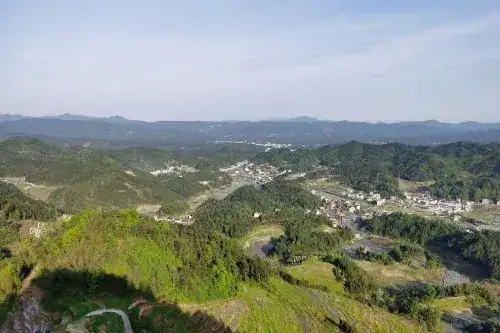
Yongzhou sits at the southern edge of a horseshoe-shaped basin opening to the northeast. Three major mountain systems -- the Yuecheng Ridge-Siming Mountain system, the Dupang Ridge-Yangming Mountain system, and the Mengzhu Ridge-Jiuyi Mountain system -- divide the city into northern and southern sections. The Lingqi Basin (855.4 million mu) lies to the north, and the Daojiang Basin (1,024.27 million mu) to the south. The highest point is Jiucai Ridge at 2,009.3 meters; the lowest is 63 meters in the Xiang River valley. Mountainous terrain covers 49.5% of the total area, with hills at 14.5%, tablelands at 17.81%, plains at 14.29%, and water surfaces at 3.94%.
Climate
Yongzhou has a subtropical continental monsoon humid climate with four distinct seasons. Average annual temperature: 17.6-18.6 degrees Celsius. Frost-free period: 286-311 days. Average annual precipitation: 1,200-1,900 mm. Average annual sunshine: 1,300-1,740 hours.
Hydrology
The Xiang River flows east through the Lingqi Basin, and the Xiaoshui River runs north across the territory. There are 733 rivers totaling 10,515 km in length. Three water systems exist: the Xiang River system (96.09% of the area), the Pearl River system (77.8 square km), and the Zijiang River system (101.3 square km). The dendritic river network originates from three mountain systems and converges into the Xiao and Xiang rivers before flowing northeast into Dongting Lake. Yongzhou's river water volume accounts for 11.1% of Hunan's total.
Natural Resources
Land Resources
Yongzhou possesses approximately 5 million mu of mountainous land, over 2 million kW of hydropower resources, and more than 30 million cubic meters of timber available for development.
Animal Resources
Over 1,000 wild animal species inhabit Yongzhou, with 31 under national protection. South China tigers and yellow-bellied tragopans are Class I protected species. Known aquatic animals total 186 species, including 153 fish species.
Plant Resources
Yongzhou has 2,712 vascular plant species across 232 families, accounting for 68% of Hunan's total. Six species are under national first-class protection, 13 under second-class, and 27 under third-class protection.
Mineral Resources
Located in the central Nanling nonferrous metal metallogenic belt, Yongzhou has identified 65 of China's 168 mineral types, with proven reserves for 40. Manganese, rare earths, rubidium, and lithium reserves rank first in the province. As of 2025, 75 mineral types have been discovered, with proven reserves for 55. There are 653 mineral occurrences, including 9 large and 23 medium deposits.
Population
Population Size
As of the end of 2025, the permanent resident population was 4.9486 million, with 2.5588 million urban residents (urbanization rate: 51.71%). Births: 31,800 (rate: 4.86 per thousand); deaths: 37,300 (rate: 5.69 per thousand); natural growth rate: -0.83 per thousand.
Ethnic Composition
Yongzhou has 49 ethnic groups, including 48 ethnic minorities. The permanent resident population of ethnic minorities is 561,342 (10.61%), ranking fourth in the province. There is one Yao autonomous county (Jianghua), one county with autonomous county treatment (Jiangyong), and 21 ethnic townships.
Politics
The Yongzhou Municipal People's Government is the city's highest administrative organ, seated at No. 1 Yiyun Road, Lengshuitan District. The city operates under China's standard prefecture-level governance system.
Economy
Overview
In 2025, Yongzhou's regional GDP reached 282.958 billion yuan (approximately $39.0 billion), up 5.6% year-on-year. The primary industry contributed 47.640 billion yuan (approximately $6.6 billion), the secondary industry 91.253 billion yuan (approximately $12.6 billion), and the tertiary industry 144.064 billion yuan (approximately $19.9 billion). Per capita GDP was 56,778 yuan (approximately $7,831), up 6.9%. The private economy reached 206.656 billion yuan (approximately $28.5 billion), or 73.0% of GDP. Fixed asset investment fell 17.2%. General public budget revenue was 14.624 billion yuan (approximately $2.0 billion), down 9.3%. Per capita disposable income was 32,313 yuan (approximately $4,460), up 6.2% -- urban residents at 42,859 yuan (approximately $5,912) and rural residents at 23,105 yuan (approximately $3,187).
Primary Industry
In 2025, total agricultural, forestry, animal husbandry, and fishery output was 94.284 billion yuan (approximately $13.0 billion), up 4.5%. Grain output reached 3.1175 million tons, up 1.3%. Vegetable output was 7.3678 million tons, up 4.3%. Hog slaughter reached 8.0947 million head, up 3.1%. There were 530 above-scale agricultural processing enterprises, including 91 national and provincial-level leading enterprises, 10,777 farmer cooperatives, and 32,800 family farms.
Secondary Industry
In 2025, above-scale industrial value-added grew 7.4%, with private enterprises up 8.9% and high-tech manufacturing up 7.5%. By sector, automobile manufacturing grew 58.7%, nonferrous metal smelting 27.6%, and computer and electronic equipment 9.4%. Industrial enterprise revenue was 192.716 billion yuan (approximately $26.6 billion), down 1.7%, with total profits of 8.182 billion yuan (approximately $1.1 billion). Construction value-added was 16.627 billion yuan. Real estate development investment fell 32.3%, with commercial housing sales of 13.478 billion yuan.
Tertiary Industry
In 2025, total retail sales of consumer goods reached 109.660 billion yuan (approximately $15.1 billion), up 4.6%. Import and export value was 14.591 billion yuan (approximately $2.0 billion), down 37.1%. Actual foreign investment utilized was $14 million. Financial institution deposits reached 415.788 billion yuan (approximately $57.3 billion), up 9.6%, and loans reached 291.555 billion yuan (approximately $40.2 billion), up 6.0%. Insurance premium income was 8.955 billion yuan (approximately $1.2 billion). Postal business volume was 763 million yuan; telecommunications business volume was 4.140 billion yuan. Mobile phone users reached 5.3677 million, and broadband internet users 1.7912 million.
Social Services
Science and Technology
In 2025, 2,453 technology contracts were signed (up 26.9%), with transaction value of 20.795 billion yuan (approximately $2.9 billion), up 14.1%. Patent grants totaled 1,786, including 296 invention patents. High-tech industry value-added grew 4.3%.
Education
As of 2025, secondary vocational education graduates numbered 24,700, regular high school graduates 44,000, junior high school graduates 87,400, and primary school graduates 82,400. Kindergarten enrollment was 109,700.
Culture
Yongzhou has 6 performing arts troupes, 207 public cultural institutions, 12 public libraries, 5 museums, and 10 broadcasting stations. There are 6 national-level and 18 provincial-level intangible cultural heritage items. National first-class libraries include the Qiyang Taozhu Library and the Ningyuan County Library.
Healthcare
Yongzhou has 5,212 health institutions, including 141 hospitals and 12 maternal and child health centers. Health personnel totaled 43,900, including 17,100 licensed physicians and 20,800 registered nurses. Hospital beds numbered 28,875, with township health centers providing 8,877 beds.
Sports
Yongzhou has 19,700 sports venues. In December 2025, the Yongzhou team won the inaugural Hunan Provincial Football League championship.
Social Security
In 2025, 63,300 new urban jobs were created. Basic pension insurance covered 3.2075 million urban and rural residents. Urban employee pension insurance covered 876,700 people, including 265,400 retirees. Minimum living allowances were provided to 25,900 urban and 152,400 rural residents. Social welfare lottery sales reached 839 million yuan.
Environmental Protection
In 2025, 100% of water quality monitoring sections met or exceeded Class III standards, and 11 county-level areas met national Class II air quality standards. There are 32 nature reserves covering 128,900 hectares. Above-scale industrial energy consumption was 2.7607 million tons of standard coal, up 2.9%.
Transportation
Overview
Four expressways -- Erguang (G55), Quannan (G72), Xiarong, and Daohe -- cross the territory. The Hengliu high-speed railway and the Xianggui and Luozhan railways converge here. Yongzhou Lingling Airport serves 20 cities. The Xiang River waterway connects to Dongting Lake and the Yangtze River. In 2025, total cargo turnover was 11.038 billion ton-kilometers, up 15.3%, while passenger turnover was 1.163 billion person-kilometers, down 12.3%.
Aviation
Yongzhou Lingling Airport is located at Lengjiaoshan Town, 7 km from both Lingling and Lengshuitan urban areas. It operates flights to 20 cities including Beijing, Guangzhou, Shenzhen, Kunming, Xi'an, Chengdu, Haikou, and Sanya, though most routes require a transfer at Changsha.
Railways
Two railways cross Yongzhou: the Luozhan Railway and the Xianggui Railway, connecting north-south and east-west transportation respectively, with stations at Yongzhou, Lingling, and Yongzhou East.
Highways
National highways 207 and 322, the G55 Erguang Expressway, and the G72 Quannan Expressway traverse the city, along with nine provincial highways. Four major passenger stations serve the urban area. As of 2025, total highway mileage reached 25,700 km, including 626 km of expressways. Civilian vehicle ownership was 711,600.
History and Culture
Dialects
The Yongzhou dialect (Linglinghua), used in the Lingling and Lengshuitan districts, belongs to the Southwestern Mandarin group. Other local dialects include Donganhua, Qiyanghua, Daozhouhua, Ningyuan-Lanshan-Xintianhua, and Jianghua-Jiangyonghua.
Literature and Art
During the Tang and Song dynasties, Yongzhou was a cultural and educational center. The Tang poet Liu Zongyuan lived in exile here for ten years, writing the famous "Eight Records of Yongzhou" and "The Snake Catcher's Tale." Zhou Dunyi, a native of Dao County, founded Neo-Confucianism after studying at Yueyan (Moon Rock) in Daozhou. The monk Huai Su, who practiced calligraphy at the Lutian Temple in Yongzhou, became one of China's most celebrated calligraphers. Yongzhou is also known for Qiju opera, Lingling huagu opera, and Nushu (women's script) -- a unique writing system used exclusively by women in parts of Jiangyong County, comprising over 1,000 syllabic characters used in poems, letters, and autobiographies.
Religion
The main religions practiced in Yongzhou are Buddhism, Daoism, Islam, Catholicism, and Christianity. Buddhism, Daoism, and Islam have had the greatest influence on the city's history, culture, and art.
Intangible Cultural Heritage
As of 2024, Yongzhou had 6 national-level and 19 provincial-level intangible cultural heritage items. The Daozhou dragon boat race, originating in the Song Dynasty to commemorate the poet Qu Yuan and the Neo-Confucian pioneer Zhou Dunyi, was inscribed on the national intangible cultural heritage list in 2021.
Cultural Heritage Protection
Yongzhou maintains numerous cultural heritage sites under national and provincial protection, preserving its rich historical legacy as a city with over 2,000 years of continuous habitation.
Origin of the Place Name
Before the Sui Dynasty, Yongzhou was called Lingling. The name derives from Emperor Shun's burial at Jiuyi Mountain, as recorded in the Records of the Grand Historian: "He collapsed in the wilderness of Cangwu during his southern inspection tour and was buried at Jiuyi in Jiangnan, which is called Lingling."
Festivals and Customs
The Yao people celebrate the Bird-Chasing Festival on the first day of the second lunar month, featuring bird competitions and antiphonal singing for courtship. The Ox King Festival on the eighth day of the fourth lunar month suspends farm work and features purple "wu rice" made from tree leaves. The "Dou Niu" (Bull) Festival in Jiangyong is a gathering where young women share homemade foods, sing folk songs, and discuss personal aspirations; any young man caught peeking must perform chores as a penalty. The Panwang Festival on the sixteenth day of the tenth lunar month is the Yao people's most important holiday, featuring singing, long drum dances, and sacrifices to King Pan. The Daogao (Harvest Completion) Festival marks the end of autumn harvests, after which anyone may gather remaining crops.
Scenic Spots
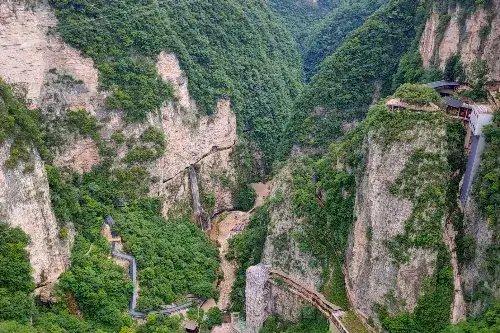
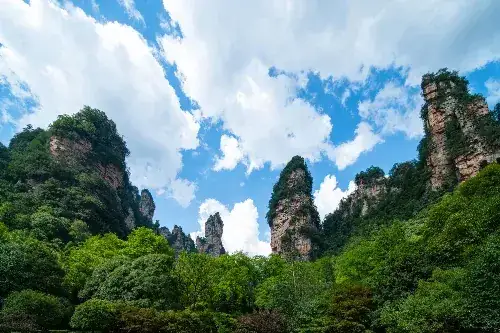
Yongzhou's scenic attractions include the Jiuyi Mountain scenic area, Pingzhou (the island where the Xiao and Xiang rivers converge), the Wuxi Stele Forest, and the Lingling Tower.
Specialty Products
Local specialties include Yongzhou blood duck, Dongan chicken, Yongzhou snail soup, Yishe (strange snake) wine, oil tea, Jiangyong's "Three Fragrances" (fragrant rice, fragrant pomelo, and fragrant taro), Jianghua bitter tea, Dao County red melon seeds, Daozhou gray goose, Xintian potato wine, Lanshan black paste wine, and kumquat.
Notable Figures
Notable historical figures from Yongzhou include Huang Gai (a general under Sun Quan during the Three Kingdoms), Huai Su (a renowned Tang Dynasty calligrapher), and Zhou Dunyi (the Song Dynasty philosopher who founded Neo-Confucianism).
Honors and Titles
Yongzhou has been designated as a National Forest City (2015), National Health City (2015), National Historical and Cultural City (2016), and National Dual Support Model City (2025). In 2022, the Chinese Prose Society named it "China's Hometown of Prose," and it was recognized as a National Green Travel City.
Sister Cities
Yongzhou has established sister city relationships with Nuwara Eliya, Sri Lanka (September 2009); Klang, Malaysia (May 2012); Zhanjiang, Guangdong Province (June 2012); and Djibouti City, Djibouti (April 2023).
Travel information can change. Check current opening hours, reservations and entry requirements before you travel.
Traveller discussion
Start the conversation with a helpful tip or a question.