
Yangquan City
Yangquan CityYangquan, historically known as "Yangquan" (Springs), also called Mountain City and the "First City of the CCP," is a prefecture-level city in Shanxi Province, located in the central-eastern part of the province. It borders Xin
Yangquan City
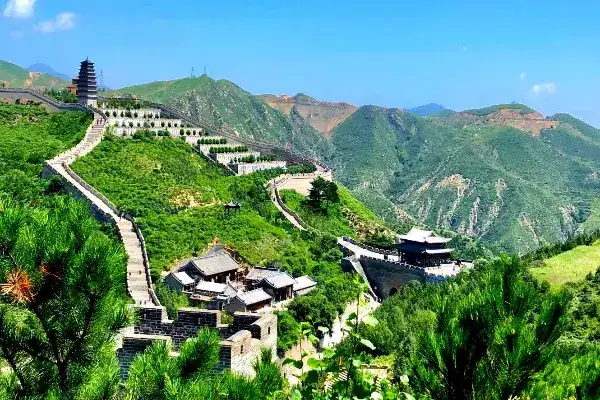
Yangquan, historically known as "Yangquan" (Springs), also called Mountain City and the "First City of the CCP," is a prefecture-level city in Shanxi Province, located in the central-eastern part of the province. It borders Xinzhou to the north, faces Shijiazhuang (Hebei) across the Taihang Mountains to the east, borders Taiyuan to the west, and Jinzhong to the south. It is on the eastern edge of the Loess Plateau, with mountainous terrain predominant, and has a warm temperate semi-humid continental monsoon climate. As of the end of 2022, the city administers 3 municipal districts and 2 counties, with a total area of 4,559 square kilometers. As of the end of 2025, the permanent resident population was 1,280,200. On May 4, 1947, Yangquan City was established from part of Pingding County. It is an emerging industrial city, the gateway of the "Three Jin" (Shanxi), and a strategic point between Shanxi and Hebei. The city is home to Niangziguan Pass (the ninth pass of the Great Wall), Zangshan Mountain tourist area, Guanshan Academy, the former residence of Shi Pingmei, Liangjia Hot Springs, and Shinao Mountain Forest Park centered on the Hundred Regiments Offensive memorial complex. The city has over 1,000 immovable cultural relics, 23 industrial heritage sites, and 34 War of Resistance sites. In 2025, GDP was 87.06 billion yuan, up 4.4%.
History
Yangquan has a long history. Artifacts unearthed in the 1950s from Zaoyan and Daliangding prove human habitation since the middle Paleolithic period. During the Tang-Yu and Xia-Shang eras, the area was part of ancient Jizhou. During the Spring and Autumn period (770–476 BCE), the Chouyou State existed in present-day Yuxian. In 457 BCE, the Jin minister Zhi Bo conquered Chouyou. After the Partition of Jin in 453 BCE, the area belonged to the State of Zhao.
During the Qin Dynasty (221–206 BCE), the area belonged to Taiyuan Commandery. During the Western Han Dynasty (206 BCE–9 CE), Shang'ai County was established at present-day Xincheng Village in Pingding County. During the Eastern Han Dynasty, Shang'ai belonged to Changshan Kingdom of Jizhou. During the Three Kingdoms, the area was divided between Wei's Leping and Xinxing commanderies. During the Eastern Jin and Sixteen Kingdoms period, the area changed hands among Former Zhao, Later Zhao, Ran Wei, Former Yan, Former Qin, Later Yan, and Northern Wei. The Northern Wei (386–534) established Shih'ai County and Dingxiang County. During the Sui Dynasty (581–618), Weize County was established at Niangziguan and Yuanqiu County in Yuxian. During the Tang Dynasty (618–907), the area belonged to Shouzhou, then Bingzhou and Taiyuan Prefecture. In 742, Shih'ai was renamed Guangyang. During the Northern Song (960–1127), Guangyang was renamed Pingding County in 979. During the Jin Dynasty (1115–1234), Pingding and Yuzhou were elevated. During the Ming Dynasty (1368–1644), Yuzhou was downgraded to a county. In 1724, Pingding became a directly-administered prefecture. During the War of Resistance, Pingding and Yuxian were divided into multiple counties between the Jin-Ji-Lu-Yu and Jin-Cha-Ji border regions. On May 4, 1947, Yangquan City was established from part of Pingding County. In 1983, Pingding and Yuxian counties were placed under Yangquan City.
Administrative Divisions
As of the end of 2022, Yangquan administers Pingding County, Yuxian County, and 3 districts (Cheng, Kuang, and Jiao). The Municipal Government is at No. 23 Nanda Street, Chengqu District.
Geographical Environment
Location and Boundaries
Yangquan is in the central-eastern wing of Shanxi Province, between 112°5′–114°4′E and 37°40′–38°31′N, on the western side of the central Taihang Mountains. It borders Dingxiang and Wutai counties of Xinzhou to the north, Pingshan and Jingxing counties of Shijiazhuang (Hebei) to the east, Xiyang County of Jinzhong to the south, and Shouyang County of Jinzhong and Yangqu County of Taiyuan to the west. The north-south length is about 106 kilometers, east-west width about 42 kilometers, with a total area of 4,559 square kilometers. It is approximately 100 kilometers from both Taiyuan and Shijiazhuang.
Landforms
The city is on the eastern edge of the Loess Plateau, part of the eastern Shanxi mountainous area. The terrain is predominantly mountainous, with hills and plains in the remainder. Nine mountain ranges include: Niudaoling in the north (at the junction of Xizhou and Taihang Mountains), Liangling in the northwest, and two columns of ranges—eastern (Baima, Qiulin, Mianshan, and Aishan, part of the Taihang mid-section at 700–1,700m) and western (Beifangshan, Nanfangshan, and Qiling). The Taihang Mountains form the border between Hebei and Shanxi, with steep eastern slopes dropping to the North China Plain and gentler western slopes. Intermontane basins include Xiyan, Yucheng, and Pingding.
Climate
Yangquan has a warm temperate semi-humid continental monsoon climate. Characteristics: long winters and summers, short springs and autumns, four distinct seasons; abundant sunshine, large diurnal temperature range; spring droughts, hot rainy summers, rapid autumn cooling, cold dry winters. Average annual solar radiation: 134 kcal/cm²; actual sunshine: 2,700–2,900 hours. Average annual temperature: 8–12°C. Accumulated temperature ≥10°C: 2,400–3,000°C. Frost-free period: 130–180 days. Annual precipitation: 450–550 mm. Significant vertical climate variation.
Hydrology
Except for 22 square kilometers in the west belonging to the Yellow River basin, the entire city belongs to the Hai River basin. There are over 60 rivers, of which 34 have drainage areas exceeding 10 square kilometers and 7 exceed 300 square kilometers with lengths over 30 kilometers. The main rivers are the Hutuo River in the north (northern source of the Ziya River) and the Mian River in the central-south, formed by the confluence of the Wen and Tao rivers.
Natural Resources
Water Resources
Total water resources: 1.584 billion cubic meters/year, including 1.382 billion river runoff (490 million local + 892 million inflow) and 543 million groundwater (435 million local + 108 million inflow), with 341 million overlap. Per capita local water resources: 562 cubic meters/year, slightly above the provincial average of 546 but less than 1/4 of the national average of 2,400.
Plant Resources
The city has 93 families and 437 species of plants, including 5 fungi families, 4 fern families, 4 gymnosperm families, and 80 angiosperm families. The most diverse families are Compositae, Leguminosae, Rosaceae, and Gramineae (154 species total). Over 160 medicinal plant species are found. Forest area: 941,000 mu (13.74% of total), with 22.05 million scattered trees and 550,000 cubic meters of timber stock. Pasture/grassland: 1.821 million mu, over 90% usable, with total grass production exceeding 100 million kg.
Animal Resources
Wildlife is limited due to scarce forests and environmental pollution. Historically, tigers, river deer, and deer were recorded in the Qing Dynasty; tigers are now extinct locally. 49 species across 4 classes, 17 orders, 28 families are recorded, including 14 mammals, 27 birds, 5 reptiles, and 3 amphibians. 831 forest pest insect species are known. The city also raises pigs, cattle, sheep, horses, donkeys, mules, chickens, and rabbits.
Mineral Resources
Yangquan is a major national mineral concentration area, known as the "Hometown of Coal and Iron." 52 mineral types have been proven, with anthracite coal, pyrite, and bauxite being the most significant. It is one of China's largest anthracite production bases, one of three national bauxite production bases, and one of five pyrite production bases. Coal-bearing area: 1,051 square kilometers; coal geological reserves: 10.4 billion tonnes; pyrite: 250 million tonnes; bauxite: 227 million tonnes. Annual coal production: 35 million tonnes; pyrite: 2 million tonnes; bauxite clinker: 1.8 million tonnes. Additional reserves: ceramic raw materials (177.409 million tonnes), feldspar (43.17 million), quartz (43.20 million), and diopside (500 million).
Population
As of the end of 2024, the permanent resident population was 1,284,800, a decrease of 14,400. Birth rate: 6.17‰; death rate: 9.01‰; natural growth rate: -2.84‰. Urban population: 949,700 (73.92% urbanization rate). Males: 664,500; females: 634,600; sex ratio: 104.72.
Politics
Current Leadership
Sister Cities
Economy
Overview
In 2025, GDP was 87.06 billion yuan, up 4.4%. Primary industry: 1.80 billion yuan (up 3.1%); secondary: 35.82 billion (up 3.3%); tertiary: 49.45 billion (up 5.2%). In 2024, GDP was 85.62 billion yuan (down 0.9%), with structure adjusted to 2.0:44.5:53.5.
In 2023, fixed asset investment was 25.76 billion yuan (down 11.3%). General public budget revenue: 8.31 billion yuan (up 1.3%). General public budget expenditure: 16.87 billion yuan (up 6.4%), with livelihood expenditure at 13.07 billion (77.5%, up 9.6%).
Primary Industry
In 2022, crop planting area was 57,000 hectares (up 0.6%), including 55,000 hectares of grain. Grain output: 237,000 tonnes (up 1.9%). Meat output: 22,000 tonnes (up 7.2%), including pork 17,500, beef 500, mutton 800, and poultry 4,000 tonnes. Milk: 5,000 tonnes; eggs: 35,000 tonnes. In 2023, total agricultural output was 3.01 billion yuan (up 7.8%), with grain output at 238,300 tonnes (up 0.6%).
Secondary Industry
In 2022, total industrial value added was 52.03 billion yuan (up 6.9%). Industrial enterprises above designated size grew by 8.7%, with coal up 6.4% and non-coal up 17.0%. Revenue: 88.28 billion yuan (up 7.6%); profits: 8.60 billion yuan (up 208.2%). Construction industry: 176 qualified enterprises, output value 8.28 billion yuan (down 7.9%).
In 2023, industrial enterprises above designated size grew by 0.5%, with coal down 0.4% and non-coal up 3.9%. Raw coal output: 67.617 million tonnes (down 2.1%); power generation: 27.28 billion kWh (up 5.3%); coalbed methane: 1.36 billion cubic meters (down 1.3%). Strategic emerging industries grew by 7.1%, with environmental protection up 11.7%, biotechnology up 67.3%, high-end equipment up 12.7%, and new energy up 20.6%.
Tertiary Industry
In 2023, service industry value added was 45.03 billion yuan (up 4.1%). Wholesale/retail: 5.98 billion (up 0.3%); transportation/warehousing/postal: 4.62 billion (up 5.9%); accommodation/catering: 1.62 billion (up 10.1%); financial: 5.70 billion (up 3.1%); real estate: 5.97 billion (up 5.0%); for-profit services: 5.40 billion (up 2.7%); non-profit services: 15.65 billion (up 5.1%).
Retail sales of consumer goods: 33.26 billion yuan (up 2.5%). Financial institution deposits: 226.0 billion yuan (up 7.2%); loans: 150.04 billion (up 4.3%). Insurance premium income: 3.83 billion yuan (up 7.2%). Express delivery volume: 22.969 million parcels (up 83.5%). Mobile phone users: 1.678 million, including 810,000 5G users. Internet subscribers: 645,000.
Social Undertakings
Science and Technology
In 2023, 667 patents were authorized (down 27.7%), including 115 invention patents (up 57.5%). Valid invention patents per 10,000 people: 3.1. Technology contracts: 190, valued at 1.34 billion yuan (down 71.9%). The city has 1 national, 20 provincial, and 62 municipal enterprise technology centers, and 164 high-tech enterprises.
Education
As of the end of 2023: 391 kindergartens, 175 primary schools, 62 junior high schools, 16 general high schools, 13 secondary vocational schools, 3 higher education institutions, and 1 adult higher education institution.
Culture
As of the end of 2023: 6 cultural centers, 5 performing troupes, 6 public libraries, 98,000 cable TV subscribers. Yangquan Daily circulation: 5.97 million copies.
Healthcare
As of the end of 2023: 1,373 medical institutions, 7,808 authorized beds, 7 maternal/child health centers, 12,605 health technical personnel.
Sports
Sports venue area: 2.941 million square meters; 5,007 venues, including 2,351 ball sports venues, 2,307 fitness venues, and 2 large stadiums. Athletes won 18 gold, 16 silver, and 9 bronze medals in major competitions.
Social Security
As of the end of 2023: urban employee pension insurance 424,000; urban-rural resident pension 454,000; employee medical insurance 388,000; resident medical insurance 785,000; work injury insurance 301,000; unemployment insurance 289,000; maternity insurance 231,000. 14,000 urban and 31,000 rural residents received minimum living allowance. 3 relief stations, 32 residential service institutions, 2,763 elderly care beds, and 350 welfare beds.
Transportation
In 2023, railway freight volume was 35.001 million tonnes (down 15.5%), including 32.487 million tonnes of coal. Civilian automobile ownership: 323,000 (up 5.9%), including 282,000 private vehicles.
Aviation
Yangquan is between Taiyuan and Shijiazhuang, approximately 140 km from Shijiazhuang Zhengding International Airport and 100 km from Taiyuan Wusu International Airport. Both airports have city terminals in Yangquan providing ticketing and shuttle services.
Railways
The Shitai Railway (China's first electrified double-track railway) runs through the city, connecting to the Beijing-Guangzhou, Tongpu, and Yangshe lines, with 10 stations and 32 branch/specialized lines. In 2009, the Shitai Passenger Dedicated Line opened, and Yangquan North Station was put into operation, making Yangquan the second city in Shanxi with high-speed rail. The station offers direct service to Beijing, Shanghai, Qingdao, Tianjin, Zhengzhou, Chengdu, and other cities. The Yangda Railway (Yangquan-Dahe), China's first high-speed EMU offline railway, opened on September 24, 2020, with Yangquan East Station providing convenient city-center access. On January 27, 2025, the Yangshe Railway passenger service opened, with Pingding Station beginning operations.
Highways
The highway network radiates from the city center to all counties and districts. The Taijiu Expressway (Shanxi's first high-grade outbound highway) connects with the Beijing-Hong Kong-Macao Expressway. Expressways passing through Yangquan include the G5 Beijing-Kunming, Tianli, G20 Qingyin (formerly Taijiu), G207, G307, and G239. Travel to Taiyuan or Shijiazhuang airports takes about 1 hour; to Beijing about 3 hours. The Yangquan Bus Terminal offers routes to Zhengzhou, Taiyuan, Shijiazhuang, Beijing, and Jinzhong.
Scenic Spots
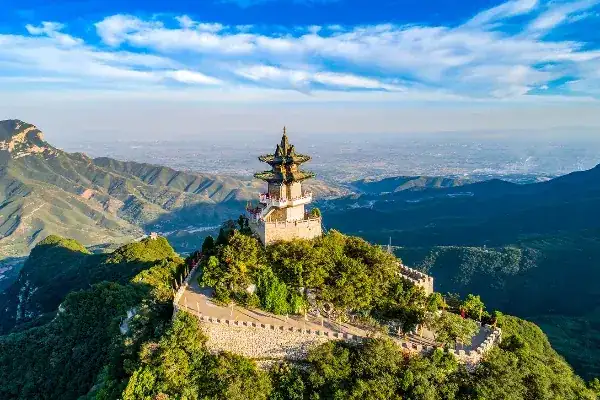
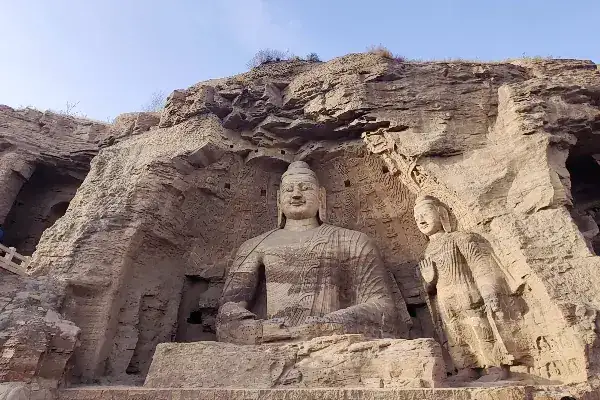
Major parks include Nanshan Park, Taohe Park, Beishan Park, Yangquan Botanical Garden, and City Center Park. Historical sites include the Spring and Autumn period Zhao Jianzi ancient city ruins, Han Dynasty Han Xin military camp site, and Tang Dynasty Princess Pingyang's Niangziguan garrison. Dongfu Mountain in southern Pingding is traditionally associated with Nuwa mending the sky. Zangshan Mountain, 60 kilometers north of the city, is traditionally associated with the Orphan of Zhao hiding there during the Spring and Autumn period. The city also preserves Northern Wei grottoes, Northern-Southern Dynasties cliff carvings, Song Dynasty Guandi Temple, and Jin-Yuan architectural complexes.
The Hundred Regiments Offensive memorial on Shinao Mountain features a 40-meter monument shaped like a sharp bayonet, inscribed with calligraphy by Peng Zhen, Xu Xiangqian, and Bo Yibo. Other attractions include Liangjia Hot Springs, Yaolin Temple, Niangziguan Waterfall, and the Lianhua and Wuhua karst caves.
Famous Specialties
Yuxian walnut mooncakes, Pingding sand pots, and Yangquan noodles are notable local specialties.
Famous Figures
Honorary Titles
Travel information can change. Check current opening hours, reservations and entry requirements before you travel.

Traveller discussion
Start the conversation with a helpful tip or a question.