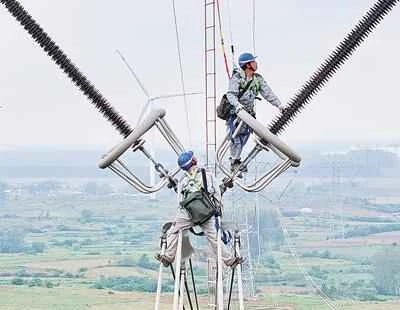
In Liuxiang Town, Chuzhou City, Anhui Province, maintenance workers are conducting inspections at a height of over 100 meters to ensure the safe and stable operation of the ultra-high-voltage power transmission line connecting the West and East China. (Photo by Song Weixing/Image China)

At a training course for new farmers engaged in e-commerce held in Renshou County, Meishan City, Sichuan Province, instructors guide trainees. (Photo by Pan Shuai/Visual China)
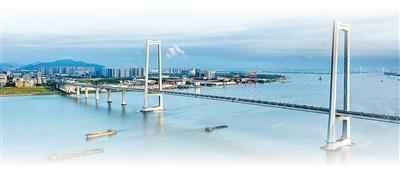
A view of the Shenzhen-Zhongshan Bridge from Zhongshan City, Guangdong Province. Photo by Liu Guoxing (Image China)
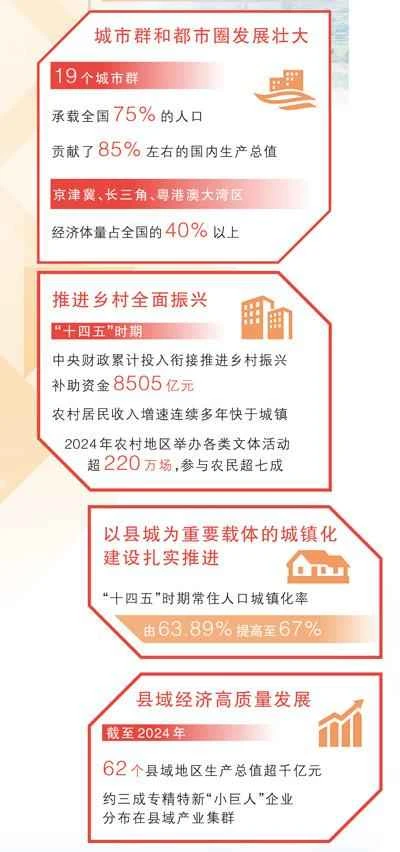
Data source: National Bureau of Statistics, etc.
Coordinated regional development is an inherent requirement of Chinese-style modernization.
General Secretary Xi Jinping emphasized that "only by achieving coordinated development between urban and rural areas and between regions can the domestic economic cycle have a broader scope and a more substantial quality."
The Central Economic Work Conference proposed to "adhere to coordinated development and promote urban-rural integration and regional cooperation."
All regions and departments have thoroughly implemented the spirit of General Secretary Xi Jinping's important speech and the spirit of the Central Economic Work Conference, and have deeply implemented the regional coordinated development strategy, the major regional strategy, and the main functional area strategy. They have leveraged the advantages of the superposition of multiple national development strategies, coordinated the urbanization construction with county towns as the important carriers and the comprehensive revitalization of rural areas, and accelerated the construction of a regional economic pattern with complementary advantages and high-quality development.
"Hard connectivity" and "soft connectivity" support in-depth collaboration among key city clusters
Looking across China, in the Yangtze River Delta, all the necessary components for new energy vehicles can be supplied within a 4-hour drive; in the central region, major transportation corridors and hubs are under construction, and industries such as quantum technology, memory chips, and construction machinery are showing strong momentum; in the northeastern region, tangible results have been achieved in coordinating the transformation and development of resource-based areas…
Behind the new space for China's economic development lies a grand strategy of coordinated regional development.
"Hard connectivity" is being accelerated.
A series of inter-regional and inter-basin transportation corridors support the "skeleton" of regional coordinated development. Currently, regions such as Beijing-Tianjin-Hebei, the Yangtze River Delta, and the Guangdong-Hong Kong-Macao Greater Bay Area have formed a 1- to 2-hour transportation circle. The main framework of the "6 axes, 7 corridors, and 8 channels" national comprehensive three-dimensional transportation network has been basically completed, serving about 90% of the country's total economy and population... Connecting east and west and running north and south, "mobile China" is surging with momentum.
"Soft connectivity" continues to expand.
Henan, Shanxi, and Shaanxi provinces signed the "Horizontal Ecological Protection Compensation Agreement for the Yellow River Basin (Henan-Shanxi-Shaanxi Section)," marking a new stage in collaborative governance; at the 15th National Games, the 231.8-kilometer road cycling race spanned the Guangdong-Hong Kong-Macao Greater Bay Area, witnessing the new development of the world-class bay area... Looking at the overall picture, various regions are accelerating the co-construction and sharing of public services, and continuously breaking down administrative barriers and institutional obstacles that restrict collaborative development.
In early December 2025, the first national-level territorial spatial plan for the Yangtze River Delta region was launched. "This marks a substantial breakthrough in the integration of the Yangtze River Delta urban agglomeration," said Wang Shuhua, vice president of the Regional Modernization Research Institute of the Jiangsu Academy of Social Sciences.
The Central Economic Work Conference proposed to "strengthen coordination and collaboration among key urban clusters and deepen cross-administrative region cooperation."
Currently, my country's 19 city clusters house 75% of the country's population and contribute approximately 85% of its GDP, with Chinese cities continuously enhancing their global influence and competitiveness. The Beijing-Tianjin-Hebei region, the Yangtze River Delta, and the Guangdong-Hong Kong-Macao Greater Bay Area have become important driving forces for leading high-quality development across the country.
Looking ahead to the 15th Five-Year Plan, Henan is focusing on its strategic positioning as "three bases and one hub" and improving inter-provincial cooperation mechanisms; Shandong is strengthening exchanges and cooperation with central cities and urban clusters along the Yellow River; Guangdong is launching more "Greater Bay Area standards" and "Greater Bay Area certifications" to enhance the level of market integration in the Greater Bay Area... With urban clusters as an important carrier, we are promoting multi-field linkage and interconnection, efficient collaboration between innovation chains and industrial chains, and pushing regional coordinated development to a higher level.
A strong agricultural sector, beautiful countryside, and prosperous farmers—the pace of agricultural and rural modernization is accelerating.
my country has a population of over 1.4 billion, with more than 900 million living in urban areas and nearly 500 million in rural areas.
The modernization of agriculture and rural areas is crucial to the overall situation and quality of China's modernization. The Central Economic Work Conference proposed to "unwaveringly focus on grain production" and "continuously consolidate and expand the achievements in poverty alleviation."
With a focus on prioritizing agricultural and rural development, profound changes are taking place in the vast countryside.
The agricultural supply chain is more resilient.
Looking back on the past year's bumper harvest, despite the impact of disasters such as spring drought, high temperatures and drought, and continuous rain in autumn, my country's total grain output has once again achieved a high level of growth, with the average yield per mu increasing by 4.4 kg.
The stability of food security is not only due to the improvement of total factor productivity brought about by good farmland, good seeds, good machinery, and good methods, but also to the enhanced quality and efficiency of agriculture brought about by the integration of grain production and food processing, and the integration of agriculture and industry, which makes the foundation of food security increasingly solid.
In Yanjin County, Henan Province, a 10 billion yuan industrial cluster has emerged around wheat, encompassing grain, oil, and flour products, baked and puffed foods, and frozen snacks. In Suihua City, Heilongjiang Province, there are more than 40 kinds of corn bio-fermentation products, with an annual processing capacity of nearly 20 billion jin. Industrialization has enabled more major grain-producing areas to say goodbye to being "value depressions".
Rural areas have better living and production conditions.
In terms of "appearance", the national rural sanitary toilet coverage rate has reached about 76%, the proportion of administrative villages where domestic waste is collected and disposed of has remained stable at over 90%, the 5G coverage rate of administrative villages exceeds 90%, and infrastructure such as water, electricity, roads, gas, and telecommunications continues to extend to villages and households.
Looking at the overall atmosphere, village-based activities such as village-wide cultural events, village songs, and village galas are vibrant and diverse. In 2024, over 70% of farmers participated in cultural and sports activities, and rural civility continues to flourish.
The 15th Five-Year Plan proposed "promoting rural revitalization in a categorized and orderly manner, and in a regionalized manner" and "creating high-quality living spaces in rural areas." "my country's rural areas have significant regional differences, requiring a more detailed classification of villages based on local conditions. Adopting a regionalized approach is conducive to breaking through the bottlenecks and natural limitations of single-village development, generating comprehensive effects in many aspects," said Wei Houkai, a member of the Chinese Academy of Social Sciences and a researcher at the Institute of Rural Development.
The foundation for common prosperity has become more solid.
2025 will be the final year of the five-year transition period established by the Central Committee of the Communist Party of China after the complete victory in the battle against poverty. The government, society, and the market will work together to continuously strengthen the foundation for development in poverty-stricken areas.
In Kuido Town, Jiulong County, Sichuan Province, the tea industry has achieved quality and efficiency improvements with the counterpart assistance from Xihu District, Hangzhou City, Zhejiang Province. "The East-West cooperation brings far more than just sales channels; it also brings advanced business and development concepts," said Qin Xiuzhen, Secretary of the Party Committee of Kuido Town. Relying on the interaction of "industrial park becoming a scenic spot, scenic spot becoming an industrial park, and industrial park becoming a business," the town is accelerating the creation of a new route for modern homestays and ecological tea garden sightseeing.
Since the transition period began, the per capita disposable income of rural residents in poverty-stricken counties across the country has increased by an average of 7.8% annually in real terms, which is 0.9 percentage points higher than the national average annual growth rate in rural areas.
According to relevant officials from the Ministry of Agriculture and Rural Affairs, during the 15th Five-Year Plan period, the government will adhere to the principle of "major stability and minor adjustments," persist in implementing precise policies, and incorporate routine assistance into the overall implementation of the rural revitalization strategy to ensure that the bottom line of preventing large-scale relapse into poverty is firmly maintained.
Developing industries, strengthening the county, and enriching the people, the county's role as a hub connecting urban and rural areas continues to be highlighted.
Counties, the junction of urban and rural areas, are also the basic units for economic and social development.
The Central Economic Work Conference proposed to "coordinate the urbanization process with county towns as the main carriers and the comprehensive revitalization of rural areas, and promote the high-quality development of county-level economies."
By using industry to supplement agriculture, the county's development capacity has been continuously upgraded.
In Jiangkou County, Guizhou Province, the matcha refining production line in the Guizhou Tea Industrial Park is operating at high efficiency. "From January to November 2025, the company's matcha production and sales volume exceeded 2,150 tons, with an output value of over 460 million yuan," said a relevant person in charge of Guizhou Tea Group.
The "2025 Research on High-Quality Development of County Economy in China" shows that the scale of county economy across the country continues to grow. In 2024, the number of counties with a GDP exceeding 100 billion yuan increased to 62, and the number of counties with a GDP exceeding 90 billion yuan reached 21.
Shaodong City in Hunan Province is focusing on strengthening six major industrial chains, including light industry, new energy, and big data, with its lighter industry being selected as a national-level characteristic industrial cluster for small and medium-sized enterprises. Liuba County in Shaanxi Province, aiming to become a well-known domestic tourist destination, is connecting the most beautiful homestays in the Qinling Mountains, the most beautiful towns in the Qinling Mountains, and the Yingpan Football Town…
Develop industries where suitable, agriculture where suitable, commerce where suitable, and tourism where suitable; each small but beautiful county has forged its own unique development path.
With cities leading the way to rural areas, the "roads" between urban and rural areas are smooth and unobstructed.
With the implementation of a new round of urbanization initiatives for rural migrants, various regions are improving policy support in multiple areas, including residency requirements, education for accompanying children, and employment training, to ensure that rural migrants can stay and thrive in cities and enhance their sense of belonging.
Data shows that by the end of 2024, my country's urbanization rate of permanent residents reached 67%, and the urbanization rate continued to increase; by the end of 2025, more than 90% of counties had established closely integrated county-level medical consortia... With the downward flow of various resources and services, the functions of counties, townships and villages are organically connected and complementary, the comprehensive carrying capacity of counties is constantly improving, and vitality and momentum are continuously being released.
The blueprint has been drawn, and now is the time to forge ahead. By adhering to systematic thinking, comprehensively promoting coordinated development between urban and rural areas and between different regions, further smoothing the industrial-agricultural-urban-rural cycle, and continuously enhancing economic resilience and strategic depth, we will surely accumulate powerful momentum for realizing Chinese-style modernization.


