"To leave a beautiful homeland with blue skies, green land, and clear water for future generations."
Gobi deserts, rivers and lakes, high mountains and dense forests... On the vast land of our motherland, ecological guardians measure the green mountains and clear waters with their footsteps, protect the coexistence of all things with their original aspirations, deeply implement General Secretary Xi Jinping's earnest instructions, and use their own strength to make their homeland more and more beautiful.
The "Green Great Wall" of Shali
At 6 a.m. in Babusha, before dawn, the wind from the Hexi Corridor stung my face.
Guo Wangang, who is over 70 years old, is wearing rubber shoes and walking on the sand ridge with uneven steps.
A recent snowfall draped the yellow sand in a silver cloak. He gently brushed the snow off the branches of a saxaul tree, his eyes filled with affection; these were trees he had planted himself. "The snow is good; the soil moisture will be better next year, and we can plant even more trees."
On August 21, 2019, General Secretary Xi Jinping visited the Babusha Forest Farm. "At that time, we were carrying out 'grass checkerboard sand stabilization' operations. The General Secretary came over, asked us about the operation methods, and even picked up a ditching plow and worked with us," said Guo Wangang.
Babusha is the largest wind-blown sand area in Gulang County, Wuwei City, Gansu Province. Guo Wangang, the Party Branch Secretary of the forest farm, told the General Secretary that three generations of forest farm workers have completed more than 200,000 mu of afforestation and sand control. The General Secretary earnestly instructed: "We must continue to carry forward the spirit of the 'Six Old Men,' a contemporary version of the Foolish Old Man Who Moved Mountains, and promote their enterprising spirit of never giving up in the face of difficulties and daring to turn the desert into an oasis. We must make persistent efforts, achieve new successes, and persevere to make the green Great Wall indestructible."
"The General Secretary's words have strengthened our resolve to be like the Foolish Old Man Who Moved Mountains, digging shovel by shovel and working generation after generation!" Guo Wangang said.
Bearing in mind the General Secretary's instructions, Guo Wangang and his team have never stopped their efforts in combating desertification. Building on the significant achievements in the treatment of Babusha, Guo Wangang has led his team to continuously advance into the northern sandy areas of Gulang County over the years. By the end of 2019, the three major wind erosion areas of Heigangsha, Dachaosha, and Momisha had been completely contained; in 2023, they moved further north, turning 157,500 mu of desertified land in Mahuangtang green; and in 2024, the initial treatment of all 2.39 million mu of desertified land in Gulang County was completed, and they then extended their efforts to Zhangye, Jinchang, and Baiyin by setting up checkerboard barriers.
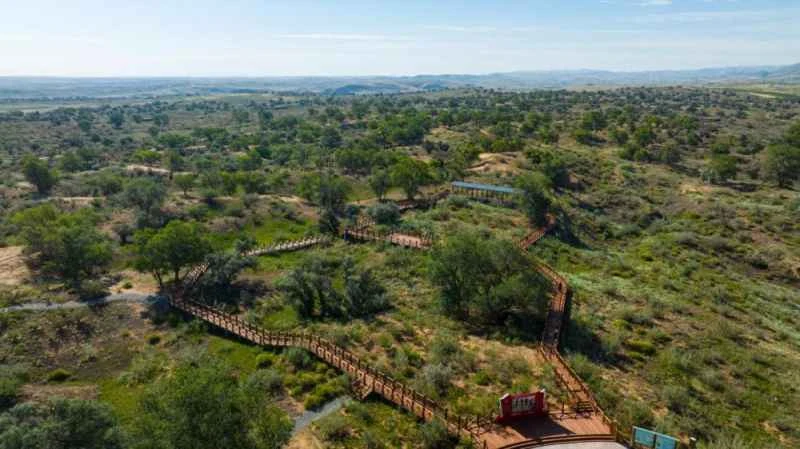
This photo, taken on July 22, 2025, shows the Babusha Forest Farm in Gulang County, Wuwei City. (Photo provided by Wuwei City Media Convergence Center)
Guo Wangang also called his nephew back. "Young people have quick minds and understand new technologies. We introduced drones, hole diggers, and hay buffers, which increased efficiency several times over!"
They also registered an account called "Babusha Forest Farm" on a short video platform to showcase the desertification control efforts and the changes in the forest farm, attracting the attention of netizens and social welfare organizations. Like trickling streams, new greenery is sprouting, more young people are joining the forest farm, and netizens across the country have started "cloud tree planting," ushering Gulang's desertification control efforts into the "information age."
As the sandstorms receded, the forest farm developed its understory economy. They formed a cooperative with surrounding farmers, raising free-range chickens and grafting Cistanche deserticola onto the saxaul trees, thus controlling desertification and increasing their income. "The villagers have benefited from the desert, and their enthusiasm for afforestation and greening is even higher," said Guo Wangang.
Despite his advanced age, Guo Wangang still comes to Babusha every day before dawn, regardless of the weather, to check for fire prevention, care for saplings, and prune branches...
"This spring, another batch of new seedlings will be planted," he said, gazing at the boundless forest.
Rare treasures along the riverbank
The Three Gorges Dam area in Hubei Province is characterized by high gorges and a vast, tranquil lake.
On a small island in the Tongzhuang River in Zigui County, Yichang City, Huang Guiyun, deputy director of the Yangtze River Biodiversity Research Center of the Three Gorges Group, bent down to carefully examine each plant of *Plantaina fengduensis*. This rare plant, which was nearly extinct due to being submerged by the reservoir, has been rescued and protected by Huang Guiyun's team. The number of plants has increased from the initial 10 to nearly 10,000, and it was successfully reintroduced into the wild in March 2024.
Seeing the thriving growth of the plantain in Fengdu, Huang Guiyun felt a little more at ease.
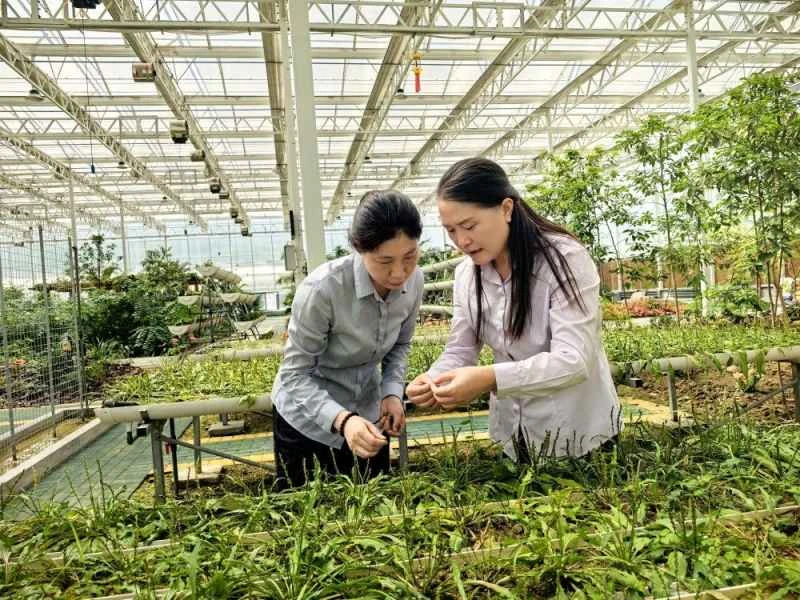
In September 2025, Huang Guiyun (first from right) and researchers inspected the growth of space-bred *Plantago asiatica* from Fengdu. (Photo by Yang Lanfang)
Walking along the riverbank, Huang Guiyun often recalls what General Secretary Xi Jinping said to her during his inspection of the left bank of the Three Gorges Dam in April 2018: "Your work is very meaningful and will benefit future generations."
The General Secretary's affirmation deeply moved Huang Guiyun, who has dedicated over 30 years to the rescue and protection of rare plants along the Yangtze River. She felt that all those years had been worthwhile. She promised the General Secretary that by the end of the 13th Five-Year Plan period, they would be protecting 1,000 unique and rare plant species.
Today, this number has reached 2,130 species and 32,000 plants.
"We have increased our protection efforts, extending the protection area from the Three Gorges to the Jinsha River," Huang Guiyun told reporters. In 2022, they built a 400,000-square-meter rare plant garden at the Xiangjiaba Hydropower Station on the upper reaches of the Yangtze River. Together with the 1 million-square-meter base in the Three Gorges Dam area, it forms the largest conservation base for rare and unique plants in the Yangtze River Basin in China.
"Mountains, rivers, forests, fields, lakes, grasslands, and deserts form a community of life. The ultimate goal of protection is to allow rare species with hundreds of millions of years of history to return to the Yangtze River and play a role in ecological restoration," said Huang Guiyun.
In recent years, Huang Guiyun's team has been selecting suitable species for artificial breeding and reintroduction into the wild in ecologically fragile areas such as high slopes and drawdown zones in the reservoir area. Fengdu plantain is one of the successful cases.
"In 2021, we sent 4,000 seeds of *Plantago asiatica* from Fengdu into space, using space-induced mutation breeding technology to improve its survival rate." Huang Guiyun's team has reintroduced over 63,000 unique and rare plant resources, including *Plantago asiatica*, *Myrica rubra*, and *Davidia involucrata*, into the reservoir area and even the entire Yangtze River basin, achieving full afforestation coverage in the Three Gorges Reservoir area. To date, all the plants potentially affected mentioned in the Three Gorges Project environmental impact report have been effectively protected, and none have become extinct.
"For the long term and for the benefit of future generations, this is what I have been striving to do, keeping in mind the General Secretary's instructions." Right now, Huang Guiyun and her colleagues are working tirelessly on geological surveys. "This year, we are going to build a modern seed bank, with an initial investment of 50 million yuan. It will be able to preserve 90,000 seed samples for more than 30 years, and the last piece of the puzzle in the protection of rare plants in the Yangtze River will be filled!"
The picturesque landscape in the forest
Under the warm winter sun, the Jinxi River in Changkou Village, Jianle County, Sanming City, Fujian Province, shimmers with golden light, with lush green mountains on both banks, and kayaks occasionally gliding across the tranquil water.
“Every year, water sports teams from the north come here for winter training!” Zhang Linshun, secretary of the Party Committee of Changkou Joint Village, told reporters on the riverbank.
From a poor village deep in the mountains of northwestern Fujian to a "star village" that receives more than 100,000 tourists annually, Zhang Linshun said, "The great changes in Changkou Village are due to General Secretary Xi Jinping's concern and entrustment over the past 20 years."
Back in April 1997, when Xi Jinping, then Deputy Secretary of the Fujian Provincial Party Committee, visited Changkou Village, he said, "Green mountains and clear waters are priceless treasures. Mountainous areas should create beautiful landscapes and make the most of their natural resources." Zhang Linshun, who was present at the scene, kept the instruction to "protect the ecology" in mind.
During the 2019 National People's Congress and the Chinese People's Political Consultative Conference (NPC & CPPCC) sessions, Zhang Linshun, a deputy to the NPC, met with General Secretary Xi Jinping again. The General Secretary inquired in detail about the environmental sanitation improvement and toilet renovation in Changkou Village, and earnestly said that to accelerate the development of old revolutionary base areas, we must have a long-term vision and do more to coordinate and promote economic development and ecological protection.
"The General Secretary's earnest teachings have once again pointed out the direction for the development of Changkou Village," said Zhang Linshun. They carefully considered the "mountains, rivers, and fields" as their guiding principles and embarked on a "diversified transformation" amidst the green mountains and clear waters.
Protecting the Mountains – Deepening the reform of the collective forest tenure system and implementing carbon sequestration afforestation through "village-enterprise cooperation." In May 2021, Changkou Village received the nation's first forestry carbon ticket. "It involves 3,197 mu of ecological public welfare forest in the village, with a calculated carbon emission reduction of 12,723 tons, which sold for about 140,000 yuan. The whole village, young and old, happily received dividends. Nobody expected that they could make money without cutting down trees!" Zhang Linshun said with a smile.
Water management – To protect the clear water in front of the village, Changkou Village implemented rural domestic sewage treatment, simultaneously burying power and communication lines underground and connecting natural gas, and ensuring that every household has access to clean water toilets; it also developed projects such as Yunqushan rafting and Changshang Lake sightseeing bamboo rafting, built a kayaking training base, and hosted national-level competitions, resulting in significant benefits from the "beautiful water economy".
Enriching the "Fields" - In 2019, Changkou Village transferred 800 mu of land to plant navel oranges. The golden fruits hanging from the branches bring the village a sweet income of 1.3 million yuan every year. In the more remote mountains, Chinese medicinal herbs such as Polygonatum odoratum and Dendrobium officinale are quietly growing.
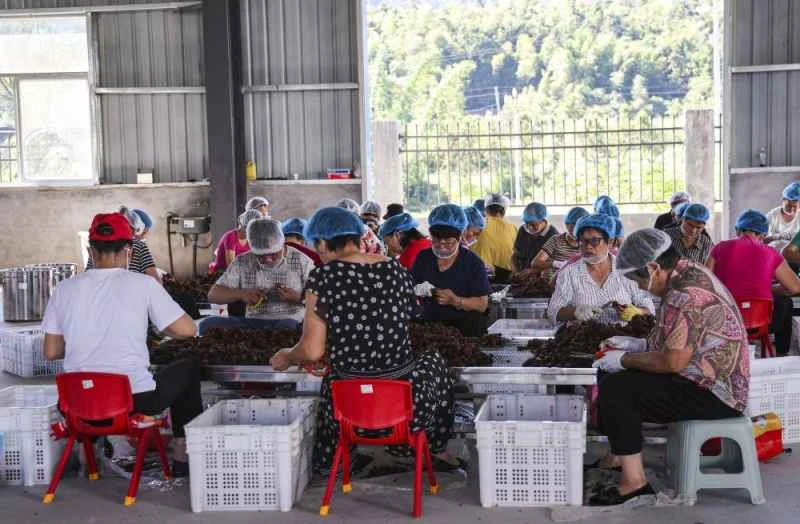
On September 17, 2025, villagers from Changkou Village cleaned Polygonatum sibiricum at a Polygonatum sibiricum processing plant. (Photo by Dong Guansheng)
Zhang Linshun said that more and more people are coming to the village for tourism, competitions, and study tours. Villagers have started characteristic homestays and local restaurants, so they can have work and earn money right at their doorstep.
Changkou Village, which has undergone a complete transformation, has also formed a joint village party committee with five surrounding villages to achieve coordinated governance and joint development of industries.
Looking ahead to the new year, Zhang Linshun is full of expectations: "This year, the Provincial Games will be held in Sanming City. We will take this opportunity to build a water sports center, upgrade the rafting project, and develop 'day tour + night tour' routes... We must not only make a living from ecological resources, but also hold onto our ecological resources firmly, and make our 'mountain, water and field' resources even more wonderful!"
If people cherish the green mountains, the green mountains will surely reward them. Ecological guardians, bearing in mind the General Secretary's instructions, have poured their sweat and toil into creating a green landscape, protecting our harmonious home. Where the spring breeze blows, a vibrant scene of life will surely unfold once more.
Lead reporter: Liu Ziling
Text reporters: Ma Lijuan, Zhang Rui, Li Siyuan, Lin Kai
Planning: Zhang Xiaosong
Editor-in-Chief: Jiang Xiao
Coordinated by: Leng Yanyan, Sun Suying
Poster design: Hu Ge
Produced by Xinhua News Agency Domestic Department


