
Hainan
HainanCity OverviewHainan, China’s southernmost provincial-level administrative region, is entirely located on the continental shelf of the South China Sea. Its main landmass is Hainan Island, the second-largest island in China after Taiwan
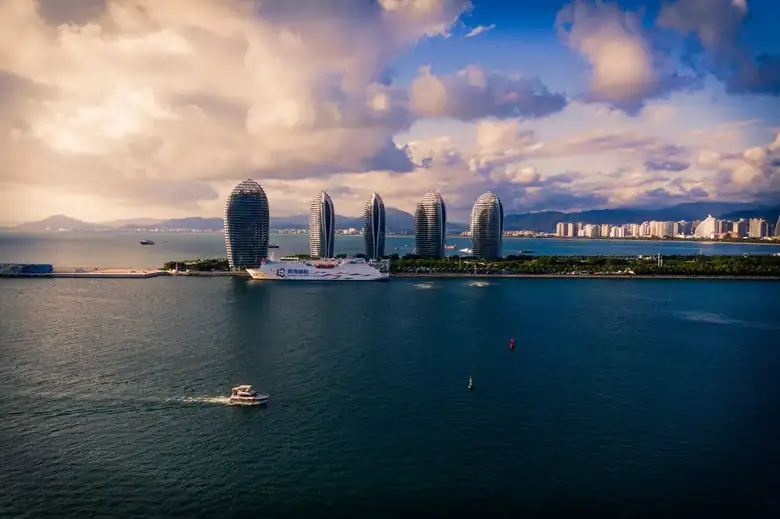
Hainan
City Overview
Hainan, China’s southernmost provincial-level administrative region, is entirely located on the continental shelf of the South China Sea. Its main landmass is Hainan Island, the second-largest island in China after Taiwan Island. The island has an elliptical shape stretching from northeast to southwest, with a long axis of approximately 290 kilometers and a short axis of about 180 kilometers, covering a total area of roughly 35,400 square kilometers. To the north, it faces the Leizhou Peninsula across the Qiongzhou Strait, which narrows to only 18 nautical miles at its narrowest point. To the west lies the Beibu Gulf, across from Vietnam, while the east and south open toward the vast South China Sea. Hainan administers approximately 2 million square kilometers of surrounding maritime territory.
The island’s terrain displays a clear stepped structure. The central region consists of uplifted mountainous areas, with Mount Wuzhi (1,867 meters above sea level) as the highest peak. Mountain ranges such as Yinggeling and Limu Mountain extend radially toward the coast. Surrounding these are rolling hills and plateaus, followed by coastal plains encircling the island, creating a geographic pattern of higher terrain in the center and lower terrain around the edges. The Nandu River, Changhua River, and Wanquan River are the island’s three major river systems. All originate in the central mountains and flow outward into the sea, collectively nurturing the island-encircling lifeline corridors.
As of the end of 2023, Hainan Province had a permanent resident population of approximately 10.27 million. The Han ethnic group accounts for around 83%, while ethnic minorities including the Li, Miao, and Hui peoples account for approximately 17%. The Li people are the earliest inhabitants of Hainan and the largest ethnic minority group on the island, with a population of about 1.5 million, mainly concentrated in the central and southern mountainous regions. Hainan Province administers four prefecture-level cities (Haikou, Sanya, Sansha, and Danzhou), five county-level cities, four counties, and six autonomous counties, with Haikou serving as the provincial capital.
Hainan’s administrative status has undergone several transformations. In 1988, it was separated from Guangdong Province and established as an independent province, while simultaneously being designated as China’s largest special economic zone. This unique dual identity of “province + special economic zone” has continued to this day. In 2018, Hainan received a new strategic mission: the construction of a province-wide pilot free trade zone and exploration of a free trade port with Chinese characteristics, making it a new landmark in China’s reform and opening-up era.
Hainan has many poetic nicknames. “Qiong” is its official abbreviation, derived from Qiongzhou, which was established here during the Tang Dynasty. The Song Dynasty’s Gazetteer of Qiongzhou Prefecture recorded that the name came from Qiong Mountain. The character “琼” originally means “beautiful jade,” perfectly capturing the image of this southern island paradise. “Coconut Island” refers to the countless coconut palms that grow across the island, embodying its tropical scenery. “The Hawaii of the East” is a global compliment to its tropical scenery, while names such as “Sunshine Island,” “Longevity Island,” and “Ecological Island” reflect its climate, livability, and natural environment. In ancient pre-Qin texts, Hainan was also known as “Dan’er” and “Zhuya,” reflecting how ancient Chinese people perceived and imagined this distant frontier.
The urban structure of Hainan features a distinctive dual-core development pattern. Haikou, located at the northern tip of the island, serves as the province’s political, economic, cultural, and transportation center, functioning as the primary gateway connecting Hainan with mainland China. Its GDP has long ranked first among cities in the province. Sanya, located at the southernmost point of the island, is an internationally renowned tropical coastal tourism city, famous for its high-end resort industry and serving as a showcase of Hainan’s international image.
In recent years, Danzhou (including the Yangpu Economic Development Zone) has rapidly emerged as an important western regional center. Positioned as an industrial pioneer of the Hainan Free Trade Port and a western hub city, it plays a key role in port logistics, petrochemicals, and advanced materials industries. Qionghai on the eastern coast, home to the permanent venue of the Boao Forum for Asia, and Wanning, known as a surfing destination and hometown of overseas Chinese, respectively serve international conference hosting and emerging tourism development. The central mountainous areas, including Wuzhishan and Qiongzhong, focus on ecological conservation and ethnic cultural preservation, forming Hainan’s “green lungs” and “cultural roots.” This functional division of “coastal development and central protection” clearly outlines the province’s economic landscape.
Historical Development
The formation of Hainan Island can be traced back approximately 80 million years to the Yanshanian Movement, when crustal fractures and volcanic activity caused it to separate from the Leizhou Peninsula and become an independent island. Human activity on this land began in the late Neolithic period. Archaeological discoveries indicate that around 6,000–7,000 years ago, the ancestors of the Li people crossed the sea from the Guangxi and Guangdong regions and became the earliest inhabitants of Hainan. They left traces of ancient human activity at sites such as Luobi Cave in Sanya and Shigong Archaeological Site in Lingshui.
In the first year of Emperor Wu of Han’s Yuanfeng era (110 BC), the Han Dynasty defeated Nanyue and established the Zhuya and Dan’er commanderies on Hainan Island, officially incorporating the island into the administrative territory of the central dynasty. This marked the beginning of Hainan’s recorded history.
During the Han and Tang dynasties, Hainan entered a period characterized by frontier governance and indirect administration. Control by central governments was intermittent due to the island’s remote location, humid tropical climate, and prevalence of disease, causing Hainan to be regarded for centuries as a place of exile and banishment by dynastic China. In 607 AD, during the Sui Dynasty, Yazhou was renamed Zhuya Commandery. In 622 AD, during the Tang Dynasty, the Yazhou Governor’s Office was formally established to administer the entire island.
Many notable officials were exiled to Hainan during the Tang Dynasty, among whom the most famous was Chancellor Li Deyu, who was banished to serve as a minor official in Yazhou. He left behind the sorrowful verse: “Alone I climb the tower and gaze toward the imperial capital; even birds would need half a year to fly there.” The culture of exile during this period objectively contributed to the spread of Central Plains culture throughout Hainan.
The Song and Yuan dynasties marked an accelerated period of development for Hainan. In 971 AD, during the Northern Song Dynasty, Hainan was divided into five prefectures: Qiongzhou, Yazhou, Danzhou, Wanzhou, and Zhenzhou. The great writer Su Shi (Su Dongpo) was exiled to Danzhou in 1097 during the Shaosheng era. There, he established schools, taught students, promoted agricultural techniques, and developed wells, greatly advancing local education and cultural development. His farewell poem, “I was originally a man of Dan’er, living temporarily in western Shu,” reveals his deep emotional connection to the land.
During the Yuan Dynasty, Hainan was placed under the Qiongzhou Pacification Office of the Haibei-Hainan Circuit, strengthening its connection with mainland China. Notably, Song Dynasty officials such as Li Gang, Zhao Ding, and Hu Quan were also exiled to Hainan, making the region a symbolic spiritual center for the Southern Song resistance movement. Haikou still preserves historical sites commemorating these figures, including the Five Officials Temple and Su Gong Temple.
The Ming and Qing dynasties marked a period when Hainan became more deeply integrated into the Chinese administrative and cultural system. In 1368, the first year of the Hongwu era of the Ming Dynasty, Qiongzhou Prefecture was established in Hainan, governing three prefectures and ten counties, with its administrative seat located in Haikou. During this period, education and culture flourished, producing nationally influential figures such as Qiu Jun and Hai Rui.
Qiu Jun served as a Grand Secretary of the Wenyuan Pavilion and wrote Supplement to the Extended Meaning of the Great Learning, becoming an important Ming Dynasty politician and economist. Hai Rui became famous throughout China for his integrity and fearless opposition to corruption, earning the title “Hai Qingtian (the Incorruptible).” In the late Qing Dynasty, in 1858, the Treaty of Tianjin designated Qiongzhou (Haikou) as a treaty port. Western merchants and missionaries gradually entered the region, and arcade-style buildings began appearing in Haikou’s Deshengsha area, marking the arrival of modern civilization.
Since modern times, Hainan has undergone dramatic transformation from isolation toward openness. From 1939 to 1945, the Japanese army occupied Hainan and carried out extensive exploitation of the island’s mineral resources, while constructing railways connecting Shilu to Basuo and Tiandu to Sanya. In May 1950, the People’s Liberation Army launched the Hainan Island Campaign and liberated the island. The Hainan Administrative Office was subsequently placed under Guangdong Province.
On April 13, 1988, the Seventh National People’s Congress approved the establishment of Hainan Province by abolishing the former Hainan Administrative Region, while simultaneously designating Hainan Island as a special economic zone. This decision transformed Hainan from a national defense frontier into a forefront of China’s reform and opening-up movement. In April 2018, the central government announced support for building a province-wide pilot free trade zone in Hainan and gradually developing a free trade port with Chinese characteristics, opening a new chapter in the island’s history.
Cultural Heritage
Hainan’s cultural identity has been shaped by the layering and interaction of multiple civilizations. It preserves the ancient heritage of the Baiyue ethnic groups, incorporates the profound influence of Han Chinese culture from the Central Plains, and embraces the openness of maritime civilization, forming a distinctive island cultural character.
The dialect landscape within Hainan is highly complex and diverse, often described as “different sounds every ten miles.” The most widely spoken dialect is Hainanese (also known as Qiong dialect), which belongs to the Hainan branch of the Southern Min language family. With approximately 5 million speakers, it is widely distributed across coastal plains and urban areas and serves as the most common dialect throughout the province. In addition, Danzhou dialect (belonging to the Cantonese language family) is spoken in western Danzhou, while Mai dialect (a branch of Hakka) is scattered across parts of central and western Hainan. Jun dialect (a variant of Northern Mandarin left behind by military settlements during the Ming Dynasty) is preserved in areas such as Yazhou in Sanya and Changjiang. Lingao dialect and Cun dialect belong to the Zhuang-Dong language family and are independent languages closely related to Li languages. Among the Li people, five major dialect groups — Ha, Qi, Run, Sai, and Meifu — each maintain their own linguistic systems. This extraordinary linguistic diversity serves as the strongest evidence of Hainan’s rich history of migration and cultural integration.
In terms of folk traditions, the Third Day of the Third Lunar Month Festival of the Li people is the most iconic regional celebration. Every year on the third day of the third month of the lunar calendar, Li men and women wear traditional tubular skirts, gather for antiphonal singing, swing on swings, enjoy five-colored rice, and hold ceremonies honoring their legendary ancestor Polong Kui. The festival has been included in China’s national intangible cultural heritage list.
The Han Chinese Junpo Festival (also known as Gongqi Festival) is another unique collective celebration in Hainan. Held from the sixth to the twelfth days of the second lunar month, it commemorates Lady Xian, a female military leader and heroine from the Northern and Southern Dynasties period. Villages and towns take turns hosting grand celebrations known as “celebrating the Junpo,” featuring thrilling performances such as climbing blade ladders, walking through fire, and piercing the body with poles. These customs reflect deep-rooted folk beliefs and strong local identity. Hainan’s marriage and funeral traditions also preserve many elements of southern Fujian culture, including wedding rituals such as “arranging the bridal bed,” “hair-pinning ceremony,” and “scattering grain,” as well as funeral practices such as the “seven-day memorials” and “second-year remembrance ceremonies,” reflecting the Confucian value of honoring ancestors and showing respect for the deceased.
Hainan is the birthplace of Qiong Opera, one of China’s major traditional opera forms. Also known as “Hainan Opera,” it is performed in the Hainanese dialect and originated during the late Ming and early Qing dynasties. It combines elements of Southern Fujian opera, Cantonese opera, Chaozhou opera, and local folk songs. Traditional works include Writing a Poem on Red Leaves, The Dog Carrying the Golden Hairpin, and Zhang Wenxiu. With graceful melodies and delicate performances, Qiong Opera reflects the aesthetic preferences of Hainan’s people. In addition, Lingao puppet theater, Danzhou folk antiphonal singing, and Yazhou folk songs are all recognized as national intangible cultural heritage items, each preserving the cultural memories of different communities and regions.
In the field of traditional arts and crafts, the traditional spinning, dyeing, weaving, and embroidery techniques of the Li people are undoubtedly one of Hainan’s greatest cultural treasures. With a history of more than 3,000 years, this craft involves four major processes: spinning, dyeing, weaving, and embroidery. Using waist looms, Li women create Li brocade featuring exquisite patterns and vivid colors. Its designs are based on human figures, animals, and plants, and it is often described as “the oracle bone inscriptions of Hainan Island”. In 2009, this tradition was inscribed by UNESCO on the List of Intangible Cultural Heritage in Need of Urgent Safeguarding.
Hainan rosewood (Dalbergia odorifera) is another globally renowned cultural symbol. With its fine texture and magnificent grain patterns, it has been a preferred material for imperial furniture since the Ming and Qing dynasties. Today, due to its extreme rarity, it has become one of the most treasured materials in the world of collecting.
As of 2023, Hainan Province had 32 national-level intangible cultural heritage items and 82 provincial-level intangible cultural heritage items, covering ten major categories including traditional music, dance, theater, and folk customs. Yazhou folk songs in Sanya, Danzhou folk singing, Qiong Opera in Ding’an, and Li bamboo and wood musical instruments in Baoting together form a vibrant and diverse cultural landscape.
Architecture and Urban Landscapes
Traditional architecture in Hainan has been shaped by three major forces: climate, local materials, and cultural influences, resulting in a distinctive tropical island architectural style. The Li people’s boat-shaped thatched houses (also known as “Longgui”) represent the earliest form of local architecture. Inspired by the shape of an overturned boat, these structures use bamboo and wood as frameworks with thatched roofs and low entrances, adapting effectively to Hainan’s hot, humid climate and frequent typhoons.
Han Chinese settlements generally adopted brick-and-wood courtyard houses. The “Ten-Pillar Houses” of northern Hainan are among the most representative examples. Their main halls are supported by ten wooden pillars, with front corridors and rear rooms designed to provide ventilation and shade. The shared characteristics of these traditional buildings include: deep overhanging roofs that protect against rain and sunlight, semi-outdoor living spaces beneath the eaves, thick walls made from local volcanic rock or adobe for insulation, and compact courtyards designed to create natural airflow.
Although Hainan architecture was influenced by Central Plains traditions of ritual order and feng shui principles, it was not as strictly oriented according to north-south principles as northern architecture. Instead, layouts were often adapted flexibly according to terrain and wind direction. In overseas Chinese villages in Qionghai and Wenchang, a unique fusion of Chinese and Western architectural styles emerged, reflecting the broader cultural vision brought back by overseas Chinese returning from Southeast Asia.
Since the modern era, the most iconic architectural landscape in Hainan has undoubtedly been the arcade buildings (Qilou). From the late 19th century to the 1930s, as Haikou became a treaty port, many Hainanese overseas Chinese returned from Southeast Asia with wealth and architectural influences. They constructed continuous arcade districts along Deshengsha Road, Bo’ai Road, Zhongshan Road, and Xinhua Road in Haikou.
These buildings typically have two to four floors, with commercial spaces on the ground floor and residences above. Continuous arcades create shaded and rain-protected pedestrian spaces, perfectly suited to the tropical climate. Their facades incorporate Western architectural elements from Baroque, Renaissance, and Islamic styles, combined with traditional Chinese motifs such as flowers and birds, creating a unique architectural language. Haikou’s Qilou Old Street still preserves more than 600 historic buildings and serves as an important example for studying modern Chinese overseas Chinese architecture and maritime cultural exchange.
Hainan’s urban structure displays a clear dual character. Haikou’s old city centers around the Qilou districts, with dense and organically developed streets reflecting the natural growth patterns of commercial port cities. In contrast, the new districts developed after the establishment of Hainan Province in 1988 adopted broad avenues and planned urban blocks, with Binhai Avenue and Guoxing Avenue becoming new urban axes.
Sanya’s urban form is even more distinctive. The city stretches along the Sanya River and Linchun River, developing in clusters around coastal areas such as Sanya Bay, Dadonghai, and Yalong Bay. The spatial organization of tourism and resort development has become the dominant force shaping the city, surpassing traditional residential and industrial planning patterns. Danzhou has developed a “dual-center” structure: the old city (Nada Town) serves administrative and residential functions, while the Yangpu Port area acts as the industrial engine and free trade port development zone.
Among characteristic urban districts, Haikou Qilou Old Street is a must-visit destination. Following years of restoration and revitalization, it now combines cafés, cultural creative shops, and boutique accommodations, becoming a living urban space where history and modern life meet. Sanya’s Jiefang Road Pedestrian Street and Tianya District Li-Miao Cultural Street present a different atmosphere: the former serves as a commercial and consumption center, while the latter seeks to attract visitors through ethnic cultural symbols.
Bo’ao Town is famous as the permanent host site of the Boao Forum for Asia. The modern conference facilities on Dongyu Island stand in dramatic contrast with the traditional fishing village landscape nearby, showcasing Hainan’s unique identity during its journey toward internationalization.
Culinary Culture
Hainan cuisine (Qiong cuisine) stands among China’s major culinary traditions while maintaining a distinctive identity of its own. Its core philosophy can be summarized as “preserving the original flavor and returning to simplicity.” Unlike many mainland cuisines that emphasize heavy oil, strong spices, or intense seasoning, Qiong cuisine places extraordinary respect on the freshness and natural taste of ingredients. Its primary cooking methods include steaming, poaching, blanching, and slow simmering, with seasonings serving only as subtle enhancements rather than dominating the dish. This culinary aesthetic originates from Hainan’s abundant tropical marine and mountainous resources — from seafood and livestock to tropical fruits, vegetables, and forest delicacies. Freshness is considered the highest principle, and excessive cooking is regarded as a waste of the ingredients’ natural qualities.
The unique Hainan dining tradition known as “Da Bian Lu” (clear broth hot pot) best represents this philosophy. A pot of plain water or bone broth is prepared with a few slices of ginger and pieces of scallion, while freshly caught fish, shrimp, and shellfish are added one by one and eaten immediately once cooked. The dipping sauce usually consists of soy sauce, small green lime, minced garlic, and chili. The result is a pure and unforgettable freshness that needs no words. This dining style can be found everywhere in Hainan, from upscale restaurants to street-side seafood stalls, making it one of the most representative social dining experiences of the island.
The most iconic Hainan dish is undoubtedly Wenchang Chicken. It uses a special local breed of chicken from Wenchang City, traditionally raised with coconut shreds, peanut cakes, and other natural feed. The meat is firm yet tender, with a delicate texture. The traditional preparation method is poached chicken, featuring golden skin and white meat served with a ginger-garlic dipping sauce, allowing the chicken’s original aroma to fully emerge.
Wenchang Chicken, together with Jiaji Duck, Dongshan Goat, and Hele Crab, forms the famous “Four Great Hainan Dishes,” representing the highest standards of poultry, duck, livestock, and seafood respectively. Jiaji Duck originates from Jiaji Town in Qionghai and is a hybrid breed combining Muscovy ducks with local ducks. It features thin skin and rich meat and is commonly prepared by poaching or braising. Dongshan Goat comes from the Dongshan Mountain area of Wanning; its meat is tender, delicate, and free of the strong smell often associated with goat meat, making it suitable for braising or hot pot. Hele Crab is a species of mud crab from the waters around Hele Town in Wanning, famous for its steamed preparation and rich crab roe with a texture as smooth as condensed fat.
Hainan’s snacks are equally impressive. Hainan Rice Noodles (also known as Yan Fen) are a traditional breakfast choice for island residents. Fine white rice noodles are combined with pickled vegetables, peanuts, sesame seeds, dried beef, bean sprouts, and coriander, then topped with a special sauce, creating a refreshing and appetizing flavor. Qingbuliang, a classic summer dessert, is the ultimate tropical refreshment. Using coconut milk or fresh coconut water as the base, it combines more than ten ingredients including mung beans, red beans, barley, sago, taro, watermelon, and coconut meat. Served chilled, it provides a sweet and cooling comfort during tropical nights.
Lingshui Sour Noodles stand out among Hainan snacks for their unique character. The slightly fermented rice noodles carry a distinctive sour aroma and are paired with dried sandworms, dried squid, and dried beef, creating a rare combination of sour, spicy, and savory flavors in Hainan cuisine. “Laoba Tea” is another important part of everyday Hainan life. In tea houses scattered throughout streets and neighborhoods, people can sit with a pot of black tea and several baskets of dim sum from morning until noon, chatting and sharing stories. It reflects the island’s relaxed rhythm of life and the warmth of its local community.
Hainan’s dining customs also carry deep cultural meanings. The saying “a person’s character can be seen through how they eat chicken” represents an unwritten social rule: chicken legs are traditionally given to elders and children, and the most respected person begins eating first as a basic etiquette, reflecting the influence of Confucian ethics on everyday meals. Meanwhile, the saying “no chicken, no feast” means that at important occasions such as ancestor worship, weddings, and festivals, a complete poached chicken must be present. It serves as a symbolic food connecting the living with ancestors and linking humans with nature.
Modern Development
The starting point of Hainan’s modern development can be traced back to the opening of Haikou as a trading port in 1858. As one of the treaty ports designated under the Treaty of Tianjin, Haikou’s Deshengsha area established customs offices and consular districts, gradually increasing trade connections between Qiongya (historical Hainan) and Southeast Asia as well as Western countries.
At the beginning of the 20th century, large numbers of Hainanese people traveled overseas to seek opportunities, forming large communities of Hainanese Chinese in Malaysia, Singapore, Thailand, and other regions. These overseas Chinese not only sent remittances back home but also introduced tropical cash crops such as rubber, coffee, and pepper to Hainan, laying the foundation for the island’s tropical agricultural industries. In 1906, He Linshu, an overseas Chinese entrepreneur from Lehui, introduced rubber seedlings from Malaysia and established China’s first rubber plantation in Qionghai, marking the birth of China’s rubber industry.
During the Japanese occupation from 1939 to 1945, Japan constructed railways connecting the Shilu iron mines with Basuo Port and Tiandu with Sanya Port in order to exploit Hainan’s resources. The total railway length reached approximately 240 kilometers, becoming Hainan’s earliest railway system. At the same time, the Japanese military forced large numbers of laborers to mine iron ore, quartz, and phosphate resources and construct military facilities and airports. These infrastructures later provided part of the foundation for postwar industrial development.
After Hainan was liberated in 1950, its special strategic location led to its long-term positioning as a national defense frontier, with economic development constrained by military priorities. In 1952, China established a natural rubber cultivation base in Hainan. Large numbers of demobilized soldiers and officials from other regions entered the island and developed rubber plantations in areas such as Danzhou, Qiongzhong, and Baoting, creating a large-scale state-owned agricultural farm system.
During this period, Hainan’s industries were mainly concentrated in food processing, salt production, and mining, and its overall level of development lagged far behind China’s coastal regions. Administratively, Hainan remained under Guangdong Province, meaning that resource allocation and policy support were limited.
The year 1988 marked a historic turning point for Hainan. That year, Hainan officially became an independent province and a special economic zone, serving as a major experimental ground for China’s reform policies. In the early years after establishment, the island experienced the famous wave of “100,000 talents moving to Hainan,” as young people from across China came seeking opportunities. Job applications covered the “talent wall” at Haikou’s Sanjiachi area, symbolizing the hopes and ambitions surrounding the new economic frontier.
During the 1990s, Hainan experienced a dramatic real estate bubble. Between 1991 and 1993, real estate investment in Haikou expanded rapidly, but after the bubble burst, large numbers of unfinished buildings and banking debts remained, becoming a classic warning example for later property regulation efforts across China.
Meanwhile, the Yangpu Economic Development Zone was approved in 1992 and introduced special policies featuring “opening the first line and controlling the second line,” making it one of the most open economic regions in China at that time.
Entering the 21st century, Hainan gradually moved beyond the shadow of the real estate crisis, with tourism becoming its pillar industry. In 2003, Sanya successfully hosted the 53rd Miss World Final, significantly increasing its international visibility. In 2010, the construction of Hainan International Tourism Island became a national strategy, accompanied by the introduction of offshore duty-free shopping policies. In 2013, the influence of the Boao Forum for Asia continued to expand, further strengthening Hainan’s role on the international stage.
On April 13, 2018, during the celebration of Hainan Province’s 30th anniversary, President Xi Jinping announced that the central government supported the construction of a province-wide pilot free trade zone in Hainan and the gradual development of a free trade port with Chinese characteristics. This decision placed Hainan at the forefront of China’s reform and opening-up process.
In 2020, the Overall Plan for the Construction of the Hainan Free Trade Port was released, proposing the implementation of island-wide customs operations before 2025 when appropriate, together with a special taxation system featuring “zero tariffs, low tax rates, and a simplified tax system.” Yangpu Port became a demonstration zone for the free trade port, taking the lead in implementing the “first-line opening and second-line control” import-export management system. Eleven key development zones including Haikou Jiangdong New Area, Sanya Yazhou Bay Science and Technology City, and Boao Lecheng International Medical Tourism Pilot Zone became major platforms for institutional innovation.
Today, Hainan has developed a clear regional industrial division. Haikou serves as the province’s comprehensive service center, focusing on modern services, headquarters economy, and airport-related industries. Sanya specializes in international tourism consumption and deep-sea research industries. Danzhou-Yangpu plays a dual role as a shipping hub and coastal industrial center. Qionghai-Boao supports international conferences and medical tourism. The Wanning-Lingshui region explores sports tourism and educational innovation, while the central mountainous areas strictly protect ecological boundaries and develop tropical specialty agriculture and cultural ecotourism.
Hainan is undergoing a historic transformation — from a remote tropical island frontier into the world’s largest free trade port.
Transportation and Travel
Hainan’s transportation system is largely self-contained within the island while remaining closely connected to the national transportation network through cross-sea links. As China’s only tropical island province, Hainan’s transportation development has always faced two major challenges: the barrier of the Qiongzhou Strait and frequent typhoons. Over time, it has developed a comprehensive transportation framework characterized by “dual air and sea gateways, an island-circling high-speed railway backbone, and an extensive highway network.”
In terms of external transportation, Hainan has established a dual-channel system combining air and maritime routes. The air transportation network is centered around Haikou Meilan International Airport and Sanya Phoenix International Airport. Meilan Airport is located approximately 25 kilometers southeast of Haikou. Following the completion of its second-phase expansion in 2021, the airport’s passenger handling capacity reached 45 million passengers annually. Its routes cover major cities across China as well as destinations in Southeast Asia, Japan, and South Korea, making it Hainan’s primary aviation gateway connecting the island with mainland China and the international market.
Phoenix Airport is located close to downtown Sanya and serves as a major tourism-oriented airport, with a route network focusing on popular tourist destinations and international connections. In addition, Qionghai Bo’ao Airport operates several domestic routes, mainly serving business travelers.
The maritime transportation system centers around the Qiongzhou Strait ferry service, currently the most convenient channel for logistics and passenger movement between Hainan and mainland China. The route from Haikou Xinhai Port to Xuwen Port in Guangdong takes only around 1.5 hours and serves as the lifeline for vehicles entering and leaving the island. The Guangdong-Hainan Railway Ferry represents another remarkable engineering achievement — railway carriages are divided into sections, loaded onto ferries, transported across the strait, and then reassembled on the other side. It remains the only operating railway ferry system of its kind in China.
Within Hainan, the transportation network is built around the “grid-shaped” expressway system and the island-circling high-speed railway. The G98 Hainan Ring Expressway, stretching approximately 613 kilometers, connects coastal cities and counties including Haikou, Qionghai, Wanning, Lingshui, Sanya, Dongfang, and Danzhou, allowing travelers to enjoy views of coconut groves and tropical coastlines along the journey.
The newly constructed G9811 Central Line Expressway runs through the interior of the island, connecting Haikou and Sanya while passing through the tropical rainforest regions of Wuzhishan. It significantly shortens north-south travel time and makes ecological tourism in the central mountainous areas more accessible. The Wanyang Expressway (Wanning–Yangpu) serves as a horizontal connection within Hainan’s grid-shaped highway network, efficiently linking the eastern coastal tourism zones with the western industrial ports.
The Hainan Round-Island High-Speed Railway is China’s first high-speed railway system to circle an entire island. It was completed in two phases: the eastern and western loops. The eastern loop opened in 2010, running from Haikou through Wenchang, Qionghai, Wanning, and Lingshui to Sanya. Covering approximately 308 kilometers with a designed speed of 250 km/h, it offers one of the best ways to experience Hainan’s tropical scenery, with breathtaking landscapes visible from the train windows.
The western loop opened in 2015, connecting Sanya with Ledong, Dongfang, and Danzhou before returning to Haikou, with a total length of approximately 344 kilometers. Together, the two lines form a 653-kilometer circular high-speed railway — the only one of its kind in the world — allowing passengers to complete a full island journey in around three hours and bringing Hainan’s major cities into a highly integrated “same-city living circle.”
Travel experiences in Hainan are especially diverse. Riding the island-circling high-speed railway is itself a journey, particularly along the Wanning–Lingshui section of the eastern route, where the railway runs close to the coastline. Through the train windows, the deep blue ocean appears and disappears behind coconut forests before suddenly opening into vast panoramic views.
Self-driving around the island offers another level of freedom. Along the G98 expressway, there are many sections where travelers can directly overlook the sea. Driving through the Wuzhishan mountains on the central route reveals mist-covered tropical rainforests and winding mountain roads that create a natural landscape painting.
For travelers with more time, cycling around the island is another excellent option. Hainan’s mature round-island road network and extensive network of homestays have made it one of China’s most popular destinations for cycling and motorcycle touring.
Travel Recommendations
The best time to visit Hainan is from November to April of the following year. This period coincides with winter in the Northern Hemisphere, when much of mainland China experiences cold weather while Hainan enjoys comfortable temperatures ranging from 20°C to 28°C, making it an ideal winter escape destination. During this season, rainfall is limited, sunshine is abundant, and seawater remains clear and suitable for swimming and various water activities.
December to February is the peak tourism season, and hotel prices in popular destinations such as Sanya can increase significantly, so advance reservations are recommended. May to October is Hainan’s rainy and typhoon season, with August to October being the period of highest typhoon activity, which may affect flights and ferry services. However, fewer tourists visit during this period and hotel prices are lower, making it a cost-effective option for budget-conscious travelers who do not mind occasional rain showers.
The transition period between spring and summer (March to May) is the best time to experience Hainan’s tropical flowers and fruits in abundance. Mangoes, lychees, and longans come into season one after another, filling the island with the fragrance of fresh tropical produce.
The first must-have experience in Hainan is enjoying a true tropical coastal vacation in Sanya. Yalong Bay and Haitang Bay offer world-class resorts and soft sandy beaches where visitors can go snorkeling, sailing, or simply relax beneath coconut trees with a book.
At the same time, travelers should reserve time to explore Yanoda Rainforest or Binglang Valley, where they can experience the mystery of tropical rainforest ecosystems and the cultural depth of the Li ethnic people.
The second essential experience is walking through Haikou Qilou Old Street. This historic district condenses Hainan’s modern opening-up history, where Southeast Asian influences blend with local daily life. A bowl of Qingbuliang dessert and a pot of Laoba Tea can easily fill an entire afternoon, allowing visitors to experience the relaxed philosophy of “slow Hainan.”
Third, completing an island journey by high-speed railway is itself a unique experience. The eastern coastal section from Sanya to Wenchang is especially beautiful, with coconut forests, rice fields, and coastlines constantly appearing outside the window, making it one of China’s most scenic railway routes.
Fourth, travelers visiting during the Bo’ao Forum for Asia period (usually in late March or April) can experience the international atmosphere of Bo’ao Town. During the forum, the possibility of encountering global political and business figures increases significantly. In addition, cycling around the island or driving through the central highway across the Wuzhishan tropical rainforest offers outdoor enthusiasts an entirely different perspective on Hainan.
For practical travel tips, visitors should prepare high-SPF sunscreen, sunglasses, sun hats, and lightweight breathable clothing. Tropical ultraviolet radiation in Hainan is much stronger than many travelers expect. The hot and humid weather can easily cause skin problems, so insect repellent is also highly recommended.
Although mobile payment is widely accepted in urban areas, remote villages and local markets may still accept only cash, so carrying a small amount of cash is advisable. When purchasing seafood at local markets, always confirm prices and weighing methods before ordering. Understanding current market prices can help avoid unnecessary disputes.
Renting a car is the most flexible way to explore Hainan. Both Haikou and Sanya airports provide car rental services. Travelers need a valid driver’s license and credit card, and should note that Hainan’s expressways do not have toll stations, although fuel prices are slightly higher than on the mainland.
Regarding local customs, visitors should respect traditional beliefs and practices. In Li villages, certain ancient trees and large stones may be regarded as sacred objects and should not be touched or climbed. “Prohibition steles” at village entrances, which record community rules and customs, should be treated with respect.
During folk religious events such as the Junpo Festival, performances like body-piercing rituals and fire-walking ceremonies carry sacred meanings. Visitors should watch quietly and avoid intrusive photography driven only by curiosity.
When swimming, always stay within designated safe areas and pay attention to beach warning flags. A red flag indicates swimming is prohibited, while a yellow flag means extra caution is required. Rip currents can occur on some Hainan beaches.
Finally, Hainan’s sun is much stronger than it appears. Even on cloudy days, only two or three hours of outdoor activity can cause sunburn. The local rule of thumb is simple: “No sunscreen, no going outside.”
Travel information can change. Check current opening hours, reservations and entry requirements before you travel.

Traveller discussion
Start the conversation with a helpful tip or a question.