
Chongqing
ChongqingCity OverviewChongqing, the youngest municipality directly administered by the central government in the People's Republic of China, is a truly surreal metropolis built amid mountains and rivers. Located in southwestern China, it s
Chongqing
City Overview
Chongqing, the youngest municipality directly administered by the central government in the People's Republic of China, is a truly surreal metropolis built amid mountains and rivers. Located in southwestern China, it sits in the upper reaches of the Yangtze River, commanding the strategic confluence of the Yangtze and Jialing Rivers. Geographically, it extends from 105°17′E to 110°11′E and 28°10′N to 32°13′N, stretching approximately 470 kilometers east to west and 450 kilometers north to south.
More than 75% of Chongqing's territory consists of hills and mountains, making it China's most iconic "Mountain City." The terrain gradually descends from the north and south toward the Yangtze River valley. The northwestern and central regions are characterized by rolling hills and low mountains, while the southeastern part is dominated by the Daba Mountains and the Wuling Mountains. The municipality's highest point is Yintiaoling Peak in Wuxi County, rising 2,796.8 meters above sea level.
The Yangtze River flows diagonally across Chongqing from southwest to northeast for approximately 665 kilometers, joined by major tributaries such as the Jialing River and the Wu River, forming an intricate network of waterways. At the confluence of the Yangtze and Jialing Rivers lies the Yuzhong Peninsula, resembling a giant ship anchored between the two rivers. It forms the core of Chongqing's urban center.
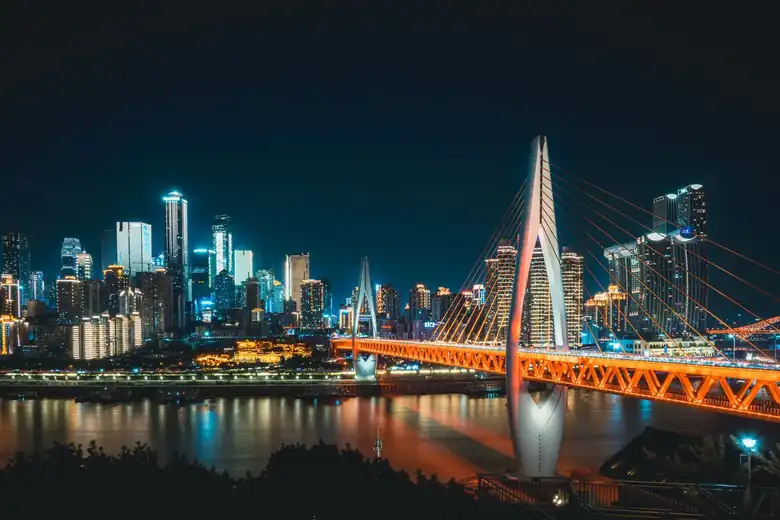
Water gave birth to Chongqing, while mountains shaped its extraordinary character. The city rises layer upon layer along steep hillsides, creating one of the world's most spectacular three-dimensional urban landscapes. Metro trains pass directly through residential buildings, multilayered highway interchanges spiral high above the streets, and neighborhoods climb continuously from the riverbanks to the mountain ridges. This remarkable vertical cityscape leaves an unforgettable impression on first-time visitors.
As of the end of 2024, Chongqing had a permanent resident population of approximately 32.13 million and covers an area of 82,400 square kilometers, making it the largest municipality in China by land area. Administratively, it is one of China's four municipalities directly under the central government and the only one located in the country's inland region. Chongqing serves multiple national strategic roles, including being the economic center of the upper Yangtze River region, a national advanced manufacturing hub, the financial center of western China, and an international consumption center city.
Chongqing is also known by many historic and poetic names, each reflecting a different chapter of its long history. It was originally called Ba, after the ancient State of Ba founded by the Tushan clan here during the Xia Dynasty. In the 16th year of the Chunxi era of the Southern Song Dynasty (1189), Emperor Zhao Dun, having first been invested as Prince Gong before ascending the throne, declared the event a "double celebration" (chong qing), officially giving the city its present name.
Over the past two millennia, Chongqing has also earned nicknames such as the Mountain City, Yuzhou, the Fog City, the City of Bridges, and the River City. Among these, Yu (渝) remains the city's most commonly used abbreviation, derived from the ancient name of the Jialing River, once known as the Yu River, after which Yuzhou Prefecture was established during the Sui and Tang dynasties.
The title "Fog City" reflects Chongqing's location along the southeastern edge of the Sichuan Basin, where abundant moisture produces frequent fog, especially during autumn and winter. The city experiences an average of 104 foggy days each year, making it one of the world's most famous foggy cities. Meanwhile, the nickname "City of Bridges" pays tribute to Chongqing's extraordinary engineering achievements. With more than 18,000 bridges spanning its rivers and valleys, it stands as one of the world's greatest bridge cities.
---
Historical Development
The history of Chongqing as a city dates back to approximately 1046 BCE. Following King Wu of Zhou's conquest of the Shang Dynasty, the State of Ba was established in the region, with its capital at Jiangzhou (present-day Yuzhong District). This marked the beginning of Chongqing's urban history.
The city came under the direct rule of the State of Qin in 316 BCE, when the State of Qin conquered the kingdoms of Ba and Shu and established Ba Commandery. Throughout the Qin and Han dynasties, Ba Commandery remained a major political and military center in southwestern China. Governed from Jiangzhou, it maintained close connections with the Central Plains through the Yangtze River transportation network.
During the Three Kingdoms, Jin, and the Northern and Southern Dynasties (220–589 CE), Chongqing's strategic importance became even more pronounced. Before launching his Northern Expeditions, Zhuge Liang, Chancellor of the Shu Han Kingdom, assembled and trained troops here. Another prominent Shu general, Li Yan, later constructed extensive city walls that laid the foundation for the defensive system of the Yuzhong Peninsula.
During the Sui and Tang dynasties, the city was first known as Yuzhou, later renamed Nanping Commandery, and eventually reverted to Yuzhou. Throughout this period, it remained an important administrative and transportation hub linking the circuits of Jiannan and Shannan West. Renowned Tang poets such as Li Bai, Du Fu, and Bai Juyi all visited or passed through Chongqing, leaving behind numerous celebrated poems that testify to the city's prosperity and cultural significance.
The first golden age of Chongqing arrived during the Southern Song Dynasty. In 1189, Prince Gong, Zhao Dun, ascended the throne as Emperor Guangzong. Believing that becoming both a prince and an emperor constituted a "double celebration," he elevated Gong Prefecture to Chongqing Prefecture, giving the city the name it has retained ever since.
Yet the chapter that secured Chongqing's place in world history came centuries later during the Second Sino-Japanese War.
Following the outbreak of the full-scale war in 1937, the Nationalist Government issued the Declaration on Relocating the National Government to Chongqing on November 20, officially making Chongqing China's wartime capital. During the following eight years, the city served not only as China's political, military, economic, and cultural center but also as the headquarters of Allied operations in the China Theater of World War II.
After the outbreak of the Pacific War in December 1941, China's strategic importance within the Allied coalition increased significantly. The headquarters of the China Theater Command was established in Chongqing, with Chiang Kai-shek serving as Supreme Commander.
Throughout the war, Chongqing endured over five and a half years of indiscriminate strategic bombing by Japanese forces—one of the longest and most devastating bombing campaigns in modern history. The peak period, known as the Chongqing Bombing Campaign (1939–1941), claimed the lives of tens of thousands of civilians. Despite the relentless air raids, the people of Chongqing remained steadfast, embracing the spirit of becoming "stronger with every bombing." It was during these years that the city earned its enduring reputation as one of China's great heroic cities.
On November 30, 1949, the People's Liberation Army under Liu Bocheng and Deng Xiaoping liberated Chongqing. The city subsequently became the seat of the Southwest Military and Administrative Commission, serving as the political center of southwestern China.
In 1954, Chongqing ceased to be a centrally administered municipality and became a city under Sichuan Province. Nevertheless, it remained one of the country's key industrial development centers for many years.
In 1983, Chongqing became China's first pilot city for comprehensive economic system reform.
A historic turning point came on June 18, 1997, when the Fifth Session of the Eighth National People's Congress approved the establishment of the Chongqing Municipality directly under the Central Government, opening an entirely new chapter in the city's long history.
Today, the numerous wartime heritage sites scattered across the Yuzhong Peninsula—including Hongyan Village, Guiyuan, Zhou Gongguan (Zhou Enlai's Former Residence), Zhazidong Prison, and Baigongguan Prison—stand as enduring witnesses to the city's extraordinary resilience and sacrifice during one of the most turbulent periods in modern Chinese history.
Cultural Heritage
The local dialect of Chongqing belongs to the Chuan-Qian subgroup and the Chengdu–Chongqing sub-dialect of Southwestern Mandarin. Locals simply refer to it as "Chongqinghua" or "Chongqing Yanzier" (the Chongqing vernacular). Compared with Standard Mandarin, Chongqing dialect lacks retroflex initials, makes little distinction between the initials n and l, and often merges front and back nasal finals. These phonetic features give the dialect its distinctive sense of boldness and directness.
The charm of Chongqing dialect lies not only in its pronunciation but also in its highly expressive vocabulary. People describe chatting as "bai longmenzhen" (telling stories or chatting casually), use "anyi" to mean comfortable or wonderful, exclaim "oh huo!" when surprised, say "heimen" to emphasize something to an extreme degree, and compliment an attractive person with "guai sangsang." These colorful expressions vividly reflect the passionate, straightforward, and easygoing personality for which Chongqing people are well known.
Folk traditions remain deeply rooted in everyday life. Among the city's most distinctive cultural symbols are the "Chongqing Yanzier" language culture and the "Bangbang" porters. The latter emerged as a direct response to Chongqing's mountainous terrain. Armed with nothing more than a bamboo carrying pole and two ropes, these manual laborers became an iconic part of the city's streetscape and are celebrated as one of the famous "Eighteen Wonders of Chongqing."
Traditional festivals are equally rich in local character. During the Chinese New Year, families observe the custom of "zou renhu", visiting relatives and friends to exchange greetings. During the Dragon Boat Festival, dragon boat races have taken place on the Wu River and the Jialing River for over a thousand years. The Mid-Autumn Festival is traditionally marked by the communal making of ciba (glutinous rice cakes), a cherished family activity.
Wedding and funeral customs also preserve distinctive regional traditions. The ancient custom of the "crying bride" still survives among some Tujia communities in southeastern Chongqing, while the practice of "sitting through the night"—keeping vigil beside the deceased before burial—remains common in both urban and rural areas.
Another defining feature of local life is Chongqing's thriving teahouse culture. In teahouses scattered throughout the city's streets and alleys, elderly residents can spend an entire day sipping gaiwan tea while chatting away the day
The performing arts of Chongqing possess a strong regional identity. Sichuan Opera is the area's most influential traditional theatrical form, and its famous face-changing (bian lian) technique has earned worldwide recognition. Within moments, performers transform their painted masks through astonishingly swift movements—wiping, blowing, or pulling masks away with such speed that audiences are left spellbound.
The Chongqing Sichuan Opera Theatre has long been one of China's foremost centers for preserving this intangible cultural heritage, while celebrated performers such as Shen Tiemei have brought the centuries-old art form to international audiences.
In the visual arts, the Chongqing Woodcut Movement, which emerged during the War of Resistance Against Japanese Aggression, became an important school of revolutionary art. Meanwhile, the Qijiang Peasant Woodblock Prints, known for their simple yet exaggerated rustic style, have developed into a distinctive artistic tradition of their own.
Traditional handicrafts are equally renowned. Rongchang ramie cloth and traditional folding fans have long enjoyed an excellent reputation throughout China, while Liangping bamboo blinds and Liangping woodblock New Year prints have both been inscribed on China's National Intangible Cultural Heritage List.
Chongqing possesses an exceptionally rich collection of intangible cultural heritage. As of 2025, two cultural traditions associated with Chongqing—Sichuan Opera and the Dragon Boat Festival (shared with other regions of China)—have been included on UNESCO's Representative List of the Intangible Cultural Heritage of Humanity. In addition, the municipality is home to 53 national-level intangible cultural heritage items, including the Xiushan Lantern Dance, Tongliang Dragon Dance, Liangping Woodblock New Year Prints, Rongchang Ramie Weaving Techniques, and the Traditional Craftsmanship of Fuling Preserved Mustard Tubers.
Among these, the Tongliang Dragon Dance is widely acclaimed as "China's Finest Dragon Dance." During major festivals and celebrations, its spectacular Fire Dragon Dance, with dragons engulfed in showers of sparks and flames, delivers one of the most exhilarating folk performances in China.
---
Architecture and Urban Landscape
Chongqing's traditional architecture is deeply shaped by its dramatic mountainous landscape. The city's most iconic architectural form is the diaojiaolou, or stilt house. These elevated wooden buildings are constructed along steep hillsides, supported by timber pillars anchored into the cliffs below. The suspended lower sections—known as the "hanging feet"—allow the structures to cascade gracefully down the slopes. This ingenious design not only adapts perfectly to Chongqing's rugged terrain but also provides excellent ventilation and protection against moisture.
The best-known example of this architectural tradition is Hongya Cave on the Yuzhong Peninsula. Although extensively restored and redeveloped in 2006, its magnificent multi-level complex still climbs dramatically from the banks of the Jialing River to Cangbai Road, vividly evoking the appearance of old Chongqing's historic Lower City. In southeastern Chongqing, clusters of traditional Tujia stilt houses, particularly those in Gongtan Ancient Town in Youyang County, cling to the cliffs above the Wu River, preserving the authentic appearance of centuries-old timber architecture.
Following the opening of Chongqing as a treaty port in 1891, Western architectural influences gradually appeared in today's Nan'an District and Yuzhong District. Buildings such as the French Naval Barracks, Lidele & Co., and the former U.S. Embassy bar along Nanbin Road adopted an eclectic style that blended Chinese and Western architectural traditions. Classical arcades stand alongside gray brick walls and traditional tiled roofs, representing some of the city's earliest expressions of international architecture.
During Chongqing's years as China's wartime capital, numerous government agencies and prominent public figures relocated to the city, leaving behind an impressive collection of Republican-era architecture. Historic residences such as Guiyuan, Zhou Gongguan (Zhou Enlai's Former Residence), and Teyuan, located along Zhongshan Fourth Road in Yuzhong District, are characterized by gray brick facades, sloping tiled roofs, and an understated elegance that reflects the architectural aesthetics of Republican China.
Contemporary Chongqing, by contrast, showcases remarkable architectural innovation. Faced with an extreme shortage of buildable land, the city's architects and engineers have been forced to create space vertically, producing some of the world's most astonishing architectural wonders.
Perhaps the most famous is Liziba Station, where Chongqing Rail Transit Line 2 passes directly through a 19-story residential building, creating the globally recognized spectacle of a metro train traveling through an apartment block.
Another modern icon is Chongqing Raffles City, located in the Jiefangbei Central Business District. Designed by internationally renowned architect Moshe Safdie, the complex features eight skyscrapers connected by a spectacular 300-meter-long Crystal Skybridge suspended high above the city. Resembling a giant sailing ship setting off from the historic Chaotianmen waterfront, it has quickly become one of Chongqing's defining modern landmarks.
To truly understand Chongqing's urban fabric, one must first understand the historic distinction between the Upper City and the Lower City.
For centuries, elevation divided old Chongqing into two very different worlds. The Upper City, located above Jiaochangkou, served as the political and commercial center, with relatively broad and level streets. The Lower City, stretching down toward the rivers, was a lively maze of docks, markets, shops, residences, and steep stone stairways winding through densely packed neighborhoods.
The historic district of Shibati (Eighteen Steps) remains one of the best-preserved examples of this traditional urban landscape. A long flight of stone steps descends from Jiaochangkou to Houci Street on the banks of the Yangtze River, lined with humble hillside dwellings that vividly capture the everyday life of old Chongqing.
Standing in dramatic contrast are the gleaming skyscrapers of modern commercial centers such as Jiefangbei and Guanyinqiao. It is precisely this powerful coexistence of history and modernity—of ancient stone stairways and futuristic skylines within the same urban space—that makes Chongqing so captivating and unforgettable.
Culinary Culture
Chongqing cuisine belongs to the Xiahe School, one of the three major branches of Sichuan cuisine, and is renowned for its signature combination of five defining characteristics: numbing, spicy, fresh, aromatic, and piping hot. Unlike the refined and delicate culinary style of the Shanghe School centered around Chengdu, Chongqing cuisine reflects the city's rugged, bold, and free-spirited dockside culture. It makes masterful use of chili peppers, Sichuan peppercorns, and fermented broad bean paste—the celebrated “three-pepper blend” (chili peppers, Sichuan peppercorns, and fermented broad bean paste)—to create flavors that are intensely rich, fiery, and deeply satisfying. This distinctive culinary tradition is inseparable from Chongqing's identity as a major port on the Yangtze River. Dockworkers and boatmen relied on heavily seasoned food to stimulate their appetite and ward off the damp, chilly river climate, while generous amounts of chili peppers and Sichuan peppercorns also provided an affordable yet highly effective way to season their meals.
No discussion of Chongqing cuisine would be complete without hotpot, the city's undisputed culinary icon. Chongqing hotpot originated at Chaotianmen Wharf during the late Qing Dynasty and the early Republican era. It began as a humble meal for boatmen and trackers, who placed inexpensive beef tripe, pork aorta, and other offal into iron pots filled with vigorously boiling chili peppers and Sichuan peppercorns. Cuts once dismissed by the wealthy were transformed into irresistible delicacies by the intensely spicy broth. Authentic traditional Chongqing hotpot features a rich beef tallow base simmered with Pixian broad bean paste, Yongchuan fermented black beans, Hanyuan Sichuan peppercorns, dried chili peppers, and numerous other seasonings, producing a brilliantly red broth with an unmistakably bold aroma. Beef tripe, duck intestines, and yellow throat are among the essential ingredients, briefly cooked using the famous "seven up, eight down" dipping technique before being enjoyed for their crisp yet tender texture. For Chongqing locals, there is a saying: "There’s nothing that can’t be solved with one hotpot meal—if there is, then have two." Far from being a joke, it perfectly embodies the city's straightforward and spirited philosophy of life.
Chongqing noodles, commonly known as Xiaomian, represent another soul of the city's daily life. By six o'clock every morning, plastic stools at roadside noodle stalls are already occupied by hungry locals. A bowl of spicy noodles accompanied by a fried egg is the quintessential Chongqing breakfast. The true essence of Xiaomian lies in its seasoning, with more than a dozen carefully balanced ingredients blended according to each shop's closely guarded recipe. Chili oil forms the soul of the dish, ground Sichuan peppercorns provide the finishing touch, while ginger-garlic water, preserved mustard greens, crushed peanuts, chopped scallions, and other condiments add remarkable depth of flavor. For generations of Chongqing residents, that steaming bowl of numbing, spicy, and aromatic noodles is nothing less than the taste of home.
Beyond hotpot and Xiaomian, Chongqing's celebrated Jianghu cuisine deserves equal attention. Laziji (spicy diced chicken) is stir-fried with an overwhelming quantity of dried red chilies—so many that diners jokingly say the challenge is finding the chicken among the peppers—with Geleshan Laziji standing as its most famous variation. Laifeng Fish features grass carp simmered in a broth packed with Sichuan peppercorns and chilies, while Taian Fish is prepared by lightly coating fish pieces in batter, deep-frying them until crisp, and then braising them in a rich spicy sauce. Both dishes showcase the culinary creativity inspired by Chongqing's rivers. Other celebrated specialties include Qianjiang Chicken Giblets, Nanshan Spring Water Chicken, and Bishan Rabbit. Characterized by generous use of oil, bold spiciness, and hearty ingredients, these dishes perfectly reflect the straightforward, passionate, and energetic character for which Chongqing people are known.
Modern Development
Chongqing's modern history has always been closely intertwined with the broader course of China's national development. In March 1891, under the Additional Convention to the Chefoo Convention signed between China and Britain, Chongqing was officially opened as a treaty port. British steamships soon appeared on the waters beyond Chaotianmen, and a customs office was established shortly thereafter. The opening of the port integrated Chongqing into the global capitalist trading network and marked the beginning of its modernization. Match factories, silk mills, coal mines, and other domestic industries emerged in succession, while the southern bank of the Yangtze gradually developed into a district of foreign consulates and trading houses. Western architecture, education, and lifestyles steadily found their way into this ancient city. It is no exaggeration to say that without the opening of the port, modern Chongqing would never have taken shape.
The years from 1937 to 1945, when Chongqing served as China's wartime provisional capital during the War of Resistance Against Japanese Aggression, constitute the most heroic chapter in the city's modern history. Within these eight years, Chongqing transformed from a regional commercial center into the nation's political, economic, cultural, and military capital. Hundreds of factories relocated inland laid the foundation for the city's industrial development, while munitions plants operated around the clock to supply the front lines. Under the leadership of Minsheng Shipping Company's general manager Lu Zuofu, dozens of vessels successfully carried out the Yichang Evacuation—often referred to as the "Dunkirk of China"—transporting enormous quantities of strategic personnel and supplies to Chongqing despite relentless Japanese bombardment. During this period, the city's population surged from approximately 470,000 before the war to well over 1.2 million, bringing rapid urban expansion and leaving behind an enduring historical legacy.
Following the founding of the People's Republic of China in 1949, Chongqing rapidly developed into one of the country's foremost heavy industrial centers. During the Third Front Construction campaign, numerous defense and military enterprises were established here, leading to the rise of major state-owned manufacturers such as Changan, Jianshe, and Jialing. Chongqing became one of China's principal production bases for conventional weaponry, as well as a major industrial city. The era of Reform and Opening-up brought significant challenges. In 1983, Chongqing became China's first pilot city for comprehensive economic reform, while its designation as a municipality directly under the central government in 1997 ushered in a new era of accelerated development. Since then, Chongqing has undertaken a series of monumental tasks, including the resettlement of residents displaced by the Three Gorges Project, the revitalization of aging industrial districts, rural poverty alleviation, and ecological development. Of the more than one million people relocated for the Three Gorges Dam, over 85 percent were resettled within Chongqing Municipality, creating one of the largest and most remarkable population relocation efforts in the history of modern engineering.
Today, Chongqing's strategic role continues to grow increasingly prominent. As the economic center of the upper Yangtze River region and a key junction connecting the Belt and Road Initiative with the Yangtze River Economic Belt, the city is accelerating its transformation into China's leading inland gateway to the world. In 2024, Chongqing's gross domestic product is expected to exceed RMB 3.2 trillion. The China–Singapore (Chongqing) Demonstration Initiative on Strategic Connectivity continues to advance, while the New International Land-Sea Trade Corridor links the city with more than 500 ports across over 120 countries and regions worldwide. Chongqing's remarkable evolution—from a manufacturing powerhouse to a center of intelligent manufacturing and, increasingly, a smart city—is already well underway. The intelligent factories of Changan Automobile and the Lijia Smart Experience Park in Liangjiang New Area exemplify this new chapter in the city's industrial transformation. Standing atop the One Tree Viewing Platform on Nanshan Mountain and gazing across the dazzling skyline of the Yuzhong Peninsula, visitors cannot help but feel that, much like its dramatic mountainous landscape, Chongqing's ambition continues to rise ever higher.
Transportation
Over the past decade, Chongqing's transportation infrastructure has undergone remarkable transformation. Chongqing Jiangbei International Airport, one of China's eight major regional aviation hubs, operates four runways and two passenger terminals (T3A and T2). Handling more than 45 million passengers annually, the airport offers nearly one hundred international and regional routes connecting Chongqing directly with destinations across Europe, the Americas, Oceania, and Southeast Asia. On the rail network, Chongqing West Railway Station and Chongqing North Railway Station serve as major national transportation hubs. The Chengdu–Chongqing High-Speed Railway reduces travel time to Chengdu to approximately one hour, while the Zhengzhou–Chongqing High-Speed Railway, Chongqing–Guiyang Railway, and Chongqing–Wanzhou Intercity Railway provide convenient connections to neighboring provincial capitals. The Chongqing–Kunming High-Speed Railway and Chongqing–Guiyang High-Speed Railway, scheduled to open in 2024 and 2025, will further shorten travel times to Yunnan and Guangxi. Chongqing is also the starting point of the Yuxinou (Chongqing–Xinjiang–Europe) International Railway, an overland freight corridor stretching roughly 11,000 kilometers. Trains depart from Chongqing, cross the border at Alashankou in Xinjiang, pass through Kazakhstan, Russia, Belarus, and Poland, before arriving in Duisburg, Germany, in just 12 to 14 days—more than twice as fast as traditional sea freight.
Within the city, Chongqing's rail transit system forms the backbone of one of the world's most distinctive public transportation networks. By early 2025, the Chongqing Rail Transit system had expanded to approximately 540 kilometers in operation, encompassing 12 lines that cover most of the metropolitan area. Designed to navigate the city's dramatic mountainous terrain, the network is unlike any other. Trains frequently transition between underground metro tunnels and elevated tracks that climb steep hillsides, with the famous Liziba Station becoming an international sensation for its seemingly impossible route through the middle of a residential building. Line 2, which follows the Jialing River, offers spectacular views as trains glide along cliffsides overlooking the water, creating an almost surreal travel experience. Line 3, often nicknamed the "Metro to the Sky," crosses both the Jialing River and the Yangtze River while traversing dramatic changes in elevation. Meanwhile, Line 1 connects many of the city's most important destinations, including Jiefangbei, Ciqikou Ancient Town, and University Town. Complementing the rail network are an extensive bus system and several uniquely Chongqing modes of transport, including the Yangtze River Cableway, the Crown Escalator, and the Kaixuan Road Elevator. Together, they create one of the world’s most “8D” (three-dimensional) and diverse urban transportation systems.
For visitors, the greatest joy of getting around Chongqing lies in its unmistakably "magical" urban landscape. The Yangtze River Cableway, often called "the First Aerial Corridor Across the Yangtze River," stretches 1,166 meters and has been in continuous operation since 1987. More than just a tourist attraction, it remains a practical means of crossing the river for local residents. Suspended high above the Yangtze, passengers are rewarded with breathtaking views of the confluence of the Yangtze and Jialing rivers—an experience found nowhere else. Another unique attraction is the Crown Escalator at Lianglukou. Measuring 112 meters in length with a vertical rise of 52.7 meters, it is the second-longest single-section hillside escalator in Asia. For just RMB 2, the leisurely two-and-a-half-minute ride has become an attraction in its own right. Equally remarkable is the Kaixuan Road Elevator, China's first urban passenger elevator, ingeniously built into the cliffs of the Yuzhong Peninsula to connect streets at dramatically different elevations. In Chongqing, every step can feel extraordinary, and every journey may lead to an unexpected discovery. It is this endlessly surprising, three-dimensional cityscape that offers visitors one of the world's most unforgettable urban travel experiences.
Travel Tips
The best times to visit Chongqing are spring (March to May) and autumn (September to November). During these seasons, temperatures typically range between 15°C and 25°C (59°F–77°F), with comfortable weather and moderate rainfall, making them ideal for exploring the Mountain City. In spring, fresh greenery blankets the hillsides, while cherry blossoms and peach blossoms bloom throughout Nanshan Botanical Garden. Autumn arrives after the intense summer heat has faded, bringing crisp skies and pleasant temperatures. From late October through mid-November, visibility reaches its annual peak, offering the finest conditions for enjoying Chongqing's spectacular night views. Summer (June to August), by contrast, has earned Chongqing the nickname "one of China's Four Furnaces." Daytime temperatures frequently exceed 38°C (100°F), accompanied by high humidity that can make outdoor sightseeing exhausting. Unless you are well prepared for extreme heat, this season is generally not recommended. Winter (December to February) is comparatively mild, but persistent fog and damp weather often reduce visibility. On the other hand, it is arguably the perfect season to savor an authentic Chongqing hotpot.
Among the city's must-visit attractions, the combination of Jiefangbei and Hongyadong should be at the top of every itinerary. Jiefangbei, Chongqing's symbolic landmark, was originally built in 1947 as a monument commemorating China's victory in the War of Resistance Against Japanese Aggression. Today, it stands amid luxury boutiques and modern skyscrapers, creating a fascinating contrast between history and contemporary urban life. As evening approaches, take a leisurely walk from Jiefangbei to Hongyadong, where the illuminated stilt houses gradually come alive along the riverbank, creating a dreamlike atmosphere often compared to scenes from Spirited Away. Another unforgettable experience is combining a ride on the Yangtze River Cableway with Rail Transit Line 2. The cableway carries passengers across the Yangtze in just a few minutes; visiting during off-peak weekday hours is recommended to avoid long queues. For Line 2, begin your journey at Jiaochangkou Station, pass through the famous Liziba Station where the train runs through a residential building, and continue to Zengjiayan Station to fully appreciate the spectacular scenery of trains hugging mountainsides above the rivers. Your next stop should be Ciqikou Ancient Town, a historic settlement dating back to the Song Dynasty, famous for its traditional snacks such as Chen Mahua (crispy fried twisted dough), Maoxuewang (a spicy blood curd stew), and its "Three Treasures" — jiaoyan huasheng (peppery-salt peanuts), maoxuewang (spicy blood curd stew), and qianzhangpi (thin dried tofu skin). Arriving early in the morning allows you to wander its stone-paved streets before the crowds arrive. Another highly recommended destination is Eling No. 2 Factory Creative Park, a former banknote printing facility of the Central Bank during the Republican era that has been transformed into a vibrant cultural and creative complex. From its rooftop, visitors can enjoy panoramic views of the Yuzhong Peninsula and the confluence of the Yangtze and Jialing rivers. It also served as a filming location for the popular Chinese film I Belonged to You. Finally, if your schedule permits, make time for the One Tree Viewing Platform on Nanshan Mountain. Widely regarded as the finest place to admire Chongqing's legendary night skyline, it offers a breathtaking panorama where the entire Yuzhong Peninsula sparkles like a golden galaxy. Standing there, you will truly understand the local saying: "If you haven't seen Chongqing at night, you haven't truly seen Chongqing."
A few practical tips will help make your visit even more enjoyable. Chongqing is a truly three-dimensional city, where a straight-line distance of just 200 meters on a map may involve climbing or descending dozens of meters in elevation. Comfortable walking shoes are therefore essential. If you're worried about the heat of Chongqing hotpot, order an oil dipping sauce made with sesame oil and minced garlic, which effectively mellows the spiciness. A bottle of Weiyi Soy Milk or a bowl of bingfen, a refreshing chilled jelly dessert, also provides welcome relief from the fiery flavors. If you find the local Chongqing dialect difficult to understand, simply respond with "An?" (meaning "Pardon?"). Locals will usually smile and happily switch to a more widely understandable version of Mandarin. Carrying a compact umbrella is another wise idea, as the local saying "There are rarely three consecutive sunny days in Chongqing" is no exaggeration. Most importantly, leave behind the expectations of a conventional flat city and embrace the pleasure of getting pleasantly lost. Around the next corner, you may unexpectedly discover a cliffside walkway, a hidden hotpot restaurant tucked beneath an underground passage, or a cool river breeze sweeping through the narrow gap between towering buildings. It is these unplanned moments of discovery that reveal the true magic of Chongqing—this 8D magical city where the greatest adventures are often the ones you never planned.
Travel information can change. Check current opening hours, reservations and entry requirements before you travel.
Traveller discussion
Start the conversation with a helpful tip or a question.