
Guyuan City
Guyuan CityGuyuan, abbreviated as "Gu," formerly known as Dayuan, Gaoping, Xiaoguan, and Yuanzhou, is a prefecture-level city under the Ningxia Hui Autonomous Region. Located in southern Ningxia in the Liupan Mountain area, with terrain hig
Guyuan City
Guyuan, abbreviated as "Gu," formerly known as Dayuan, Gaoping, Xiaoguan, and Yuanzhou, is a prefecture-level city under the Ningxia Hui Autonomous Region. Located in southern Ningxia in the Liupan Mountain area, with terrain higher in the south and lower in the north, it borders Qingyang and Pingliang cities of Gansu to the east, Pingliang to the south, Baiyin City to the west, and Zhongwei and Wuzhong of Ningxia to the north. It has a typical continental climate with a total area of 10,500 square kilometers. As of June 2026, the city administers 1 district and 4 counties. As of the end of 2025, the permanent resident population was 1,133,800. On July 7, 2001, Guyuan Prefecture was abolished and Guyuan City was established. Guyuan is the sub-center city of Ningxia, located at the center of the triangle formed by Xi'an, Lanzhou, and Yinchuan. It is the only non-Yellow River city among Ningxia's five prefecture-level cities. Situated at the intersection of Central Plains agricultural culture and northern nomadic culture, it was a key passage on the Northern Route of the eastern Silk Road. In 2025, the gross regional product was 48.807 billion yuan, up 5.6%.
History
Human activity dates back 27,000–32,000 years to the Paleolithic Age. During the Warring States period, it was part of Qin territory. During the Qin Dynasty (221–206 BC), Wushi County was established. In 114 BC, Emperor Wu of Han established Anding Commandery with its seat at Gaoping County (present-day Yuanzhou District).
During the Northern and Southern Dynasties, the area was successively under Northern Wei, Western Wei, and Northern Zhou. In 436, Gaoping Garrison was established, later changed to Yuanzhou in 524. During the Sui Dynasty (581–618), it was renamed Pingliang Commandery. During the Tang Dynasty (618–907), Yuanzhou was restored, later falling to Tubo (763–764).
During the Song Dynasty (960–1279), the area included Zhenrong Army, Huaide Army, Deshun Army, and Xi'an Zhou. During the Ming Dynasty (1368–1644), Guyuan Zhou and Guyuan Guard were established. In 1452, the name "Guyuan" first appeared, derived from "former Yuanzhou" with "former" (gu) changed to "solid" (gu). In 1502, it became the seat of Guyuan Zhou and Guyuan Garrison, one of the Nine Border Garrisons.
During the Qing Dynasty (1644–1912), Guyuan Zhou was under Gansu Province. In 1873, it was elevated to a directly administered Zhou. In 1913, it became Guyuan County. In 1936, the Red Army established the Northern Guyuan County Soviet Government. In 1949, Guyuan was liberated. In 1953, the Xi-Hai-Gu Hui Autonomous Region was established. In 1955, it was renamed Guyuan Hui Autonomous Prefecture. In 1958, the Ningxia Hui Autonomous Region was established and the autonomous prefecture was abolished, replaced by Guyuan Special District. In 1983, Pengyang County was established. In 2001, the State Council approved the establishment of prefecture-level Guyuan City. In 2002, Guyuan City was formally established. In 2004, Haiyuan County was transferred to Zhongwei.
Administrative Divisions
As of June 2026, Guyuan administers 1 district (Yuanzhou) and 4 counties (Xiji, Longde, Jingyuan, Pengyang), with 62 townships and towns, 3 subdistricts, 795 villages, and 68 communities. The City People's Government is seated in Yuanzhou District.
Geographical Environment
Location
Guyuan is located in the Liupan Mountain area of southern Ningxia, between 35°14'–36°31' north latitude and 105°19'–106°57' east longitude, with a total area of 10,500 square kilometers. It is at the center of the triangle formed by Xi'an, Lanzhou, and Yinchuan, and is one of China's 179 highway transportation hubs.
Topography
Located at the northwestern edge of the Loess Plateau, with the Liupan Mountains as a north-south spine dividing the city into east and west. Elevation mostly 1,500–2,200 meters, characterized by loess hills, ridges, mounds, and gullies. The main peak of the Liupan Mountains, Meigao Mountain (Migang Mountain), reaches 2,942 meters.
Climate
Guyuan has a typical continental climate in the warm temperate semi-arid zone of the Loess Plateau: long cold winters, variable springs, brief cool summers, rapid autumn cooling, large diurnal temperature ranges, and significant regional precipitation differences. Average temperature: 6.7–8.8°C. Annual precipitation: 458.6–668.2 mm. Annual sunshine: 2,056.9–2,384.4 hours.
Natural Disasters
Main hazards include drought, frost, cold waves, and hail. Hail occurs April–October, averaging 11 days per year, concentrated in May–August. A severe hailstorm on June 23–24, 2000 damaged 12,000 hectares of crops with direct losses of 8+ million yuan.
Natural Resources
Water Resources
Several river systems including the Jing River, Qingshui River, Hulu River, and Zu Li River, with annual runoff of about 730 million cubic meters. Groundwater reserves of 324 million cubic meters, of which 244 million are exploitable. The Liupan Mountain area is Ningxia's richest water resource region, known as the "Natural Water Tower," with annual runoff of 210 million cubic meters and forest water regulation capacity of 28.4 million tons.
Biological Resources
The Liupan Mountain Nature Reserve has economically valuable plants including bracken, sea buckthorn, and facai, plus protected species like astragalus. Valuable tree species include spruce, Chinese pine, Huashan pine, and Manchurian ash. 530 wild medicinal plant species. Protected animals include leopard, forest musk deer, golden eagle, and red-bellied pheasant.
Mineral Resources
Coal reserves: 9.3 billion tons at 5 sites; quartz sand: 1.6 billion tons at 4 sites; gypsum: 3 billion tons at 10 sites; limestone: 130 million tons; salt: proven reserves of 17+ billion tons in a 30-square-kilometer core area, with predicted reserves of 100+ billion tons; oil and gas: 492 million tons.
Population
Population Size
As of the end of 2025, the permanent resident population was 1,133,800, down 7,000. The urban population was 542,900 (47.88% urbanization rate, up 0.93 percentage points); the rural population was 590,900.
Ethnic Composition
Guyuan is a multi-ethnic area with a Han majority and significant Hui population, plus Manchu, Mongolian, Zhuang, Korean, Tibetan, Tu, Dong, Miao, Buyi, Tujia, Uyghur, Dongxiang, Yi, Qiang, and other ethnic groups.
Politics
Economy
Overview
In 2025, the gross regional product was 48.807 billion yuan, up 5.6%. By industry: primary 9.102 billion, up 6.9%; secondary 10.902 billion, up 5.0%; tertiary 28.803 billion, up 5.3%. Structure: 18.7:22.3:59.0. Per capita GDP: 42,915 yuan, up 6.2%. Fixed-asset investment up 8.6%. Local general public budget revenue: 1.532 billion, down 4%. General public budget expenditure: 28.777 billion, up 2.1%. Urban per capita disposable income: 39,803 yuan, up 5.3%; rural: 17,675 yuan, up 6.4%.
Primary Industry
Grain area: 3,131,100 mu, output 836,400 tons. Vegetables: 2,054,300 tons, up 5.3%. Total meat output: 113,900 tons, up 13.3% (beef 68,900 tons, up 14.1%; mutton 24,000 tons, up 18%). Cattle inventory: 703,100, up 4.4%; sheep: 991,500, up 0.7%; pigs: 141,600, up 14.3%; poultry: 3,555,900, up 22.3%.
Secondary Industry
Industrial added value: 6.181 billion yuan, up 0.3%. Above-scale industrial added value down 1.2% (mining down 12.3%; manufacturing up 13.5%; electricity/heat/gas/water down 2.5%). Total installed power capacity: 2,139.1 MW, up 12% (thermal 705 MW; wind 640.1 MW, up 8.8%; solar 389 MW, up 84%). Above-scale profits: 678 million yuan, down 38.7%.
Tertiary Industry
Wholesale/retail: 3.417 billion, up 6.8%. Transportation: 1.89 billion, up 5.5%. Accommodation/catering: 873 million, up 8.1%. Finance: 2.017 billion, up 4.1%. Real estate: 1.792 billion, up 2.0%. IT: 1.639 billion, up 10.1%. Total retail sales: 14.484 billion, up 5.4%. Domestic tourists: 18.4487 million, tourism revenue: 8.544 billion yuan. Express delivery: 17.9088 million pieces. 5G mobile users: 906,800. Total deposits: 76.241 billion, up 10.3%. Total loans: 73.373 billion, up 8.3%. Insurance premiums: 1.601 billion, up 2.2%.
Economic Functional Zones
Ningxia Guyuan Economic Development Zone: Provincial-level zone established in 1993, reorganized in 2018 into "one zone, three parks" (New Materials, Light Industry, and Qingshui River Industrial Parks), covering 1,901.43 hectares with 132 operating enterprises (72 industrial, 20 above-scale).
Social Affairs
Science and Technology
6 autonomous region engineering research centers, 2 key laboratories. 80 registered S&T achievements, 352 patent authorizations (145 valid invention patents, 1.27 per 10,000 people). Technology contract turnover: 125.3947 million yuan.
Education
606 schools, 20,719 staff. Preschool gross enrollment: 94.19%; primary enrollment: 100%; junior high enrollment: 113.14%; nine-year completion: 101.43%. Higher education: Ningxia Normal University and Guyuan Vocational and Technical College.
Culture
8 public museums, 6 public libraries, 6 cultural centers, 6 archives.
Healthcare
1,172 health institutions including 30 hospitals (11 public, 19 private), 1,125 grassroots institutions (62 township health centers, 804 village clinics), and 15 professional public health institutions. 11,615 health workers (9,628 technical: 3,618 physicians, 4,191 nurses). 7,812 beds (6,172 in hospitals). 5.8946 million outpatient visits, 221,300 discharges.
Environment
Air quality excellent days: 94.2%. Urban noise: 48.6 dB(A), Class I (Good).
Social Security
Enterprise pension: 153,900, up 3,200; urban-rural pension: 659,300, down 5,300; employee medical: 129,800, up 4,400; urban-rural medical: 1,132,400, down 30,200; unemployment: 93,300, up 3,000; work injury: 126,500, up 4,200; maternity: 98,900, up 3,600. 9,539 new urban jobs, 317,000 rural labor transfers.
Transportation
Overview
Located at the center of the Xi'an-Lanzhou-Yinchuan triangle, historically a key transportation hub on the eastern Silk Road. In 2025: highway freight 7.2 million tons, up 5.6%; railway passengers 285,000, up 0.7%; railway freight 6.8554 million tons, up 12%; civil aviation passengers 58,500, up 12%.
Highways
Fuyin (Fuzhou-Yinchuan), Qinglan (Qingdao-Lanzhou), Jinghua, Guxi, Xihui, Pengqing, Yinkun, and Heihai expressways. National Highways 22, 309, 312, 327, 341, 344, 566. Provincial Highways S101, S203, S202.
Railways
The Baolan Railway runs through Guyuan, with trains from Yinchuan, Xi'an, Lanzhou, Shanghai, Chengdu, Guangzhou, and Urumqi stopping at Guyuan Station. Pengyang Station also serves the area.
High-Speed Rail
Planned: Lantai High-Speed Railway (Taiyuan-Luliang-Yan'an-Qingyang-Guyuan-Lanzhou) and Baozhong Passenger Dedicated Line.
History and Culture
Religion
Four religions: Taoism, Buddhism, Islam, and Christianity. Islam is the religion of the Hui people; other religions are practiced by some Han residents. The City Religious Affairs Bureau and Islamic Association manage religious affairs.
Festivals
Language
The Xihai-Gu dialect belongs to the Central Plains Mandarin group, specifically the Qin-Long sub-group, distinct from both Shaanxi Guanzhong and Gansu Longzhong dialects.
Intangible Cultural Heritage
225 heritage resources with 554 inheritors. 6 national-level items (Yang family clay sculpture, Gaotai horse shehuo, Guyuan brick carving, Jingyuan Hui stories, Xiji spring official blessing, Guyuan traditional construction techniques), 34 autonomous region-level, 55 municipal, and 132 county-level items.
Folk Customs
Hua'er (folk songs): Mountain songs with fast and slow melodies, using comparative and evocative rhetoric. Mouth harp: A traditional instrument popular among Hui women in the Xihai-Gu area. Treading Dance: Evolved from "leg kicking" martial arts brought by Hui migrants from Shaanxi to Jingyuan County. Paper cutting: Traditional craft mostly done by women during winter. Embroidery: Widely practiced, including pillow ends, children's shoes, wedding decorations, and sachets. Shehuo: Known as the "living fossil of folk art," featuring high platforms, horse shehuo, stilts, boat dance, lion dance, and yangge (folk dance).
Place Names
The name "Guyuan" originated in 1452 during the Ming Dynasty. One theory: after Yuanzhou fell to Tubo, it was administered from Pingliang and Zhenyuan, and called "Former Yuanzhou" (gu meaning "former"), later changed to gu meaning "solid." Another theory: Northern Wei established Yuanzhou here, named for its "solid and defensible" terrain.
Scenic Spots
Overview
As of the end of 2022, Guyuan has 20 scenic areas including 6 4A-level, 6 3A-level, and 8 2A-level.
Main Scenic Spots
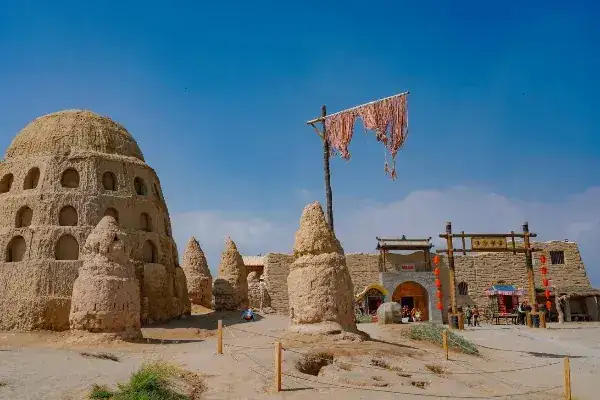
Guyuan Ancient City: A historical and cultural city on the ancient Silk Road. The city was established in 114 BC as the seat of Anding Commandery. The Ming Dynasty city walls were among the most magnificent in the northwest. Ancient wall ruins park on the southern outskirts.
Liupan Mountain Ecological Botanical Garden: Between Liangdian Gorge and Xiao Nanchuan, 390 hectares at 1,900–2,590 meters elevation, with 24 themed gardens including spring and summer gardens.
Xumishan Grottoes: 55 km northwest of Guyuan, one of China's top ten grotto groups, first carved during the Northern Wei (477–499 AD), with construction continuing through the Tang Dynasty (618–907). The largest grotto group in Ningxia, designated as a national-level protected cultural heritage site in 1982.
Laolongtan Scenic Area: 22 km southeast of Jingyuan County, the source of the Jing River, known as the "Natural Water Tower" of the Loess Plateau. Features four interconnected pools in a zigzag pattern with steep cliffs and lush vegetation.
Huoshizhai National Geological Park: 15 km north of Xiji County, covering 100 square kilometers of Danxia landform with red cliffs, green trees, and blue sky creating colorful natural scenes. Includes natural stone cities, grottoes, and caves.
Liupan Mountain National Forest Park: Spanning Jingyuan, Longde, and Yuanzhou, 678 square kilometers with the main peak at 2,942 meters. 80%+ forest coverage, annual average temperature 5.8°C, annual precipitation 676 mm. The source of the Jing, Qingshui, and Hulu rivers.
Liupan Tianchi (North Union Pool): 20 km northeast of Longde County at 2,530 meters elevation, the source of the Hulu River, believed to be the birthplace of Fuxi. Temple fairs held annually on the sixth day of the sixth lunar month attract over 10,000 pilgrims.
Guyuan Museum: One of 70 key museums designated by the State Administration of Cultural Heritage in 1998, opened September 25, 1988. 20,000+ artifacts spanning 30,000 years from the Neolithic to 1942.
Zhenhu Lake: Formed by the 1920 Haiyuan earthquake landslide, with 40+ earthquake lakes in Xiji County.
Yanzhi Gorge: 45 km long, formed 800 million years ago in the Ordovician period.
Xiaoguan Ruins Cultural Park: At Wating Village, Dayan Township, Jingyuan County, featuring restored city walls, Han-style gates, and 18 poems about Xiaoguan by famous calligraphers.
Local Specialties and Food
Shengyuan Noodles: Hand-pulled noodles served with meatballs, day lily, wood ear mushroom, and glass noodles in seasoned broth.
Sanzi: Ancient Chinese snack of fried dough twists, golden and crispy.
Lamb Head: A Hui specialty using 30–35 day old lamb heads, slow-cooked with secret spices.
Lamb Offal Soup: Boiled lamb internal organs and head meat cut into strips, served in original broth with chili oil, cilantro, and garlic.
Guyuan Cold Noodles: Made from premium potato starch, thin and smooth, served with special sauce.
Lamb Pita Bread: Ancient "lamb soup," mentioned by Su Shi of the Song Dynasty (960–1279). Premium lamb cooked with spices, served with crumbled pita bread.
Buckwheat Oil Ring: Buckwheat dough scalded with boiling water, shaped into rings with center holes, deep-fried.
Jiaotuan (Stirred Dough): A northwest specialty from the 1960s–70s, made from corn or potato flour, served two ways: "water surrounding city" or "floating fish."
Sour Soup Noodles: Noodles in fermented vegetable broth, golden-green in color with red oil, sour and spicy. The key is the fermented "sour water" made from celery, cabbage, and other vegetables.
Oat Noodles: Steamed oat flour extruded into thin strips, served with leeks, chili oil, and garlic vinegar.
Buckwheat Hele: Buckwheat flour pressed through a wooden press into noodles, steamed and served with scallions, shredded meat, and chili.
Ruhe Dried Apricots: Fresh apricots pitted, dried, and sugar-cured, rich in glucose and fructose.
Famous People
Li Xian: General and minister of Northern Wei, Western Wei, and Northern Zhou.
Zhang Zhongfu and Zhang Zhongyan: Jin Dynasty officials.
Qu Duan: Famous general of early Southern Song (1127–1279).
He Guang: Commander of the 24th Army of the Chinese Workers' and Peasants' Red Army.
Han Liancheng: Founding lieutenant general.
Sun Shouming, Ma Zhijian, Ma Sizhen: Revolutionary martyrs.
Chen Liangbi: Anti-Japanese martyr.
Li Chengyu: Former Governor of Henan Province.
Ma Qizhi: Former Chairman of the Ningxia Hui Autonomous Region Government.
Honorary Titles
Top 10 Long March Potential Cities, China Cold Vegetable Hometown, National New Urbanization Pilot, National Hygiene City (2021), National Ecological Civilization Construction Demonstration Zone (2021), "Natural City" selected at the UN Biodiversity COP16 (2024, the only city in northwest China), National Double Support Model City (2025).
Sister Cities
Guyuan has established sister city relationships with Aral City (Xinjiang), Baoji City (Shaanxi), and Pingliang City (Gansu).
Travel information can change. Check current opening hours, reservations and entry requirements before you travel.

Traveller discussion
Start the conversation with a helpful tip or a question.