
Dehong Dai and Jingpo Autonomous Prefecture
Dehong Dai and Jingpo Autonomous PrefectureDehong Dai and Jingpo Autonomous Prefecture, abbreviated as "Dehong," is located in western Yunnan Province. It borders Baoshan City to the east and is surrounded by Myanmar on three sides—north, w
Dehong Dai and Jingpo Autonomous Prefecture
Dehong Dai and Jingpo Autonomous Prefecture, abbreviated as "Dehong," is located in western Yunnan Province. It borders Baoshan City to the east and is surrounded by Myanmar on three sides—north, west, and south. With a southern subtropical climate, it covers an area of 11,526 square kilometers. As of the end of 2025, the permanent population was 1.354 million. The prefecture administers 2 county-level cities and 3 counties, with the prefectural government seated at No. 5 Yonghan Street, Mangshi. "Dehong" is a phonetic transliteration from the Dai language: "De" means "below" and "Hong" refers to the Nu River, together signifying "the place downstream of the Nu River." The autonomous region was established in July 1953 and reorganized as an autonomous prefecture in 1956. Dehong serves as a strategic platform connecting South Asia and Southeast Asia, linking the Pacific and Indian Oceans, and is the core zone for China-Myanmar trade cooperation. In 2025, the prefecture achieved a GDP of 64.807 billion yuan (approximately US$9.0 billion). Per capita GDP was 48,165 yuan (approximately US$6,690). Monetary figures are converted at approximately 1 US dollar = 7.2 Chinese yuan.
History
Human habitation in the Dehong region dates to the Neolithic Age. Around 364 BCE, Dai ancestors established the Mengmao Kingdom along the Ruili River valley, building Leiyun City, whose ruins survive today. During the Western Han Dynasty (109 BCE), Emperor Wu incorporated the area into Yizhou Commandery. In 69 CE, the Eastern Han established Yongchang Commandery, encompassing modern Yingjiang. Successive dynasties—Tang (under the Nanzhao Kingdom), Song (under the Dali Kingdom), Yuan, Ming, and Qing—governed the region through the tusi (native chieftainship) system. During the Republic of China era, administrative reorganization created six county-level bureaus. Japanese forces occupied Dehong in 1942, with liberation following in 1945. In May 1950, the People's Liberation Army entered and peacefully liberated Dehong. The Dehong Dai and Jingpo Autonomous Region was established in 1953, upgraded to an autonomous prefecture in 1956, briefly merged into Baoshan Prefecture in 1969, and restored in 1971.
Administrative Divisions
Division Evolution
In 1953, the autonomous region administered six counties and Wanding Town. Over subsequent decades, Lianshan County merged into Yingjiang (1958), Wanding was elevated to a county-level city (1985), and Ruili (1992) and Luxi (1996) were upgraded from counties to cities. In 2010, the State Council approved renaming Luxi to Mangshi—China's only two-character city name combining both proper and generic terms. As of 2025, the prefecture governs 2 county-level cities (Mangshi and Ruili) and 3 counties (Yingjiang, Longchuan, and Lianghe).
Division Details
As of August 2025, the prefecture governs 2 county-level cities and 3 counties. The prefectural government is seated at No. 5 Yonghan Street, Mangshi.
Geography
Location and Territory
Dehong is situated in western Yunnan between 97°31′–98°43′E and 23°50′–25°20′N. It is one of Yunnan's eight ethnic minority autonomous prefectures. Bordered by Baoshan's Longling County and Tengchong City to the east and northeast, it shares boundaries with Myanmar on three sides. Except for Lianghe County, all counties and cities are border areas, with a total border length of 503.8 kilometers. The maximum east-west span is 122 kilometers, and the maximum north-south span is 170 kilometers, covering a total area of 11,526 square kilometers.
Topography
The terrain descends from the northeast, which is high and steep, to the southwest, which is low and gentle. Elevations generally range from 800 to 2,000 meters. The highest point is Daniang Mountain in Yingjiang County at 3,404.6 meters; the lowest is the Jieyang River Valley in Yingjiang at 210 meters. The prefecture contains 20 major river valley basins, with five exceeding 100 square kilometers: Yingjiang, Longchuan, Ruili, Mangshi, and Zhefang.
Climate
Dehong has a southern subtropical monsoon climate, with annual average temperatures of 18.6–21.0°C, annual rainfall of 1,366.1–1,606.6 millimeters, and annual sunshine of 2,119.1–2,318.7 hours. Winters are mild and summers are free from extreme heat.
Hydrology
The prefecture's river system comprises "three rivers and four streams." The three rivers are the Nu River, the Daying River, and the Ruili River, belonging to the Nu River and Irrawaddy River systems. The four streams are the Mangshi River, Nanwan River, Husa River, and Luobuba River. Apart from the Nu River, all other waterways flow into the Irrawaddy system.
Natural Resources
Water Resources
The prefecture's rivers produce an average of 13.63 billion cubic meters annually, with 8.17 billion cubic meters of transit water. Total water resources reach 21.8 billion cubic meters. There are 143 hydropower stations with a combined installed capacity of 3.858 million kilowatts, achieving over 95% hydropower development.
Mineral Resources
Thirty-four types of mineral resources have been proven. Key advantageous minerals include lead, zinc, geothermal energy, silica, gold, tin, rare earths, limestone, granite, gneiss, clay, and kaolin.
Biological Resources
Dehong boasts 6,053 species of higher plants across 339 families and 1,911 genera, including 5,369 native species and 684 cultivated species. There are 156 nationally protected plant species and 39 regionally endemic species. The prefecture is home to approximately 1,000 species of terrestrial and aquatic vertebrates, with 238 species under national Class I and II protection, including hornbills, the Gaoligong hoolock gibbon, Phayre's leaf monkey, clouded leopards, and red pandas.
Population
Population Size
As of the end of 2023, the permanent population was 1.337 million, with an urbanization rate of 50.43%. By the end of 2025, the permanent population reached 1.354 million, with urban residents totaling 715,000 and rural residents 639,000. The birth rate was 7.73 per mille, the death rate was 10.11 per mille, and the natural growth rate was -2.38 per mille. The urbanization rate rose to 52.81%.
Ethnic Composition
The prefecture's main ethnic minorities include the Dai, Jingpo, Lisu, Achang, and De'ang peoples. The Dai population numbers 357,900, and the Jingpo population 134,200.
Politics
The prefectural government administers the autonomous prefectecture under the leadership of the Chinese Communist Party, with administrative, legislative, and judicial organs based in Mangshi.
Economy
Overview
In 2025, the prefecture achieved a GDP of 64.807 billion yuan (approximately US$9.0 billion), up 4.0% year-on-year. The primary sector contributed 13.896 billion yuan (approximately US$1.93 billion), the secondary sector 12.445 billion yuan (approximately US$1.73 billion), and the tertiary sector 38.456 billion yuan (approximately US$5.34 billion). The three-sector contribution rates were 21.6%, 34.4%, and 44.0% respectively. Per capita GDP was 48,165 yuan (approximately US$6,690), up 3.3%. The private economy generated 40.771 billion yuan (approximately US$5.66 billion), accounting for 62.9% of GDP. In 2024, GDP was 62.012 billion yuan (approximately US$8.61 billion), up 3.0%.
Primary Industry
In 2025, total agricultural, forestry, pastoral, and fishery output reached 22.033 billion yuan (approximately US$3.06 billion), up 3.7%. Grain was planted on 1.9411 million mu (approximately 129,400 hectares), with grain output of 726,200 tons, up 0.2%. Sugarcane production reached 2.8802 million tons, up 6.2%. Macadamia nut output was 106,000 tons, up 13.7%. Meat production totaled 59,900 tons, down 6.0%. The prefecture had 1.7157 million kilowatts of agricultural machinery.
Secondary Industry
In 2025, total industrial value added reached 8.695 billion yuan (approximately US$1.21 billion), up 9.8%. Above-scale industrial value added grew 12.6%, with manufacturing surging 39.3% and mining rising 22.0%. The textile and apparel industry emerged as the core growth driver, with value added increasing 2.7-fold and accounting for 29.8% of above-scale industrial value added. Construction output grew 10.6%.
Tertiary Industry
In 2025, above-scale service industry revenue reached 3.984 billion yuan (approximately US$553 million), up 4.7%. Postal deliveries totaled 55 million items, up 6.8%. Telecom business volume reached 1.651 billion yuan (approximately US$229 million), up 17.3%. Real estate investment was 3.931 billion yuan (approximately US$546 million), down 13.7%. Total retail sales of consumer goods reached 34.244 billion yuan (approximately US$4.76 billion), up 4.0%. Foreign trade totaled 33.427 billion yuan (approximately US$4.64 billion), up 15.8%, with imports of 20.298 billion yuan and exports of 13.129 billion yuan. Actual foreign investment was US$8.75 million. Local fiscal revenue was 3.559 billion yuan (approximately US$494 million), down 12.6%; fiscal expenditure was 17.548 billion yuan (approximately US$2.44 billion). Bank deposits reached 101.059 billion yuan (approximately US$14.04 billion) and loans 78.853 billion yuan (approximately US$10.95 billion). Insurance premium income was 2.05 billion yuan (approximately US$285 million).
Social Services
Education
In 2025, the prefecture had 246 kindergartens, 214 primary schools, 52 junior high schools, 15 senior high schools, 5 vocational high schools, 3 special education schools, and 2 universities. Primary school enrollment rate was 99.88%, and nine-year compulsory education retention rate was 99.65%.
Science and Technology
In 2025, the prefecture secured 84 national and provincial science and technology projects, with fiscal funding of 23.77 million yuan (approximately US$3.3 million). A total of 279 patents were authorized, and 39 high-tech enterprises were registered.
Culture
As of 2025, the prefecture had 7 performing arts troupes, 7 cultural centers, 8 public libraries, and 6 cultural relic management offices. Radio coverage reached 99.53% and television coverage 99.47%.
Healthcare
As of 2025, the prefecture had 721 medical institutions with 10,434 beds and 13,385 health professionals, including 5,056 practicing physicians and 6,096 registered nurses.
Sports
The prefecture had 12 sports venues. Athletes competed in 6 national, 8 provincial, 24 prefectural, and 97 county-level events, winning 64 gold, 68 silver, and 95 bronze medals at provincial and above levels.
Social Security
In 2025, per capita disposable income was 25,030 yuan (approximately US$3,477), up 5.2%. Urban residents earned 37,059 yuan (approximately US$5,147) and rural residents 16,441 yuan (approximately US$2,283). Per capita consumption expenditure was 17,522 yuan (approximately US$2,434). Basic pension insurance covered 827,300 people, and basic medical insurance covered 1.2392 million. The prefecture operated 14 eldercare institutions and 6 child welfare facilities.
Environmental Protection
In 2025, all 16 monitored water quality sections met Class III or above standards. PM2.5 averaged 28 micrograms per cubic meter, with air quality excellent on 93.2% of days. The prefecture completed artificial afforestation on 82,600 mu (approximately 5,507 hectares) and forest tending on 510,600 mu. It maintained 2 nature reserves covering 54,700 hectares. Urban garbage treatment and sewage treatment rates reached 100% and 98.6% respectively, with urban green coverage at 44.4%.
Transportation
Dehong serves as a key node in China's comprehensive transportation network, connecting the Shanghai-Kunming and Guangzhou-Kunming corridors and serving as a gateway to Southeast Asia. Highways link the prefecture to major domestic cities and Myanmar.
Aviation
As of 2022, the prefecture had 3 airports: Dehong Mangshi International Airport, Longchuan General Airport, and Ruili Jingcheng Airport. Mangshi Airport was elevated to a port airport, with 27 domestic and international routes and annual passenger throughput exceeding 2 million.
Highways
As of 2020, the prefecture had 9,540 kilometers of highways, including 283 kilometers of expressways. It was the third prefecture in Yunnan and the first border prefecture to achieve expressway connectivity to all counties. Operational expressways include the Hangzhou-Ruili, Ruili-Longchuan, Tengchong-Longchuan, and Mangshi-Lianghe routes.
Railways
The prefecture has two railway stations: Mangshi and Ruili. The Dali-Ruili Railway, 108.4 kilometers within Dehong, began construction in December 2015, with a design speed of 140 km/h and future plans to connect to Myanmar's Indian Ocean port.
Waterways
As of 2022, the prefecture had 259 kilometers of navigable waterways, including 94 kilometers of border river routes, with 55 ferry crossings.
Ports of Entry
Yunnan has 11 national-level and 10 provincial-level ports, of which Dehong holds 3 national Class I ports (Wanding, Ruili, and Mangshi Airport) and 2 national Class II ports (Longchuan Zhangfeng and Yingjiang Xiaopingyuan). Dehong's ports are not only the primary China-Myanmar trade gateways but also vital passages to Southeast and South Asia.
History and Culture
Ethnic Culture
The Dai language belongs to the Zhuang-Dai branch of the Sino-Tibetan family, closely related to Thai, Lao, and Shan. Dai opera originated in Yingjiang County, evolving from folk storytelling and dance, later incorporating elements from Han shadow puppetry, Dian opera, and Sichuan opera. By 2013, over 300 Dai opera works existed in three categories: adapted, traditional, and modern. Dai music uses a five-tone scale with folk melodies. Dai painting is closely tied to Buddhism, decorating temple interiors and scripture covers. In 1989, Ruili was designated "China's Folk Painting Village."
Jingpo knife dancing is widespread among Jingpo men, with two styles: "Quanga" emphasizes martial arts with solid footwork, while "Baiquanga" features graceful, performance-oriented movements. Both single and double knife forms are practiced.
Religious Beliefs
Dehong is a multi-religious prefecture. Five major religions coexist: Buddhism (including Theravada and Chinese traditions), Daoism, Islam, Christianity, and Catholicism. The Dai, De'ang, and Achang peoples follow Theravada Buddhism; some Jingpo follow Christianity; the Hui practice Islam; and some Han adhere to Chinese Buddhism or Daoism. Before organized religion arrived, all ethnic groups practiced animism—worshiping nature, totems, ancestors, and spirits. Theravada Buddhism, introduced in the 11th century, became dominant under the Luchuan Kingdom in the 14th century.
Ethnic Festivals
The Water Splashing Festival is the Dai New Year and a Buddhist holiday, celebrated around mid-April over 3–7 days. Participants bathe Buddha statues, splash water for blessings, sing, dance, and release sky lanterns. The Munao Zongge Festival is the grandest Jingpo celebration, held on the 15th–16th of the first lunar month, featuring mass dancing led by elders wearing hornbill headdresses and wielding long knives. The Aluwoluo Festival honors the Achang ancestor heroes Zhepama and Zha Mima, celebrated on March 20 with dragon and elephant dances. The Kuoshi Festival is the Lisu New Year, held on the 9th of the first lunar month, featuring music, dancing, and archery competitions.
Intangible Cultural Heritage
As of 2022, the prefecture had 1 UNESCO intangible cultural heritage entry, 14 national-level, 23 provincial, 126 prefectural, and 179 county-level protected projects.
Cultural Relics
As of 2022, the prefecture had 4 national-level, 19 provincial, 53 prefectural, and 99 county-level protected cultural relic sites.
Scenic Spots
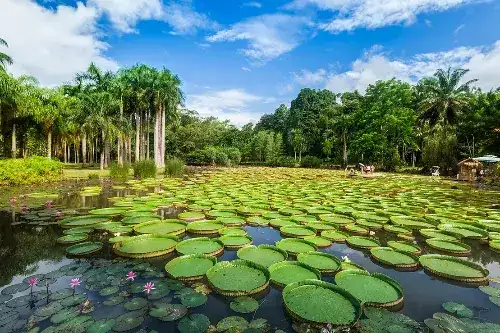
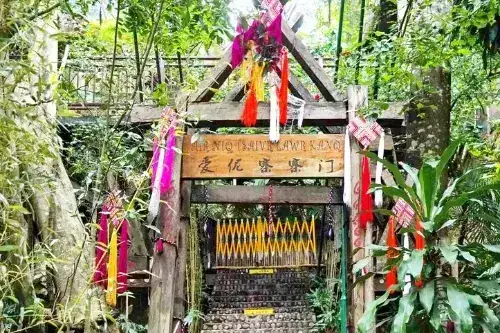
Mengbanaxi Rare Botanical Garden, located 7 kilometers from Mangshi Airport, is a national 4A scenic area covering over 300 mu. It features paleontological fossil, petrified wood, and rare stone exhibitions, along with eleven themed gardens. Moli Tropical Rainforest, 20 kilometers northeast of Ruili, covers 7 square kilometers with 96% forest coverage and 1,540 plant species. The "One Village, Two Countries" site near Ruili features a village straddling the China-Myanmar border, where residents of both nations share wells, streets, and customs. Bodhi Temple, built in 1667 in central Mangshi, is the best-preserved Buddhist temple in the area. Wanding Ecological Park, known as "China's Peacock Homeland," houses over 40 rare tree species and 100 animal species.
Local Specialties
Huilong Tea from Lianghe County is a national agricultural geographical indication product, known for tightly rolled leaves and bright yellow-green liquor. Dehong water buffalo, bred for over a thousand years, numbers over 100,000 head. Dehong coffee, primarily small-grain Arabica, once set a national record of 363.5 kg of beans per mu. By 2010, planting area reached 139,000 mu with annual output exceeding 11,000 tons. Husa knives, crafted by the Achang people for 600 years, are renowned for sharpness and flexibility, available in over 50 types and 130 styles, and exported to Myanmar, Thailand, India, and Japan. Bamboo tube rice and the hulusi (gourd flute), a traditional reed instrument, are also local specialties.
Notable Figures
Dao Anren (1872–1913) was a democratic revolutionary and the 24th-generation head of the Ganya chieftainship. Mao Xiang (1918–1986), a Dai dancer, founded the Dai peacock dance. Gen Dequan (1958–2008) was a master craftsman and performer of the hulusi, known as the "father of the hulusi."
External Exchange
Dehong maintains cross-border trade and cultural exchange programs with Myanmar and serves as a key node in the Bangladesh-China-India-Myanmar economic corridor.
Honors
In December 2020, Dehong received the National Voluntary Blood Donation Advanced City Award. In November 2021, it was selected for the ninth batch of National Ethnic Unity and Progress Demonstration Zones.
Travel information can change. Check current opening hours, reservations and entry requirements before you travel.
Traveller discussion
Start the conversation with a helpful tip or a question.