
Qiandongnan Miao and Dong Autonomous Prefecture
Qiandongnan Miao and Dong Autonomous PrefectureQiandongnan Miao and Dong Autonomous Prefecture is an autonomous prefecture under Guizhou Province, located in southeastern Guizhou. It borders Hunan to the east and Guangxi to the south, in th
Qiandongnan Miao and Dong Autonomous Prefecture
Qiandongnan Miao and Dong Autonomous Prefecture is an autonomous prefecture under Guizhou Province, located in southeastern Guizhou. It borders Hunan to the east and Guangxi to the south, in the transition zone from the Yunnan-Guizhou Plateau to the Xiang-Gui Hills. The terrain is higher in the west, south, and north, lower in the east. Subtropical humid monsoon climate. Total area: 30,282 square kilometers. As of February 2026: 1 county-level city, 15 counties. As of end 2025: 3,721,200 permanent residents. Established in 1956. It is a national-level ethnic culture ecological protection area, known as the "Prefecture of Song and Dance, Prefecture of Forests, Magical Prefecture, Hometown of Hundred Festivals, Hometown of Folk Culture and Art." It has 1 5A and 22 4A scenic areas. UNESCO intangible heritage: Dong Grand Song. Birthplace of "Village BA" (rural basketball) and "Village Super" (rural football). In 2025, the gross regional product was 150.024 billion yuan, up 5.0%.
History
Pre-Qin Period
During the Spring and Autumn period, the area belonged to Zangke and Chu's Qianzhong. During the Warring States period, it was Qielan and Chu's Qianzhong Commandery.
Qin-Han to Northern and Southern Dynasties
Under the Qin (221–206 BC), it was part of Qianzhong and Xiang commanderies. During the Han (202 BC–220 AD), it was under Wuling, Zangke, and Yulin commanderies.
Sui-Tang to Song-Yuan Period
During the Sui (581–618), under Zangke and Yuanling commanderies. During the Tang (618–907), under Qianzhong Circuit with Sizhou, Yingzhou, Chongzhou, and Liangzhou established. During the Song (960–1279), divided among Jinghu North, Kuizhou, and Guangnan circuits. During the Yuan (1271–1368), under Huguang and Sichuan provincial pacification offices.
Ming-Qing Period
During the Ming (1368–1644), 8 guards and 4 prefectures were established under Guizhou Province. During the Qing (1644–1912), 5 subprefectures were established in the Yongzheng era.
Republic of China Period
In 1913, all prefectures, subprefectures, and departments were converted to counties. Multiple administrative inspectorate adjustments followed. By 1948, counties were divided between the 1st and 2nd inspectorates.
After the Founding of the People's Republic of China
In November 1949, Zhenyuan was liberated and Zhenyuan Special District was established. In April 1956, the State Council decided to establish Qiandongnan Miao and Dong Autonomous Prefecture. On July 23, 1956, it was formally established, governing 16 counties with the prefecture seat at Kaili. In 1958, 16 counties were merged into 7. In 1961–1962, all 16 counties were restored. In 1983, Kaili County became Kaili City. In 1984, Kaili City was formally established.
Administrative Divisions
As of February 2026: 1 county-level city (Kaili) and 15 counties (Danzhai, Majiang, Huangping, Shibing, Zhenyuan, Cengong, Sansui, Tianzhu, Jinping, Liping, Congjiang, Rongjiang, Leishan, Taijiang, Jianhe), with 28 subdistricts, 129 towns, and 60 townships (15 ethnic). The Prefecture People's Government is at No. 21 Beijing East Road, Kaili City.
Geographical Environment
Location
Southeastern Guizhou, between 107°17'20"–109°35'24" east longitude and 25°19'20"–27°31'40" north latitude. Transition zone from Yunnan-Guizhou Plateau to Xiang-Gui Hills. Borders Hunan, Guangxi, Qiannan, Tongren, and Zunyi. Spans 220 km east-west, 240 km north-south. Total area: 30,282 square kilometers.
Geology
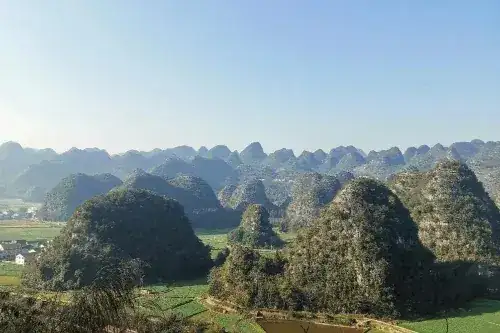
Straddles the Yangtze Paraplatform and South China Fold Belt. Carbonate rocks cover 23.1% of exposed area, forming the basis for karst landscapes.
Topography
North, west, and south high; east low. Central Leigong Mountain and southern Moon Mountain are medium mountain zones. Most areas: 500–1,000 m elevation. Highest: Huangyang Mountain at 2,178.8 m. Lowest: 148 m at Liping Diping Township.
Climate
Subtropical humid monsoon climate. No extreme winter or summer heat. Four distinct seasons with abundant rain and clear vertical climate variation. 2023 average: 16.3–20.3°C. Annual precipitation: 730.7–1,137.5 mm. Annual sunshine: 1,063–1,778.4 hours. Relative humidity: 73–81%. Frost-free: 344–365 days.
Hydrology
983 rivers (225 over 50 km²). Three main trunks: Qingshuijiang, Wuyanghe, and Duliujiang. Average annual runoff: 19.21 billion m³. Yangtze basin: 21,535 km²; Pearl River basin: 8,802 km². Important ecological barrier for upper Yangtze and Pearl rivers.
Soil
11 soil types, 26 subtypes, 6 genera, 222 species in 7 orders. Yellow soil: 62.32% (largest). Red soil: 10.26%. Black limestone soil: 10.04%. Paddy soil: 5.56%.
Natural Disasters
January–March: freezing, hail, flooding. July: heavy rain, lightning, high temperatures, main flood season. 2022 June 17-18: extreme rainstorms, 345.9 mm maximum. 712 households (2,515 people) evacuated from Congjiang. Flood emergency level IV activated.
Natural Resources
Water Resources
Theoretical hydropower: 3.32 million kW. Developable: 2.7 million kW. 333 hydropower stations built (2.2547 million kW total). 41 large and medium reservoirs (total capacity 6.124 billion m³). 2023 water resources: 8.219 billion m³ (dry year, 57.2% below multi-year average). Per capita: 2,187 m³.
Land Resources
Cultivated: 329,777 hectares (65.83% paddy, 34.16% dryland). Forest: 2,323,826 hectares. Grassland: 11,240 hectares. Wetland: 867 hectares. Construction: 76,856 hectares. Transportation: 42,275 hectares. Water: 45,881 hectares. 13 cultivated basins over 5,000 mu. 3,751 hectares of rocky desertification (88.62% in Zhenyuan and Shibing).
Biological Resources
557 vertebrate species: 217 birds (13 orders, 37 families), 96 mammals (8 orders, 25 families), 130 fish, 69 reptiles, 45 amphibians. 120+ nationally protected species (17 Class I: leopard, forest musk deer, small civet, white-crowned pheasant, Chinese merganser; 105 Class II). Forest coverage: 68% (first in Guizhou). 5 national forest parks, 1 national nature reserve, 1 national geopark. 3,623 plant species (214 families, 1,050 genera). 400+ medicinal plants. 120+ nationally protected plant species (6 Class I, 119 Class II). Leigong Mountain Nature Reserve: established 1982, national since 2001, protecting Taiwania (6,640+ trees). "China's Most Beautiful Forest" award.
Mineral Resources
61 mineral types discovered (44.5% of Guizhou's 137). 46 with proven reserves. Barite: ranked first nationally. Glass quartz sandstone and antimony: top 3 in Guizhou. 349 mineral occurrences (12 large, 29 medium, 306 small, 2 prospects).
Politics
Population
Population Size
As of end 2025: 3,721,200 (down 19,100). Urban: 1,855,000 (49.85%). Birth rate: 9.10 per mille; death rate: 8.87 per mille; natural growth rate: 0.23 per mille. Registered: 4,904,700.
Ethnic Groups
33 resident ethnic groups. Minorities: 4,044,100. Miao: 2,148,500; Dong: 1,504,800. China's most concentrated Miao-Dong population area. 17 ethnic townships. 7 of 9 main minorities still use their own languages (Miao, Dong, Shui, Buyei, She, Zhuang, Yao).
Language
7 of 9 main minority groups still use their own ethnic languages (Miao, Dong, Shui, Buyei, She, Zhuang, Yao). Tujia and Gelao have switched to Chinese.
Religious Beliefs
4 religious organizations (3 prefectural: Buddhist Association, Christian Self-Improvement Movement, Christian Association; 1 municipal: Kaili Catholic Patriotic Association). 40 registered religious venues.
Economy
Overview
"5+N" modern industrial system: mineral deep processing, recycled materials, specialty food, wood processing/furniture, health pharmaceuticals + N special industries (new energy materials, baijiu, ethnic handicrafts, textiles, sports equipment). In 2025, the gross regional product was 150.024 billion yuan, up 5.0%. By industry: primary 28.945 billion (19.3%), secondary 32.363 billion (21.6%), tertiary 88.715 billion (59.1%). Per capita GDP: 40,213 yuan. Fixed-asset investment up 6.3% (industrial up 43.2%, high-tech up 11.7%, private up 14.5%). Total fiscal revenue: 13.214 billion, up 6.0%. General public budget revenue: 8.367 billion, up 4.0%. General public budget expenditure: 55.579 billion, up 5.4%.
Primary Industry
Agricultural added value: 30.402 billion yuan, up 4.5%. Total agricultural output: 50.877 billion, up 4.7%. Grain area: 4.0502 million mu. Grain output: 1.4128 million tons, up 1.4% (autumn 1.2477 million tons). Vegetables: 4.1984 million tons, up 3.3%. Edible mushrooms: 50,800 tons, up 8.2%. Rapeseed: 105,700 tons, up 3.8%. Medicinal herbs: 451,800 tons, up 9.1%. Tea: 24,700 tons, up 5.2%. Fruit: 1.0365 million tons, up 4.3%. Meat: 199,900 tons, up 4.3%. Pigs sold: 1.6099 million, up 8.4%. Aquaculture: 70,900 tons, up 5.2%.
Secondary Industry
Industrial added value: 22.175 billion yuan, up 9.2%. Above-scale industrial added value up 13.0% (light industry up 13.6%; heavy industry up 12.8%). Mining up 15.7%; manufacturing up 17.0%; electricity/heat/gas/water up 1.5%. Revenue: 54.516 billion, up 28.9%. Profits: 1.244 billion, down 36.6%. Construction added value: 10.219 billion, down 1.9%.
Tertiary Industry
Total retail sales: up 2.1%. Foreign trade: 1.003 billion yuan, down 9.3% (exports 646 million, up 3.9%; imports 357 million, down 26.2%). Actual foreign investment: 18.09 million USD, up 140.9%. Total deposits: 245.128 billion, up 7.0%. Total loans: 258.547 billion, up 2.6%. Insurance premiums: 4.454 billion, up 8.9%.
Social Affairs
Education
4 higher education institutions (1 undergraduate with 11,234 students, 3 college with 30,208). 20 secondary vocational (86,403), 51 high schools (108,860), 150 junior high (213,841), 608 primary (374,285), 1,051 kindergartens (120,630). Preschool enrollment: 95%. Compulsory education consolidation: 96.71%. High school enrollment: 93.27%.
Science and Technology
31 provincial+ S&T projects (22.94 million yuan). 2 provincial key laboratories. 44 prefectural projects (2.69 million yuan). 101 valid high-tech enterprises (23 new). 389 technology contracts worth 4.6 billion yuan (up 15%).
Culture
17 cultural centers, 17 public libraries, 40 museums. 20 national protected heritage sites. 18 TV transmitters. 1.181 million digital cable households. TV coverage: 99.96%. Radio coverage: 99.87%.
Healthcare
3,815 health institutions: 119 hospitals, 217 township health centers, 17 maternal/child centers, 17 CDCs, 721 clinics, 2,693 village clinics. 29,755 beds. 36,064 health workers (10,329 physicians, 2,612 assistant physicians, 15,749 nurses, 1,387 pharmacists, 3,266 technicians).
Sports
14 public stadiums, 14 public gymnasiums, 5 fitness centers, 4 swimming pools, 17 sports parks. 1,214+ Class II athletes (66 new in 2025). 41 gold, 56 silver, 47 bronze at provincial+ competitions. Birthplace of "Village BA" (rural basketball, 1.5+ billion views in 2022) and "Village Super" (rural football), hailed as "a window into Chinese-style modernization."
Social Security
Employee pension: 479,200 (up 9,000). Urban-rural pension: 2,476,300 (down 28,700). Work injury: 407,400 (down 16,600). Unemployment: 221,700 (up 67,000). Medical insurance: 4,374,800 (up 1,200). Maternity: 244,100 (up 6,000). Urban minimum living: 50,400 (785.63 yuan/month). Rural: 167,600 (7,218 yuan/year). 1.064 billion yuan disbursed. 53 social service institutions (45 elderly care, 3 child welfare) with 5,683 beds.
Transportation
Overview
Key junction of Guizhou, Guangxi, and Hunan. National expressways (Hukun, Lanhua, Xiarong) plus provincial expressways connect all counties.
Highways
Total mileage: 31,887 km (1,311 km expressway, 1,751 km national, 3,257 km provincial). Density: 105.11 km/100 km². 100% village hard-surface road and bus coverage. Leirong Expressway opened November 3, 2023.
Railways
Shanghai-Kunming old railway (stations: Kaili, Shibing, Zhenyuan, Yangping), Shanghai-Kunming HSR (stations: Kaili South, Sansui), Guiyang-Guangzhou HSR (stations: Congjiang, Rongjiang). Kaili South: 3 platforms, 7 tracks, 2,000-person capacity.
Water Transport
Inland waterway: 1,158 km.
Aviation
Kaili Huangping Airport: Opened October 1, 2013. 4C-level, 2,600 m runway, 3,500 m² terminal. 20 km from Kaili. Designed for 200,000 annual passengers and 800 tons cargo.
Liping Airport: Opened September 26, 2006. 4C-level, 2,200 m runway, 3,000 m² terminal. Serves B737-300/A319 and below.
Tianzhu Airport: Under construction, 4C-level, 2,600 m runway planned.
Public Transportation
110 bus routes (2 yuan or segmented fare). 304 long-distance routes.
Human History and Culture
Overview
National-level ethnic culture ecological protection area. Known as "Prefecture of Song and Dance," "Hometown of Hundred Festivals." 390+ annual ethnic festivals (120+ with 10,000+ participants). One of UNESCO's "Top 10 Return-to-Nature Tourism Destinations."
Customs
Sama Festival (Dong, January-February), Gannang Xiang Miao Lusheng Festival (Zhuxi, January), Luoxiang Lusheng Festival (Dong, August 15), Miao Sisters' Festival (Taijiang, March 15-17), New Crop Festival (Miao), Guzang Festival (Miao, every 13 years, national heritage).
Arts
Known as "Ocean of Song and Dance." Miao "Flying Song" and "Traveling Song," Dong Grand Song (multi-part, a cappella, no conductor, UNESCO heritage 2009). Dances: Miao wooden drum dance ("Eastern Disco"), Lusheng dance, Dong Duoye dance. Crafts: Miao batik (Song Dynasty tribute), Dong brocade, embroidery. Architecture: stilt houses, Drum Towers, Flower Bridges.
Cultural Relics
20 national, 99 provincial, 54 prefectural, 867 county-level protected sites. 41 museums. 10 Miao and 12 Dong villages on China World Cultural Heritage tentative list. 1 national historical city, 2 historical towns, 7 historical villages. 415 traditional villages. 126 ethnic minority villages.
Intangible Cultural Heritage
UNESCO: Dong Grand Song (2009). National: 56 items (78 sites). Provincial: 218 items (307 sites, first in Guizhou). Prefectural: 329 items. Miao multi-part love songs, batik, Miao silver forging (30+ processes), Miao Flying Song, Dong opera (created by Wu Wencai ~1830).
Regional Symbol
In 2020: Prefecture tree = Yew (national Class I protected plant, distributed in Huangping, Shibing, Leishan, Liping). Prefecture flower = Rhododendron (distributed in all 16 counties, with continuous areas in Danzhai and Liping).
Scenic Spots
Overview
As of end 2025: 1 5A, 22 4A, 42 3A scenic areas. 10 scenic areas groups (3 national, 7 provincial) covering 227,400 hectares. 19 nature reserves (1 national, 1 provincial) covering 233,200 hectares (7.7% of total).
Important Scenic Spots
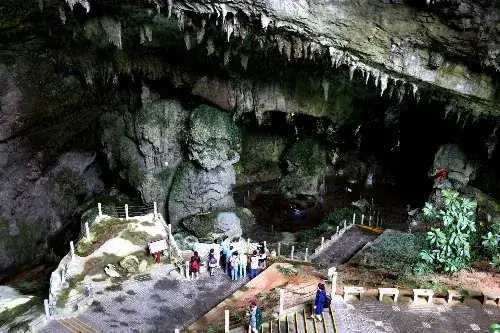
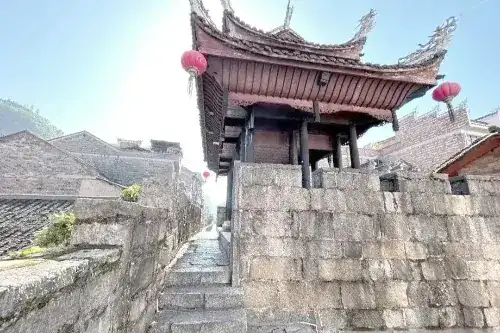
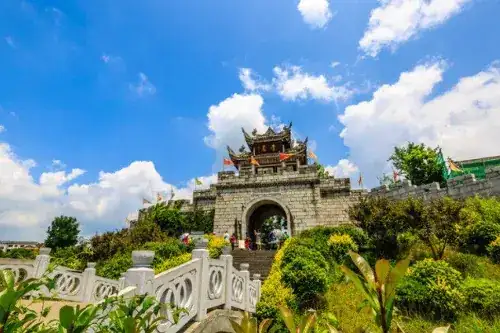
Xijiang Qianhu Miao Village (1,000-household Miao village), Shibing Yuntai Mountain, Zhenyuan Ancient City.
Food Specialties
Congjiang pickled fish (Miao-Dong specialty, sour-spicy-sweet, can be steamed/stewed/grilled/roasted), crispy sour soup pig trotters (Shibing specialty), Prince ginseng banquet (Shibing, "China's Prince Ginseng Hometown"), grey alkali rice cake (Spring Festival traditional food), Kaili sour soup fish (Guizhou's famous sour soup, rich in calcium, phosphorus, iron, zinc), five-color sticky rice (made with maple leaf, plum bark, and other natural dyes), Congjiang roasted fragrant pig.
Famous People
Zhou Ying (1429-1503, first Jinshi from Qiandongnan), Sun Yingao (1527-1586, first Guizhou native to lecture the Emperor), He Tengjiao (1592-1649, Ming loyalist general), Wu Wencai (1798-1845, creator of Dong opera), Zhang Xiumei (1823-1872, Miao uprising leader), Tan Junpei (1828-1894, Qing Dynasty official), Luo Dachun (1833-1890, Qing military commander), Le Jiacao (1867-1944, author of first "Chinese Architecture History"), Xia Tonghe (1868-1925, last imperial Zhuangyuan from Guizhou, pioneer of modern Chinese administrative law), Wang Tianpei (1888-1927, Northern Expedition general), Zhou Changshou (1888-1950, physicist and translator who introduced quantum theory and relativity to China), Liang Juwu (1892-1977, Miao studies pioneer).
Important Honors
National Ethnic Culture Ecological Protection Area. UNESCO "Return to Nature" destination. "Village BA" and "Village Super" birthplace. "China's Top 10 Sweet Cities" (2026).
External Exchange
Sister city with Hangzhou (signed 2021). East-west poverty alleviation collaboration with Hangzhou since 2018.
Travel information can change. Check current opening hours, reservations and entry requirements before you travel.
Traveller discussion
Start the conversation with a helpful tip or a question.