
Chongzuo City
Chongzuo CityChongzuo City is a prefecture-level city under the jurisdiction of the Guangxi Zhuang Autonomous Region. It is an important node city in the Pearl River-Xijiang Economic Belt, the Beibu Gulf Urban Agglomeration, and the Guangxi
Chongzuo City
Chongzuo City is a prefecture-level city under the jurisdiction of the Guangxi Zhuang Autonomous Region. It is an important node city in the Pearl River-Xijiang Economic Belt, the Beibu Gulf Urban Agglomeration, and the Guangxi Beibu Gulf Economic Zone. Located in southwestern Guangxi (between latitudes 21 degrees 36 minutes and 23 degrees 22 minutes North, and longitudes 106 degrees 33 minutes and 108 degrees 6 minutes East), it borders Nanning and Fangchenggang to the east and southeast, Baise to the north, and Vietnam to the west. It is the prefecture-level city with the longest land border in Guangxi, covering a total area of 17,300 square kilometers. Chongzuo is China's most convenient land gateway to ASEAN, a key node in the China-Vietnam Two Corridors and One Ring framework and the Nanning-Singapore Economic Corridor, and the Chinese city with the most border ports. As of 2022, it administers one municipal district, five counties, and one county-level city. At the end of 2024, the resident population was 2.0461 million. During the Qin Dynasty's unification of China, the area belonged to Xiang Commandery. The city was formally established on August 6, 2003. Chongzuo is hailed as China's Sugar Capital and Manganese Capital, the largest sugarcane cultivation and sugar production base in the country, home to the white-headed langur, and a National Forest City. In 2025, its GDP reached 135.864 billion yuan (approximately $18.7 billion), up 6.0% year-on-year.
History
Before the founding of the People's Republic of China, Chongzuo was a settlement of the Luoyue people, ancestors of the Zhuang ethnic group. During the Warring States period, the Lingnan region was known as the land of Baiyue, with Chongzuo as part of it. When Qin Shi Huang unified China, the area fell under Xiang Commandery. During the Han Dynasty, it belonged to Xiang and Yulin Commanderies. In the Sui Dynasty, it was under Yulin Commandery. In the Tang Dynasty, it was part of the Lingnan West Circuit. In the late Song Dynasty, it belonged to Yongzhou. Under the Yuan Dynasty's provincial system, the area was administered through routes including Taiping Route, Siming Route, Zhen'an Route, and Longzhou Myriarch Office.
In the Ming Dynasty, the provincial system was replaced by a three-tier prefecture, department, and county system, with the territory divided among Taiping, Nanning, Siming, and Si'en Prefectures. In the Qing Dynasty, the area was split between Taiping and Zhen'an Prefectures. In the early Republic of China era, the administrative system was reformed to a province, circuit, and county structure, and the area belonged to Zhennan Circuit and others. In 1929, all hereditary tusi (native chieftain) systems were abolished and replaced with appointed officials, bringing the former tusi regions under the same administrative system as Han Chinese areas. By the eve of liberation, the area comprised 17 counties.
After liberation, the Guangxi Provincial People's Government established three special districts in southwestern Guangxi. The current Chongzuo area belonged to Longzhou Special District. In 1952, Longzhou Special District was renamed Chongzuo Special District. In 1953, Chongzuo and Binyang Special Districts merged to form Yongning Special District, which was later renamed Nanning Special District in 1958 and Nanning Prefecture in 1971. On December 23, 2002, the State Council approved the abolition of Nanning Prefecture and the establishment of the prefecture-level Chongzuo City.
Administrative Divisions
Division Evolution
In 1952, Funan, Suilu, and Tongzheng counties were merged to form Fusui County; Leiping, Wancheng, and Yangli counties formed Daxin County; Longjin and Shangjin counties formed Lijiang County; and Chongshan and Zuo counties formed Chongzuo County. In 1953, Sile and Zhennan counties merged to form Ningming County, and Lijiang County was renamed Longjin County. In 1955, Pingxiang Town of Ningming County was elevated to county-level status. In 1956, county-level Pingxiang City was established. In 1960, Longjin County was renamed Longzhou County. In 2002, Nanning Prefecture was abolished and Chongzuo City was established, incorporating Jiangzhou District, Fusui, Daxin, Tiandeng, Longzhou, and Ningming counties, with county-level Pingxiang City under its administration.
Division Details
As of 2025, Chongzuo City administers one municipal district (Jiangzhou), five counties (Fusui, Daxin, Longzhou, Ningming, and Tiandeng), and one county-level city (Pingxiang), comprising 3 subdistricts, 41 towns, and 34 townships, with 751 administrative villages and 113 communities. The municipal government is seated at No. 1 Xincheng Road, Jiangzhou District.
Geography
Location
Chongzuo is located in southwestern Guangxi, south of the Tropic of Cancer, facing Southeast Asia and backed by the great southwest. It borders Nanning and Fangchenggang to the east and southeast, Baise to the north, and Vietnam to the west, with a total area of 17,300 square kilometers.
Geology
The geological structure is ancient, primarily based on Devonian, Permian, and Triassic strata, with limestone predominating, followed by shale and sandstone, covered by Quaternary acidic red soil.
Topography
The western part features the Daqingshan mountain range, while the south includes the Gongmushan range and the tail of the Shiwan Dashan mountains. The terrain is slightly higher in the northwest and southwest, sloping eastward, with the Zuojiang River and its tributaries cutting through the central area to form interleaving hills and plains. The highest peak is Pulongshan at 1,358 meters on the border of Ningming County and Fangchenggang, followed by Gongmushan at 1,357.6 meters near the Vietnam border at Aidian.
Climate
Chongzuo lies south of the Tropic of Cancer in a subtropical humid monsoon climate zone, characterized by high temperatures, abundant sunshine, and plentiful but unevenly distributed rainfall, with long summers and no winter. The average annual rainfall is 1,261 millimeters over 147 rainy days, with 79% concentrated in the April-to-September wet season. The average annual temperature is 22.1 degrees Celsius, with the hottest month being July at 28.1 degrees and the coldest January at 13.6 degrees. Extreme high and low temperatures reach 41.7 degrees and 0.0 degrees Celsius, respectively. The average annual sunshine duration is 1,555 hours.
Hydrology
A total of 106 rivers with basin areas exceeding 50 square kilometers flow through Chongzuo. The Zuojiang River is the city's largest river, flowing 552 kilometers from its source at Kulun Mountain on the Vietnam border through Pingxiang, Longzhou, Ningming, the urban area, and Fusui County, until it merges with the Youjiang River at Songcun in suburban Nanning. The Mingjiang River is the largest tributary, and the Heishui River has an average flow of about 135 cubic meters per second. There are 11 transnational rivers.
Natural Resources
Land Resources
The total land area is 17,332 square kilometers, including 456,400 hectares of arable land (26.33%), 1,052,900 hectares of forest land (60.75%), and 64,900 hectares of garden land (3.74%). In 2021, the state-owned construction land supply totaled 31,916.15 hectares.
Mineral Resources
Chongzuo is located in the southern section of the mineral-rich western Guangxi belt. Thirty-six mineral types have been discovered across 202 deposits and occurrences, including coal, manganese, iron, tungsten, copper, lead, zinc, gold, silver, rare earths, and bentonite. Notable reserves include approximately 82.92 million tons of coal, 140.85 million tons of manganese ore, 53,700 tons of zinc, and 10,990 tons of rare earth oxides. As of 2021, the city had 98 mines of various types.
Forest Resources
As of 2021, forest land totaled 1,052,899 hectares, with timber forest accounting for 47.18%, shrub forest 46.69%, and other categories 5.34%. The forest coverage rate is 55.8%.
Water Resources
In 2021, total water consumption was 1.078 billion cubic meters, including 829 million cubic meters for agricultural use. The total hydropower potential is 604,300 kilowatts, with 157,200 kilowatts already developed.
Biological Resources
Chongzuo is home to 696 species of terrestrial vertebrates across 34 orders, including 23 species under Class I national protection such as the white-headed langur, black leaf monkey, and clouded leopard, and 117 species under Class II protection. The white-headed langur population includes approximately 149 groups with over 1,350 individuals. The city also hosts 3,071 species of wild vascular plants across 234 families, including 15 species under Class I national protection and 35 under Class II. There are 17,724 ancient and notable trees, including 29 specimens over 1,000 years old.
Population
Population Figures
At the end of 2024, the resident population was 2.0461 million, a decrease of 15,100 from the previous year. The urbanization rate reached 47.28%. The birth rate was 6.96 per thousand and the death rate 9.09 per thousand, resulting in a natural growth rate of negative 2.13 per thousand.
Ethnic Composition
According to the Seventh National Census in 2020, the Han Chinese population was 307,779 (14.74%), while ethnic minorities totaled 1,780,913 (85.26%), with the Zhuang people comprising 1,756,280 (84.09%). Chongzuo is home to 38 ethnic groups, with the Zhuang accounting for 89% of the population, the highest minority proportion among prefecture-level cities in Guangxi and the most concentrated Zhuang population in China.
Politics
The municipal government is seated in Jiangzhou District. The city's political structure follows standard Chinese governance with party and government organs at the municipal and county levels.
Economy
Overview
In 2025, Chongzuo's GDP reached 135.864 billion yuan (approximately $18.7 billion), a year-on-year increase of 6.0%. In 2024, the general public budget expenditure was 28.334 billion yuan (approximately $3.9 billion), up 6.9%, with 79.1% allocated to livelihood areas. Fixed asset investment grew 0.1%, with industrial investment increasing 7.8% and private investment up 7.4%.
Primary Industry
Chongzuo is China's largest sugarcane cultivation and sugar production base, hailed as the Sugar Capital of China. Sugarcane planting area exceeds 4 million mu, and raw cane and sugar output have ranked first nationally for 13 consecutive crushing seasons, accounting for about one-fifth of national and one-third of Guangxi's production. In 2024, the total output value of agriculture, forestry, animal husbandry, and fisheries was 44.965 billion yuan (approximately $6.2 billion), up 4.0%. Pig slaughter reached 1.445 million head, up 4.6%, and aquatic product output was 67,300 tons, up 3.8%.
Secondary Industry
In 2024, value-added of designated-scale industries grew 15.1%, with manufacturing up 17.3%. The sugar industry grew 14.6%, food manufacturing 31.8%, wood processing 21.2%, and non-ferrous metal smelting 17.2%.
Tertiary Industry
In 2024, the tertiary industry's value-added grew 1.9%. Total retail sales of consumer goods increased 1.8%. Foreign trade reached 272.961 billion yuan (approximately $37.6 billion), up 14.0%, with exports totaling 230.421 billion yuan. Inbound tourists numbered 23,089, up 111.4%, with international tourism revenue of $5.04 million, up 55.0%. Domestic visitors reached 56.3852 million, with domestic tourism revenue of 54.034 billion yuan (approximately $7.5 billion), up 17.2%. Year-end deposits in financial institutions reached 141.098 billion yuan (approximately $19.5 billion).
Social Affairs
Education
In 2024, Chongzuo had 9 regular higher education institutions with 140,986 enrolled students, 24 regular senior high schools with 53,172 students, 87 junior high schools with 84,202 students, and 192 primary schools with 176,319 students. The nine-year compulsory education retention rate was 98.9%, and the gross enrollment rate for senior high school was 93.5%.
Science and Technology
In 2023, 758 patents were granted, including 108 invention patents.
Culture
The city has 7 public libraries with 991,200 volumes, 3 theaters, 5 museums, and 11,555 sports venues. Radio and television coverage rates reach 99.1% and 99.4%, respectively.
Healthcare
As of 2024, there were 1,221 medical and health institutions, including 32 hospitals and 88 township health centers, with 12,581 beds and 16,016 health professionals, including 4,740 licensed physicians and 7,289 registered nurses.
People's Livelihood
In 2024, per capita disposable income was 27,909 yuan (approximately $3,850), up 5.1%. Urban residents earned 41,043 yuan and rural residents earned 19,190 yuan, up 3.9% and 7.1%, respectively. Per capita consumption expenditure was 16,807 yuan, up 8.5%.
Social Security
At the end of 2024, 325,300 people participated in urban employee basic pension insurance, and 1.2558 million in urban-rural resident basic pension insurance. Social welfare institutions provided 1,158 beds, including 836 in elderly care facilities.
Urban Construction
In 2020, the State Council approved the establishment of a cross-border e-commerce comprehensive experimental zone in Chongzuo. In 2021, the urban built-up area was 112.59 square kilometers, with a greenery coverage rate of 38.22%, 100% harmless waste treatment, and 96.30% sewage treatment rate.
Transportation
Overview
Chongzuo enjoys strategic transport advantages along the border, expressways, and proximity to the capital and ASEAN. Multiple expressways connect the city, including the Nanning-Youyiguan, Chongzuo-Qinzhou, Chongzuo-Jingxi, and Chongzuo-Shuikou routes. The Xianggui Railway and national highways G322, G358, G359, and G219 run through the city, making it one of the few border cities with railway and highway connections to the national transport network.
Highways
As of mid-2022, total highway mileage reached 10,412 kilometers, including 426 kilometers of expressways. All 752 administrative villages are connected by roads, with 100% access to passenger transport. The city has 410 passenger stations and 231 bus routes, including 44 inter-provincial routes.
Railways
The Nanning-Pingxiang section of the Xianggui Railway, spanning 220 kilometers, serves as a vital link in the Hanoi-Beijing-Moscow international rail route. On December 5, 2022, the Nanning-Chongzuo high-speed railway opened, ending Chongzuo's history without high-speed rail. Major stations include Chongzuo Station, Fusui Station, Ningming Station, and Pingxiang Station.
Water Transport
Chongzuo has 387 kilometers of navigable waterways. Five port areas, including Chongzuo Port Central, Fusui, Longzhou, Ningming, and Pingxiang, serve water transport, with 3 waterway passenger transport enterprises and 9 tourist vessels.
History and Culture
Origin of the Name
In August 1952, Longzhou Special District was renamed Chongzuo Special District after merging Chongshan and Zuo counties. The name Chongzuo derives from the first characters of Chongshan and Zuo counties.
Cultural Relics
As of 2021, there are 192 protected cultural heritage sites, including 6 national-level and 30 autonomous-region-level sites.
Intangible Cultural Heritage
Chongzuo has 3 national-level intangible cultural heritage items: the Zhuang Frost Descent Festival, Zhuang Tianqin Art, and Zhuang Nongdong Festival. The Zhuang Frost Descent Festival was inscribed on the UNESCO Representative List of the Intangible Cultural Heritage of Humanity in 2016 as part of the Twenty-Four Solar Terms. The Zhuang Tianqin Art, a fusion of singing, playing, and dancing, is widespread in Longzhou, Pingxiang, Ningming, Daxin, Tiandeng, and Fusui. The Zhuang Nongdong Festival is a traditional large-scale celebration held by the Zhuang people in the Zuojiang River basin, integrating sacrificial rituals, socializing, antiphonal singing, trade, and entertainment.
Ethnic Customs
The Tea-Picking Dance is popular in Tuolu, Nalong, and Zuozhou, depicting the labor and love of the Zhuang people. The Firecracker Grabbing is a traditional sport in Zuozhou Town, featuring teams competing to capture an iron ring launched into the air. The Flower Festival is held on the second day of the second lunar month in Ningming and Longzhou, commemorating the Flower Fairy. The Southern Zhuang Opera is popular in Jingxi, Debao, Napo, Daxin, and Tiandeng, with major repertoire including Jie Jiu, Double Champion, and Hundred Bird Garment.
Local Cuisine
Five-Color Glutinous Rice is a traditional Zhuang snack named for its black, red, yellow, white, and purple colors, symbolizing good fortune and abundant harvests. Guanglang flour, made from the pith of the Guanglang palm tree, is a historic specialty of Longzhou County. Sour Porridge is a traditional Zhuang condiment made by fermenting rice in a sealed ceramic jar.
Local Specialties
Tiandeng Sky-Pointing Chili is a premium variety grown in Tiandeng County under specific soil and climate conditions, recognized as the hottest chili in the world with a 1983 national quality product award. The city also produces star anise across 9,800 mu with an annual output of about 2,000 tons of dried fruit, and Kuding tea with an annual fresh output of over 450 tons, believed to aid gastrointestinal, throat, and blood pressure conditions.
Scenic Spots
Overview
Chongzuo has over 500 tourism resources across scenic landscapes, cultural relics, rare wildlife, and primeval ecology. As of 2022, there are 45 national A-level scenic areas, including 2 at the 5A level.
Major Attractions
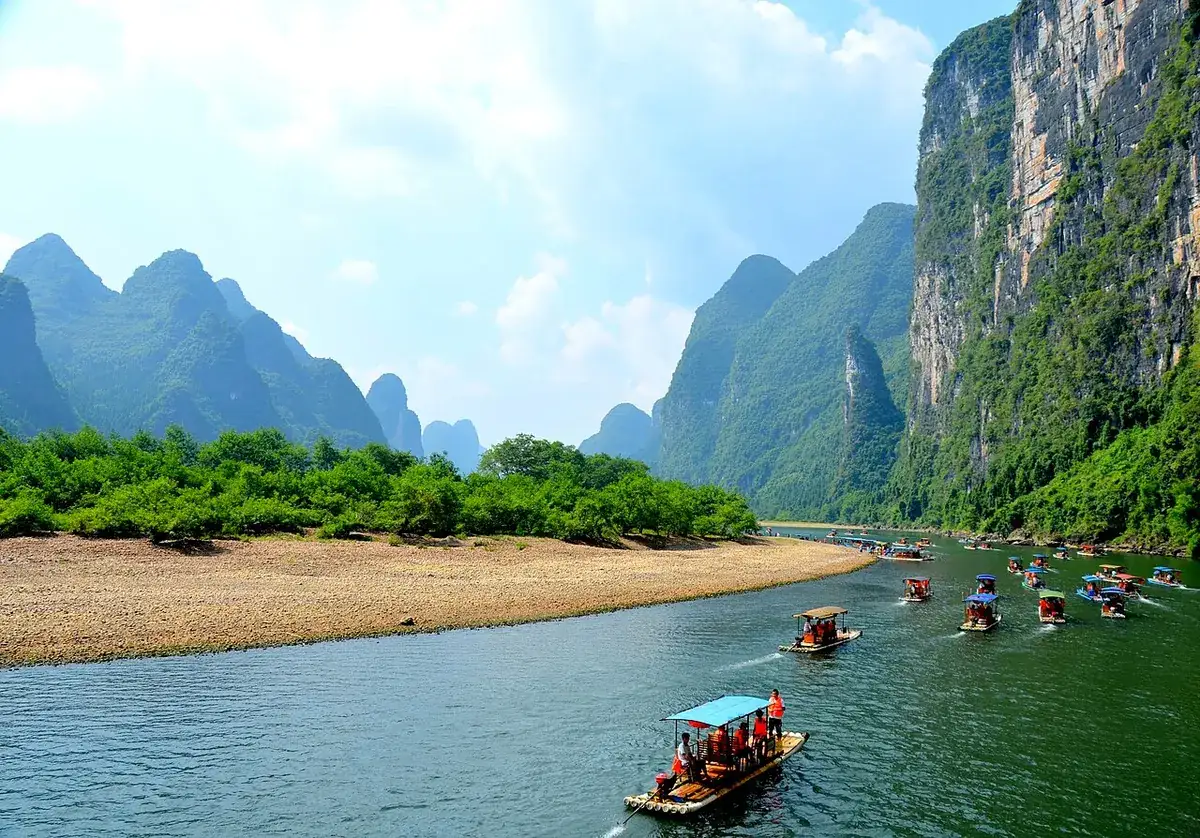
The Heishui River Scenic Area in Daxin County features karst peak-cluster canyon landscapes with three main scenic points. The Longgong Fairyland is a karst cave with a constant temperature of 15 to 20 degrees Celsius. The Zuojiang Leaning Tower, built in 1621, is one of the world's eight leaning towers, tilting at 4 degrees and 24 minutes. The Detian Transnational Waterfall, a national 5A scenic area, is Asia's largest transnational waterfall, located on the China-Vietnam border 66 kilometers from Daxin County seat. Youyiguan, or Friendship Pass, located 18 kilometers southwest of Pingxiang, is a historic border pass dating to the Ming Dynasty, where the famous Zhennanguan Victory against French forces was won in 1885.
Honors
In October 2025, Chongzuo was named a National Demonstration City for Rule of Law Government Construction.
Sister Cities
Travel information can change. Check current opening hours, reservations and entry requirements before you travel.
Traveller discussion
Start the conversation with a helpful tip or a question.