
Laibin City
Laibin CityLaibin (Zhuang: Laizbinh) is a prefecture-level city in Guangxi Zhuang Autonomous Region, located between 23 degrees 16 minutes 10 seconds to 24 degrees 28 minutes 14 seconds north latitude and 108 degrees 24 minutes 39 seconds t
Laibin City
Laibin (Zhuang: Laizbinh) is a prefecture-level city in Guangxi Zhuang Autonomous Region, located between 23 degrees 16 minutes 10 seconds to 24 degrees 28 minutes 14 seconds north latitude and 108 degrees 24 minutes 39 seconds to 110 degrees 27 minutes 18 seconds east longitude. Situated in the central-northeastern part of Guangxi, it is known as "the heart of Gui." With a total administrative area of 13,400 square kilometers, it has a subtropical monsoon climate with long summers and short winters, abundant rainfall, and concurrent heat and rain seasons. As of June 2023, the city administers 1 district, 4 counties, and 1 county-level city. The permanent population was 2.0511 million at end-2023. In 743 CE, Huaiyi County was renamed Laibin County under Yanzhou. In December 1949, the Liuzhou Special District was established, later renamed Liuzhou Prefecture in 1970. On September 29, 2002, Liuzhou Prefecture was abolished and Laibin City was established. Laibin is an important node city on the Pearl River-Xijiang Economic Belt, a "4+2" city in the Beibu Gulf Economic Zone, and a key component of the southwest corridor to the sea. Known as "China's City of Ornamental Stones," it has been recognized as a National Forest City, Guangxi Garden City, and a national new-type urbanization pilot area. In 2025, Laibin's GDP reached 104.966 billion yuan (approximately USD 14.6 billion), up 4.8% at constant prices.
Historical Evolution
In 1956, researchers from the Institute of Vertebrate Paleontology discovered the "Qilinshan Man" skull fossil at Qilin Mountain in Laibin, proving that Zhuang ancestors lived in the central Guangxi region approximately 36,000 years ago during the late Paleolithic period. In 214 BCE, the Qin unified Lingnan and established Zhongliu County at Wuxuan, marking the beginning of administrative governance in the area. In 111 BCE, Guilin County was established at present-day Xiangzhou. During the Jin, Three Kingdoms, and Northern and Southern Dynasties, Guilin Commandery was established with its seat at the junction of present-day Xiangzhou and Wuxuan. During the Tang dynasty, Xiangzhou, Yanzhou, Zhizhou, and Sigangzhou were established in the territory. In 743 CE, Huaiyi County was renamed Laibin County under Yanzhou. From the Song to Qing dynasties, administrative divisions changed frequently. During the Republic of China era, the area underwent multiple reorganizations across the Liuzhou, Cangwu, and Nanning circuits. In December 1949, the Liuzhou Special District was established. In 1958, the Yishan Special District was renamed Liuzhou Special District. In 1965, Hechi Special District was carved out from Liuzhou. In 1970, it was renamed Liuzhou Prefecture. On September 29, 2002, Liuzhou Prefecture was abolished and Laibin City was established.
Administrative Divisions
Division History
This section records only the division history of the 5 counties (county-level cities, districts) now under Laibin. In December 1949, the Liuzhou Special District was established, with Xiang County (present-day Xiangzhou), Wuxuan, and Laibin counties under its jurisdiction. In 1952, Shilong County was created from the merger of Wuxuan and Xiang counties. In November 1952, Qianjiang County was abolished and merged into Laibin County. In 1960, Shilong County was renamed Xiangzhou County. In 1962, Wuxuan County was re-established from Xiangzhou. In 1966, Dayao Mountain Yao Autonomous County was renamed Jinxiu Yao Autonomous County. In 1981, Heshan City was established from the former Beisi Township of Laibin County. In 2002, Liuzhou Prefecture was abolished and Laibin City was established; Laibin County became Xingbin District. Laibin administers Xingbin District, Xincheng County, Xiangzhou County, Wuxuan County, and Jinxiu Yao Autonomous County, with Heshan City under its management. The former Liuzhou Prefecture counties of Luzhai, Rongan, Rongshui Miao Autonomous County, and Sanjiang Dong Autonomous County were transferred to Liuzhou.
Division Details
As of June 2023, Laibin City administers 1 district, 4 counties, and 1 county-level city. The city has 21 townships, 45 towns, 4 subdistricts, 712 administrative villages, and 97 communities. The municipal government is seated at No. 1 Renmin Road, Chengbei Subdistrict, Xingbin District.
Geography
Location and Territory
Laibin is located in the central-northeastern part of Guangxi, earning the name "heart of Gui." It borders Wuzhou to the east, Guigang to the southeast and south, Nanning to the southwest and west, Hechi to the northwest, Liuzhou to the north, and Guilin to the northeast. The east-west span is 202.1 kilometers. The total administrative area is 13,400 square kilometers.
Topography
The terrain is dominated by mountains and hills with complex landforms, including mountains, hills, plains, and karst areas. The main range is the Dayao Mountains in Jinxiu Yao Autonomous County. Peaks above 1,000 meters mostly belong to the Dayao range, concentrated in the core area of Jinxiu and at Shuangjishan in Wuxuan. Xingbin District is divided among the Lianhua, Daming, and Fenghuang mountain branches.
Climate
Laibin has a subtropical monsoon climate. Annual solar radiation ranges from 376.6 to 502.1 kJ per square centimeter, with summer receiving the most. Average annual sunshine hours range from 1,499 to 1,605 hours, with the Jinxiu mountain area at 1,119 hours. Average annual temperatures vary from 17.3 degrees Celsius in the Jinxiu mountains to 20.7 to 21.2 degrees Celsius in other areas. The coldest month is January with average temperatures of 10.6 to 11.4 degrees Celsius. The hottest month is July with average maximum temperatures of 33 to 33.6 degrees Celsius in lowland areas and 28.3 degrees Celsius in the Jinxiu mountains. Average annual precipitation is 1,500 mm, concentrated from April to September, with the Dayao Mountains receiving over 2,000 mm. Wuxuan, Xincheng, and Xingbin receive only about 1,100 mm and are known as the central Guangxi dry zone. Average annual evaporation is 666.5 mm. In 2022, average precipitation was 1,638.3 mm and average temperature 20.5 degrees Celsius, down 0.7 degrees from the previous year.
Hydrology
Laibin has a well-developed water system within the Pearl River-Xijiang basin, with a river network density of approximately 0.31 km per square kilometer. There are 25 rivers with catchment areas above 200 square kilometers, including 7 in the Liujiang system, 14 in the Hongshui River system, and 4 in the Qianjiang system. Major rivers include the Qianjiang, Hongshui, Liujiang, Qingshui, Yunjiang, and Beizhi rivers. Water quality has consistently met national Class II to III standards.
Natural Resources
Water Resources
Total surface water resources are 11.405 billion cubic meters and groundwater resources 5.366 billion cubic meters. Of these, 62% belong to the Hongshui River, 17% to the Qianjiang, 19% to the Liujiang, and 2% to the Guihe River. Hydropower potential is approximately 341,700 kW (excluding through-flowing rivers), with developable capacity of 148,600 kW and developed capacity of 34,400 kW.
Land Resources
In 2022, state-owned construction land supply totaled 1,562 hectares, up 35.3% year-on-year, including 634 hectares for industrial, mining, and warehousing use (up 30.4%), 108 hectares for residential use (down 28.5%), and 747 hectares for infrastructure (up 703.4%).
Biological Resources
The city has over 5,400 species of higher plants across 327 families and 1,388 genera, representing 65.5% of Guangxi's vascular plant species. Main native tree species include 106 families, 326 genera, and 1,047 species. Over 460 species of terrestrial vertebrate wildlife are recorded, representing 52.1% of Guangxi's total. The city has 8 Class I and 31 Class II nationally protected animal species, plus over 120 Guangxi priority-protected species.
Mineral Resources
Thirty-eight mineral types have been discovered, characterized by variety but small, scattered deposits. Major minerals include coal, manganese, copper, lead, zinc, aluminum, silver, barite, pyrite, gypsum, limestone, and decorative materials. Proven reserves include: coal 698 million tons, manganese 3.27 million tons, copper 47,800 tons, lead-zinc 1.044 million tons, barite 22.9277 million tons, bauxite 3.24 million tons, and gypsum 4.7 million tons. Barite, coal, and manganese reserves rank first in Guangxi.
Population
According to the seventh national census (November 2020), the permanent population was 2,074,611. At end-2023, the registered population was 2.6662 million and the permanent population 2.0511 million. The urban population was 1.03 million with an urbanization rate of 50.22%, up 1 percentage point. Births totaled 16,600 (8.04 per thousand) and deaths 18,800 (9.11 per thousand), with a natural growth rate of negative 1.07 per thousand. The city has 18 ethnic groups including Zhuang, Han, Yao, Miao, Dong, and Mulao. Per the 2020 census, Han Chinese numbered 484,400 (23.35%) and ethnic minorities 1,590,211 (76.65%), with the Zhuang population at 1,493,971 (72.01%).
Politics
The municipal government follows standard Chinese governance structures under the leadership of the Communist Party of China, with the Municipal Party Committee, People's Congress, and People's Government administering city affairs.
Economy
Overview
In 2024, Laibin's GDP was 103.042 billion yuan (approximately USD 14.3 billion), up 5.1% at constant prices. Primary industry added value was 22.481 billion yuan (approximately USD 3.1 billion, up 5.3%), secondary industry 39.979 billion yuan (approximately USD 5.5 billion, up 6.0%), and tertiary industry 40.582 billion yuan (approximately USD 5.6 billion, up 4.2%). Per capita disposable income was 29,924 yuan (approximately USD 4,160), up 5.2%. Urban disposable income was 43,370 yuan (approximately USD 6,020, up 4.0%) and rural disposable income 18,783 yuan (approximately USD 2,610, up 7.2%). The urban-rural income ratio was 2.31:1, narrowing 0.07 from the previous year. General public budget revenue grew 23.3% and expenditure 4.4%, with livelihood spending accounting for 78.1% of total expenditure. Infrastructure investment rose 5.4%, with strong growth in information technology services (up 57.4%) and water, environmental, and public facility management (up 52.1%).
Primary Industry
In 2024, total agricultural, forestry, animal husbandry, and fishery output grew 5.3%. Agriculture grew 4.9% (vegetables 4.4%, fruits 4.6%). Forestry grew 16.6% (timber harvesting 18.8%). Animal husbandry grew 2.8% (pigs 3.8%, silkworm cocoons 6.2%). Fishery grew 3.6%.
Secondary Industry
In 2024, designated-scale industrial value-added grew 10.1%. Manufacturing grew 16.1%, while electricity, heat, gas, and water production fell 10.5% and mining fell 4.7%. Of 32 major industries, 20 achieved growth, including agricultural processing (up 72.2%), paper products (up 40.3%), wood processing (up 11.1%), and non-ferrous metal smelting (up 5.5%). Major product outputs: pulp up 89.3%, refined sugar up 82.1%, hydropower up 33.2%, machine paper and board up 31.7%, rice up 11.0%, plywood up 8.0%, and silk up 6.3%.
Tertiary Industry
In 2024, service sector value-added grew 4.2%. Wholesale and retail grew 12.7%, transportation, warehousing, and postal services 9.2%, accommodation and catering 1.9%, finance 2.4%, real estate 1.9%, and other services 3.2%. January to November designated-scale service enterprise revenue grew 7.6%, with leasing and business services up 40.1%. Postal and telecom business volumes grew 19.3% and 8.7% respectively. Total retail sales of consumer goods grew 4.3%, with urban retail up 3.9% and rural up 5.7%. New energy vehicle sales grew 57.6%. At end-December 2024, deposits in domestic and foreign currencies reached 113.355 billion yuan (approximately USD 15.7 billion, up 3.0%) and loans 129.319 billion yuan (approximately USD 18.0 billion, up 9.1%), with new loans of 10.834 billion yuan. In 2023, insurance premium income was 2.049 billion yuan (approximately USD 285 million, up 5.2%), with claims and payouts of 910 million yuan.
Social Development
Science and Technology
In 2023, the city organized 99 innovation projects, receiving 31.06 million yuan (approximately USD 4.3 million) in science and technology fiscal support. There were 79 science achievements at or above municipal level, 91 national high-tech enterprises (up 13), and 921 patent grants (up 8.4%), including 77 invention patents.
Education
At end-2023, full-time teachers included 10,197 in regular secondary schools, 12,234 in primary schools, and 5,199 in kindergartens. Higher education enrolled 7,100 new students with 24,700 total. Vocational schools enrolled 6,700 students. Regular high schools enrolled 16,800 with 50,000 total. Junior high schools enrolled 31,300 with 95,000 total. Primary schools enrolled 30,600 with 199,400 total. The nine-year compulsory education retention rate was 97.1% and high school gross enrollment rate 94.5%.
Culture
At end-2023, the city had 7 cultural centers, 7 public libraries, 13 museums, and 70 township cultural service centers. Radio and TV coverage reached 99.58% and 99.62% respectively, with 100% coverage of comprehensive cultural service centers in administrative villages.
Healthcare
At end-2023, the city had 1,472 healthcare institutions including 35 hospitals, 74 township health centers, 737 village clinics, 596 clinics, and 7 disease control centers. There were 16,400 health workers including 4,900 practicing physicians and 7,200 registered nurses, with 15,800 beds.
Sports
In 2023, Laibin won 9 medals at national competitions (5 gold, 2 silver, 2 bronze) and 108 medals at regional competitions (23 gold, 43 silver, 42 bronze).
Social Security
At end-2023, 299,300 people participated in urban employee basic pension insurance (up 14,200), 1.173 million in urban-rural resident basic pension (up 30,000), 235,200 in urban employee basic medical insurance (up 5,400), and 2.1273 million in urban-rural resident basic medical insurance (down 34,200). Unemployment insurance participants reached 143,800 (up 6,600). Social security card holders reached 2.3424 million (up 50,700). Urban and rural minimum living standards were 735 yuan per person per month (approximately USD 102) and 6,000 yuan per person per year (approximately USD 833), respectively, benefiting 14,900 urban and 119,700 rural residents. The city had 38 residential welfare institutions with 6,010 beds and 813 community service facilities.
Transportation
Highways
At end-2005, total highway mileage was 2,706.9 km. By end-2023, total highway mileage reached 9,502 km (up 403 km), including 592 km of expressways, 47 km of Class I, 1,120 km of Class II, 646 km of Class III, and 6,587 km of Class IV. Waterway navigation mileage was 341 km, and 712 administrative villages had bus service. Total motor vehicle ownership was 611,700, including 271,300 passenger cars, 24,600 freight vehicles, and 298,000 motorcycles. Civilian automobile ownership was 297,900 (up 3.2%), including 282,000 private vehicles. In 2023, total highway and waterway freight turnover was 11.313 billion ton-km (up 12.1%), and port throughput reached 40.69 million tons (up 87.4%).
Railways
The Hunan-Guangxi railway runs through Laibin with a double-track length of 182.3 km under the Liuzhou Railway Bureau. The local Laihe Line connects Laibin to Heshan over 57 km. The Liunan intercity railway serves Laibin North Station in Xingbin District.
Navigation
The Qianjiang River supports year-round navigation for 800 to 1,000 DWT vessels, unaffected by low water. The Hongshui River serves as a southwest water corridor to the sea. After channel improvements completed in 2003, navigation conditions significantly improved. Vessels carrying 1,000 tons can travel from Heshan to the Pearl River Delta, Hong Kong, and Macau under normal water levels. Upon completion of the Longtan Hydropower Station, the Hongshui River section below Laibin will support year-round 1,000-ton navigation, and after the Datengxia Water Conservancy Project, 2,000-ton vessels will be possible. In 2021, waterway freight turnover was 7.178 billion ton-km (up 34.7%), with port throughput of 15.78 million tons (up 85.1%). As of end-2022, waterway navigation mileage was 341 km.
History and Culture
Origin of Place Name
The name "Laibin" derives from the municipal seat, Laibin County (now Xingbin District). The Tang dynasty Yuanhe Junxian Zhi records that the area was north of the Duni River (present-day Hongshui River) and east of the Laibin River (present-day Beizhi River), hence the name. The Republican-era Laibin County Gazetteer notes that "Laibin Water" and "Lei Stream" are both Zhuang phonetic translations for small stream. The county seat was originally located about one li east of Wudong Village, positioned east of the Laibin Water, giving the county its name.
Dialects
The Han population in Laibin speaks various Chinese dialects. The Guangxi-Guilin dialect has the widest circulation. Others include Hakka, Binzhou, Nong, Guxi, Cantonese, Southern Min, and Tanka in Xingbin District, and the Yaya dialect in Xiangzhou and Wuxuan counties.
Intangible Cultural Heritage
As of 2021, Laibin has 1 national-level and 47 provincial-level intangible cultural heritage items.
Scenic Spots
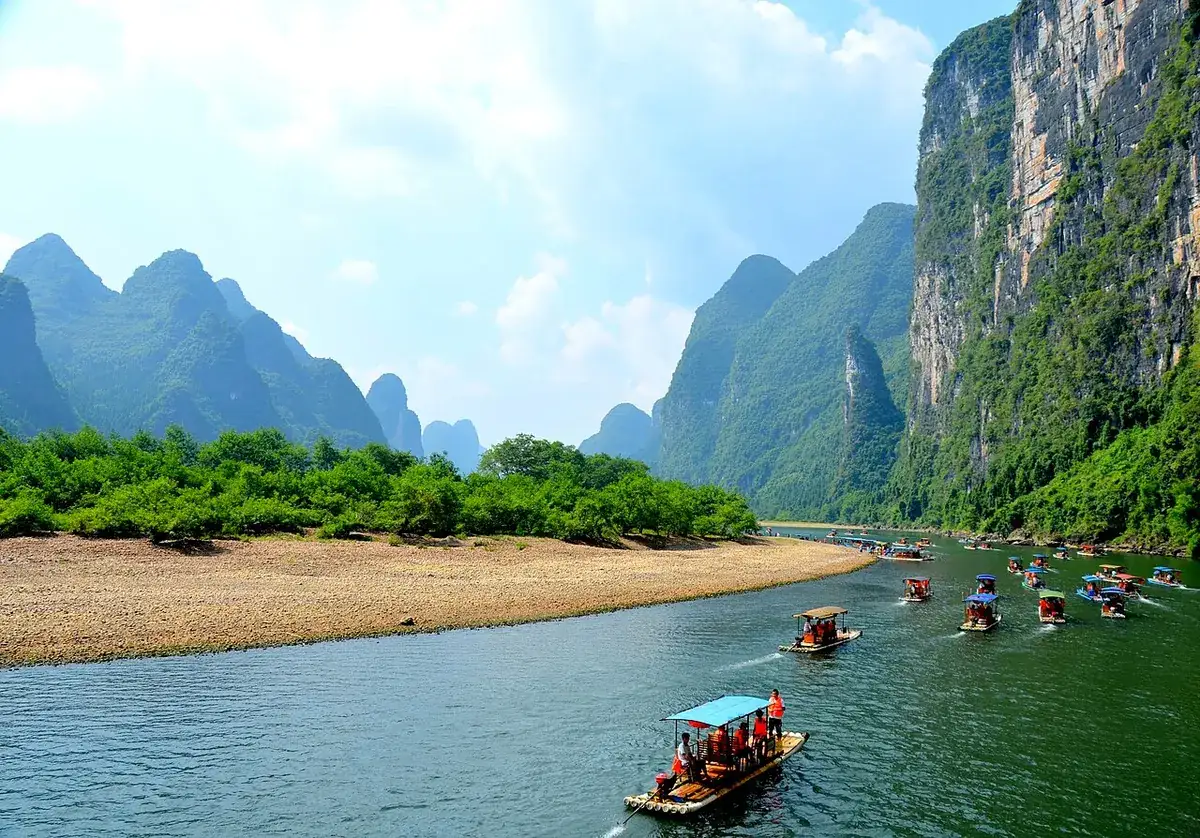
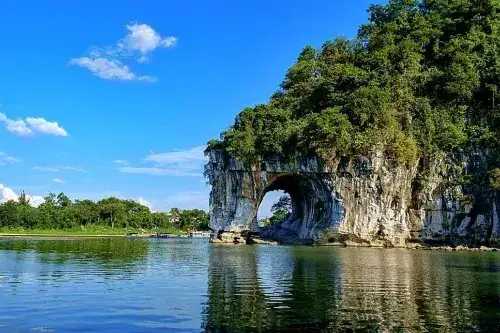
In 2023, the Jinxiu Shengtang Grand Canyon was added as a national 4A tourist attraction. The city now has 33 national A-level attractions, including 17 at 4A level (over 50% of total), achieving full county coverage. There are 8 star-rated hotels, 4 autonomous region-level rural tourism key villages, 3 four-star rural tourism areas, 1 five-star agritainment establishment, and 3 lower-rated rural tourism areas. The city has 4 national key cultural relic protection units, 19 regional-level, and 25 municipal-level protected sites, plus 6 new urban-rural public cultural spaces.
Famous Figures
Notable historical figures include: Xie Hong and Xie Ze (Song dynasty twin scholar-officials from Wuxuan); Mo Jingcheng (first hereditary magistrate of the Xincheng Mo clan, 1440); Mo Zhenwei (8th hereditary magistrate, who built the Mosher Tusi Yamen in 1582, known as the "Zhuang Imperial Palace"); Liao Shengtai (Ming dynasty general who settled in Wuxuan); Chen Ren (1706-1780) and Chen Xu (1706-?), twin scholar-officials from Wuxuan; Zheng Xianfu (1801-1872, Qing scholar and poet from Xiangzhou); Xiao Chaogui (1820-1852, Zhuang, key leader of the Taiping Heavenly Kingdom from Wuxuan); Chen Yagui (1826-1850, Tiandihui leader from Wuxuan); Qin Guifu (1839-1913, top military exam graduate in the Taiping era from Wuxuan); Su Shousong (1873-1939, modern Guangxi educator from Xiangzhou); Guo Songnian (1876-1950, military official from Wuxuan); Liu Daqing (1881-1922, National Revolutionary Army corps commander from Wuxuan); Wei Chunshu (born 1922, Zhuang, former chairman of Guangxi from Xiangzhou); Huang Gesheng (born 1950, Zhuang, former vice chairman of the China Artists Association from Wuxuan); and Li Ning (born March 10, 1963, Zhuang, "Prince of Gymnastics" from Xingbin).
Honors
In December 2020, Laibin was recognized as an 8th-round Guangxi Civilized City. On December 25, 2020, it was awarded the Voluntary Blood Donation Advanced City by the National Health Commission. On February 1, 2021, it was designated as a National Barrier-Free Environment Demonstration City.
Travel information can change. Check current opening hours, reservations and entry requirements before you travel.

Traveller discussion
Start the conversation with a helpful tip or a question.