
Luoyang City
Luoyang CityLuoyang City is a prefecture-level city in Henan Province, located in the western part of the province. It borders Zhengzhou to the east, Sanmenxia to the west, Pingdingshan and Nanyang to the south, and Jiaozuo and Jiyuan to th
Luoyang City
Luoyang City is a prefecture-level city in Henan Province, located in the western part of the province. It borders Zhengzhou to the east, Sanmenxia to the west, Pingdingshan and Nanyang to the south, and Jiaozuo and Jiyuan to the north. It covers a total area of 15,230 square kilometers and administers 7 municipal districts, 7 counties, and 2 national-level development zones. As of the end of 2025, the permanent resident population was 7.083 million. Luoyang, abbreviated as "Luo" and anciently known as Zhongguo (China), Shendu (Divine Capital), Luoyi, Chengzhou, and Luojing, is a World Cultural City, one of the first National Historical and Cultural Cities, a National Regional Center City, a sub-center of the Central Plains City Cluster, an important node city of the Belt and Road Initiative, and a sub-center city of Henan Province. The name Luoyang derives from its location on the north (yang) bank of the Luo River. With over 5,000 years of civilization, over 4,000 years of city-building history, and over 1,500 years as a capital, Luoyang is the birthplace of Huaxia civilization, the cradle of the Chinese nation, the birthplace of the Yan and Yellow Emperors, the origin of Chinese characters, the eastern starting point of the Silk Road, the center of the Sui-Tang Grand Canal, and the ancestral court of the Three Teachings (Confucianism, Buddhism, and Taoism). Thirteen dynasties—including Xia, Shang, Western Zhou, Eastern Zhou, Eastern Han, Cao Wei, Western Jin, Northern Wei, Sui, Tang (including Wu Zhou), Later Liang, Later Tang, and Later Jin—established their capitals here (some scholars count 15). Luoyang is the Chinese city with the earliest founding, the most dynasties, the longest duration, and the greatest influence as a capital, earning it the title "First Ancient Capital of China." Together with Rome, Thebes, and Babylon, it is known as one of the "Four Great Ancient Capitals of the World" and ranks first among them. It is also the only Chinese city selected as one of the "Four Great Holy Cities of the World" and honored by the United Nations as a "World Cultural City," and serves as the permanent venue of the World Ancient Capitals Forum. Luoyang has five major capital-city ruins—Erlitou site, Yanshi Shang City, Eastern Zhou Royal City, Han-Wei Ancient City, and Sui-Tang Luoyang City—as well as three items and six sites of World Cultural Heritage (Longmen Grottoes, the Grand Canal, and the Silk Road), five 5A-level tourist attractions, and thirty 4A-level attractions. It has been awarded titles including China Excellent Tourist City, National Garden City, National Sanitary City, and National Civilized City. In 2025, Luoyang's GDP reached 616.452 billion yuan (approximately $85.6 billion USD), growing 6.0% year-on-year, ranking it as a second-tier city.
Historical Evolution
Ancient Period
As early as the Paleolithic Age, approximately 500,000 to 600,000 years ago, early inhabitants already lived and thrived here. The ancient capital of Huaxu was located at Yisushan Mountain in Luoyang, where the customs of celebrating the New Year and ancestral worship during Spring Festival originated. Fuxi was born at Leize (the Lei River in Luoyang) and, at Mengjin in Luoyang, encountered the Dragon-Horse bearing the River Map and created the Eight Trigrams (Bagua), making Luoyang the birthplace of the Eight Trigrams. Fuxi enfeoffed Nüwa north of the Ru River, which originates in Songxian County, Luoyang; Nüwa's main sphere of activity was the Heluo region, where legends such as Nüwa creating mankind took place.
During the Neolithic Age, many tribal clans were distributed along both banks of the middle Yellow River and on the terraces of the Yi, Luo, Chan, and Jian rivers. The Yan and Yellow Emperors, the cultural ancestors of the Chinese nation, were born at Pingfengshan Mountain in Luoyang, earning Luoyang the name "Hometown of Yan and Huang." Emperor Yan established his capital along the Yi River in Luoyang and was thus called "Yiqi." The Yellow Emperor built his capital at Qingyaoshan Mountain in Luoyang and formed an alliance with Emperor Yan at Xitaishan in Ruyang. In the fiftieth year of the Yellow Emperor's reign, phoenixes flew to Luoyang, and the emperor performed sacrifices to the Luo River, receiving all deities at the Bright Court—Luoyang was thereafter called "Phoenix City." Leizu, the Yellow Emperor's chief consort, cultivated silkworms and invented silk in Luoyang, from which Chinese silk became world-renowned. Cangjie ascended Yangxushan Mountain in Luoning and, inspired by the divine tortoise bearing the Luo River Script, invented writing, making Luoyang the birthplace of Chinese characters; the Cangjie Writing Platform site still survives today.
Zhuanxu, one of the Five Emperors, resided at "Ruoshui," believed to be the Ru River originating in Songxian County, Luoyang. Gonggong, who lived in the Gong River basin in Luoyang, failed in his struggle with Zhuanxu for the throne and struck Mount Buzhou in rage. Emperor Ku established his capital at Yanshi in Luoyang, and his daughter Chang'e left behind the legend of flying to the moon here. Yao was born by the Luo River and raised by the Yi River, later building an altar in the Heluo region and ascending Shouyangshan Mountain to abdicate to Shun.
Nearly 200 settlement sites discovered around Luoyang after the founding of New China—including the Sunqitun Cultural Site, Wangwan Site, and Zhaili Site—mark the places where people of that era lived.
Xia, Shang, and Zhou Periods
At the beginning of the Xia Dynasty, Yu divided the realm into Nine Provinces, with the Heluo region belonging to ancient Yuzhou. Yu the Great tamed the waters at Luoyang, carving open Longmen and clearing Yique, and convened the feudal lords at Santushan Mountain in Luoyang, where "ten thousand states bore jade and silk." Luoyang was the central region of the Xia Dynasty's founding and activities; Tai Kang, Zhong Kang, and Jie of Xia all established their capital at Zhenxun—today's Erlitou site in Luoyang. Erlitou culture is regarded as the creator of Huaxia orthodoxy and the core and leader of the overall process of Chinese civilization. The Erlitou site yielded the "First Dragon of China"—a turquoise dragon-shaped artifact—widely considered by the academic community to be the most direct and orthodox root of the Chinese dragon totem and the earliest origin and compelling evidence of the Chinese people as "Descendants of the Dragon." The Erlitou site also produced China's earliest porcelain—"primitive porcelain"—earning Luoyang the titles "Source of Chinese Ceramics" and "World's Earliest Porcelain Capital." The English name of China, "China," is said to derive from this.
Around 1600 BCE, the Shang Dynasty was founded, and Shang Tang established his capital at Xibo—today's Yanshi Shang City site in Luoyang—the first capital of the Shang Dynasty. From Shang Tang to the ninth Shang king Tai Wu, the court resided at Xibo. The Yanshi Shang City is the earliest, largest, and best-preserved early Shang Dynasty city site discovered in China to date.
In 1046 BCE, after the Western Zhou overthrew the Shang, King Wu of Zhou decided to move the capital to Luoyi, calling it "Zhongguo" (China), and resolved to "dwell in this Middle Kingdom"—the earliest known occurrence of the term "Zhongguo." He moved the Nine Tripods, symbols of royal authority, to Luoyi and ordered the Duke of Zhou to build the Royal City and Chengzhou City on the north bank of the Luo River. King Cheng of Zhou then formally moved the capital to Luoyi as the center of the realm, historically known as "King Cheng's Relocation to Luo." By the fifth reign, King Mu of Zhou, Luoyang remained the capital of Western Zhou.
In the first year of King Ping of Zhou (770 BCE), King Ping moved east to Luoyi, marking the beginning of the Eastern Zhou.
Qin and Han Periods
In the first year of King Zhuangxiang of Qin (249 BCE), Qin established Sanchuan Commandery in Luoyang, with the seat at Chengzhou City.
In 219 BCE, Qin Shi Huang (Ying Zheng) led his ministers to perform sacrifices to the Luo River and composed the "Song of Sacrificing to the Luo River"—the only poem left by Qin Shi Huang.
In the first year of the Han King (206 BCE), Xiang Yu enfeoffed Shen Yang as King of Henan, residing in Luoyang.
In the fifth year of Han Gaozu (202 BCE), Liu Bang founded the Han Dynasty and initially established the capital at Luoyang, historically recorded as "The realm was settled, and the High Ancestor established his capital at Luoyang, and all lords submitted." He renamed Sanchuan Commandery as Henan Commandery, governing Luoyang with 22 counties under its jurisdiction, before later moving the capital to Chang'an. Emperor Wu of Han called Luoyang "the Great Capital of the Han Empire." By the second year of the Yuanshi era of Emperor Ping of Han (2 CE), Luoyang had a population of 332,620—86,000 more than Chang'an—making it the largest commercial and industrial city of the Western Han. Henan Commandery, with Luoyang as its seat, had a population of 1,740,279, the most counties and the largest population of any commandery in the Western Han, earning it the title "First Commandery of the Western Han."
At the end of the Western Han, Wang Mang usurped power and renamed Luoyang as Yiyang, designating it as the Eastern Capital of the Xin Dynasty. However, his reforms led to the Green Forest and Red Eyebrow uprisings, and the capital relocation was never completed.
In the first year of Gengshi of Xuan Han (23 CE), Xin fell, and Emperor Gengshi (Liu Xuan) moved the capital to Luoyang.
In the first year of Jianwu of the Eastern Han (25 CE), Emperor Guangwu (Liu Xiu) established Luoyang as the capital, renaming it Luoyang and calling it "Dongjing" (Eastern Capital). In the fifteenth year of Jianwu (39 CE), Henan Commandery was renamed Henan Yin.
During the reign of Emperor Ming of Han, large-scale construction was carried out in Luoyang, including the reconstruction of the Northern Palace and the addition of urban gardens, establishing the basic layout of Luoyang. In the western part of the city, the White Horse Temple was built—China's first state-sponsored Buddhist monastery.
In the sixth year of Yongyuan of Emperor He of Han (94 CE), over fifty Western Region states submitted tribute, and the influence of the Luoyang court reached its zenith. Gan Ying was later dispatched as an envoy to the Roman Empire, extending Luoyang's reach to the eastern coast of the Mediterranean in West Asia.
In 100 CE, a Macedonian merchant named Maes sent agents to Luoyang, and Emperor He "bestowed upon their king a gold seal and purple ribbon," marking the first documented direct contact between China and Europe. Luoyang was recorded in Western sources as "Sera."
In 105 CE, Cai Lun developed the world's first true paper—"Cai Hou Paper"—in Luoyang.
In 119 CE, Empress Dowager Deng founded the world's first coeducational school, the "Yuanchu Academy," in Luoyang.
In 132 CE, Zhang Heng invented the world's first seismoscope for detecting the direction of earthquakes in Luoyang.
Wei, Jin, Southern and Northern Dynasties
In the first year of Huangchu (220 CE), Emperor Wen of Cao Wei (Cao Pi) established Luoyang as the capital and established the Sili Xiaowei office. Emperor Ming of Wei (Cao Rui) later built Jinyong City in Luoyang.
In the first year of Taishi of Western Jin (265 CE), Western Jin succeeded Wei and continued to use Luoyang as its capital.
In the second year of Taiyan of Northern Wei (436 CE), Luozhou was established in Luoyang.
In the eighteenth year of Taihe of Northern Wei (494 CE), Emperor Xiaowen moved the capital to Luoyang.
In the first year of Daxiang of Northern Zhou (579 CE), Emperor Xuan of Zhou (Yuwen Yun) planned to move the capital to Luoyang, designating it the Eastern Capital, but died the following year, halting construction.
Sui, Tang, and Five Dynasties
In the first year of Kaihuang of Sui (581 CE), the Department of State Affairs of the Eastern Capital was established in Luoyang. In the first year of Daye (605 CE), Emperor Yang of Sui moved the capital to Luoyang, calling it "Dongjing" (Eastern Capital), and built a new city—the Sui-Tang Luoyang City—east of the Eastern Zhou Royal City and 18 li west of the Han-Wei Ancient City. In 606 CE, Emperor Yang inaugurated the "Myriad Nations Coming to Court" at Luoyang. In 609 CE, the Eastern Capital (Luoyang) was renamed the Eastern Metropolis (Dongdu).
In the second year of Huangtai (619 CE), Wang Shichong deposed Emperor Huangtai and proclaimed himself emperor of the state of Zheng, with Luoyang as his capital.
In the fourth year of Wude of Tang (621 CE), after Li Shimin suppressed Wang Shichong's forces in Luoyang, Li Yuan conferred upon Li Shimin the title "General of the Heavenly Strategy" and authorized him to establish his own office in Luoyang (the Tian Ce Mansion). In the first year of Zhenguan (627 CE), the empire was divided into ten circuits, with Luoyang belonging to the Henan Circuit. In the eleventh year of Zhenguan (637 CE), Emperor Taizong came to Luoyang for provisions and elevated Luozhou to the Luoyang Palace, marking the rise of Luoyang's political status. In the second year of Xianqing (657 CE), Emperor Gaozong designated Luoyang the Eastern Metropolis, on par with the Western Capital Chang'an, implementing the dual-capital system. Emperor Gaozong relocated to Luoyang seven times for provisions, residing there for a total of eleven years.
In the first year of Guangzhai (684 CE), Wu Zetian renamed the Eastern Metropolis "Shendu" (Divine Capital) and undertook major expansion, building the Mingtang (Bright Hall) and Tiantang (Heavenly Hall).
In the first year of Tianshou (690 CE), Wu Zetian ascended the throne at the Zetian Gate in Luoyang, changed the dynasty from Tang to Zhou, and established Shendu (Luoyang) as her capital. In 694 CE, the Persian chieftain Aluohan rallied leaders of foreign states to "gather a hundred trillion in funds" to build the "Myriad Nations Heavenly Axis" (Wanguo Tianshu) in Luoyang, symbolizing the axis of the world and witnessing the Wu Zhou Empire's supremacy over all nations. In the second year of Wansui Tongtian (697 CE), Wu Zetian cast the Nine Tripods and placed them in the Mingtang of Luoyang—the only imperial Nine Tripods of the Sui-Tang period.
In the first year of Shenlong (705 CE), Emperor Zhongzong (Li Xian) ascended the throne at the Tongtian Palace (Mingtang) in Luoyang, restoring the Tang Dynasty.
In the first year of Kaiyuan (713 CE), Luozhou was renamed Henan Prefecture. From the fifth year of Kaiyuan (717 CE), Emperor Xuanzong relocated to Luoyang five times for provisions, governing from Luoyang for eleven years and creating the "Kaiyuan Era of Prosperity."
Song to Qing Periods
During the Northern Song, Luoyang served as the Western Capital, with Henan Prefecture established there. In the eighth year of Kaibao (975 CE), Emperor Taizu (Zhao Kuangyin) toured the Western Capital and proposed moving the capital to Luoyang, but after heated debate, the plan was abandoned. The Song court established the Imperial Academy in Luoyang, where many distinguished officials and scholars gathered. Sima Guang completed his monumental historical work, the Zizhi Tongjian, in Luoyang.
During the Jin Dynasty, Luoyang was designated the Central Capital; Henan Prefecture was renamed Jinchang Prefecture, and Henan County was merged into Luoyang County. Since the old city of Luoyang was destroyed, a new city was built at the northeast corner of the Sui-Tang city, with a perimeter of less than 9 li—the predecessor of the later Luoyang Old City.
From the Yuan Dynasty onward, Luoyang ceased to be a capital and was reduced to the seat of Henan Prefecture.
During the Ming Dynasty, Henan Prefecture governed ten counties. In the twenty-fourth year of Hongwu (1391 CE), Crown Prince Zhu Biao was sent to inspect the Guanzhong and Luoyang regions and proposed establishing the capital at Luoyang, but he died soon after, and the grieving Emperor Hongwu abandoned the relocation plan.
During the Qing Dynasty, Luoyang remained the seat of Henan Prefecture. In the twenty-fifth year of Guangxu (1899 CE), Empress Dowager Cixi planned to move the capital to Luoyang and ordered the Henan Prefect to survey the area, but the plan was never implemented.
Republic of China Period
In the first year of the Republic (1912), Henan Prefecture was abolished and the Heluo Circuit was established, with the circuit intendant's office stationed in Luoyang, governing 19 counties including Luoyang and Yanshi.
In the ninth year of the Republic (1920), the warlord Wu Peifu occupied Luoyang and established the office of the Two-Lakes Inspector-General and the headquarters of the Third Army Division. In the twelfth year (1923), the Henan Provincial Governor's office moved to Luoyang, making it the provincial capital.
In the twenty-first year of the Republic (1932), following the January 28 Incident in Shanghai, the National Government relocated to Luoyang, known as the "Luoyang National Government." Chiang Kai-shek convened a National Crisis Conference in Luoyang and established the Luoyang Branch of the Whampoa Military Academy. At the time, Luoyang was called "China's Babylon."
In May 1933, the Provisional Government of the Republic of Korea relocated to Luoyang to establish a Korean Military Academy, with key figures including Kim Gu residing at the Luojing Hotel.
In 1936, Chiang Kai-shek came to Luoyang to deploy military affairs and built the Chiang-Soong Villa at Xiangshan near Longmen. After the July 7 Incident, the War of Resistance against Japan fully erupted, and Luoyang became the northern frontline stronghold, with the First War Zone Headquarters stationed there.
In the autumn of the twenty-eighth year of the Republic (1939), the Henan Provincial Government moved to Luoyang again, making it the provincial capital for a second time.
In 1944, Japanese forces launched a full-scale assault on Luoyang, and the Defense of Luoyang broke out.
After Liberation
In 1948, Luoyang was liberated, and the Luoyang City People's Democratic Government was established, with the urban area of Luoyang County carved out as a city.
In 1994, historian and historical geographer Shiweile identified Luoyang as a "Thirteen-Dynasty Ancient Capital," stating that "whether among the Six Great Ancient Capitals or the Seven Great Ancient Capitals, Luoyang served as a capital earliest and longest, and should rank first among them."
In 2007, the Henan Featured Tourism and Culture editorial committee named Luoyang "First of China's Eight Great Ancient Capitals."
In 2011, Luoyang was jointly awarded the title "World Cultural City" by the United Nations International Strategy for Disaster Reduction, the World City Science Development Alliance, and the International Sister Cities Alliance—the only Chinese city to receive this honor.
In 2014, the American travel website SmarterTravel recommended the "World's Ten Timeless Historical Cities," with Luoyang ranked first, representing China's Eight Great Ancient Capitals.
In April 2018, the first World Ancient Capitals Forum opened in Luoyang. After consultation among Chinese and international parties, Luoyang was designated as the permanent venue of the World Ancient Capitals Forum.
Administrative Divisions
Division Evolution
In May 1950, the Luoyang Suburban District Office was established. In 1954, Luoyang was elevated to a provincial municipality directly under Henan Province. In 1955, Luoyang County was abolished—part was incorporated into Luoyang City, and the remainder was allocated to Yanshi, Mengjin, Yiyang, and other counties. In July of the same year, Jianxi District was established. In 1956, Luoyang's Old Town District, Xigong District, and Suburban District were established. In November 1957, the Chanhe Hui District was established. In 1982, Jili District was newly established with State Council approval. In 1986, the Luoyang Prefecture was abolished, and Luoning, Yiyang, Songxian, Luanchuan, Ruyang, and Yichuan were transferred to Luoyang City. In 1993, Yanshi County was converted to Yanshi City. In June 2000, the Luoyang Suburban District was renamed Luolong District.
In March 2021, with State Council approval, county-level Yanshi City was abolished and Yanshi District was established; Mengjin County and Jili District were abolished and Mengjin District was established.
Division Details
As of 2022, Luoyang City administers 7 municipal districts and 7 counties, along with 2 national-level development zones. The municipal government is located at 228 Kaiyuan Avenue, Luolong District.
Geography
Location and Territory
Luoyang City is located in western Henan Province, straddling both banks of the middle and lower Yellow River, between 112 degrees 8 minutes and 112 degrees 59 minutes E longitude and 33 degrees 35 minutes and 35 degrees 5 minutes N latitude. It is approximately 179 km long from east to west and 168 km wide from north to south. The total area is 15,200 square kilometers, of which the urban area is 2,274 square kilometers. Luoyang is situated at the junction of China's second and third topographic steps, with the Qinling Mountains to the west, Mount Song to the east, and the Taihang Mountains to the north. It spans three major river basins—the Yellow River, Huai River, and Yangtze River—with the Yellow River basin covering 12,446.1 square km (81.8% of the total area).
Geology
Luoyang is located at the junction of the North China Platform and the Qinling fold system, spanning two first-order tectonic units. The region features complex multi-phase tectonic activity with significant rock- and ore-controlling effects, forming rich mineral resources. Major regional deep faults include the Sanmenxia-Lushan Fault, the Machaying Fault, the Luanchuan Fault, and the Waxuezi Fault.
Topography
Luoyang's terrain is higher in the west and lower in the east, with mountains accounting for 45.51%, hills 40.73%, and plains 13.8%. The region is situated in the western Henan area and the Eastern Qinling fold system, featuring four major mountain ranges: Funiu Mountain, Waifang Mountain, Xiong'er Mountain, and Xiaoshan Mountain. Funiu Mountain ranges 1,500 to 2,000 m in elevation; Xiong'er Mountain, 1,500 to 2,000 m; and Xiaoshan Mountain, 1,200 to 1,800 m. The highest point in the territory is the summit of Laojun Mountain in the Funiu range, at 2,212.5 m.
Climate
Luoyang has a warm-temperate continental monsoon climate, with an average annual temperature of 12.2 to 24.6 degrees Celsius, a frost-free period of over 210 days, annual precipitation of 528 to 800 mm, and 2,200 to 2,300 hours of sunshine per year. The four seasons are distinct: spring is windy and dry, summer is hot and rainy, autumn brings clear skies and crisp air, and winter is cold with little rain or snow. January is the coldest month (average around 0 degrees C, extreme low around minus 15 degrees C), and July is the warmest (average around 27 degrees C, extreme high up to 42 degrees C). The best season to visit Luoyang is autumn.
Hydrology
Luoyang spans three major river basins—the Yellow, Huai, and Yangtze—with over 27,000 rivers and streams of various sizes, including 7,500 with perennial or seasonal flow. Major rivers include the Yellow River (northern boundary river, 97 km through the territory), the Luo River (200 km), and the Yi River (175.3 km, originating in the Funiu Mountains of Luanchuan County and joining the Luo River at Yanshi).
Soil
Luoyang has two major soil categories and five subcategories. Brown forest soil is distributed on mountains above 800 to 1,000 m; cinnamon soil has the widest distribution across all counties; and alluvial soil is found along riverbanks.
Natural Resources
Water Resources
Luoyang has reservoirs of various sizes built along its rivers. The multi-year average total water resource (1980 to 1999) is 2.81 billion cubic meters, including 2.627 billion cubic meters of surface water and 1.679 billion cubic meters of groundwater.
Plant Resources
Luoyang retains 4.3738 million mu (approximately 291,600 hectares) of forest land, with 85 families, 252 genera, and 831 species of woody plants, accounting for 69.3% of Henan Province's total. There are 64 species under national or provincial protection. Over 2,000 century-old trees of 49 species have been documented.
Animal Resources
Luoyang's territory straddles the boundary between the Palearctic and Oriental realms along the main Funiu Mountain range. Wild terrestrial vertebrates number 365 species (plus 9 subspecies), representing 15.89% of the national total and 77.2% of Henan Province's total. There are 12 species under national first-class protection and 58 under second-class protection.
Mineral Resources
Luoyang has rich underground mineral resources, including over 40 types such as coal, iron, lead, gold, silver, aluminum, molybdenum, copper, tungsten, zinc, quartz, asbestos, gypsum, limestone, marble, granite, and others.
Population
Population Figures
As of the end of 2025, Luoyang's permanent resident population was 7.083 million, with 4.893 million urban residents and an urbanization rate of 69.08%. The birth rate was 6.52 per thousand, the death rate 8.08 per thousand, and the natural growth rate minus 1.55 per thousand.
Ethnic Composition
Luoyang is a multi-ethnic city with 45 ethnic groups. The Han Chinese constitute approximately 98.8% of the total population, while ethnic minorities account for about 1.2%. Groups with over 1,000 members include the Hui, Manchu, and Mongol peoples. The Hui are the largest minority, with nearly 60,000 people, representing over 80% of the minority population.
Politics
Economy
Overview
In 2025, Luoyang's GDP reached 616.452 billion yuan (approximately $85.6 billion USD), up 6.0% year-on-year at comparable prices. The primary industry value-added was 23.071 billion yuan, up 3.9%; the secondary industry 247.063 billion yuan, up 6.2%; and the tertiary industry 346.318 billion yuan, up 6.0%. The three-sector structure ratio was 3.7:40.1:56.2.
Primary Industry
In 2024, Luoyang's total grain output was 2.4965 million tons, up 3.36% year-on-year, including 1.2246 million tons of summer grain and 1.2718 million tons of autumn grain. Vegetable and edible mushroom output was 2.9004 million tons, and garden fruit output was 957,400 tons. In 2025, grain planting covered 7.449 million mu, with total grain output of 2.473 million tons. Oil crop output was 145,000 tons, vegetable output 2.856 million tons, edible mushroom output 134,000 tons, fruit output 1.293 million tons, and Chinese medicinal herb output 147,000 tons. Pork, beef, and mutton output totaled 199,000 tons, up 6.4%. Year-end hog inventory was 1.33 million head, and cattle inventory was 289,000 head.
Secondary Industry
In 2024, the value-added of Luoyang's above-scale industries grew 7.0% year-on-year. Among 39 industry categories, 28 achieved growth. Petrochemicals grew 9.2% and equipment manufacturing 15.6%. From January to November, above-scale industrial profit totaled 30.33 billion yuan, up 30.1%, with a revenue-to-profit margin of 6.9%. In 2025, above-scale industrial value-added grew 8.5%. Equipment manufacturing value-added grew 20.7%, accounting for 29.4% of above-scale industry; high-tech industries grew 11.7% (59.3% of total); and strategic emerging industries grew 32.8% (18.9% of total). Construction industry value-added was 42.225 billion yuan, up 0.3%.
Tertiary Industry
From January to November 2024, 6 of the 10 major service industry categories achieved revenue growth. Internet and software services grew 10.4%; leasing and business services grew 16.7%. Luoyang successfully hosted the 33rd World Hakka Reunion Conference and held over 700 cultural and tourism consumption events. Entertainment industry revenue grew 13.6%.
In 2024, total retail sales of consumer goods reached 260.54 billion yuan (approximately $36.2 billion USD), up 6.2% year-on-year. Rural above-scale retail sales grew 17.5%. New energy vehicle retail sales grew 41.4%, and home appliance retail grew 23.3%. In 2025, total retail sales reached 247.51 billion yuan, up 5.7%, with urban retail at 217.06 billion yuan (up 6.0%) and rural retail at 30.44 billion yuan (up 3.0%). As of the end of 2025, total deposits at financial institutions reached 912.802 billion yuan (approximately $126.8 billion USD), up 8.1%, and total loans reached 723.008 billion yuan (approximately $100.4 billion USD), up 1.1%.
Social Services
Science and Technology
As of the end of 2025, Luoyang had 168 provincial-level or above enterprise technology centers (19 national-level), 123 engineering laboratories (7 national), 432 engineering technology research centers (2 national), and 23 provincial key laboratories. A total of 9,797 patents were granted. Effective invention patents reached 16,785, up 12.1%. Technology contracts valued at 28.49 billion yuan were signed.
Education
In 2025, Luoyang had 9 regular institutions of higher education with 231,000 enrolled students; 84 regular senior high schools with 167,000 students; 305 junior high schools with 304,000 students; 665 primary schools with 586,000 students; and kindergartens with 208,000 children enrolled.
Culture
As of the end of 2025, Luoyang had 15 cultural centers, 15 public libraries, and 112 museums. There were 51 nationally protected cultural heritage sites and 146 provincial-level protected sites, with 9 entries on the national intangible cultural heritage list. Radio coverage reached 99.19% and television coverage 99.31% of the population. The city received 160 million domestic and international tourists, up 3.3% year-on-year, including five 5A-level and thirty-six 4A-level scenic areas. There were 38 star-rated hotels and 192 travel agencies.
Healthcare
As of the end of 2025, Luoyang had 5,604 health institutions with 57,497 beds, including 308 hospitals and township health centers with 53,689 beds. There were 70,214 health professionals, including 26,816 licensed physicians and assistant physicians and 33,365 registered nurses.
Social Security
In 2025, Luoyang created 106,000 new urban jobs, with 25,000 unemployed persons reemployed and 9,500 persons with employment difficulties placed. As of the end of 2025, 1.9323 million people participated in urban employee basic pension insurance, and 3.2675 million in urban-rural resident basic pension insurance. Participants in basic medical insurance totaled 6.5411 million (including retirees).
Sports
As of the end of 2025, Luoyang had 21,872 sports venues covering 20.259 million square meters. Athletes won 1,004 provincial-level or above medals, including 325 gold, 328 silver, and 358 bronze.
Environmental Protection
In 2025, above-scale industrial comprehensive energy consumption decreased 2.0%, and energy consumption per unit of value-added decreased 9.7%. Water quality compliance rate at national and provincial monitoring sections was 100%, and safe utilization rate of contaminated farmland reached 100%. The proportion of days with good air quality was 71.9%, with an average PM2.5 concentration of 40.0 micrograms per cubic meter. There were 4 nature reserves (2 national-level) and 14 forest parks (6 national-level).
Transportation
Overview
In 2025, Luoyang's highway freight volume was 180 million tons (up 5.4%), highway freight turnover was 45.74 billion ton-kilometers (up 4.2%), highway passenger volume was 54.721 million (up 1.1%), and airport passenger throughput was 955,000 (down 19.9%).
Aviation
Luoyang Beijiao Airport began construction in 1986 and officially opened on September 26, 1987. A major expansion began in 2008, with a new 14,800 square meter terminal building put into operation in April 2010. In 2016, 3 new parking stands and a de-icing pad were added, bringing the total apron area to 62,580 square meters. In 2018, the airport handled 1.3151 million passengers (up 48.72%) and 1,339.13 tons of cargo (down 8.81%).
Railway
Luoyang is served by intercity railways including the Zheng-Luo Intercity Railway, Luoyang-Xinzheng Airport Intercity Railway, Jiao-Luo Intercity Railway, and Luo-Ping Intercity Railway. The urban rail transit network consists of 4 lines totaling 102.6 km with 63 stations, including 8 transfer stations.
Highways
National and provincial highways include the Luoyang-Yanshi Expressway, Luoyang-Yiyang Expressway, Luoyang-Luanchuan Expressway, and Luoyang-Jili Expressway.
History and Culture
Origin of the Name
Luoyang was named for its location on the north (yang) bank of the Luo River.
Dynasties That Capitalized Here
The number of dynasties that established capitals in Luoyang is variously counted as thirteen, fifteen, or eighteen. Historian Shiweile stated that "whether among the Six Great Ancient Capitals or the Seven Great Ancient Capitals, Luoyang served as a capital earliest and longest, and should rank first." The Henan Featured Tourism and Culture editorial committee called Luoyang "First of China's Eight Great Ancient Capitals," and China Commerce called it "First of China's Four Great Ancient Capitals." Scholars including Shiweile, Su Jian, and Shi Nianhai all agree on thirteen dynasties, though they differ on specifics. Meng Lingjun proposed fifteen dynasties in 1991, and Li Zhengang and Zheng Zhenfu proposed eighteen dynasties in their General History of Luoyang.
Cultural Origins
Luoyang is the founding place of Confucianism, the birthplace of Daoism, the first site of Buddhist transmission, the formation site of Xuanxue (Neo-Daoism), and the origin of Neo-Confucianism. Three of ancient China's Four Great Inventions—the compass, papermaking, and printing—all originated here. Luoyang is also the cultural root for over 100 million Hakka Chinese worldwide, who ancestrally hailed from this region. Seventy percent of China's major clan surnames originated here. The Heluo culture, represented by the "River Map and Luo Script," is the ancestral root culture of Huaxia civilization. In September 2009, Hakka representatives from around the world gathered at Hutoushan in Yanshi to build the Central Plains Hakka Ancestral Migration Monument and the World Hakka Ancestral Land Memorial Park. In 2021, the Luoyang Hakka Origins Memorial Hall opened in the Yibin District.
Religion Overview
Luoyang is the ancestral court of the Three Teachings (Confucianism, Buddhism, and Taoism). The city's major religions include Buddhism, Taoism, Protestant Christianity, Catholicism, and Islam. In 2000, Luoyang had 260,000 religious believers, 594 approved religious activity venues, and 7 religious organizations.
Intangible Cultural Heritage
City Flower of Luoyang
Luoyang Peony cultivation took root in the Heluo region during the Sui Dynasty, flourished in the Tang, and reached its zenith in the Song. As the Tang poets Liu Yuxi and Bai Juyi praised: "Only the peony bears the true national color; when it blooms, it moves the capital." In 1982, the Luoyang Municipal People's Congress officially designated the peony as the city flower. Luoyang peonies come in nine major color systems—red, white, pink, yellow, purple, blue, green, black, and multicolor—and ten flower types, including single-petal, lotus, chrysanthemum, rose, crown, and hydrangea forms.
Folk Festivals
The Luoyang Peony Festival began in 1983. In 2008, it was designated as a national intangible cultural heritage by the State Council. In 2010, it was officially renamed the "China Luoyang Peony Cultural Festival."
Local Specialties
Luoyang Water Banquet (Shuixi) is a famous local specialty—a traditional banquet featuring 24 dishes with soups and broths, originating from the Tang Dynasty.
Scenic Spots
Overview
In 2022, Luoyang received 80 million domestic and international tourists (down 31.0% year-on-year), with tourism revenue of 60.5 billion yuan (down 34.5%). The city had 66 A-level tourist attractions, including five 5A-level and thirty 4A-level sites, 42 star-rated hotels, and 104 travel agencies.
Attractions
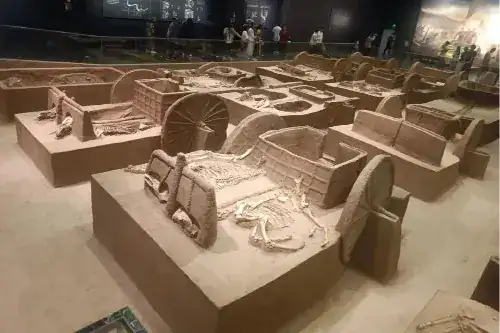
Major attractions in Luoyang include the Longmen Grottoes (a UNESCO World Heritage Site), the White Horse Temple (China's first Buddhist monastery), the Guanlin Mausoleum (the burial site of the legendary general Guan Yu), the Son of Heaven's Six-Horse Chariot Museum, the Luoyang Museum, the Sui-Tang Luoyang City National Heritage Park, and the Erlitou Site Museum.
Recent City Developments
On September 20, 2024, the Henan Provincial Government announced that Luoyang was designated as a "Large City" under the Zhengzhou Metropolitan Area Development Plan, with the construction of Luoyang as a sub-center of the Central Plains City Cluster accelerating.
Sister Cities
Notable Figures
City Honors
Travel information can change. Check current opening hours, reservations and entry requirements before you travel.
Traveller discussion
Start the conversation with a helpful tip or a question.