
Qitaihe City
Qitaihe CityQitaihe is a prefecture-level city under the jurisdiction of Heilongjiang Province, located in Northeast China, in the eastern part of Heilongjiang Province, south of Jiamusi, at the western end of the Wandashan mountain range,
Qitaihe City
Qitaihe is a prefecture-level city under the jurisdiction of Heilongjiang Province, located in Northeast China, in the eastern part of Heilongjiang Province, south of Jiamusi, at the western end of the Wandashan mountain range, with a total area of 6,221 square kilometers. As of October 2022, the city administers 3 municipal districts and 1 county. As of the end of 2024, the registered population was 726,329. The local dialect belongs to the Jiafu sub-dialect of Heilongjiang dialect. The terrain consists of low mountains and hills, higher in the southeast and lower in the northwest. Situated in the mid-latitude zone, the city has a continental monsoon climate. As early as the Xia, Shang, and Zhou dynasties, the Qitaihe area was the territory of the Sushen people, ancient inhabitants of northern China. In August 1954, Heilongjiang and Songjiang provinces merged into Heilongjiang Province, with Boli County under the Hejiang region. On March 1, 1965, the State Council approved the establishment of the Qitaihe Special District (county-level). In 1983, it was elevated to a province-administered city. Qitaihe occupies a central position in the eastern Heilongjiang city cluster and has formed regional strategic partnerships with 14 cities in eastern Northeast China. The area is one of the birthplaces of the Sushen people and was formerly the headquarters of the CCP Jidong Provincial Committee and the Second Route Army of the Northeast Anti-Japanese United Army. Qitaihe has two national forest parks (Xidaquan and Shilongshan) and the Taoshan Lake National Wetland Park. The city is the representative city of Chinese short track speed skating, having produced 10 world champions including Zhang Jie, Yang Yang, Wang Meng, Fan Kexin, and Yang Jingru. It is known as the "Coking Coal Capital," "Hometown of Chinese Winter Olympic Champions," and "Cradle of Winter Olympic Champions." In 2024, Qitaihe's regional GDP was 23.66 billion yuan (approximately $3.3 billion), a decrease of 7.2% from the previous year.
Name Origin
The name "Qitaihe" originates from the Korean language. Before the city was established, Korean residents in Xingshu Township of Boli County called the area "Qidehe" (transliteration), colloquially known as "Qitahe." After the establishment of Qitaihe city, this name was adopted with modifications, transliterated as the current "Qitaihe."
History
Pre-Qin Period
As early as the Xia, Shang, and Zhou dynasties, the Qitaihe area was the territory of the Sushen people, ancient inhabitants of northern China. The Sushen and Suoli peoples in the Heilongjiang region had already begun paying tribute to the central plains.
Sui, Tang, Song, and Yuan Periods
The Sushen people changed names several times and by the Tang Dynasty were called the Mohe. In 698, the Sumo Mohe established the Bohai State, a local Tang Dynasty regime. At its peak, it governed 5 capitals, 15 prefectures, and 62 departments, with the Qitaihe area under Tieli Prefecture. After the Bohai State was conquered by the Khitans, the Liao Dynasty established the Five Nations Department along the Songhua River, with Qitaihe under its jurisdiction. In 1115, the Jin Dynasty conquered Liao, and Qitaihe was under Huligai Route. After the Mongol Empire conquered Jin, the Yuan Dynasty established the Huligai Myriarch Office, with Qitaihe under its administration.
Ming and Qing Periods
In 1409, the Ming Dynasty established the Nurgan Regional Military Commission in the Heilongjiang and Songhua River basins. After 1644, the Qing Dynasty established various administrative offices in Yilan, with the Qitaihe area under the jurisdiction of Sanxing.
Republic of China Period
In September 1918, the Boli County government was formally established. In 1929, the circuit system was abolished and Boli County came directly under Jilin Province. In 1931, Japanese imperialism occupied Northeast China. In 1934, Boli was placed under Sanjiang Province. In 1943, it was reassigned to the Dongman General Province. After the victory of the War of Resistance in 1945, Boli came under Hejiang Province.
After the Founding of the People's Republic of China
In 1949, several provinces were merged. In August 1954, Heilongjiang and Songjiang provinces merged, with Boli County under the Hejiang region. In 1958, large-scale mining of the Qitaihe coalfield began, and the nation's first privately-built railway was completed, bringing rapid development to the previously remote mountainous area. On March 1, 1965, the Qitaihe Special District was established. In 1970, it became a county-level city. In November 1983, Qitaihe was elevated to a province-administered city, with Boli County placed under its jurisdiction. In December 2007, the Boli Breeding Farm was placed under Qitaihe's administration. In December 2009, Changxing Township was transferred to Xinxing District.
Physical Geography
Location
Qitaihe is located in eastern Heilongjiang Province, south of Jiamusi, at the western end of the Wandashan range, between 130 degrees to 131 degrees 44 minutes east longitude and 45 degrees to 46 degrees 37 minutes north latitude. It borders Baoqing County and Mishan City to the east, Yilan County to the west, Jidong and Linkou counties to the south, and Huanan County to the north. The city spans 130 km east-west and 80 km north-south, with a total area of 6,221 sq km, of which the urban area is 3,646 sq km.
Climate
The city has a cold-temperate continental monsoon climate with distinct seasons, abundant rainfall, sufficient sunlight, and a short frost-free period. The annual average temperature ranges from 2.4 to 3.9 degrees Celsius. The city is divided into a low-mountain cool-humid frost zone and a hilly mild sub-humid zone.
Topography
The terrain features low mountains and hills, with the southeast higher than the northwest, forming a narrow strip sloping from southeast to northwest. The highest point is Tieshanbao at 690.7 meters. The area includes low-mountain hills (240-695 m elevation), rolling hills (180-240 m), river floodplains (160-180 m), and intermountain valleys.
Hydrology
The city's water systems include the Woken River in the southwest and the Naoli River in the northeast. There are 20 reservoirs of various sizes with a total capacity of 698 million cubic meters, including the large Taoshan Reservoir and 4 medium-sized reservoirs (Jixing River, Huzhu, Wangqing, and Jiulong). The Taoshan Reservoir supplies industrial, domestic, and agricultural water.
Soil
Bentonite reserves total 169,000 tons, the highest quality in Northeast China. The city has 7 soil types, 16 sub-types, 16 soil genera, and 30 soil species. Dark brown earth covers 50.5% of the total soil area, while albic soil covers 26.61%.
Natural Disasters
Geological hazards include primarily debris flows and ground subsidence, with minor rockfalls and landslides. In June 2024, a spillway collapse at the Zhongxian Canal headworks was repaired through emergency flood-fighting efforts, with military and flood-control personnel using stone-filled wire cages to slow water flow.
Natural Resources
Water Resources
The average annual total water resource is 238 million cubic meters, with per capita water resources of only 466 cubic meters - less than one-quarter of the provincial average and one-fifth of the national average.
Land Resources
Of the total 6,221 sq km, cultivated land accounts for 31.3%, forestland 52.8%, pasture 0.8%, and other uses the remainder.
Mineral Resources
The city is rich in coal, graphite, gold, marble, and limestone. Coal is the dominant resource, with the coalfield extending over 100 km and covering 7,200 sq km. Proven coal reserves total 1.7 billion tons, with prospective reserves of 3.7 billion tons. It is one of three nationally protected mining coalfields and an important coking coal and anthracite production base in Heilongjiang.
Forest Resources
Total forestland covers 251,800 hectares with a forest stock of 40.05 million cubic meters and a forest coverage rate of 40.48%.
Biological Resources
The vegetation belongs to the Changbaishan plant sub-region, with over 20 tree species including oak, black birch, larch, Korean pine, and Manchurian ash. The area is rich in wild vegetables (annual fern harvest approximately 200 tons), over 300 medicinal plant species including codonopsis, platycodon, gentian, and astragalus, and more than 10 edible fungi varieties. Wildlife includes wild boar, black bear, roe deer, wolf, fox, and rare species such as sable and otter. Bird species include sparrow, magpie, crow, woodpecker, and owl.
The Xidaquan National Forest Park, located in southwestern Boli County 25 km from the county seat, was established in 2003 and covers 9,420 hectares. It was rated as a national AAA-level forest park in 2012. The Shilongshan National Forest Park, 23 km from the city center, covers 6,307.5 hectares at the foothills of the Wandashan range. The Woken River Provincial Wetland Reserve, approved in 2011, covers 7,363 hectares along the left bank of the Woken River.
Administrative Divisions
As of October 2022, Qitaihe administers 4 county-level divisions: 3 districts (Xinxing, Taoshan, and Qiezihe) and 1 county (Boli). The municipal government is located at No. 45 Datong Street, Taoshan District.
Politics
The city operates under the standard Chinese municipal governance system with a People's Congress, People's Government, and Chinese People's Political Consultative Conference committee.
Population
Population Size
According to the Seventh National Census (November 2020), the resident population was 689,611, a decrease of 230,860 (25.08%) from the 2010 census. As of the end of 2024, the total registered population was 726,329, with a male-to-female ratio of 102.40. The urban population was 444,058 (61.1%) and the rural population was 282,271 (38.9%). Those aged 60 and above accounted for 28.2% of the population.
Ethnic Groups
Among the population of 689,000, ethnic minorities number about 22,000 (3.2%), making the city a multi-ethnic community.
Language
The local dialect belongs to the Jiafu sub-dialect of Heilongjiang dialect.
Religion
The city has Islamic, Buddhist, and Christian communities. Buddhist temples include Jiling Temple, Jingxiu Temple, and Fobao Temple.
Economy
Overview
In 2024, the regional GDP was 23.66 billion yuan (approximately $3.3 billion), down 7.2% year-on-year. By sector: primary industry 3.87 billion yuan (approximately $537 million, +2.4%); secondary industry 6.25 billion yuan (approximately $868 million, -29.7%); tertiary industry 13.54 billion yuan (approximately $1.88 billion, +3.4%). The three-sector ratio was 16.4:26.4:57.2.
Urban per capita disposable income was 31,595 yuan (approximately $4,388, +1.8%), and rural per capita disposable income was 20,119 yuan (approximately $2,794, +4.5%). General public budget revenue was 2.9 billion yuan (approximately $403 million, -15.6%), of which tax revenue was 1.18 billion yuan (approximately $164 million, -21.2%). Fixed asset investment fell 7.3%, with central investment surging 2,275.8% and local investment declining 17.8%. Industrial investment fell 15.4%, while infrastructure investment grew 91.9%.
Primary Industry
In 2024, total agricultural, forestry, animal husbandry, and fishery output was 7.64 billion yuan (approximately $1.06 billion, +3.0%). Grain was planted on 3.167 million mu with output of 2.11 billion jin (+0.5%). Livestock: 309,000 pigs (-3.9%), 29,000 cattle (+1.6%), 86,000 sheep (+0.2%), and 17.383 million poultry (+7.1%).
Secondary Industry
In 2024, the value-added of industrial enterprises above designated size fell 45.9%. Coal mining and washing fell 55.1%, while pharmaceuticals, metal products, and tobacco grew by 73.7%, 23.7%, and 11.9% respectively. Clean coal output was 2.81 million tons (-59.2%), coke 2.91 million tons (-36.7%), and power generation 8.06 billion kWh (-8.1%). Revenue from industrial enterprises was 25.53 billion yuan (approximately $3.5 billion, -29.2%).
Tertiary Industry
In 2024, total retail sales of consumer goods reached 7.59 billion yuan (approximately $1.05 billion, +2.2%). Foreign trade totaled 472.87 million yuan (approximately $65.7 million, +17.6%), ranking second in the province. By the end of 2024, financial institution deposits reached 87.89 billion yuan (approximately $12.2 billion, +5.8%) and loans 44.42 billion yuan (approximately $6.2 billion, +2.3%).
Economic Zones
The Eastern Heilongjiang Renewable Resources Industrial Park, approved in 2012, is the province's only national-level urban mining demonstration base, covering 161.54 hectares with recycling industries for scrap steel, plastics, tires, and end-of-life vehicles. The Qitaihe Economic Development Zone, established in 2008, covers 26 sq km and focuses on bio-fermentation, modern agriculture, and green food. The Qitaihe High-Tech Industrial Development Zone, approved in 2016, covers 45 sq km with six industrial parks. The Jianghe Economic Development Zone, covering 85.88 sq km, focuses on modern coal chemicals, biopharmaceuticals, fine chemicals, new materials, and new energy, and serves as a cooperative development zone with Jiangmen, Guangdong.
Social Services
Education
In 2024, secondary vocational education enrolled 295 students; regular high schools enrolled 4,457; junior high schools enrolled 5,267; and primary schools enrolled 3,300. The city has 1 higher education institution, 7 high schools, 39 junior high schools, and 32 primary schools.
Healthcare
As of end-2024, the city has 682 medical and health institutions with 5,647 beds and 5,532 health professionals, including 2,421 registered nurses.
Science and Technology
In 2024, 202 patents were granted, including 8 inventions, 172 utility models, and 22 design patents.
Culture and Sports
The city has 2 public libraries with 425,000 books. Qitaihe athletes have won 270 medals, including 11 at the world level, 65 at the national level, and 194 at the provincial level.
Environmental Protection
By the end of 2022, rural environmental improvement covered 220 villages, clearing 38,400 tons of waste. Twenty villages were recognized as provincial-level beautiful clean villages. Boli County's Yuanming Village was recognized as a 2022 China Beautiful Leisure Village.
Social Security
In 2023, the city completed pilot tasks for enterprise pension insurance national coordination and provincial-level coordination of unemployment and work-related injury insurance, disbursing 5.156 billion yuan (approximately $716 million) in insurance benefits.
Transportation
Overview
In 2022, passenger volume was 665,000 (-55.8%), and freight volume was 16.433 million tons (-3.1%). The Mudanjiang-Jiamusi High-Speed Railway, Heda Expressway, and Yi-Qi Expressway run through the city.
Highways
The city has well-developed highways including the Heda and Yi-Qi expressways. It is 2 hours to Jixi, 4 hours to Mudanjiang, 2.5 hours to Jiamusi, and 6.5 hours to Harbin.
Railways
The Mudanjiang-Jiamusi and Boli-Qitaihe railways form a T-shaped network at Boli County. The Mudanjiang-Jiamusi High-Speed Railway opened in December 2021, reducing the Qitaihe-to-Harbin journey from 10 hours to 3.5 hours.
Aviation
A civil airport is planned at Qingyun Village.
Public Transit
The Qitaihe public transit system, operated by Qitaihe Public Transit Co., Ltd., has 26 bus routes and 407 buses (266 fuel, 30 hybrid, 111 electric). The system covers Taoshan, Xinxing, Qiezihe, and Jinsha districts, with approximately 600 employees and annual ridership of over 90 million.
Culture
Overview
The city has 1 national-level, 12 provincial-level, and 34 municipal-level intangible cultural heritage projects, with 11 provincial and 29 municipal representative inheritors.
Cuisine
Qitaihe rice is known for its uniform, bright white grains and excellent cooking quality. In 2017, it received geographical indication protection. Boli honeyberry (blue honeysuckle) is a dark blue berry used for wine, beverages, and anthocyanin extraction, receiving geographical indication protection in 2013.
Arts
Northeast Dagu (drum) is a folk performance art popular in the three northeastern provinces. It originated in the mid-Qing Dynasty, initially performed by a single singer accompanying themselves on a small three-stringed lute.
City Symbols
The city flower is the elm-leaved plum (Prunus triloba), symbolizing the city's spring vitality. In 2022, the city logo was unveiled, incorporating the letter "Q" and an ice athlete motif.
Intangible Cultural Heritage
As of 2023, the city has 1 national-level and 11 provincial-level intangible cultural heritage projects. The Qitaihe sword-forging technique uses traditional "Longquan sword" methods with high-carbon steel, low-carbon steel, and wrought iron, producing natural surface patterns for sharper, more flexible blades.
Scenic Attractions
Overview
The city has over 10 scenic spots, including the AAA-level Xidaquan National Forest Park, AA-level Shilongshan National Forest Park, Taoshan Lake National Wetland Park, and various parks, temples, and ski areas.
Key Attractions
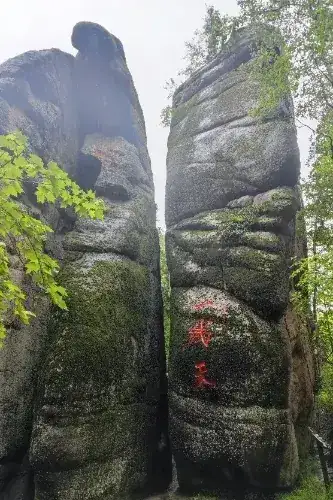
Xidaquan National Forest Park: Features five scenic areas including the Hongxia Gorge rafting area (5 km course), Wolong Peak hiking area (676 m, with natural caves and a "thread of sky" formation), primeval forest, water park, and visitor services.
Shilongshan National Forest Park: Covers 6,307.5 hectares with three scenic areas: forest viewing, Shilong Lake, and ecological garden, featuring typical broad-leaved mixed forest.
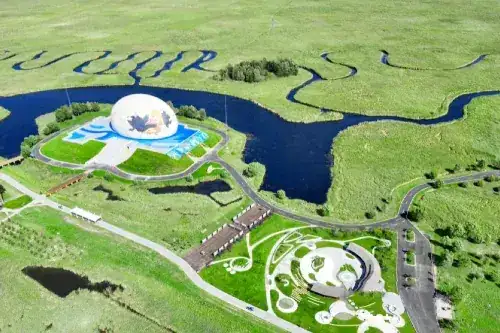
Taoshan Lake National Wetland Park: Covers 2,950 hectares and was officially designated as a National Wetland Park in 2019.
Qingsongling Forest Park: Located about 15 km from the county seat at an average elevation of 450 meters, with Korean pine, spruce, and fir forests.
Jixing River Reservoir Scenic Area: Located 25 km north of Boli County, with 20,000 mu of forestland and a capacity of 15 million cubic meters, featuring 10 scenic spots and receiving about 30,000 visitors annually.
External Exchange
The city maintains regional strategic partnerships with 14 cities in eastern Northeast China and a cooperative development relationship with Jiangmen, Guangdong.
Notable Figures
Qitaihe has produced 10 world short track speed skating champions, including Zhang Jie, Yang Yang, Wang Meng, Fan Kexin, and Yang Jingru, earning the city the reputation as the "Cradle of Winter Olympic Champions."
Honors
- National Garden City
- 2020 China Summer Resort City
- 2020 National Voluntary Blood Donation Advanced City
- 2021 National Anti-Drug Model City (first batch)
- 2022 "Olympic Champion City" award from the Chinese Olympic Committee
Travel information can change. Check current opening hours, reservations and entry requirements before you travel.
Traveller discussion
Start the conversation with a helpful tip or a question.