
Liaoyang City
Liaoyang CityLiaoyang City, historically known as Xiangping and Liaodong City, is a prefecture-level city in Liaoning Province, located in Northeast China and central Liaoning. The terrain slopes from southeast to northwest, with varying cl
Liaoyang City
Liaoyang City, historically known as Xiangping and Liaodong City, is a prefecture-level city in Liaoning Province, located in Northeast China and central Liaoning. The terrain slopes from southeast to northwest, with varying climate characteristics across different landforms. The total area is 4,735.78 square kilometers. As of May 2026, Liaoyang administers 5 districts, 1 county, and 1 county-level city. As of end-2025, the resident population was 1.49 million. Liaoyang is a modern industrial city centered on petrochemicals, designated by the State Council as a central city of the Liaozhongnan region and a national famous historical and cultural city. It serves as a sub-center of the Shenyang metropolitan area, an emerging modern petrochemical and textile industrial base, and one of the earliest cities in Northeast China with over 2,000 years of history. In 2025, Liaoyang achieved a GDP of 100.12 billion yuan (approximately $13.9 billion), a year-on-year increase of 4.1% at constant prices.
Historical Development
Archaeological discoveries along the middle reaches of the Taizi River reveal numerous Stone Age cultural sites, indicating human activity in the Liaoyang area 6,000 to 7,000 years ago.
Before the Spring and Autumn period, the area was inhabited by early Chinese peoples (primarily the Donghu tribe) and Shang Dynasty migrants. During the Xia and Shang eras, the Liaoyang area belonged to the Yingzhou region. In the Zhou Dynasty, Liaoyang was part of Youzhou. Around 1066 BCE, King Wu of Zhou granted Jizi the Liaoyang area, who brought Central Plains culture and advanced production techniques, promoting ethnic integration.
During the reign of King Zhao of Yan (c. 284 to 279 BCE), General Qin Kai attacked the Donghu and established the Liaodong Commandery, simultaneously founding Xiangping County with its seat at Xiangping City (now Liaoyang's old city). In 221 BCE, Qin Shi Huang unified China into 36 commanderies, retaining the Liaodong Commandery with its seat at Xiangping.
During the Western Han, the Liaodong Commandery administered 18 counties including Xiangping. By the late Eastern Han (189 CE), Liaodong Governor Gongsun Du declared himself Liaodong Marquis. His grandson Gongsun Yuan later declared himself King of Yan and submitted to Eastern Wu's Sun Quan. By this time, Xiangping had become a major commercial, handicraft, mining, and cultural center in Northeast China, with a population exceeding 300,000.
In 238 CE, Sima Yi led Wei forces to destroy the Gongsun regime. The Jin Dynasty reestablished Pingzhou in 274 CE, administering the Liaodong, Xuantu, and Changli commanderies. During the Eastern Jin, the Xianbei leader Murong Hui captured Liaodong and established Former Yan. In 404 CE, the Goguryeo occupied Liaodong and renamed Xiangping City as Liaodong City, ending the name Xiangping.
In 645 CE, Emperor Taizong of Tang personally led a campaign against Goguryeo, capturing Liaodong City. The Tang established the Andong Protectorate, which moved to Liaodong City in 676 CE, governing 9 commanderies, 42 prefectures, and 100 counties.
In 918 CE, Khitan leader Yelu Abaoji captured Liaodong City and established Liaoyang Prefecture. In 928 CE, Emperor Taizong of Liao designated it the Southern Capital, a secondary capital, and relocated the Dongdan Kingdom's capital to Liaoyang. The Liao Dynasty renamed it Dongjing (Eastern Capital) in 938 CE, establishing the Tokyo Circuit governing 40 prefectures. Two uprisings by Bohai people occurred during the Liao period (1029 and 1116 CE).
During the Jin Dynasty, Liaoyang served as the Eastern Capital. In 1161 CE, Wanyan Yong proclaimed himself emperor at Liaoyang, beginning the fifth reign of the Jin Dynasty. Under the Yuan Dynasty, Liaoyang became the seat of the Liaoyang Branch Secretariat, governing 7 circuits, 12 departments, and 120 relay stations.
During the Ming Dynasty, Liaoyang became the seat of the Liaodong Regional Military Commission, governing 25 military guards and 2 prefectures. It was the political, economic, and military center of Northeast China. The city walls, rebuilt over more than a decade starting in 1372, measured over 24 li in circumference. In 1621, Nurhaci captured Liaoyang and briefly established his capital at Dongjing City east of the Taizi River, before moving to Shenyang in 1625.
Under the Qing Dynasty, Liaoyang was placed under Shengjing jurisdiction. In 1653, the Liaoyang Prefecture was established, later reorganized as Liaoyang County under Fengtian Prefecture. After the Russo-Japanese War (1905), Japan established a consulate in Liaoyang and designated the area as a commercial concession.
After the 1911 Revolution, Liaoyang became a county under Liaoshen Circuit. During the Japanese occupation (1931 to 1945), Liaoyang was merged with the Manchurian Railway zone to form Liaoyang City in 1937. Liaoyang was liberated by the People's Liberation Army on February 6, 1948, and fully liberated on October 30, 1948.
Administrative Divisions
Division History
In 1949, parts of Liaoyang County were transferred to Anshan City. Over the following decades, administrative boundaries between Liaoyang, Anshan, and surrounding counties were repeatedly adjusted. In 2012, Liaoyang underwent its largest administrative reorganization: the Changda Railway became the boundary for the new Taizi River District, and areas east of the Taizi River formed the new Wensheng District. Liaoyang County and Dengta City areas were correspondingly reduced.
Division Details
As of 2026, Liaoyang has 5 municipal districts, 1 county, and 1 county-level city, comprising 30 towns, 6 townships, 14 subdistricts, 529 administrative villages, and 183 communities. The city government is located at No. 9 Xincheng Road, Wensheng District.
Geography
Location and Extent
Liaoyang borders Benxi, Fengcheng, and Xiuyan Manchu Autonomous County to the east, Anshan to the south, Liaozhong District of Shenyang to the west, and Shenyang to the north. The total boundary length is 471.8 km. Geographic coordinates: 122 degrees 35 minutes to 123 degrees 40 minutes East, 40 degrees 42 minutes to 41 degrees 37 minutes North. The total area is 4,735.78 square kilometers, with an east-west span of 92.3 km and a north-south span of 100.3 km.
Geology
Liaoyang belongs to the North China Stratigraphic Region, Liaodong Subregion. The exposed strata are complex, ranging from pre-Sinian to Quaternary across 8 systems. The Quaternary strata are widely distributed, especially in the western plains near the Liao River, where alluvial deposits thicken from about 70 meters at the piedmont to nearly 300 meters near the Hun River.
Topography
Liaoyang sits at the transition between the Liaodong low mountains and hills and the Liao River Plain. The terrain descends from southeast to northwest, from mountains exceeding 1,000 meters to plains below 50 meters, forming a uniform southeasterly-to-northwesterly slope. The highest point is Dahei Mountain at 1,181 meters in Shuiquan Township; the lowest point is near Tangmazhai and Mujia Town. The city has 166 peaks of various sizes, with key peaks including Motianling (968.8 m), Heibeizhengcha (906.3 m), and Shengtie Ridge (528.2 m).
Climate
Liaoyang has three distinct climate zones: a temperate humid monsoon climate in the eastern low mountain and hill areas (annual precipitation 800 to 900 mm, average temperature 6 to 8 degrees Celsius, frost-free period 140 to 160 days); a temperate semi-humid monsoon climate in the northern hills and plains (annual precipitation 500 to 700 mm, frost-free period about 150 days); and a warm temperate semi-humid climate in the western riverine plains (annual temperature 8 to 9 degrees Celsius, precipitation 600 to 800 mm, frost-free period 160 to 180 days).
Hydrology
Liaoyang has 86 rivers exceeding 5 km in length, of which 29 exceed 10 km, forming the Taizi River and Hun River systems. The Taizi River, historically called Yanshui, spans 413 km with 143 km within Liaoyang, draining approximately 85% of the city's total area. Its two source streams originate in Xinbin and Huanren counties, converging through Benxi before entering Liaoyang. The river has 24 tributaries exceeding 10 km, forming a centripetal water system.
Natural Resources
Water Resources
Liaoyang has 27 registered geothermal springs across 42 wells, including the famous Tanghe Hot Spring (50 to 70 degrees Celsius) and Tanghe Cold Spring. The hot spring contains valuable radon, making it an ideal medical mineral spring; the cold spring contains selenium. Liaoyang supplies approximately 230 million cubic meters of groundwater annually to the Anshan area, supporting drinking water for about 2 million urban residents and industrial use for major enterprises.
Land Resources
The total area is 4,731 square kilometers (709,190 mu), of which mountainous and hilly land accounts for 42.5%, plains 51.1%, and water bodies 5.4%. Cultivated land covers 2.21 million mu (31.2%), forest land 2.4356 million mu (34.3%), and grassland 611,200 mu (8.6%). The main soil types are brown earth (57.5%), meadow soil (28.1%), and paddy soil (8.7%), with organic matter content of 1.87%.
Biological Resources
The eastern low mountain areas feature deciduous broadleaf forests and mixed coniferous-broadleaf forests, with main species including Mongolian oak and Chinese pine. The area is the primary tussah silkworm base in Liaoyang County. Historically, over 200 wildlife species inhabited the area, including tigers, bears, leopards, wolves, deer, and various bird species, though many have declined due to habitat loss.
Mineral Resources
Liaoyang has 9 categories and 18 types of minerals across more than 500 deposits, with 28 proven reserves and 35 developed varieties. Key minerals include iron, cement limestone, silica, gypsum, magnesite, talc, gold, petroleum, natural gas, and coal. Silica accounts for 60.76% and muscovite 69.35% of Liaoning Province's reserves, both ranking first provincially. Iron (18.33%) and gypsum (40.47%) rank second, while cement limestone and flux limestone rank third.
Population
Population Size
According to the Seventh National Census (2020), Liaoyang's resident population was 1,604,580. As of end-2025, the resident population was 1.49 million, with an urbanization rate of 69.31%. The registered population was 1.6433 million, down 23,100 from the previous year. Birth rate was 3.184 per mille, death rate 14.815 per mille, and natural growth rate negative 11.631 per mille.
Ethnic Composition
Liaoyang is a multi-ethnic city. Over 3,000 years, ethnic groups including Sushen, Yilou, Wuji, Jurchen, Goguryeo, Khitan, Mongol, and Manchu migrated to Liaoyang from the northern Changbai Mountains, the western Mongolian grasslands, and the eastern Bohai coast. Minority groups with over 1,000 members include Manchu, Hui, Korean, Mongol, and Xibe. The city has 3 minority townships and 19 minority villages. Liaoyang is one of the birthplaces of the Manchu people, and the earliest city where Hui people settled in Northeast China, arriving with the Mongol army during the Yuan Dynasty.
Politics
Political governance operates under Liaoning Province through the municipal government and people's congress system.
Economy
Overview
In 2025, Liaoyang's GDP reached 100.12 billion yuan (approximately $13.9 billion), up 4.1% year-on-year at constant prices, 0.4 percentage points above the provincial growth rate. The three-sector structure was 10.9:40.2:48.9. Primary industry added value of 10.9 billion yuan ($1.5 billion, +3.5%); secondary industry 40.25 billion yuan ($5.6 billion, flat); tertiary industry 48.98 billion yuan ($6.8 billion, +7.5%). Per capita GDP was 66,772 yuan ($9,274, +5.6%).
General public budget revenue was 9.11 billion yuan ($1.3 billion, +5.5%), with tax revenue of 6.75 billion yuan ($937.5 million, +12.9%). General public budget expenditure was 16.83 billion yuan ($2.3 billion, -17.6%). Per capita disposable income was 36,031 yuan ($5,004, +5.1%), with urban residents at 43,208 yuan ($6,001) and rural residents at 23,782 yuan ($3,303). Fixed asset investment fell 23.7%.
Primary Industry
Liaoyang is a national and provincial commodity grain base, as well as a key area for lean-type pig and freshwater fish farming. The western plains produce rice, corn, and freshwater fish, earning the nickname "Granary." The eastern mountainous areas produce hawthorn and Nanguo pears. In 2025, grain output reached 1.135 million tons (a record high, +50,000 tons), with corn at 767,000 tons and rice at 354,000 tons. Vegetable and edible mushroom output was 1.002 million tons, and fruit output was 337,000 tons. The farming mechanization rate reached 95.5%. The city had 85 municipal-level and above agricultural industrialization enterprises, 3,328 family farms, and 2,118 farmers' cooperatives.
Secondary Industry
Liaoyang's industrial sectors include petrochemicals, textiles, metallurgy, chemicals, machinery, electronics, building materials, energy, and food processing. The chemical fiber industry is a national key base, with the Liaoyang Petrochemical Fiber Company being a major integrated enterprise. In 2025, above-scale industrial value-added fell 0.5%, though high-tech manufacturing grew 9.5%. Industrial revenue was 106.4 billion yuan ($14.8 billion), with profits of 2.01 billion yuan, reversing a loss of 19.85 billion yuan from the previous year. Manufacturing investment rose 20.6%, with high-tech manufacturing investment increasing 2.8-fold, and electronic and communication equipment manufacturing growing 9-fold.
Tertiary Industry
In 2025, total retail sales of consumer goods reached 29.31 billion yuan ($4.1 billion, +2.2%), with urban retail at 23.42 billion yuan and rural retail at 5.89 billion yuan. Catering revenue was 2.78 billion yuan (+4.3%). Online retail sales of above-quota units grew 18.6%.
Total import and export trade was 3.29 billion yuan ($456 million, -0.6%), with exports of 2.32 billion yuan ($322 million) and imports of 970 million yuan ($135 million, +60.2%). Exports to Asia totaled 1.42 billion yuan, Europe 510 million yuan, and North America 240 million yuan. Actual foreign investment used was $3.68 million (-35.4%).
Tourism welcomed 22.18 million visitors (+28.8%), with total tourism revenue of 15.54 billion yuan ($2.2 billion, +20.0%). Financial institution deposits reached 295.05 billion yuan ($41 billion). Insurance premium income was 4.25 billion yuan ($590 million, +7.1%). Postal deliveries totaled 109.158 million items (+13.9%), and telecom revenue was 1.49 billion yuan.
Social Development
Education
In 2025, regular higher education enrolled 8,000 students with 23,000 currently enrolled; secondary vocational education enrolled 3,000; regular senior high schools enrolled 7,000 with 21,000 enrolled; junior high schools enrolled 10,000 with 32,000 enrolled; primary schools enrolled 8,000 with 53,000 enrolled; special education had 292 students; kindergartens had 20,000 children.
Science and Technology
In 2025, 642 patents were granted, including 92 invention patents. Effective invention patents totaled 940, up 84 from the previous year. The city had 12 technology business incubators, 57 innovation platforms (including 3 provincial laboratories and 24 provincial innovation centers), and 15 science popularization bases. New additions included 144 tech SMEs, 27 high-tech enterprises, 10 gazelle enterprises, and 5 startup enterprises. The city had 77 specialized and sophisticated SMEs and 12 "little giant" enterprises.
Culture
Liaoyang has 9 public libraries (1.317 million volumes, 336,000 annual visitors), 8 cultural centers, 4 museums, 1 memorial hall, and 9 archives. There are 14 theaters and 13 registered film projection units, with 832,000 annual cinema viewers and box office revenue of 35.62 million yuan ($4.95 million). The city has 164 intangible cultural heritage projects, including 2 national-level, 16 provincial-level, and 146 municipal-level.
Healthcare
As of end-2025, Liaoyang had 1,517 health institutions including 67 hospitals, 37 health centers, 8 disease prevention and control centers, and 765 village clinics. Total beds numbered 13,000, with 15,000 health professionals including 6,141 licensed physicians and 6,916 registered nurses. Annual outpatient visits reached 8.595 million, with 295,000 discharges.
Sports
The city has 2 municipal stadiums and 37 sport associations. In 2025, the delegation won 157.5 medals at provincial and above competitions, including 50.5 gold, 51 silver, and 56 bronze. Sports infrastructure investment was 4.153 million yuan, and sports lottery sales reached 270 million yuan ($37.5 million).
Social Security
In 2025, 26,000 urban residents achieved employment or re-employment, with 10,000 new urban jobs. Registered urban unemployed was 11,000 (-36.7%). Pension insurance covered 831,000 urban workers and 300,000 rural residents. Basic medical insurance covered 1.415 million people. Minimum living allowance payments totaled 290 million yuan ($40.3 million), supporting 11,000 urban and 36,000 rural residents. The city had 99 elderly care institutions with 7,042 beds.
Environmental Protection
In 2025, urban air quality compliance rate was 89.0%, with PM10 at 57 micrograms per cubic meter and PM2.5 at 33.9 micrograms per cubic meter, both meeting national secondary standards. Functional area noise compliance rate was 94.4%. Total water consumption was 830 million cubic meters (+1.3%), with all monitored drinking water sources meeting quality standards. Per capita park green space was 21.7 square meters, with green coverage of 41.9%.
Transportation
Highways
In 2025, highway freight volume was 75.14 million tons (+4.0%), freight turnover 15.38 billion ton-kilometers, passenger volume 14.97 million (+5.4%), and passenger turnover 470 million person-kilometers (+26.7%). Total highway mileage was 4,196.4 km, including 159.1 km of expressways. Motor vehicle ownership was 387,000, including 348,000 automobiles (197,000 sedans).
Railways
Liaoyang Station serves both the Shen-Da Railway and the Ha-Da High-Speed Railway, functioning as a comprehensive station integrating high-speed and conventional rail. The station building covers nearly 8,000 square meters, accommodating 1,500 passengers simultaneously, with 8 automatic and 2 manual ticket gates.
Aviation
Liaoyang is approximately 60 km from Shenyang Taoxian International Airport.
Water Transport
Liaoyang is 332 km from Dalian Port and 162 km from Yingkou Port.
Public Transit
As of end-2025, Liaoyang had 699 public buses (623 new energy vehicles, +150), operating 107 routes totaling 2,475.4 km (new energy routes 2,079 km). Annual ridership was 43.232 million, up 1.047 million. The city also operated 3,579 taxis and 8,000 shared bicycles.
History and Culture
Intangible Cultural Heritage
Liaoyang has 164 intangible cultural heritage projects, including 2 national-level (Errenzhuan and Liaoning Drum Music), 16 provincial-level, and 146 municipal-level, with 9 new provincial and 15 new municipal additions in 2025.
Origin of the Name
Liaoyang was anciently called Xiangping. The name "Liaoyang" originated in the Han Dynasty, derived from its location north of the Xiaoliao River (present-day Hun River). According to the "Book of Han: Geography," the Daliang River (Taizi River) flows southwest to Liaoyang where it joins the Liao River, hence the name.
City Symbols
On April 26, 1994, the Liaoyang Municipal People's Congress designated the city tree as the Chinese scholar tree (Guohuai) and the city flower as the Chinese rose (Yueji).
Scenic Spots
Liaoyang features numerous historical and natural attractions. Key historical sites include Han and Wei Dynasty tomb murals, the Tang-era Goguryeo Yanzhou City (Baiyan City), the White Pagoda (Baita), Qingfeng Temple, and ancient city wall ruins. Qing-era sites include Dongjing City, Dongjing Mausoleum, and the Cao Xueqin Memorial Hall.
Notable attractions include:
- Shenwo Reservoir: Located between Benxi and Liaoyang on the Taizi River, completed in 1973 as a multi-purpose water conservancy hub for flood control, irrigation, and power generation. Designated as a provincial scenic area in the 1980s.
- Liaoyang Museum: Located in the former Peng Residence, opened in 1985, housing over 3,000 precious cultural relics. The residence features exquisite wood carvings and classical paintings depicting scenes from "Dream of the Red Chamber," "Romance of the Three Kingdoms," and other literary classics.
- Taizi River Scenic Area: A 3,260-meter riverside park opened in 1992, covering 240 hectares with 33 tree species, 14 flower varieties, and recreational facilities including natural swimming areas and pavilions.
- White Pagoda Park: Built in 1908, covering 8 hectares. The pagoda dates to the Liao Dynasty and is the tallest in Northeast China, designated a national key cultural heritage protection unit in 1988.
- Wazigou Ecological Tourism Area: Located in Gongchangling District, covering 15,000 mu of forest and orchards, 27 km from Liaoyang and 38 km from Anshan, featuring mountain scenery and the Tanghe Reservoir upstream.
- Guangyou Temple: Originally built in the Eastern Han Dynasty, one of the earliest Buddhist temples in China. Expanded in 1145 under the Jin Dynasty, it reached its peak in 1571 with nearly 200 halls, the largest in Northeast China. The temple houses two ancient bronze Buddha statues from the Yuan Dynasty or earlier: a Medicine Buddha (2.98 m tall) and a Samantabhadra Bodhisattva (1.72 m tall).
- Cao Xueqin Memorial Hall: Established in 1996 on the site of the Qing-era Wu Residence, dedicated to the author of "Dream of the Red Chamber," whose ancestral home was Liaoyang. It is the only such memorial in Northeast China.
- Tanghe Scenic Area: A 60.5 square kilometer provincial scenic area 54 km from the city center, featuring mountains, reservoirs, and water meeting national secondary drinking water standards.
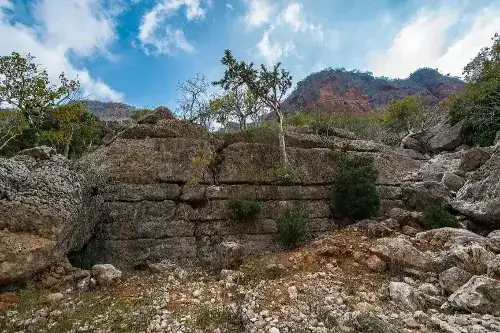
- Yanzhou City (Yanzhoucheng): A Goguryeo mountain fortress built in the 5th century on Shicheng Mountain in Dengta City, with inner and outer stone walls, a watchtower, and a reservoir. Now a provincial cultural heritage protection unit.
- Confucian Temple: Built in 1382 during the Ming Dynasty, featuring traditional layout with a screen wall, Lingxing Gate, ornamental pool, and Dacheng Hall housing statues of Confucius and his disciples.
- Guandi Temple: The largest Daoist temple in Liaoyang's history, built in 1281, covering approximately 12,000 square meters, with halls dedicated to Guan Yu, Zhang Fei, Zhao Yun, and Liu Bei.
Local Specialties
Liaoyang's local specialties include agricultural products from its fertile western plains, such as rice and freshwater fish, and mountain fruits from the eastern highlands, including hawthorn and Nanguo pears.
Notable Figures
Liaoyang has produced numerous notable historical figures throughout its 2,000-year history.
Sister Cities
Liaoyang maintains sister city relationships with several international cities, fostering cultural and economic exchange.
Honorary Titles
In April 2025, Liaoyang was selected as a National Double Support Model City, recognizing its support for military personnel and their families.
Travel information can change. Check current opening hours, reservations and entry requirements before you travel.
Traveller discussion
Start the conversation with a helpful tip or a question.