
Taiyuan City
Taiyuan CityTaiyuan, abbreviated as "Bing" (bing), historically known as Jinyang, also called Bingzhou and Dragon City, is a prefecture-level city in Shanxi Province, the provincial capital, and a Type I large city. Located in central Shanx
Taiyuan City
Taiyuan, abbreviated as "Bing" (bing), historically known as Jinyang, also called Bingzhou and Dragon City, is a prefecture-level city in Shanxi Province, the provincial capital, and a Type I large city. Located in central Shanxi at the northern end of the Jinzhong Basin, it is surrounded by mountains on three sides (east, west, and north) with the Fen River valley plain in the central-southern area. The terrain descends from north to south, with a warm temperate continental monsoon climate characterized by cold winters, hot summers, short spring and autumn, large diurnal temperature differences, and scarce but concentrated precipitation. Total area: 6,988 square kilometers. As of the end of 2024, the permanent resident population was 5,514,668. As of the end of 2023, the city administers 6 districts, 3 counties, and 1 county-level city. Taiyuan is a city with over 4,700 years of history and 2,500 years of urban history, historically described as "controlling mountains and rivers, occupying the shoulder of the world." It has been known since ancient times as "Beautiful Taiyuan." It is a famous military and cultural stronghold in northern China, a world-renowned center of Jin merchants, with 2,237 immovable cultural relics and 541 protected heritage units at all levels. It is one of China's important energy and heavy industry bases, a central city of central China as designated by the State Council, a National Famous Historical and Cultural City, a national comprehensive transportation hub, and a North China advanced manufacturing base. In 2025, GDP was 538.245 billion yuan, up 1.3%.
Administrative Evolution
Pre-Qin Period
The discovery of the "Gujiao Paleolithic Culture Site" proves human habitation 100,000 years ago. Neolithic sites at Yijing and Dongtaibu further prove that 7,000–8,000 years ago, early matriarchal clan communities created a splendid culture. The area belonged to Jizhou in ancient times, the first of the Nine Provinces. In 541 BCE, the Jin State's Xun Wu conquered the Wuzhong and Chidi tribes, bringing the Taiyuan area into Jin's territory. At the end of the Spring and Autumn period (770–476 BCE), the Six Ministers dominated Jin politics. In 497 BCE, Zhao Yang established his base at Jinyang (present-day Taiyuan), which became the foundation for the future Zhao State.
Qin-Han to Southern and Northern Dynasties
After Qin Shi Huang unified China in 221 BCE, Taiyuan Commandery was established as one of 36 commanderies, with its seat at Jinyang, governing 37 counties. During the Western Han Dynasty (206 BCE–9 CE), Emperor Gaozu enfeoffed Han Wangxin as King of Han at Jinyang. In 196 BCE, Prince Liu Heng (later Emperor Wen) was enfeoffed as King of Dai at Jinyang. During the Eastern Han Dynasty (25–220 CE), Bingzhou Inspectorate was reestablished, supervising Taiyuan and other commanderies. During the Three Kingdoms, Wei restored Bingzhou. During the Western Jin Dynasty (265–316), Taiyuan was a kingdom under Bingzhou. The Sixteen Kingdoms period saw the area change hands among Former Zhao, Later Zhao, Former Qin, Western Yan, and Later Yan. In 396 CE, the Northern Wei (386–534) captured Jinyang, establishing Bingzhou.
Sui-Tang to Song-Yuan
During the Sui Dynasty (581–618), the General Administration was established at Jinyang. During the Tang Dynasty (618–907), Bingzhou was reestablished and later elevated to the Grand Governor-General's office. In 690 CE, Empress Wu Zetian designated Jinyang as the Northern Capital. In 723 CE, Emperor Xuanzong restored the Northern Capital and renamed Bingzhou as Taiyuan Prefecture. The Five Dynasties period saw Taiyuan as the base for the Later Tang (923–936), Later Jin (936–947), Later Han (947–950), and Northern Han (951–979). In 979, the Song Dynasty conquered the Northern Han and destroyed Jinyang City, moving the administrative seat to Tangming Town (present-day Taiyuan urban area). The Jin Dynasty (1115–1234) captured Taiyuan in 1125. The Yuan Dynasty (1271–1368) established Taiyuan Circuit, later renamed Jining Circuit.
Ming-Qing Period
In 1368, Ming general Xu Da captured Taiyuan. The Ming Dynasty established Taiyuan Prefecture, governing 6 prefectures and 22 counties. In 1644, Li Zicheng captured Taiyuan, and the Qing Dynasty subsequently took over. The Qing maintained Taiyuan Prefecture. In 1724, four prefectures were elevated to directly-administered prefectures. By the late Qing, Taiyuan Prefecture governed 1 prefecture-level department and 10 counties.
Republic of China Period
In 1911, Taiyuan rose in rebellion, and in 1912, the Republic of China was established. In 1913, the prefecture system was abolished. In 1927, Taiyuan was formally established as a city. In November 1937, Japanese forces occupied Taiyuan. In 1945, after Japan's surrender, the Nationalist government returned. In 1948, the PLA approached Taiyuan, and on October 17, the Taiyuan Municipal Government was established at Yuci. On April 24, 1949, the PLA captured Taiyuan.
After the Founding of the PRC
In 1949, Taiyuan became the seat of the Shanxi Provincial People's Government and the provincial capital. In 1951, Jinyuan County was merged into Taiyuan. In 1958, Yangqu and Qingxu counties were merged in. In 1972, Loufan County was transferred from Lvliang to Taiyuan. In 2025, Shuangta Sub-district was established in Yingze District.
Geographical Environment
Location and Boundaries
Taiyuan is in central Shanxi at the northern end of the Jinzhong Basin, between 111°30′–113°09′E and 37°27′–38°25′N. East-west width: 114.25 km; north-south length: 107 km; total area: 6,988 km² (4.5% of Shanxi). It borders Xinzhou to the north, Lvliang to the northwest, Jinzhong to the south and east.
Climate
Warm temperate continental monsoon climate. Winter: cold and dry under Siberian air; summer: hot and rainy under Pacific moisture; spring: rapid warming; autumn: rapid cooling; short spring and autumn with frequent winds. Average annual solar radiation: 4,927.90 MJ/m²; annual sunshine: 2,285–2,587 hours; average annual precipitation: 390–423 mm; average annual temperature: 8.10°C–11°C; frost-free period: 153–178 days.
Geology
Taiyuan sits on the central Shanxi fault uplift, at the junction of the Lvliang fault arch, Daning platform depression, Wutai platform arch, and Qinshui platform depression. The Xishan Depression contains the Xishan Coalfield, one of Shanxi's six major coalfields.
Landforms
Mountains surround the city on three sides with the Fen River valley plain in the center-south. Five landform types: mountains (4,528 km², 64.79%), hills (904 km², 12.94%), plains (1,093 km², 15.64%), basins (279 km², 3.99%), and valleys (184 km², 2.63%). The highest peak is Heheyan Mountain in Loufan County at 2,708 meters; the lowest is at 760 meters in Qingxu County, with a relief of 1,948 meters.
Hydrology
The Fen River flows north-south through the city, with its basin covering 6,331 km² (90.6% of total). The northern part belongs to the Hai River basin (657 km², 9.4%). 2 large reservoirs: Fenhe Reservoir (110.80 million m³) and Fenhe No. 2 Reservoir (87.93 million m³), plus 15 small reservoirs and 174 silt-trap dams.
Soil
9 soil types, 15 subtypes, 37 genera, and 155 species. Cinnamon soil is the main zonal soil, ideal for agriculture, widely distributed across all agricultural counties/districts.
Natural Disasters
Main hazards: drought, flood, hail, frost damage, and strong winds. In October 2021, continuous heavy rainfall caused severe flooding in Qingxu County, requiring evacuation of 14,700+ people from 8 villages. Total affected population: 178,922; emergency relocation: 20,082; direct economic losses: 1.522 billion yuan.
Natural Resources
Water Resources
Total water resources: 660 million cubic meters/year (309 million river runoff + 566 million groundwater - 215 million overlap). In 2021, total water supply: 764.282 million cubic meters.
Land Resources
As of 2021, total land use: 691,246 hectares. Arable land: 116,598 ha (16.90%); orchard: 18,101 ha (2.60%); forest: 278,073 ha (40.20%); grassland: 168,062 ha (24.30%); urban/mining: 64,659 ha (9.40%); transportation: 13,779 ha (2%); water: 16,467 ha (2.40%).
Mineral Resources
The area is rich in minerals, especially coal. The "Taiyuan Series Coal" has proven reserves of 18.677 billion tonnes (17.224 billion remaining, 10.18% of Shanxi's total). Coal types include coking, fat, lean, meager, gas, and anthracite coal—virtually all types present. Coal-bearing area: 1,368 km² (19.58% of total). Other minerals include iron, manganese, copper, aluminum, lead, zinc, sulfur, gypsum, refractory clay, quartz, limestone, and dolomite.
Forest and Grassland Resources
Evergreen coniferous forests are mainly in low-mid mountains and loess hills. Deciduous broadleaf forests are all secondary. Meadow vegetation is widely distributed in western mountains and along rivers. As of end 2022, forest coverage reached 43%.
Biological Resources
Plants: 1,347 species across 140 families and 658 genera (including 25 fern and 1,322 seed plant species). 9 economic use categories, including 117 medicinal, 28 fiber, and 32 ornamental species. Wildlife: 173 bird species (4 national Class I, 27 Class II, 80 Sino-Japanese protected migratory), 42 mammals (1 Class I, 5 Class II), 8 reptiles, 5 amphibians, 21 fish, and 177 insect species. 9,728 registered ancient and notable trees as of 2023.
Nature Reserves
4 nature reserves: Lingjinggou (Yangqu County, 249.2 km², protecting brown eared pheasant and leopard), Fenhe Upper Reaches (Loufan County), Yunding Mountain (Loufan County), and Tianlong Mountain (Jinyuan District).
Administrative Divisions
As of the end of 2023, Taiyuan administers 6 districts (Xiaodian, Yingze, Xinghualing, Jiancaoping, Wanbolin, Jinyuan), 3 counties (Qingxu, Yangqu, Loufan), and 1 county-level city (Gujiao). The Municipal Government is at No. 69 Xinjian Road.
Politics
Population
Population Numbers
As of the end of 2025, the permanent resident population was 5,526,060, an increase of 11,392 (0.21%). Births: 36,060 (6.53‰); deaths: 41,474 (7.51‰); natural growth rate: -0.98‰. Urbanization rate: 89.34% (2022). Sex ratio: 105:100.
Ethnic Groups
Taiyuan has 46 ethnic groups, with 45 minorities totaling 24,000 (0.57%), including Hui (11,725), Manchu (5,685), and Mongolian (1,660).
Language
Taiyuan dialect belongs to the central Shanxi Jin Chinese group. It preserves ancient Chinese entering tones, retains "qiejiao" (split-foot) vocabulary from the medieval period, and has a high frequency of choice questions. The dialect varies significantly between urban areas and remote counties, with Loufan dialect being particularly archaic and valuable for research.
Religious Beliefs
Taiyuan has 5 major religions: Buddhism, Daoism, Islam, Catholicism, and Protestantism. The Puguang Temple (Eastern Han, 196–220 CE) is the city's earliest Buddhist temple. Daoism rose during the Northern Wei. Islam arrived in the mid-Tang Dynasty. Catholicism was introduced in 1634 by Belgian Jesuit Nicolas Trigault. Protestantism arrived in 1877 via British missionary Timothy Richard.
Economy
Overview
Taiyuan is a major industrial city. In 2006, it began a green transformation path. The primary industry is led by agriculture; the secondary by manufacturing (special metals, new-generation electronics, new chemical materials, high-end equipment, new energy, bio-based materials); the tertiary by services, creating 10 service industry clusters.
In 2024, GDP was 541.887 billion yuan (up 1.2%). Primary: 4.785 billion (up 3.5%, 0.9%); secondary: 166.671 billion (up 0.1%, 30.7%); tertiary: 370.431 billion (up 1.6%, 68.4%). General public budget revenue: 44.026 billion (down 2.0%). Fixed asset investment grew 0.5%.
Primary Industry
Grain is the main crop. Integrated improved varieties, methods, and machinery. Continued "10,000-mu, 1,000-plot, 100-park" greenhouse vegetable project. In 2024, agricultural output: 8.146 billion yuan (up 3.8%), including farming 4.318 billion, forestry 1.431 billion, animal husbandry 1.801 billion, and fishery 90 million yuan.
Secondary Industry
Manufacturing leads the secondary industry. In 2024, industrial enterprises above designated size grew 0.2%. Manufacturing grew 0.7% (60.4% of total); mining declined 1.2% (28.5%); utilities grew 1.1% (11.1%). Strategic emerging industries accounted for 37.3%. Construction output: 371.086 billion yuan (down 11.3%).
Tertiary Industry
Services dominate. 10 service clusters include technology services (based on university science parks), modern logistics, e-commerce, specialized markets, comprehensive services, modern finance (Yingze West CBD), and tourism-leisure areas. Cultural-tourism integration: Fenhe Yanqiu Garden, Taiyuan Northern Qi Mural Museum, and Jinyang Ancient City Archaeological Museum opened. Taiyuan Ancient County was selected as a national tourism-leisure street. In 2024, retail sales: 194.692 billion yuan (up 1.8%). Financial institution deposits: 2,021.316 billion yuan (up 6.2%); loans: 2,095.361 billion (up 7.9%).
Economic Functional Zones
Taiyuan Economic and Technological Development Zone: Features food processing, pharmaceutical/electronics, light industry, fine chemicals, and bonded zones with comprehensive rail-road-air transport. Qingxu Economic Development Zone: Provincial-level (established 2017), 29.99 km², with fine chemical circular industry and high-end equipment manufacturing, anchored by Meijin, Gengyang, Yaxin, and Lu'an Taihua Materials.
Social Undertakings
Education
As of end 2022: 1,469 schools of all types, including 5 municipal higher education institutions, 26 secondary vocational, 91 general high schools, 128 junior high schools, 409 primary schools, 800 kindergartens, and 9 special education schools. 790,000 students and 58,000 full-time teachers. Notable universities: Shanxi University (founded 1902, "Double First-Class" construction, with philosophy and physics as national key disciplines), Taiyuan University of Technology (founded 1902, "211 Project" and "Double First-Class" university, one of China's three earliest national university halls), and Taiyuan University of Science and Technology (New China's first heavy machinery undergraduate institution).
Healthcare
As of end 2022: 4,087 medical institutions, including 160 hospitals, 44,283 beds, and 70,074 health technical personnel. Notable: First Hospital of Shanxi Medical University (founded 1957, Class III Grade A, 3,000 authorized beds, 6 national clinical key specialties) and Second Hospital of Shanxi Medical University (founded 1919, 100-year history, 2,700 beds).
Media
6 TV channels and 5 radio channels. Major media: Shanxi Daily, Shanxi Evening News, Shanxi Broadcasting, Taiyuan Daily, Taiyuan Evening News, and Taiyuan News Network.
Science and Technology
As of end 2022: 2,628 technology contracts registered (26.565 billion yuan). 17 national and 140 provincial technology centers. 107 provincial and above key laboratories, 101 engineering technology research centers, 75 academician workstations, and 2,220 high-tech enterprises. 3,761 invention patents authorized, 16,381 valid. In 2023: 22 new provincial key laboratories, 21 technology innovation centers, and 3,744 technology-based SMEs, 954 specialized/sophisticated SMEs, and 55 "Little Giant" enterprises.
Culture
As of end 2022: 18 performing troupes, 12 cultural centers, 21 museums, 11 public libraries (6.7906 million books). 100% broadcast and TV population coverage. Created national-level dance "Song Dynasty Elegance," Jin opera "Zhuang Zhou Tests His Wife," and drama "New Paperboy." 18 national, 66 provincial, and 160 municipal intangible cultural heritage items.
Taiyuan Library: Originally established 1949, current building 56,066 m² with 60 service areas, 1.95 million collection items (including 100,000+ ancient books and 10,000+ rare editions), 355 TB of digital resources.
Sports
As of 2020: 10,449 sports venues, 1.95 m² per capita, 1 municipal gymnasium, 2 sports theme parks, 15.8 km Fenhe fitness trail. "15-minute fitness circle" achieved. Notable: Su Yiming won 2022 Beijing Winter Olympics gold in snowboard big air and silver in slopestyle; Zhou Zeqi won 3 World Taekunwdo Open championships; Wu Tongtong was on the Chinese women's basketball team that won World Cup silver.
Environmental Protection
As of end 2022: 241 good air quality days, PM2.5 compliance 298 days, air quality index 5.09. Drinking water compliance: 100%. Surface water quality: 80% excellent. In 2023: 302,700 mu of afforestation, forest coverage 41.96%. All 6 national monitoring sections achieved Class III or better. Ozone concentration declined for the first time in 6 years.
Social Security
As of end 2022: urban employee pension 2.1052 million (up 143,500); resident pension 835,000; basic medical insurance 3.866 million; unemployment insurance 1.2863 million; work injury insurance 1.4544 million; maternity insurance 1.2153 million. 17,300 urban and 29,800 rural residents received minimum living allowance. In 2023: 81,200 new urban jobs, 5,000 new public kindergarten places, 24,000+ basic education places, 10,000+ new parking spaces, 688 old community renovations, and 3,000+ home eldercare beds.
Transportation
Overview
Taiyuan's strategic location supports national energy security and major strategies. The "six-radial" comprehensive transport corridor includes high-speed rail, conventional rail, and expressways. Different logistics companies use Taiyuan as a base, forming a network covering the province and radiating nationwide.
Highways
As of end 2022: 6 expressways, 11 national/provincial highways, 30 expressway exits. Total highway mileage: 7,243 km; density: 1,036 km/100 km². Expressways form a "one ring, seven radials" pattern (293 km). 636 administrative villages all have paved road and bus access.
Railways
9 trunk and 2 branch lines form the railway network. Taiyuan Railway Bureau manages 2,800 km. Multiple high-speed and conventional lines converge, including the Shitai, Daxi, and planned Taiyuan-Zhengzhou and Beijing-Taiyuan high-speed railways. Taiyuan Station and Taiyuan South Station (North China's second-largest comprehensive transport hub) are the main passenger stations. In 2019: 30.9638 million railway passengers.
Aviation
Taiyuan Wusu International Airport (North China's third-largest international airport), located in Xiaodian District 13.2 km from city center, operates 112 routes to 73 cities, forming a network covering China, East/SE Asia, and Moscow. In 2019: 14.0026 million passengers. Taiyuan Yaocheng General Airport in Qingxu County (1,200 mu, 3C level, 1,800m runway) serves general aviation.
Public Transit
As of end 2023: 2,533 buses on 259 routes (4,260.78 km), carrying 258 million annual passengers (705,000 daily, including 164,000 free rides). 1,285 public bicycle stations with 41,000 bikes covering 220 km² (38.8675 million annual rides, 99.27% free). 8,719 cruising taxis (20.28% of provincial total, highest per-capita in central China's 6 provincial capitals). 57 ride-hailing platform companies with 31,091 vehicles.
Taiyuan Metro Line 2 (Phase 1) opened December 26, 2020, running 23.647 km with 23 stations from Renmin South Road to Xijianhe. Cumulative ridership exceeded 100 million by September 2023. Metro Line 1 (Phase 1) opened on February 22, 2025.
Historical Culture
Overview
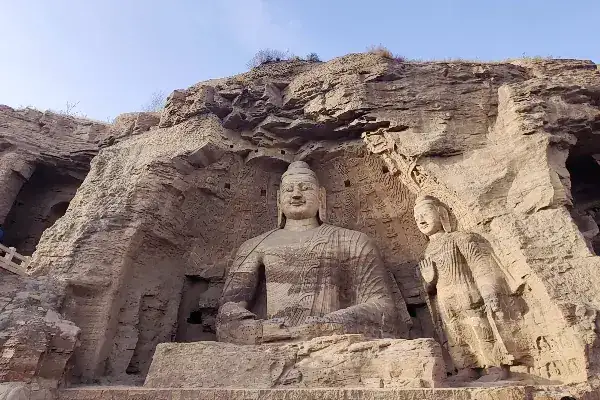
Taiyuan has 4,700+ years of history and 2,500+ years of urban history, known as "Beautiful Taiyuan" since ancient times—a military and cultural stronghold of northern China. Human activity dates back 100,000 years. The city hosts Jinci Temple (China's largest classical garden-style temple complex), Tianlong Mountain Grottoes (paragon of ancient Chinese sculpture), and important calligraphy collections. The intangible cultural heritage is rich, with 18 national-level items including medicinal food (Bazhen Soup), Qingxu back-iron-rod performance, and Qingxu colored gate. Taiyuan noodle culture is a marvel of Shanxi cuisine.
Name Evolution
Taiyuan was variously called Dalü, Daxia, and Jinyang in ancient times. The name "Taiyuan" appeared from the legendary Taidai through the Yao-Shun-Xia periods, initially as a general place name. As a specific administrative division, "Taiyuan" began with the Qin Dynasty's establishment of Taiyuan Commandery in 227 BCE, used continuously for over 2,000 years.
Cuisine
Taiyuan's traditional diet centers on noodles with vegetables and small amounts of meat. The noodle varieties are extraordinarily diverse, including helao, boyu'er, min'gedou, jiupian, sliced noodles, pulled noodles, tipicking, and many more—folk saying goes "one noodle, hundred ways to eat" and "seventy-two kinds of home cooking." Specialties: Yang Zage (sheep offal soup), Guoyou Rou (fried pork, a Jin cuisine representative since the Tang Dynasty), and Shaomei (steamed dumplings with a fluffy top).
Customs
Qingxu Colored Gate: A comprehensive art combining folk painting, traditional craftsmanship, and ancient building techniques. "Flower Pulling": A competitive spring festival sport from Taiyuan's north gate, where young men show strength and skill to win flowers for beloved girls. Jinyang Meteor Fire (huoliuxing): A folk performance art combining acrobatics and martial arts, listed as national intangible cultural heritage in 2008.
Arts
Jin Opera: One of Shanxi's "Four Great Bangzi (clapper opera)" genres, also called "Zhonglu Bangzi (clapper opera)." Developed in the Qing Dynasty from Puzhou Bangzi (clapper opera) combined with Qi-Tai yangge (folk dance) and Jinzhong folk tunes. Over 200 traditional plays. Known for both vigorous and delicate singing styles.
Taiyuan Lotus Rhyme (Lianhualao): An ancient storytelling art, also called "Jinzhong Luozi." Popular since the Qing Dynasty, now mainly performed in Taiyuan. Solo performers accompany themselves with bamboo clappers (7 pieces), chanting in seven-character verse.
Taiyuan Drum: Evolved from ancient community drums, dating back to pre-Qin times. Three performance forms: "unison playing," "contest playing," and "large-small instrument contest." 7 surviving suite pieces and 50+ common melodies. Known for powerful, vigorous style with grand performances.
City Symbols
City tree: Chinese Scholar Tree (designated 1987). The ancient Sui-Tang scholar trees at Jinci Park are nationally famous. City flower: Chrysanthemum (designated 1987), symbolizing the unyielding spirit of the Chinese nation.
Ancient Eight Views
The ancient eight views of Taiyuan (Jinyang): Lishi Cold Spring, Fenhe Evening Crossing, Twin Pagodas Soaring, Xunshui Mist, Kurei Red Leaves, Tujian Sacred Cypress, Tianmen Snow, and Mengshan Dawn Moon.
Historical Sites
As of 2022: 332 protected heritage units (33 national, 28 provincial, 143 municipal). Key sites: Chunyang Palace (Daoist temple dedicated to Lü Dongbin, Tang Dynasty origin, unique five-courtyard layout), Chongshan Temple (Tang Dynasty, Ming expansion, surviving Great Compassion Hall with 3,192 m² area), and the Grand Guandi Temple (largest in Taiyuan, built on Jin-Yuan foundations).
Intangible Cultural Heritage
As of 2022: 18 national, 66 provincial, and 160 municipal items. 11 national, 60 provincial, 196 municipal, and 334 county-level inheritors. 6 transmission centers and 25 transmission bases.
Key items: Jinci Temple Fair (dating to Northern Song, 7th month lunar calendar, listed nationally in 2008), Bazhen Soup (medicinal food with mutton and 8 herbs, listed nationally in 2008), and Liuweizhi Sauce Meat (established 1738 Qing Dynasty, "China Time-Honored Brand," traditional production methods spanning 260+ years, listed nationally in 2008).
Scenic Spots
Overview
As of end 2024: 1 national 5A, 11 national 4A, 21 national 3A, and 1 national 2A tourist attraction.
Major Attractions
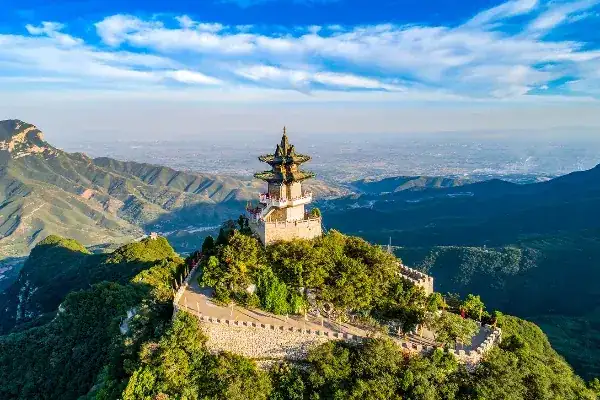
Jinci-Tianlong Mountain Scenic Area: 3.86 km², containing Jinci Temple (China's earliest, largest, and longest-spanning Tang-Song classical garden, with complete Song through Qing architecture—a "Chinese ancient architecture museum") and Tianlong Mountain Grottoes (important milestone in Sinicized grotto art). Designated as national 5A scenic area in December 2024.
Taiyuan Ancient County: Built 1375 (Ming Dynasty), in Jinyuan District. Cross-street layout with numerous historical buildings, continuing the 2,500-year Jinyang ancient city lineage. Known as "Phoenix City."
Taiyuan Botanical Garden: In Jinyuan District, ~2,730 mu, with 5 functional zones and 25 specialized gardens including exhibition greenhouses, bonsai pavilion, and research center.
Jin Merchant Museum: National AAA tourist attraction, built on the former Shanxi Military Governor's Office site, 100,000 m², combining ancient architecture, gardens, and exhibitions.
Qinglong Ancient Town: In Yangqu County, combining military, commercial, agricultural, and folk heritage with "eastern literature, western martial arts" layout.
External Exchange
Famous Figures
Ancient
Modern
Honorary Titles
In July 2021, the Ministry of Transport named Taiyuan a National Public Transit Demonstration City.
Related Events
On March 10, 2026, a rumor about an out-of-town ambulance near a school in Taiyuan spread online, speculating about "child trafficking" and "organ selling." After investigation by Taiyuan's cybersecurity and cyber police, this was confirmed as a typical "out-of-town ambulance" hoax. Similar versions have appeared in multiple cities since February 2026, all proven false.
Travel information can change. Check current opening hours, reservations and entry requirements before you travel.
Traveller discussion
Start the conversation with a helpful tip or a question.