
Police officers from the Jialangash Border Police Station of the Altay Border Management Detachment of the Xinjiang Entry-Exit Border Inspection General Station conduct border patrols. (Photo by Yang Shuai/Visual China)
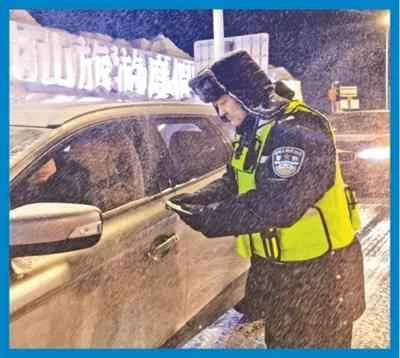
Police officers from the Changchun branch of the Jilin Provincial Public Security Department's Traffic Management Corps are on duty at the Lianhuashan toll station on the Hunchun-Ulanhot Expressway. (Photo by Li Xiulin/People's Vision)
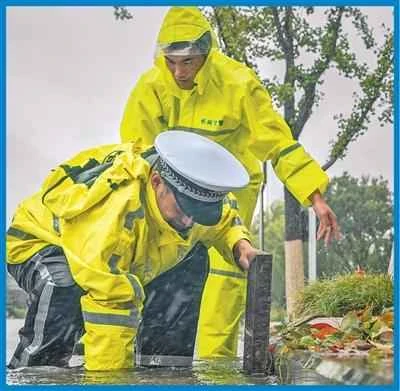
Police officers and auxiliary police officers from the Changxing County Public Security Bureau in Huzhou City, Zhejiang Province, braved heavy rain to clear drainage outlets. (Photo by Fang Jinhua/Visual China)

Police officers from the He County Public Security Bureau in Ma'anshan City, Anhui Province, visited vegetable farmers in the fields, listening attentively to their concerns. (Photo by Qin Zuquan/Visual China)
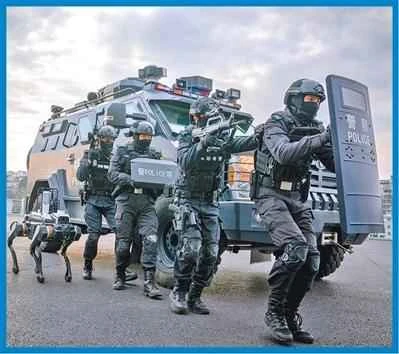
Members of the Special Police Detachment of the Mianyang Public Security Bureau in Sichuan Province, in coordination with police robot dogs, conducted a realistic combat drill. (Photo by Tang Chao/Visual China)
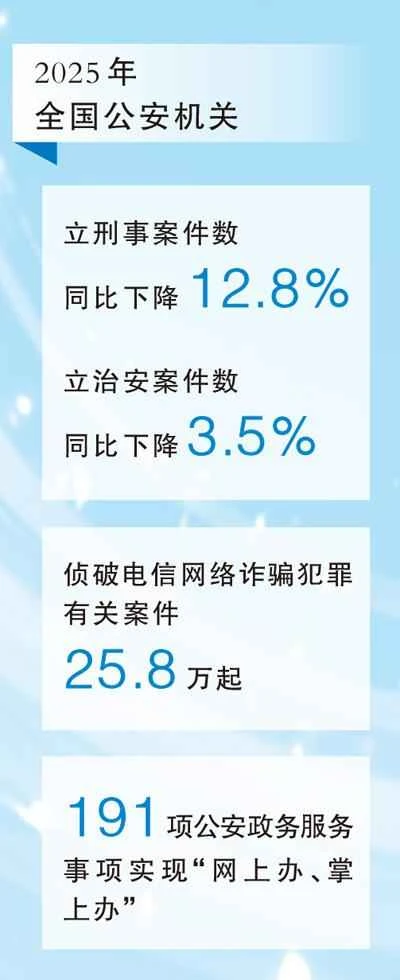
Data source: Ministry of Public Security
Police officers' true colors and peaceful nature
January 10, 2026, marks the sixth Chinese People's Police Day. Time, the fairest unit of measurement, is calculated differently for the people's police.
Time is compressed; it is often measured in seconds.
A second's difference can save a life. Mr. Chen, a resident of Chengxiang Street, Xiaoshan District, Hangzhou City, Zhejiang Province, suddenly fell ill. Xiaoshan Public Security Bureau activated the "police-medical linkage" and "one-click escort" system. The digital platform quickly planned the optimal route, adjusted traffic lights along the way in real time, and remotely guided traffic flow. The original 50-minute journey was shortened to 18 minutes, ensuring smooth traffic and a successful rescue.
A single second counts in preventing a scam. Police officers at the Pingyuan Border Police Station of the Dehong Border Management Detachment in Yunnan Province received a notification from a fraud-related intelligent identification and early warning platform. They immediately activated mechanisms including "online warning and offline dissuasion" and "police-bank cooperation" to stop payments, successfully freezing the involved accounts within 60 minutes, thus protecting the victim's money!
The efficient emergency response mechanism has outpaced time. Public security organs nationwide are continuously establishing and improving a new policing operation model based on "professionalism + mechanism + big data," resulting in more intelligent policing, more efficient emergency response, and more precise public service. Public security organs are transforming the new combat capabilities brought about by big data, artificial intelligence, and other institutional reforms into tangible benefits, happiness, and security for the people.
Time is also expansive, often starting in "years".
It's the unwavering presence at the crossroads for decades, the countless visits to the community offering words of advice, and the footsteps repeatedly measuring the border. On the evening of December 31, 2025, Li Xiangui, a police officer from the Yiwu Public Security Bureau in Zhejiang Province, conducted his last night patrol before retirement. After 30 years of silent dedication and working on the front lines, what he repeatedly gripped and released was not just the walkie-talkie, but also an undisguised reluctance to leave. Weng Honghua, a first-level police sergeant at the Huayuan Police Station of the Guixi Public Security Bureau in Jiangxi Province, voluntarily went down to the community, visiting all 59 buildings and 2,531 households in his jurisdiction, collecting more than 2,000 residents' phone numbers, and writing 12 work logs, densely recording the residents' needs. When the patrol whistle blew, the police officers of the Shiquanhe Customs Anti-Smuggling Branch of the Lhasa Customs Anti-Smuggling Bureau carried dozens of kilograms of equipment, leaving a string of deep and shallow footprints on the border line at an altitude of over 4,500 meters...
Every ordinary moment carefully protected is inseparable from the silent dedication of police officers day after day, year after year. In 2025, a total of 210 police officers and 142 auxiliary police officers nationwide died in the line of duty. Loyalty to the Party, service to the people, impartial law enforcement, and strict discipline—these busy "police blue" uniforms are the true colors of police officers and the foundation of peace and security. ( Zhang Tianpei )
More accurate, making travel faster and safer for citizens.
"Sometimes only four or five cars can pass through on a single green light." At the intersection of Wanhangdu Road and Yuyuan Road near Jing'an Temple in downtown Shanghai, traffic congestion used to be the norm. "The main reason is congestion at the intersection," Xia Liang, a police officer from the Shanghai Municipal Public Security Bureau Traffic Management Corps' Technology Branch, told reporters. "In the last few seconds of the green light, drivers try to rush through, but with so many cars ahead, they have to stop in the middle of the road." There are many such intersections in Shanghai.
Since 2025, the Shanghai Municipal Public Security Bureau Traffic Management Corps has been exploring the integration of AI big data model technology into the Shanghai Road Traffic Management Information System, launching the Shanghai AI Traffic Congestion Mitigation Big Data Model, and establishing an AI Traffic Congestion Mitigation Task Force, of which Xia Liang is a member.
The number of lanes at the intersection, traffic flow during morning and evening rush hours, and the layout of traffic lights around the intersection… For this one intersection, the special task force compiled traffic indicator data from the past three years and fed it into an AI-powered traffic congestion mitigation model, generating 10 solutions. “The solution generation was very efficient, but upon closer inspection, none of them were very feasible,” said Xiao Bin, head of the Science and Technology Branch of the Shanghai Municipal Public Security Bureau Traffic Management Corps and head of the special task force's comprehensive coordination group. For example, one suggestion from the AI-powered traffic congestion mitigation model was to dynamically adjust the green light duration based on vehicle conditions. For instance, when traffic flow is low, the green light could be switched directly to zero from the last 10 seconds. Such a design would catch drivers off guard.
To optimize the solution, Xia Liang and his colleagues went to the intersection more than 50 times during morning and evening rush hours and holidays within a month. They looked for patterns and interviewed the police officers on duty to record the actual situation as comprehensively as possible and provide feedback to the AI traffic congestion management model.
Another month passed, and after repeated trials and comparisons, a solution was adopted—at the intersection of Wanhangdu Road and Yuyuan Road, the traffic light operation was changed: an east-west straight-ahead phase was added, increasing the phase duration from 60 seconds to 80 seconds, while the north-south straight-ahead phase duration decreased from 130 seconds to 110 seconds. After the adjustment, monitoring data for the same period for three consecutive weeks showed that traffic congestion at the intersection was eliminated. Despite a 3.3% increase in traffic volume, the average vehicle speed actually increased by 14.4%, and the average number of stops per vehicle decreased by 10.6%.
To address traffic congestion at intersections, a special task force compiled over 6,000 "image-text" matching information lists, enabling the AI-powered traffic congestion management model to quickly understand and assess congestion conditions. After inputting over 950,000 pieces of traffic management knowledge and undergoing 48 rounds of debugging and optimization, the feasibility of the traffic light control schemes generated by the AI-powered model increased to 87%. Following this, and after more than six months of intensive learning, the AI-powered traffic congestion management model has gradually become a "traffic management expert." Currently, this AI-powered traffic congestion management model is operational at 360 intersections in Shanghai, and the generated schemes can be updated every 1 to 2 days based on actual conditions. ( Reporter Ju Yunpeng )
Act quickly to prevent fraud and scams and gain valuable time.
"Don't transfer! That's a scam!" Li Peizhi, an auxiliary police officer at the Nancun Police Station of the Panyu Branch of the Guangzhou Public Security Bureau in Guangdong Province, rushed into an office building and stopped Ms. Zhang, who was transferring money, thus protecting the retirement savings of a 60-year-old woman. This happened less than 50 minutes after the anti-fraud center issued a warning.
“Every second after receiving the warning, we were ‘rescuing’ people from the scammers,” said Zheng Guoxin, a police officer at the Panyu Branch Anti-Fraud Center. At 10:46 a.m. that day, the Panyu Branch Anti-Fraud Center received an urgent warning from the Guangzhou Anti-Fraud Center: Ms. Zhang, a resident in the jurisdiction, was suspected of being a victim of telecommunications fraud.
Zheng Guoxin immediately tried to contact the person involved by phone to dissuade her, but the line was constantly busy. Based on his years of experience in anti-fraud work, the police officer judged that Ms. Zhang was likely talking to fraudsters and a money transfer could occur at any moment. "Every second of delay could result in financial loss for the public," Zheng Guoxin said. "Dissuading fraudsters is a race against time."
The anti-fraud center immediately activated its emergency response mechanism, splitting into two groups to intercept the suspect: one group of police officers continued to try to call the suspect and simultaneously search for his/her family members; the other group quickly dispatched officers from the local police station to the scene to meet and dissuade him/her.
"We located Ms. Zhang's husband as quickly as possible, and with his assistance, we contacted her. At the time, Ms. Zhang was at home following the fraudsters' 'instructions,' downloading a fraudulent app and transferring money," Li Peizhi recalled. That day, Ms. Zhang received a call from someone claiming to be customer service from a major social media platform. The caller falsely claimed that she had accidentally clicked on the platform's "million-yuan guarantee" service, which would automatically deduct 800 yuan per month. To cancel, she had to follow their instructions. Subsequently, calls from the police and her family members exposed the scam.
From the issuance of the warning to the successful interception, Panyu police took less than 50 minutes, thanks to a well-functioning anti-fraud system. In recent years, Guangzhou police have adhered to a combined approach of prevention and crackdown, continuously optimizing the early warning and dissuasion system, and vigorously intercepting and combating "offline cash withdrawals," effectively advancing the work of combating and governing telecommunications and online fraud crimes. "This kind of race against time is our daily work in anti-fraud," said Zheng Guoxin. "It concerns the personal and property safety of the people, and we can't afford to be slow." ( Reporter Li Zong )
Being closer to home and visiting others for mediation allows for greater patience.
"Auntie, your angelica root is dried so well!" "Sister Yang, have there been any changes in your household population recently?"... On the streets of Qingshui Town, Minxian County, Dingxi City, Gansu Province, police officer Li Tong and auxiliary police officer Yang Jianwei from Qingshui Police Station knocked on doors one after another. Li Tong has been doing this kind of door-to-door visit work for 10 years.
“Before, in the public security brigade, I mainly dealt with people in the urban area. Now, at the Qingshui Police Station, I interact more with the villagers in the town.” Three years ago, Li Tong was transferred to the Qingshui Police Station. Qingshui Town was formed by the merger of the former Minshan Township and Qingshui Township, with more than 30,000 residents distributed across 30 administrative villages and 202 village communities. The jurisdiction covers a larger area, the population is more dispersed, and the needs are more diverse.
Shangya Temple Village is the furthest from the town center, nestled in a mountain valley with inconvenient transportation. "When it rains or snows even slightly, it takes more than an hour to drive there, making it even more difficult for residents to get things done," Li Tong explained. Therefore, the Qingshui Police Station has set up a special police station at Shangya Temple, with officers taking turns on duty.
When Wang Mingshan, a villager from Shangya Temple Village, was rebuilding his house in the fall, a conflict arose with his neighbor due to unclear land boundaries. Li Tong invited members of the Comprehensive Management Center, the village committee, and the resident lawyer to the Shangya Temple Police Station to mediate, and the two parties eventually shook hands and made peace. Wang Mingshan calculated, "If I had to go back and forth to the town police station for mediation over this matter, the house frame might not even be able to be erected by winter." "Unclear land boundaries are a common conflict in rural areas. In practice, we have developed a set of mediation methods that combine legal principles with human compassion," said Li Tong.
Yang Jianwei is a "new recruit" at Qingshui Police Station. After arriving in 2024, he initially struggled to adapt. Once, while mediating a dispute between residents, both parties became highly emotional, leaving Yang Jianwei somewhat at a loss. Li Tong, after understanding the situation, told Yang Jianwei, "Clarifying the facts is the first step. If the two sides start fighting as soon as they meet, you can first question them separately to understand the situation, and then invite more people to join in. Although it requires more effort, it will ensure the effectiveness." Yang Jianwei followed the advice, and with Li Tong's guidance during the mediation process, the conflict was ultimately resolved successfully.
In 2025, Li Tong filled three thick notebooks the size of A4 sheets with her notes. Over the past 10 years, these notes on people's lives have filled Li Tong's locker. "Our work concerns all aspects of people's lives. We need to be closer to the people, remember things more carefully, think more deeply, and act more quickly for them."
( Reporter Song Chaojun )