
Linzhi City
林芝市
Origin of the name: Linzhi is a transliteration of the Tibetan word 'nyingkhri' or 'nyangkhri,' meaning "throne of the Nyang clan" or "throne of the sun," hence the name. Basic introduction to the Polonggou Grand Bridge and Tongmai Bridge: The Himalayas and the Nyainqêntanglha Mountains, like two giant dragons, stretch parallel from west to east, …
Origin of place name:
Linzhi is a transliteration of the Tibetan word Nyingkhri, which means "throne of the Nyang clan or throne of the sun" in Tibetan.
Basic introduction:
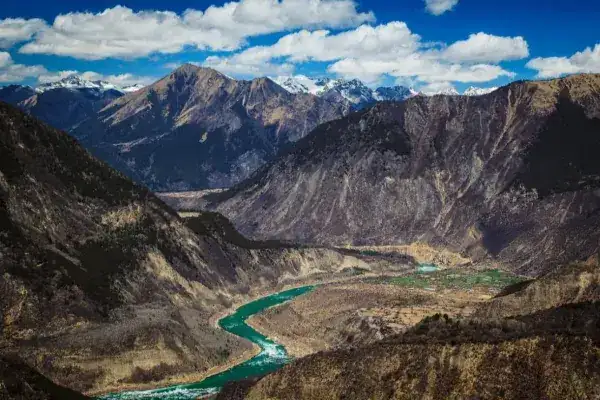
The Himalayas and the Nyainqêntanglha Mountains, like two giant dragons, stretch parallel from west to east, connecting with the Hengduan Mountains in the east to form a mountain range encircling the region. The Nyingchi area, located in southeastern Tibet Autonomous Region, China, lies nestled in the embrace of these three mountain ranges. Some call it the Switzerland of Tibet, while others refer to it as the Jiangnan region of Tibet.
Linzhi, a place of scenic beauty, means "Throne of the Sun" in Tibetan. It borders Yunnan Province and Chamdo Prefecture to the east and northeast, Nagqu Prefecture to the north, Lhasa City and Shannan Prefecture to the west and southwest respectively, and India and Myanmar to the south, with a border line stretching 1006.5 kilometers. Linzhi Prefecture administers seven counties: Linzhi, Milin, Gongbo'gyamda, Medog, Bomi, Zayu, and Lang County, covering a total area of approximately 117,000 square kilometers and a population of over 140,000.
Nyingchi Prefecture is located in southeastern Tibet, in the lower reaches of the Yarlung Tsangpo River, with an average altitude of about 3,000 meters.
View detailed information about Nyingchi City >>
Honors Ranking:
In July 2026, it was designated as a key tourism city in the "15th Five-Year Plan for Building a Tourism Power".
In January 2026, it ranked 312th in the overall ranking of overseas online influence of Chinese mainland cities in 2025.
In May 2025, the 2025 China City Charm Ranking was released, and Linzhi City ranked 316th (a fifth-tier city).
In April 2025, it was named a national model city (county) for supporting the military and giving preferential treatment to families of servicemen.
In February 2025, the 2024 China Urban Social Development, Population Development and Social Potential Top 100 List was released, with Linzhi City ranking 42nd.
In May 2024, the 2024 China City Commercial Attractiveness Ranking was released, with Linzhi City ranking 283rd.
In November 2023, it was named one of the third batch of national food safety demonstration cities.
In September 2023, the list of pilot cities for the third batch of convenient living circles in cities across the country was announced, and Linzhi City was included on the list.
In April 2023, the 2023 China City Commercial Attractiveness Ranking was released, with Linzhi City ranking 309th.
View more honors and rankings of Nyingchi City >>
Historical background:
Linzhi has a long history, dating back to the prehistoric period of Tibet.
According to the Tibetan historical record "The Origin of the Diwu Religion", Nyatri Tsenpo (the first Tibetan king), the ancestor of Yarlung Xibuye, came from Poyu (now Bomi County, Linzhi City) to the Yarlung Valley (now Nedong District, Shannan City) via Gongbu and became the founder of Yarlung Xibuye.
Niechizanbu was born in the second year of the Yuanshuo era of the Han Dynasty (127 BC). When his throne was passed to the 7th king, Zhigongzanbu, a turmoil broke out in Xibuye. Zhigongzanbu was killed by Luoang, and his three princes, Xiachi, Niechi, and Qiachi, fled to Gongbu, Bowo, and Niangbu respectively for refuge.
Not long after, Nechi returned to Yalong and succeeded to the throne as Yalongsi.
+View detailed historical evolution of Nyingchi City>>
Travel information can change. Check current opening hours, reservations and entry requirements before you travel.
Traveller discussion
Start the conversation with a helpful tip or a question.