
Bayingolin Mongolian Autonomous Prefecture
Bayingolin Mongolian Autonomous PrefectureBayingolin Mongolian Autonomous Prefecture, abbreviated as "Bazhou," is under the jurisdiction of the Xinjiang Uyghur Autonomous Region. Located in southeastern Xinjiang, it features mountains, basi
Bayingolin Mongolian Autonomous Prefecture
Bayingolin Mongolian Autonomous Prefecture, abbreviated as "Bazhou," is under the jurisdiction of the Xinjiang Uyghur Autonomous Region. Located in southeastern Xinjiang, it features mountains, basins, rivers, lakes, gobi deserts, sand deserts, and plain oases, with a mid-temperate and warm-temperate continental climate. The total area is 471,500 square kilometers. As of March 2026, the prefecture administers one county-level city, seven counties, and one autonomous county. As of the end of 2025, the permanent resident population was 1.4668 million (excluding Tiemenguan City). The prefecture has a history spanning thousands of years. Both the southern and central routes of the Silk Road pass through it. Of the Thirty-Six States of the Western Regions, eleven were located within its territory, including Loulan, Ruoqiang, Qiemo, Xiaowan, Ronglu, Shanguo, Luntai, Yanqi, Yuli, Quli, and Weixu. The prefecture boasts diverse tourism resources, including the Tianshan Mountains, Kunlun Mountains, vast deserts, large lakes, grasslands, and gobi landscapes, as well as historical sites such as Tiemenguan Pass, the ancient city of Loulan ruins, Xikeqin Thousand-Buddha Caves, and the Milan Ruins. In 2025, the prefecture's GDP reached 172.353 billion yuan (approximately $23.9 billion), up 5.5% year-on-year.
Historical Evolution
As early as the early Western Han Dynasty, the territory was home to eleven "city-states" and "nomadic states" among the Thirty-Six States of the Western Regions, including Ruoqiang, Qiemo, Xiaowan, Shanguo, Wulei, Luntou, Quli, Yanqi, and Weixu.
In 60 BCE, the Western Han government established the Protectorate of the Western Regions at Wulei (present-day Luntai County), formally incorporating the area into Chinese territory. In 91 CE, the Eastern Han Dynasty established the Chief Clerk of the Western Regions. In 648 CE, the Tang Dynasty established the Yanqi Protectorate. From the Yuan Dynasty onward, the area became a pastoral and administrative region of the Western Mongols (Oirat Mongols).
During the early Qing Dynasty, the area was under the Dzungar Khanate. After the pacification of the Dzungars in 1759, the Qing court appointed a Grand Minister at Karashar, implementing the Beg system in Yanqi, Korla, and Bugur. In 1884, following the establishment of Xinjiang Province, the Karashar Direct Department was established and later elevated to Yanqi Prefecture, administering Xinping (present-day Yuli), Ruoqiang, and Luntai counties.
After the founding of the People's Republic of China in 1949, the Yanqi Commissioner's Office was established on April 12, 1950. On June 23, 1954, it was dissolved and divided into Bayingolin Mongolian Autonomous Prefecture (administering Yanqi, Hejing, and Heshuo) and the Korla Commissioner's Office (administering Korla, Luntai, Yuli, Ruoqiang, and Qiemo). In December 1960, the Korla Commissioner's Office was merged into Bayingolin Mongolian Autonomous Prefecture, and the prefectural seat was relocated from Yanqi to Korla. Bohu County was established in 1970, and Korla City in 1979. In 1983, Korla County was merged into Korla City. In December 2012, Tiemenguan City was established under the Xinjiang Production and Construction Corps' Second Division. In 2024, parts of Hejing, Yanqi Hui Autonomous County, Bohu, Yuli, and Qiemo were placed under Tiemenguan City's jurisdiction.
Administrative Divisions
As of March 2026, the prefecture administers one county-level city, seven counties, and one autonomous county: Korla City, Luntai County, Yuli County, Ruoqiang County, Qiemo County, Hejing County, Heshuo County, Bohu County, and Yanqi Hui Autonomous County, comprising 14 subdistricts, 40 towns, and 46 townships. The prefectural government is seated at 45 Baying East Road, Korla City.
Geographical Environment
Location
The prefecture is located in southeastern Xinjiang. It borders Gansu and Qinghai to the east, connects with Tibet via the Kunlun Mountains to the south, borders Hotan and Aksu Prefecture to the west, and is bounded by the Tianshan Mountains to the north, connecting with Ili, Tacheng, Changji, Urumqi, Turpan, and Hami. It lies between 82°38′–93°45′ E and 35°38′–43°36′ N, with a total area of 471,500 square kilometers, accounting for one-quarter of Xinjiang's total area.
Topography
The landscape spans three geomorphic zones: the Tianshan Mountains, the eastern Tarim Basin, and the Kunlun and Altun Mountains, forming a large "U" shape. Mountainous areas cover 225,000 square kilometers (47.7%), while plains cover 246,600 square kilometers (52.3%), including 143,000 square kilometers of gobi and desert (30.3%). The Tianshan Mountains stretch approximately 950 kilometers within the prefecture. The Kunlun Mountains reach 4,000–6,000 meters, with the highest peak, Muztagh, at 7,723 meters. The Altun Mountains lie to the southeast, with elevations of 3,000–5,000 meters.
Climate
The prefecture has a mid-temperate and warm-temperate continental climate characterized by aridity, low rainfall, high evaporation, and long sunshine hours. The frost-free period ranges from approximately 180 days in the Yanqi Basin to 194–223 days in the Korla and Luntai areas along the Tarim Basin.
Hydrology
The prefecture has 53 rivers divided into the Tianshan and Eastern Kunlun water systems. The Tianshan system includes the Kaidu River, Huangshui Gully, Qingshui River, Dina River, and Kuerchu River. The Eastern Kunlun–Altun system includes the Qarqan River, Karamilan River, Moleqie River, Milan River, Tashisaiyi River, and Washixia River. There are 69 lakes with a total area of 2,398 square kilometers. The largest is Bosten Lake (1,001 square kilometers, elevation 1,048 meters), along with Lop Nur Lake, Taitema Lake, and Whale Lake.
Natural Resources
Water Resources
The average annual surface water runoff is 10.6 billion cubic meters, with 3.5 billion cubic meters flowing in from adjacent areas. The total usable surface water is 9.36 billion cubic meters. The theoretical hydropower potential is 2.96 million kilowatts, with the Kaidu River capable of supporting 11 cascade power stations with an installed capacity of 1.12 million kilowatts.
Biological Resources
The prefecture has 73 species of wild animals (56% of Xinjiang's total), 264 bird species (74% of Xinjiang's total), 10 amphibian and reptile species, and 14 fish species. Notable rare species include wild camels, whooper swans, Przewalski's gazelles, Tarim rabbits, Tarim red deer, Lop Nur argali, and big-headed fish. Over 2,200 wild plant species include economically valuable dogbane, reeds, licorice, and ephedra.
Mineral Resources
The prefecture has 74 discovered mineral types. Potash reserves account for approximately 50% of the national total, andalusite reserves rank first nationally, and vermiculite reserves comprise 92% of the national total. Iron ore proven resources amount to 3 billion tons, and a super-large nickel deposit of 1.58 million tons has been confirmed. The Kunlun and Altun Mountains contain concentrated deposits of lead, zinc, copper, and tungsten.
Population
As of the end of 2025, the permanent resident population (excluding Tiemenguan City) was 1.4668 million, with 923,000 urban residents and an urbanization rate of 62.93%. The birth rate was 7.38‰, the death rate was 5.97‰, and the natural growth rate was 1.41‰.
Politics
The prefecture is governed by the People's Government of Bayingolin Mongolian Autonomous Prefecture, seated in Korla City, operating under the standard Chinese administrative framework for autonomous prefectures.
Economy
Overview
In 2025, the prefecture's GDP reached 172.353 billion yuan (approximately $23.9 billion), up 5.5% year-on-year. The primary industry contributed 23.026 billion yuan ($3.2 billion, +5.4%), the secondary industry 86.299 billion yuan ($12.0 billion, +4.8%), and the tertiary industry 63.027 billion yuan ($8.8 billion, +6.2%). The industrial structure ratio was 13.3:50.1:36.6. Fixed asset investment grew by 13.0%, with infrastructure investment increasing by 36.7%. Local general public budget revenue was 12.594 billion yuan ($1.75 billion, +10.3%), and general public budget expenditure was 32.913 billion yuan ($4.57 billion, +5.0%).
Primary Industry
In 2025, the grain sowing area reached 1.8937 million mu, with grain output of 1.0897 million tons (+8.8%). Cotton output was 653,900 tons (+9.4%), oilseed output 28,200 tons (+60.2%), and sugar beet output 473,200 tons (−42.1%). Orchard fruit output was 1.1276 million tons (−12.3%). Livestock inventory was 5.1309 million head (−4.8%), with meat output of 226,900 tons (+10.7%). Aquatic product output was 13,500 tons (+7.3%).
Secondary Industry
In 2025, total industrial value-added reached 77.622 billion yuan ($10.8 billion, +6.9%). Above-scale industrial value-added grew by 7.7%, with petroleum industry up 4.6% and non-petroleum industry up 14.1%. By sector: mining +6.2%, manufacturing +8.9%, and power/heat/gas/water +20.1%. Above-scale industrial enterprises achieved total profits of 27.491 billion yuan ($3.82 billion, −0.7%). Construction industry value-added was 10.596 billion yuan ($1.47 billion, −0.8%).
Tertiary Industry
In 2025, wholesale and retail trade value-added was 6.446 billion yuan (+8.6%), transportation and postal services 3.942 billion yuan (+3.5%), accommodation and catering 1.686 billion yuan (+5.0%), finance 4.962 billion yuan (+2.8%), real estate 5.730 billion yuan (+3.2%), and information technology services 1.810 billion yuan (+7.1%). Total retail sales of consumer goods reached 31.163 billion yuan ($4.33 billion, +6.2%). Total import-export volume was $863 million (+16.7%), with exports of $831 million (+17.0%). Financial institution deposits reached 243.663 billion yuan ($33.8 billion), and loans reached 176.419 billion yuan ($24.5 billion). Insurance premium income was 5.9 billion yuan ($819 million, +4.2%).
Social Affairs
Science and Technology
In 2025, the prefecture secured 114 autonomous region science and technology projects with 98.71 million yuan in funding. It had 4 key laboratories, 6 engineering technology research centers, 205 high-tech enterprises, and 2 high-tech industrial development zones. Annual patent grants totaled 920, with 391 valid invention patents.
Education
As of the end of 2024, the prefecture had 227 preschool education institutions, 182 primary and secondary schools, 10 secondary vocational schools, 3 higher education institutions, and 1 special education school.
Culture
As of the end of 2025, the prefecture had 11 cultural centers, 10 public libraries, 4 art galleries, 14 museums, and 9 professional performing arts troupes, holding 1,012 performances throughout the year.
Healthcare
As of the end of 2025, the prefecture had 1,090 medical and health institutions, including 51 hospitals and 542 primary care institutions, with 13,869 health professionals and 9,260 hospital beds.
Sports
In 2025, prefectural athletes won 108 gold, 88 silver, and 86 bronze medals in various competitions.
Social Security
As of the end of 2025, 1.2087 million people were enrolled in basic medical insurance, and cumulative social insurance enrollment reached 1.4496 million person-times. The prefecture had 32 elderly care institutions with 3,360 beds and 1,657 residents. Welfare lottery public funds raised totaled 51.77 million yuan, with social donations of 7.7 million yuan.
Transportation
Overview
The prefecture serves as the gateway to southern Xinjiang. Five of Xinjiang's seven national highways pass through it. The Southern Xinjiang Railway runs across the territory. Korla serves as the departure station for the Xinjiang Silk Road International Freight Train to Turkey, reducing transport distance by 7,000 kilometers and 27 days compared to sea freight. The Golmud–Korla Railway provides a second rail corridor out of Xinjiang. Civil aviation connects with Beijing, Shanghai, Chengdu, Zhengzhou, Chongqing, Xi'an, Jinan, and Urumqi.
Highways
In 2025, highway freight volume was 63.2725 million tons (−0.3%), freight turnover 9.42 billion ton-kilometers (+2.1%), highway passenger volume 6.8976 million, and passenger turnover 1.233 billion person-kilometers.
Railways
The Southern Xinjiang Railway runs through the prefecture with direct service to Urumqi, Turpan, Hami, Lanzhou, and Xi'an. In 2025, railway passenger departures were 4.3832 million (+5.1%), arrivals 4.2847 million (+4.4%), and freight volume 18.9566 million tons (+17.2%).
Aviation
The prefecture operates 5 airports, forming a route network connecting major national cities and all prefectures in Xinjiang. In 2025, aviation passenger throughput was 3.1782 million (+5.5%) and cargo-mail throughput 9,314 tons (−0.2%).
Scenic Attractions
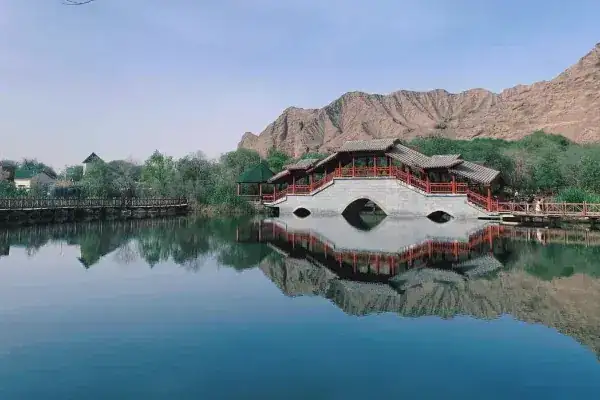
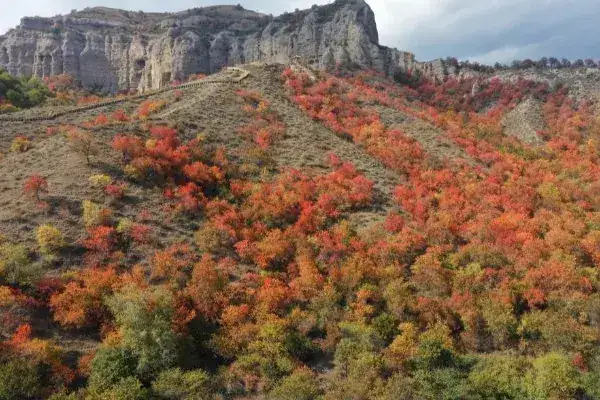
Notable attractions include Tiemenguan Pass, the ancient city of Loulan ruins, Xikeqin Thousand-Buddha Caves, Milan Ruins, Bosten Lake, and the Desert Poplar Forest along the Tarim River.
Honorary Titles
- Distinctive Chinese City of Charm
- National Industry-Education Integration Pilot City (July 2021)
- 11th Batch National Model Area for Ethnic Unity and Progress (January 2024)
- National Double Support Model City (April 2025)
Travel information can change. Check current opening hours, reservations and entry requirements before you travel.


Traveller discussion
Start the conversation with a helpful tip or a question.