
Karamay City
Karamay CityKaramay City (Uyghur: قاراماي شەھىرى; English: Karamay) is a prefecture-level city under the jurisdiction of the Xinjiang Uyghur Autonomous Region. Located between 84°44'–86°1' E longitude and 44°7'–46°8' N latitude, it is situa
Karamay City
Karamay City (Uyghur: قاراماي شەھىرى; English: Karamay) is a prefecture-level city under the jurisdiction of the Xinjiang Uyghur Autonomous Region. Located between 84°44'–86°1' E longitude and 44°7'–46°8' N latitude, it is situated in northern Xinjiang, on the northwestern edge of the Junggar Basin and at the southern foot of the Jiayier Mountains. As of September 2023, the city covers approximately 7,333.58 square kilometers and administers four districts: Karamay, Dushanzi, Baijiantan, and Urho. The permanent resident population was 489,000 as of end-2023. The majority ethnic group is Han, with Uyghur, Kazakh, and Hui minorities. The city features a typical temperate continental climate with extreme temperature variations, low precipitation, strong winds, thin snow cover, high evaporation, and deep frost. Since 1956, large-scale development of the Karamay oil field gave rise to an emerging petroleum industrial city. Karamay was established in 1958 and has undergone several administrative reclassifications, becoming a prefecture-level city in 1990. Karamay possesses a complete petroleum and petrochemical industrial chain and is a major oil and petrochemical base in China. In 2024, the city's GDP reached ¥132.7 billion (~$18.3 billion USD), up 4.0% year-on-year.
Name Origin
"Karamay" is a phonetic transliteration of the Uyghur and Kazakh word for "black oil," derived from a cluster of natural asphalt mounds—Black Oil Mountain—at the northeastern corner of the city. Karamay is the only city in China named after petroleum.
The area was originally called Qingshixia (Blue Stone Gorge), first appearing in the 1906 Old Gazetteer of Xinjiang Maps. After petroleum surveys in 1951, the name was transliterated as "Karamay" from Uyghur, though official documents used "Black Oil Mountain." In 1956, the oil field was officially renamed "Karamay," and Xinhua News Agency announced it as "a very promising large oil field," after which "Karamay" became the permanent place name.
Historical Evolution
From the Han Dynasty onward, the Xinjiang region was formally part of Chinese territory. In 60 BCE, the Western Han government established the Western Regions Protectorate at Wuleicheng (present-day Luntai, Xinjiang), which administered the Karamay area.
During the Tang Dynasty, the area was placed under the Yanbo Protectorate (657 CE) and later the Beiting Protectorate (702 CE). After the Mongol conquest in 1218, the area became part of the Mongol Empire under Ögedei. Under the Qing Dynasty, the area was administered through various circuits and counties. Karamay City was formally created on May 29, 1958, consolidating territory from Tuoli, Wusu, Shawan, and Hoboksar counties. After several administrative reclassifications, it was restored as a prefecture-level city on January 8, 1990, with four districts: Karamay, Dushanzi, Baijiantan, and Urho.
Physical Geography
Location
Karamay is situated in northern Xinjiang on the northwestern edge of the Junggar Basin, at the southern foot of the Jiayier Mountains. It borders Tacheng Prefecture to the east and north, and the Ili Kazakh Autonomous Prefecture to the south.
Climate
Karamay has a typical temperate continental climate with extreme seasonal variations: dry conditions, scarce rainfall, strong spring and autumn winds, large winter-summer temperature differences, thin snow cover, high evaporation, and deep frost. The annual average temperature is 8.6°C, with average annual precipitation of 108.9 mm and evaporation of 2,692.1 mm.
Geology
The Carboniferous structural layer features complex fold structures, predominantly high-angle tight forms. Two major fault systems characterize the region: northeast-trending major faults dividing the area into elongated blocks, and northwest-trending faults further subdividing them into rectangular fault blocks—a product of multiple tectonic development stages.
Topography
The terrain is higher in the northwest and lower in the southeast, dominated by Gobi desert landscapes. The highest point (1,335 m) is west of Bayingou in Dushanzi District; the lowest (259 m) is in the reed marshes of Baijiantan District.
Hydrology
Major rivers include the Baiyang River, Darbut River, and Kelasu River. Ailik Lake is the principal lake. The Baiyang River Reservoir, completed in 1972 with Soviet expert assistance, ensures water supply for both municipal and industrial use.
Natural Disasters
Karamay's geological hazards include rockfalls, landslides, and debris flows, with 21 identified hazard points concentrated mainly in the Dushanzi mud volcano area, Kuitun River valley, and Urho District. No geological disasters triggered by snowmelt or rainfall have occurred in recent years.
Administrative Divisions
As of September 2023, Karamay administers four districts (Karamay, Dushanzi, Baijiantan, Urho), 2 townships, 14 sub-district offices, 5 villages, and 107 communities. The municipal government is located at No. 60 Yingbin Road, Karamay District.
Natural Resources
Water Resources
Karamay has limited local water resources, relying primarily on transferred water through the Feng-Ke and Bai-Ke Canals. As of January 2024, total water resources amounted to 540 million cubic meters. The city actively promotes recycled water use, producing over 60 million cubic meters in 2023 with a reuse rate of 54%, exceeding the national target of 35% for water-scarce regions.
Land Resources
Based on the Third National Land Survey: cultivated land 54,837 hectares (all irrigated); forest land 211,673 hectares (93% shrubland); grassland 246,644 hectares; wetland 18,502 hectares; urban/industrial/mining land 52,199 hectares (67% mining); and transportation land 10,440 hectares.
Forest and Biological Resources
Total forest area is 124,866 hectares with a forest coverage rate of 16.4%, dominated by desert shrubland (96%) featuring Tamarix and Populus euphratica. Approximately 570 wildlife species inhabit the area, including goitered gazelles, argali sheep, and foxes.
Mineral Resources
Karamay's energy mineral resources are its key advantage, with proven reserves of petroleum, natural gas, and oil sands that are large and concentrated. As of 2020, 18 mineral types had been discovered. Proven petroleum geological reserves total 1.79 billion tons, making the Junggar Basin one of China's most important oil and gas resource bases.
Population
As of end-2023, Karamay's permanent resident population was 489,000, with an urbanization rate of 98.98%. The birth rate was 5.33‰ and the death rate 7.17‰. Han Chinese constitute the majority, with Uyghurs being the largest minority group. Kazakh, Hui, Mongol, Xibe, and Manchu communities also reside in the city. The local dialect belongs to the Beijing Mandarin Northern Xinjiang subgroup.
Religious Beliefs
Islam, Buddhism, Protestantism, and Catholicism are practiced in Karamay, with Islam having the largest following.
Economy
Overview
In 2024, Karamay's GDP reached ¥132.7 billion (~$18.3 billion USD), growing 4.0% year-on-year. The primary, secondary, and tertiary sectors contributed ¥2.11 billion, ¥93.41 billion, and ¥37.18 billion respectively. In 2023, the three-sector ratio was 1.8:69.5:28.7. General public budget revenue was ¥11.05 billion (~$1.5 billion USD), up 8.1%.
Primary Industry
In 2023, total agricultural, forestry, animal husbandry, and fishery output value was ¥1.64 billion (~$226 million USD), up 7.3%. Grain was planted on 60,300 mu (4,020 hectares) and cotton on 247,400 mu (16,493 hectares).
Secondary Industry
Karamay Well No. 1 struck industrial oil flow in 1955, marking the birth of New China's first major oil field. In 2023, above-scale industrial value-added reached ¥79.06 billion, up 5.5%. Oil and gas extraction grew 3.5%, while chemical manufacturing grew 11.6%. Industrial enterprises achieved ¥186.47 billion in revenue.
Tertiary Industry
In 2023, wholesale and retail, transportation and warehousing, and accommodation and catering added values were ¥1.39 billion, ¥2.03 billion, and ¥0.53 billion respectively. Total retail sales of consumer goods reached ¥12.27 billion (~$1.7 billion USD), up 17.4%. Foreign trade totaled $239 million. Tourism revenue reached ¥11.09 billion (~$1.5 billion USD), with 19.258 million visitors, up 120.5%. Investment projects totaled 965, with secured funding of ¥66.52 billion (~$9.2 billion USD).
Economic Functional Zones
In December 2022, the Karamay High-Tech Industrial Development Zone was upgraded to a national-level high-tech zone, the fourth in Xinjiang.
Social Services
Education
Karamay hosts the Karamay University Town, including the Karamay Campus of China University of Petroleum (Beijing) and Karamay Vocational and Technical College. As of 2023, the city had 3 full-time higher education institutions, 19 secondary schools, 26 primary schools, and 53 kindergartens. Primary school enrollment and retention rates both reached 100%.
Science and Technology
By end-2023, Karamay had 189 tech SMEs (up 42.1%) and 192 high-tech enterprises (up 43.3%), accounting for 10% of Xinjiang's total. Technology contract transactions totaled ¥992 million (~$137 million USD), ranking second in Xinjiang.
Culture
The city operates cultural centers, libraries, and theaters at municipal and district levels, with 2 state-owned museums and 12 private museums. Key cultural heritage sites include Well No. 1 of Karamay and Xinjiang's First Oil Well (both national-level protected sites).
Healthcare
As of 2023, Karamay had 112 medical institutions (excluding Production and Construction Corps facilities), with 2,592 beds and 4,820 health professionals.
Social Security
As of end-2023, basic pension insurance covered 310,200 people, unemployment insurance 168,800, and medical insurance 375,000. The urban-rural minimum living standard was ¥810 per person per month (~$112 USD). The city had 6 elderly care institutions with 2,265 beds.
Transportation
Overview
Karamay is positioned at the midpoint of the Eurasian Continental Bridge, connecting eastern China to Central Asia and Europe, and serves as a node on the China-Pakistan Economic Corridor. The city has developed a comprehensive transportation network of highways, railways, and aviation.
Highways
A road network centered on the G3014 Kuike Expressway, G3015 Keta Expressway, and G217 national highway connects Karamay to Altay, Tacheng, Kuitun, and Urumqi. Civil vehicle ownership reached 196,600 in 2023. Highway passenger volume was 117,000 and freight volume was 29.002 million tons.
Railways
Karamay Station opened in October 2011. In 2019, electrified rail service launched, with "Fuxing" EMU trains reaching Urumqi in 2 hours 33 minutes, bringing Karamay into Urumqi's 3-hour railway rapid transit circle. In 2023, railway passenger volume was 1.785 million and freight was 3.497 million tons.
Aviation
Karamay Airport (renamed Karamay Guhai Airport in January 2022) is a 4D-class airport that opened in April 2006. By 2018, it surpassed 500,000 annual passengers. In January 2020, a temporary aviation port opened with Karamay's first international route to Novosibirsk, Russia. The Urho Baikouquan Airport, Xinjiang's first A1-class general aviation airport, opened in May 2022. In 2023, civil aviation passenger volume was 513,000.
Public Transportation
As of end-2023, the city operated 385 public buses across 32 routes.
Culture
Overview
As the "eldest son of the Republic's petroleum industry," Karamay possesses a distinctive petroleum industrial culture, with rich oil industry heritage.
Food
Karamay's cuisine reflects its diverse population, with Han Chinese restaurants alongside Uyghur, Kazakh, and Hui ethnic foods. Popular spots include the Boda Market on Tianshan Road, the Tahe Road night market, and the food street beneath the Karamay River Bridge.
Customs
Since 1997, Karamay has celebrated the annual "Water Festival" on August 8th, commemorating the completion of a 400-kilometer water diversion project. The festival features music events, fish-catching competitions, and carnival parades. Eid al-Adha (Corban Festival) is also widely celebrated among Muslim communities with bonfire parties and sheep-catching competitions.
Cultural Relics
As of 2023, Karamay has 23 immovable cultural heritage sites, including 2 national-level sites (Well No. 1 of Karamay and Xinjiang's First Oil Well), 7 autonomous region-level sites, and 4 municipal-level sites.
Scenic Spots
Overview
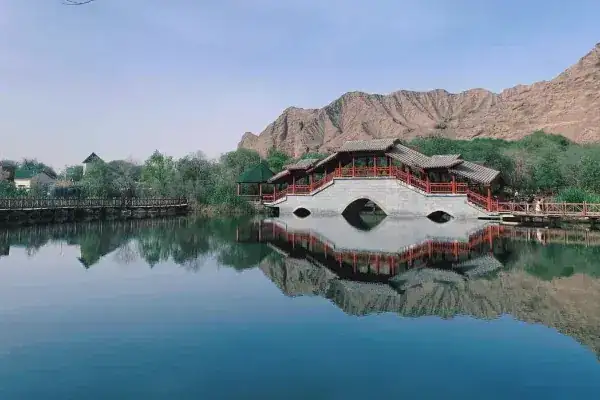
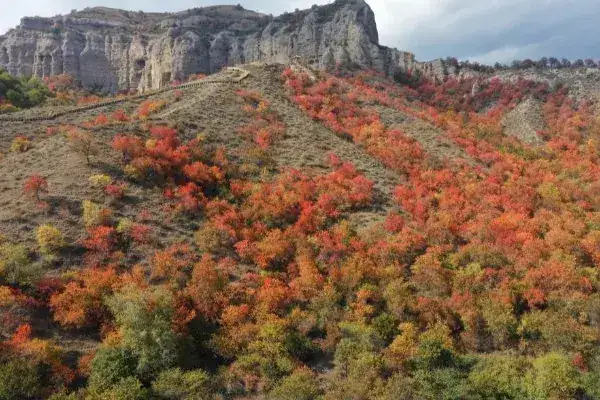
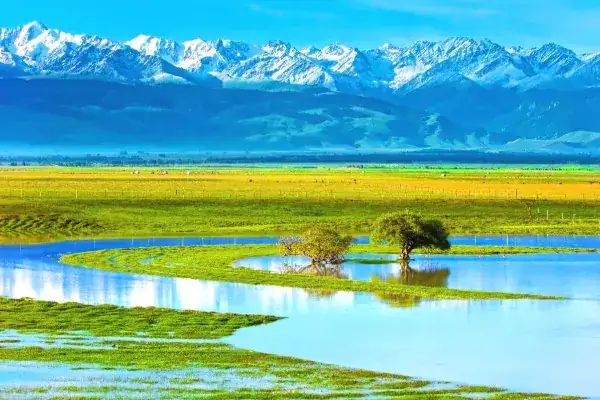
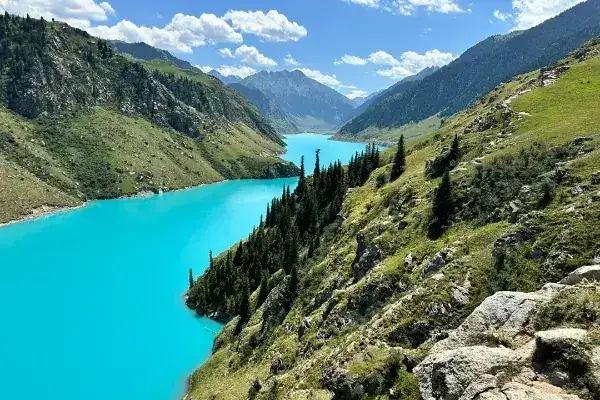
Karamay has 20 A-level scenic areas (including one 5A and three 4A sites), 4 S-level ski resorts, and 73 tourism enterprises.
Important Attractions
World Devil's City — A quintessential Yadan landform geological wonder in Urho District, about 100 km from Karamay. Formed over hundreds of millions of years from an ancient freshwater lake, wind erosion has sculpted the rocks into fantastical formations resembling palaces, terraces, humans, and animals.
Black Oil Mountain — Located northeast of central Karamay, this cluster of asphalt mounds formed from subterranean oil seepage. The largest mound stands 13 meters high. In the 1950s, geologists' discovery of these mounds led to the development of New China's first major oil field.
Dushanzi Grand Canyon — Carved by a river over millions of years, featuring dramatic cliff formations and adventure attractions including Xinjiang's first 9D glass bridge, canyon ziplines, and cliff swings.
Baiyang River Grand Canyon — A 24-kilometer canyon showcasing classic Yadan landform and canyon scenery, with rich riparian vegetation dominated by Populus euphratica.
Travel information can change. Check current opening hours, reservations and entry requirements before you travel.
Traveller discussion
Start the conversation with a helpful tip or a question.