
Zhongwei City
Zhongwei CityZhongwei City, abbreviated as "Wei," is a prefecture-level city under the Ningxia Hui Autonomous Region, located in central-western Ningxia at the head of the Yellow River's front loop, in the transition zone from the Ningxia P
Zhongwei City
Zhongwei City, abbreviated as "Wei," is a prefecture-level city under the Ningxia Hui Autonomous Region, located in central-western Ningxia at the head of the Yellow River's front loop, in the transition zone from the Ningxia Plain to the Loess Plateau, at the junction of Ningxia, Inner Mongolia, and Gansu. The total area is 17,391.3 square kilometers. As of June 2024, Zhongwei administers 1 district and 2 counties. As of the end of 2023, the permanent resident population was 1,080,600. Zhongwei is situated at China's geometric center, guarding Ningxia's "Western Gate," and is a strategic passage on the Eurasian Land Bridge and an important node on the ancient Northern Silk Road. It is a key corridor for the West-East Gas Pipeline, known as "China's Gas Artery." In 2025, the gross regional product was 63.338 billion yuan, up 6.0%.
Name Evolution
During the Ming Dynasty (1368–1644), the Wei-Suo (military garrison) system was implemented. In the first year of Yongle (1403), the Ningxia Zhongwei Command was established, giving origin to the name. "Zhong" means central (direction), and "Wei" refers to the military garrison system.
History
Pre-Qin Period
During the Spring and Autumn period, the area was inhabited by Qiang and Rong tribes.
Qin-Han to Northern and Southern Dynasties
After the Qin Dynasty (221–206 BC) unified the six states, the area was incorporated into the territory. During the Qin, it was part of Fuping County, Beidi Commandery. During the Western Han Dynasty (202 BC–220 AD), it belonged to Xunjuan County, Anding Commandery. During the Northern and Southern Dynasties, it was part of Mingsha County, Lingzhou.
Sui-Tang to Song-Yuan Period
During the Northern Zhou, Huizhou was established. During the Sui and Tang Dynasties (618–907), it was part of Xiongzhou and Feng'an County. During Western Xia (1038–1227), it was Yingli Zhou. The Yuan Dynasty (1271–1368) maintained Yingli Zhou.
Ming-Qing Period
In 1403, Ningxia Zhongwei was established. In 1724, it was renamed Zhongwei County under Ningxia Prefecture, while Haiyuan County was under Pingliang Prefecture. In 1933, Zhongwei County was split into Zhongwei and Zhongning counties.
After the Founding of the People's Republic of China
In 1954, Ningxia was merged into Gansu Province, with Zhongwei under Yinchuan Special District. In 1958, the Ningxia Hui Autonomous Region was established. In 2003, the State Council approved the abolition of Zhongwei County and the establishment of prefecture-level Zhongwei City, incorporating Zhongning County from Wuzhong and Haiyuan County from Guyuan. In 2004, prefecture-level Zhongwei City was formally established. In 2016, Shapotou District was formally established.
Natural Geography
Location
Zhongwei is located in central-western Ningxia, at the junction of Ningxia, Inner Mongolia, and Gansu. It borders Wuzhong to the east, Guyuan and Jingyuan County (Gansu) to the south, Jingtai County (Gansu) to the west, and Alxa Left Banner (Inner Mongolia) to the north, between 104°17'–106°10' east longitude and 36°06'–37°50' north latitude, spanning 130 km east-west and 180 km north-south, with a total area of 17,391.3 square kilometers.
Climate
Zhongwei has a typical temperate continental monsoon climate, influenced by desert conditions, with abundant sunshine and large diurnal temperature ranges. Average temperature: 7.3–9.5°C. Annual relative humidity: 57%. Frost-free period: 158–169 days. Annual precipitation: 180–367 mm.
Geology
The geology varies by county. Shapotou District is on the southeastern edge of the Zhongwei fault basin, with thick Quaternary deposits and good water storage conditions. Zhongning County spans the northern Yellow River plain and central arid plateau hills. Haiyuan County features loess hills on a Tertiary red mudstone base, covering about 76% of the city's area, with Liupan Mountain remnants (West Huashan, South Huashan, Moon Mountain) intruding from the southeast.
Topography
The terrain is higher in the southwest and lower in the northeast, with an average urban elevation of 1,225 meters. Five landform types: Yellow River alluvial plain, platform, desert, mountains, and hills. The Tengger Desert edge covers 120,000 hectares (7%); the Yellow River alluvial plain covers 100,000 hectares (5.9%); platforms 60,000 hectares (3.5%); and southern mountains and loess hills 1,424,500 hectares (83.6%).
Hydrology and Water Conservancy
The Yellow River flows 182 km through the city (45.8% of its 397 km course in Ningxia), with an average annual flow of 1,039.8 cubic meters/second and transit volume of 32.814 billion cubic meters. The maximum natural drop is 144.13 meters, with hydropower potential of 2+ million kilowatts. The Shapotou Water Conservancy Hub is one of the 10 major Western Development projects, designed to irrigate 1.07 million mu and generate 606 million kWh annually. The planned Daliushu Hub has a designed dam height of 163 meters, total capacity of 110 billion cubic meters, and 2 million kilowatts installed capacity.
Soil
Main soil types: gray calcic soil and aeolian sandy soil, with small amounts of gray-brown soil, alluvial soil, and saline soil. Both have poor structure, low organic matter (0.5–0.8%), and high erosion susceptibility.
Natural Disasters
Drought is the main natural disaster, with spring droughts most frequent, severely affecting agriculture and the selenium-rich watermelon industry.
Natural Resources
Water Resources
The Yellow River provides 32.814 billion cubic meters of annual transit water. Groundwater is abundant.
Land Resources
Total land area: 1,373,965 hectares (agricultural: 1,174,241; construction: 49,144; unused: 150,580).
Mineral Resources
30+ mineral types with 189 occurrences (62 industrial deposits). 19 types with proven reserves including coal, iron, copper, gold, limestone, marble, gypsum, and clay. Gypsum reserves of about 7 billion tons rank second nationally; coal reserves about 1.2 billion tons. It is one of Ningxia's richest mineral areas.
Biological Resources
Biodiversity surveys recorded 118 bird species, 48 mammal species, 24 fish species, 14 reptile species, and 4 amphibian species. Forest area: 153,600 hectares (11.25% coverage). Grassland: 1,111,260 hectares (58.43% vegetation coverage), mainly desert grassland with species including Convolvulus, Cleistogenes, Oxytropis, and Stipa.
Administrative Divisions
As of June 2024, Zhongwei administers 1 district (Shapotou), 2 counties (Zhongning, Haiyuan), and 1 development zone (Haixing), with 40 townships, 443 villages, and 68 communities. The City People's Government is seated at No. 5 Zhengtong East Road, Shapotou District.
Politics
Population
Population Size
According to the Seventh National Census (November 1, 2020), the permanent resident population was 1,067,336. As of the end of 2023, it was 1,080,600, up 200. The urban population was 557,800, with an urbanization rate of 51.62%, up 0.79 percentage points. Registered population: 1,219,800. Birth rate: 11.85 per mille; death rate: 6.76 per mille; natural growth rate: 5.09 per mille.
Ethnic Composition
21 ethnic groups including Han, Hui, Manchu, Mongolian, and Dongxiang.
Language
Zhongwei dialect belongs to the Lanyin Mandarin group of Northern Chinese dialects.
Religious Beliefs
All five major religions—Islam, Buddhism, Taoism, Catholicism, and Christianity—are present. As of June 2008, there were 1,430 religious venues (977 Islamic, 155 Buddhist, 8 Taoist, 3 Catholic, 9 Christian, 273 folk temples) with 2,032 religious professionals and nearly 430,000 believers, including 323,000 Muslims.
Economy
Overview
In 2025, the gross regional product was 63.338 billion yuan, up 6.0%, leading all five cities in the autonomous region. By industry: primary 9.426 billion, up 6.8%; secondary 19.295 billion, up 5.5%; tertiary 34.617 billion, up 6.1%. Structure: 14.9:30.5:54.6. In 2024, GDP was 60.025 billion yuan, up 5.8%. Urban per capita disposable income: 37,813 yuan, up 4.4%; rural: 16,612 yuan, up 7.6%. General public budget revenue: 2.538 billion, up 9.5%. Fixed-asset investment up 17%.
Primary Industry
Total agricultural output: 17.657 billion yuan, up 7.7%. Grain area: 1,915,600 mu, output 707,200 tons, up 1.9%. Vegetables: 522,100 tons. Fruits: 272,800 tons, up 34.0%. Cattle sold: 161,000, up 22%; sheep sold: 1,525,200, up 23.8%; pigs sold: 469,400, up 12.2%. Meat output: 100,300 tons, up 20.2%; milk: 667,300 tons, up 12.0%.
Secondary Industry
Above-scale industrial added value up 8.1% in 2024. All three sectors grew: mining up 12.6%, manufacturing up 10.6%, electricity/heat/gas/water up 2.8%. Construction added value: 3.168 billion in 2023, down 7.4%. Total construction output: 3.682 billion, down 8.9%.
Tertiary Industry
Services added value: 32.385 billion yuan, up 5.2%, accounting for 54% of GDP. Wholesale/retail up 6.0%; transportation up 3.7%; accommodation/catering up 4.1%; finance up 5.3%. Total retail sales: 13.707 billion, up 3.4%. Foreign trade: 2.024 billion yuan, up 11.5% (exports 1.748 billion, up 14.4%). Total deposits: 83.52 billion, up 10.6%. Total loans: 69.417 billion, up 9.6%.
Economic Development Zones
Haixing Development Zone: Established in 2013, managed by Zhongwei City. Zhongning Industrial Park: Established in 2006, upgraded to a high-tech development zone in 2021, China's largest electrolytic manganese production base and an important aluminum alloy base in northwest China.
Social Affairs
Education
514 schools, 17,061 staff (14,157 full-time teachers). Primary enrollment: 100%. Junior high enrollment: 99.64%. High school enrollment: 95.0%.
Healthcare
702 health institutions (21 hospitals, 665 grassroots, 14 professional public health). 7,048 health workers (2,432 physicians, 3,059 nurses). 4,489 beds. 6.6243 million outpatient visits, 135,100 discharges.
Science and Technology
277 S&T projects, 166 million yuan in funding. 816 patent authorizations (86 inventions). 14 national high-tech enterprises, 32 technology-based SMEs. 3.83 invention patents per 10,000 people.
Culture
9 professional art troupes, 191 amateur troupes, 3 cultural centers, 3 public libraries, 7 theaters, 39 cultural stations, 10 large public cultural venues, 443 village cultural rooms.
Sports
23 sports venues, 3.1 million square meters of sports area. 50 competition events, 8 major sports meets.
Environment
Air quality excellent days: 290 (79.5%). PM2.5: 28 micrograms/m³. PM10: 66 micrograms/m³.
Social Security
Pension insurance: 306,100, up 302; urban-rural resident pension: 457,700, down 20,300. Medical insurance: 1,109,800, down 6,200. Unemployment: 94,100, up 2,600. Work injury: 163,400, down 1,500. Maternity: 111,000, up 2,200. 16,900 urban minimum living (94.83 million yuan); 85,000 rural minimum living (327.6 million yuan). 24 elderly care institutions with 5,727 beds.
Transportation
Overview
Zhongwei is the third-largest railway hub connecting northwest and north China, and a strategic passage on the Eurasian Land Bridge. The Baolan, Baozhong, Tai-Zhong-Yin, and Ganwu railways converge here, with 210 daily trains. The Yinlan High-Speed Railway opened December 29, 2022. Five expressways and 4 national/provincial highways pass through. Zhongwei Shapotou Airport operates 8 routes to 10 cities. Total highway mileage: 3,800 km.
Highways
Five expressways (Beijing-Tibet, Zhongying, Zhonghao, Zhonggu, Zhongyan) and National Highway 109, Provincial Highways 101, 201, 202.
Railways
Baolan, Baozhong, Tai-Zhong-Yin, and Ganwu railways converge. The Yinlan High-Speed Railway serves via Zhongwei South Station, part of China's "Eight Vertical and Eight Horizontal" HSR network.
Aviation
Zhongwei Shapotou Airport: 4C-level domestic tourism airport, 7.5 km from city center. Terminal: 3,300 square meters, 5 C-class stands. Runway: 2,800 m × 45 m, accommodating B737/A320. Opened December 26, 2008.
Public Transportation
Total highway network: 8,363 km, with 1,699 km of Class II or above (20.3%).
Culture
Overview
National-level intangible cultural heritage items include Haiyuan mountain folk songs, mouth harp, and Shapotou sheepskin raft making. Provincial items include Shapotou River God worship, handmade carpets, Zhongning wormwood noodles, and Sui-Tang yangge (folk dance). Municipal items include Zhongwei Daoqing, water music, and folk songs.
Food
Zhongning Goji Berries: 433,000 mu planted (1/7 of national total), annual dry fruit output 50,000 tons (25% of national). Zhongwei is known as the "World Goji Capital."
Zhongwei Selenium Watermelon: Grown in gravel-rich soil containing selenium, zinc, and calcium, with high sugar content and immunity-boosting properties.
Haiyuan Selenium Watermelon: Over 100 years of cultivation history, grown using gravel mulching technology, known as "watermelons from stone crevices."
Haiyuan Potatoes: Grown in the loess plateau hills and Yellow River irrigation areas, with starch, vegetable, and grain-vegetable varieties.
Haiyuan Cumin: Long cultivation history, known for superior color, flavor, and quality.
Nanchangtan Soft Pear: Planted since the Ming Dynasty, over 600 years of history. Trees in Nanchangtan are 300–500 years old.
Traditional foods include vegetarian dishes (tofu, carrot buns, rice cakes), meat dishes (braised pork offal, lamb offal soup, steamed lamb), fish (steamed, deep-fried, sour-spicy), dairy (date cake in sheep milk), noodles (hand-pulled, spring onion, fried rice), and snacks (braised chicken, rice wine eggs, sesame candy).
Customs
Sui-Tang Yangge: A classical court-style folk dance, also called "large formation yangge (folk dance)," practiced in the Mingsha and Enhe areas of Zhongning, a rare yangge (folk dance) variety embodying wishes for exorcising evil and ensuring peace.
Art
Raft Making Technique
Chinese skin rafts have a long history. Zhongwei rafts, known as "paizi," originated in the Yuan Dynasty (1271–1368) for water transport, initially using cowhide and later sheepskin. They served as Yellow River water transport tools.
Wormwood Noodle Making Technique
Haozi noodles, known as "handmade long noodles," were designated as Ningxia's first intangible cultural heritage in 2007. The technique involves unique ingredients and complex processes, believed to aid digestion, protect the liver, and promote longevity.
Scenic Spots
Overview
As of 2020, Zhongwei has 5 A-level scenic areas (2 above 4A).
Important Scenic Spots
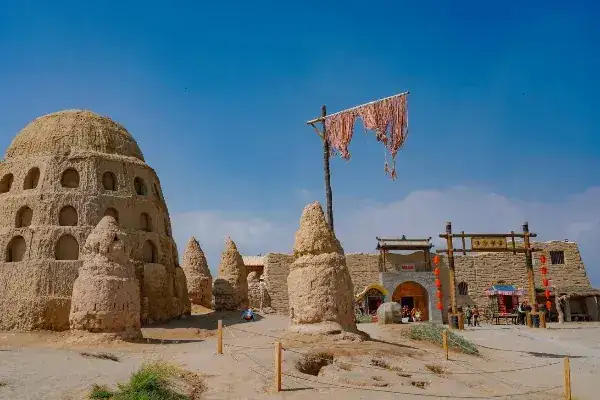
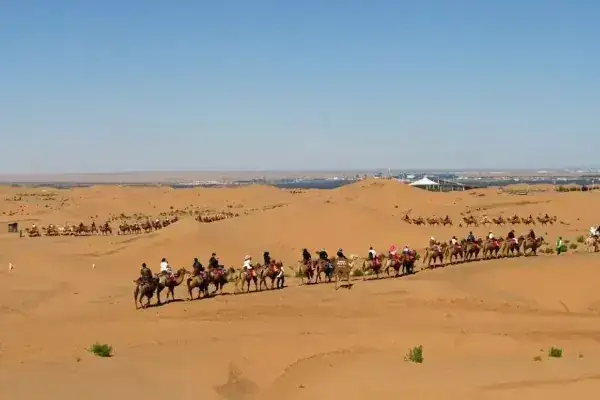
Shapotou National Nature Reserve: National 5A scenic area, 15 km from the city, awarded as one of the world's top 500 environmental protection units by UNEP. Five signature activities: Yellow River crossing, desert adventure, desert surfing, sand sliding, and Yellow River rafting.
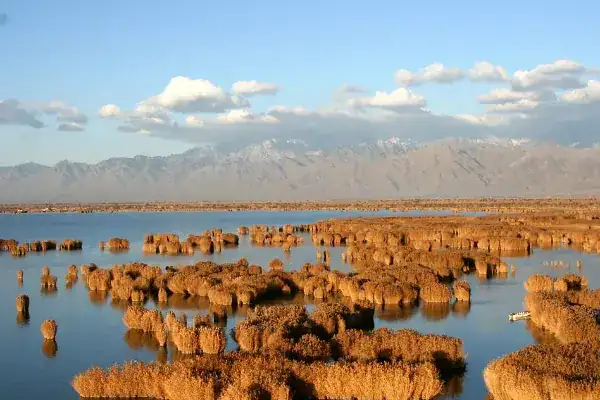
Tengger Desert Wetland and Jinsha Island: National 4A scenic area, 8 km from the city center, covering 22 square kilometers with 10,000 mu of water area, featuring ecological sightseeing, vacation, aquaculture, and desert golf.
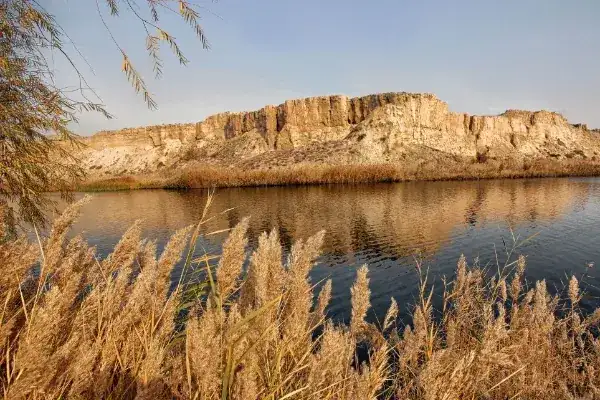
Zhongwei Sikouzi Scenic Area: National 3A scenic area covering 18 square kilometers with two zones: eastern karst landscape with "fortress gorge" and western Danxia landscape with cultural legends.
Gaomiao Baoan Temple: National 3A scenic area, built during the Ming Dynasty (1403–1424), a three-in-one Buddhist-Taoist-Confucian temple complex with 24 steps leading to the main hall, with nearly 100 rooms on a 2,000+ square meter platform.
Shikong Temple Grottoes: First carved during the Tang Dynasty (618–907), a major cultural and religious site on the ancient Silk Road, with 13 caves including Flame Light Cave, Ten Thousand Buddha Cave, and Sleeping Buddha Cave.
External Exchange
Famous People
Important Honors
Travel information can change. Check current opening hours, reservations and entry requirements before you travel.
Traveller discussion
Start the conversation with a helpful tip or a question.