
Wuzhong City
Wuzhong CityWuzhong City is a prefecture-level city under the Ningxia Hui Autonomous Region, recognized as a China Excellent Ecological Tourism City, National Garden City, National Hygienic City, National Double Support Model City, and Nati
Wuzhong City
Wuzhong City is a prefecture-level city under the Ningxia Hui Autonomous Region, recognized as a China Excellent Ecological Tourism City, National Garden City, National Hygienic City, National Double Support Model City, and National Ethnic Unity and Progress Demonstration City. Located in central Ningxia, it was originally the site of ancient Lingzhou City and Jinji County, situated in the heart of the Ningxia Plain. The terrain is higher in the south and lower in the north, with a mid-temperate arid and semi-arid climate. The total area is 21,400 square kilometers. As of July 2026, the city administers 2 districts, 2 counties, and 1 county-level city. As of the end of 2025, the permanent resident population was 1,418,500. Wuzhong has a long history spanning over 2,200 years: Fuping was established during the Qin Dynasty (221–206 BC), Lingzhou during the Han Dynasty (202 BC–220 AD), Wuzhong Fort during the Ming Dynasty (1368–1644), and Ningling Subprefecture during the Qing Dynasty (1644–1912). It was an important channel on the ancient Silk Road and is a key node city on the Silk Road Economic Belt, with 4 railways and 5 expressways running through it. Wuzhong is China's best wine grape growing region and has scenic spots including Qingtongxia Yellow River Grand Canyon, Haba Lake, Luoshan National Nature Reserve, and Qingtongxia Bird Island. In 2025, the gross regional product was 96.167 billion yuan, up 5.0%.
History
As early as 30,000 years ago in the Paleolithic Age, humans lived in Wuzhong. Ancient Qiang, Rong, and Xiongnu nomadic tribes grazed here.
After Qin Shi Huang unified the six states, Meng Tian was ordered to drive north against the Xiongnu. In 214 BC, 34 counties were established along the river, including Fuping County, the oldest city on the Ningxia Plain, with its site in present-day southwestern Wuzhong.
In 191 BC, Lingzhou County was established, the earliest precisely dated ancient city in Ningxia's history.
During the Eastern Han Dynasty, it was renamed Lingzhou County. During the Northern Wei, it was Bogulu Garrison, later Lingzhou. During the Sui and Tang Dynasties (618–907), it was also called Lingwu. In 646, Emperor Taizong Lingzhou to receive submissions from various peoples. During the An Lushan Rebellion, Crown Prince Li Heng ascended the throne at Lingwu, making it the national political and military center.
During Western Xia (1038–1227), the area was the heartland of Tangut Emperor Yuanhao's rule. During the Yuan Dynasty (1271–1368), Ningxia Route was established. During the Qing Dynasty (1644–1912), Ningshuo County was established.
In the early Ming Dynasty, Wuzhong Fort was named after the garrison leader Wuzhong. In 1913, Yanchi County was established. In September 1949, Wuzhong was liberated. In 1950, Wuzhong Town was formally upgraded to Wuzhong City. In 1954, the Hedong Hui Autonomous Region was established. In 1958, the Ningxia Hui Autonomous Region was established and the autonomous prefecture was abolished. In 1960, Jinji County was abolished and Qingtongxia City was established. In 1998, the prefecture-level Wuzhong City was established. In 2002, Lingwu City was transferred to Yinchuan. In 2003, Zhongwei and Zhongning counties were transferred to the new prefecture-level Zhongwei City. In 2009, Hongsibao was upgraded to a district.
Administrative Divisions
As of July 2022, Wuzhong City administers Litong District, Hongsibao District, Qingtongxia City, Yanchi County, and Tongxin County, totaling 2 districts, 2 counties, 1 county-level city, 44 townships and towns, 4 subdistricts, 66 communities, and 497 villages. The City People's Government is seated in Litong District.
Geographical Environment
Location and Boundaries
Wuzhong is located in central Ningxia, in the heart of the Ningxia Plain, between 105°7'–107°47' east longitude and 36°34'–38°15' north latitude, with a total area of 21,400 square kilometers. It borders Yinchuan to the north, Zhongwei to the west, Guyuan to the south, Dingbian County of Shaanxi to the east, Otog Front Banner and Alxa Left Banner of Inner Mongolia to the northeast and northwest, and Huan County of Gansu to the southeast.
Topography
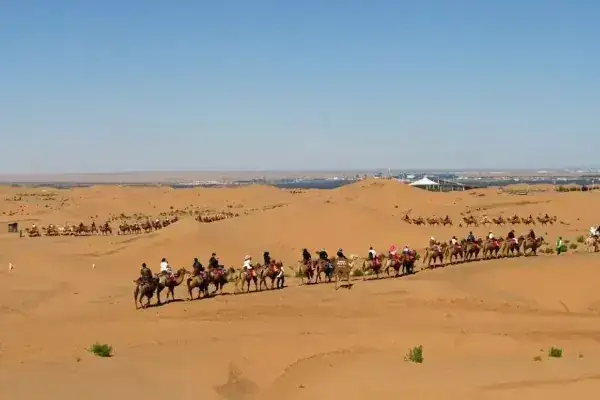
The city is wider east-west (297 km) than north-south (200 km), with higher terrain in the south. The north features Yellow River alluvial plain, the east is Ordos Plateau, connecting to the Mu Us Desert. The south is the transition zone between the western Ordos Plateau and northern Loess Plateau, with loess hills, mountains, and ravines. The west has the Helan Mountains and Niushou Mountain. Average elevation: 1,200 m in plains, 1,300–1,900 m in mountains.
Climate
Wuzhong has a mid-temperate arid and semi-arid climate with continental characteristics: distinct seasons, dry climate, strong evaporation, concentrated precipitation, good atmospheric transparency, abundant sunshine, rich heat, large temperature differences, short frost-free period, and frequent wind and sand. Annual average temperature: 9.3°C. Annual precipitation: 184.6–273.5 mm, concentrated in July–August.
Hydrology
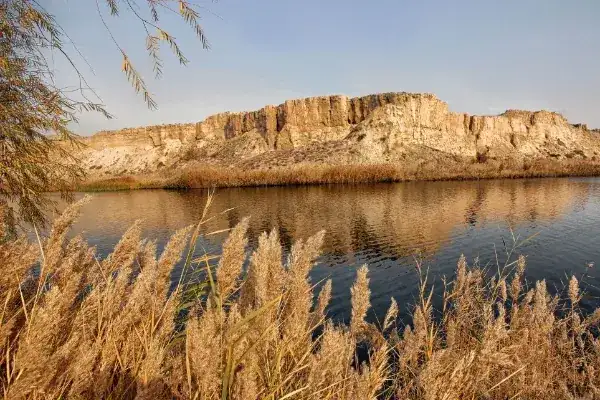
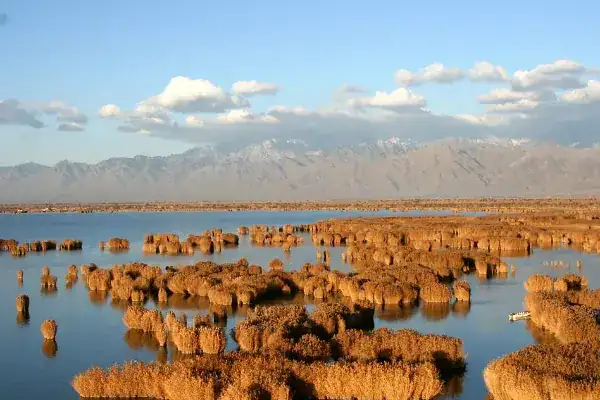
The Yellow River flows 69 km through the city. There are 42 mountain flood channels with drainage areas over 50 square kilometers, 13 reservoirs, and 9 urban water systems totaling 57.9 km with 32 lakes covering 19,600 mu.
Natural Resources
Water Resources
Total water intake: 1.9275 billion cubic meters (933 million groundwater), including agriculture 1.81 billion, industry 79.5 million, urban domestic 17.9 million, and rural 201 million. Total consumption: 1.1214 billion cubic meters (493 million groundwater).
Plant Resources
Common forage grasses include Bromus inermis, Elymus nutans, Cleistogenes, Poa pratensis, Stipa, and Setaria. Legumes include Melilotoides, Oxytropis, Astragalus, and Glycine soja. Medicinal plants include licorice, ephedra, Bupleurum, Cynomorium, Sophora alopecuroides, and Cistanche.
Animal Resources
Aquatic animals include otter, mink, carp, crucian carp, catfish, loach, turtle, and shrimp. Mammals include wolf, fox, badger, weasel, gazelle, blue sheep, and Mongolian rabbit. Birds include wild duck, gull, owl, crow, magpie, goose, eagle, and pheasant. Reptiles and amphibians include lizards, snakes, and frogs.
Mineral Resources
30+ mineral types including petroleum (37 million tons), natural gas (800 billion cubic meters, core of the Shaanxi-Gansu-Ningxia oilfield), coal (6.47 billion tons), limestone (4.9 billion tons), and magnesium smelting dolomite (2.369 billion tons). Total installed power capacity accounts for 54% of Ningxia, making it an important energy base.
Population
Population Size
As of the end of 2025, the permanent resident population was 1,418,500, up 3,200. The urban population was 852,900, with an urbanization rate of 60.13%, up 1.27 percentage points. Registered population: 1,443,100, with an urbanization rate of 36.37%.
Ethnic Composition
Han: 618,594 (44.74%); minorities: 764,119 (55.26%), of which Hui: 755,108 (54.61%).
Politics
Economy
Overview
In 2025, the gross regional product was 96.167 billion yuan, up 5.0%. By industry: primary 13.553 billion, up 5.5%; secondary 40.391 billion, up 5.2%; tertiary 42.223 billion, up 4.6%. Structure: 14.1:42.0:43.9. Per capita GDP: 67,871 yuan, up 4.4%. Fixed-asset investment up 6.6%. Local fiscal revenue: 6.825 billion, up 3.0%. General public budget revenue: 4.749 billion, up 10.1%. Urban per capita disposable income: 41,495 yuan, up 5.4%; rural: 21,442 yuan, up 6.3%.
Primary Industry
Total agricultural output: 27.761 billion yuan, up 5.6%. Grain area: 3,041,100 mu, output 1,061,400 tons. Vegetables and mushrooms: 1,254,000 tons, up 6.8%. Melons: 325,000 tons, up 68.8%. Goji berries: 16,600 tons, down 25.1%. Cattle inventory: 772,600, up 2.7% (dairy 311,100; beef 461,500). Sheep: 3,163,000, up 1.8%. Pigs: 184,900, up 9.3%. Poultry: 4,426,600, down 2.8%. Total meat output: 169,200 tons, up 12.4%. Milk: 1,723,200 tons, up 0.7%.
Secondary Industry
Industrial added value: 34.362 billion yuan, up 5.7%. Above-scale industrial added value up 6.8% (mining down 4.3%; manufacturing up 14.8%; electricity/heat/gas/water up 0.1%). Above-scale revenue: 151.829 billion, down 3.2%. Profits: 7.233 billion, up 22.6%. Total installed power capacity: 28,438.8 MW, up 11.9% (thermal 5,359 MW; hydro 339 MW; new energy 22,740 MW including wind 10,297.3 MW and solar 12,443.5 MW). Construction added value: 6.177 billion, up 3.3%. 136 qualified construction enterprises, output 9.38 billion, up 3.8%.
Tertiary Industry
Services added value: 42.223 billion, up 4.6%. Wholesale/retail: 4.865 billion, up 6.2%. Transportation/warehousing/postal: 4.298 billion, up 1.1%. Accommodation/catering: 1.189 billion, up 5.7%. Finance: 3.627 billion, up 4.0%. Real estate: 3.505 billion, up 0.3%. IT: 1.758 billion, up 9.8%. Total retail sales: 20.126 billion, up 3.7%. Foreign trade: 826 million yuan, up 25.5% (exports 567 million, up 14.7%; imports 259 million, up 57.9%). Total deposits: 121.714 billion, up 10.6%. Total loans: 112.633 billion, up 7.2%. Insurance premiums: 3.888 billion, up 2.0%. Tourist arrivals: 18.3146 million, tourism revenue: 10.973 billion yuan.
Social Affairs
Science and Technology
130 national high-tech enterprises, 484 national technology-based SMEs. 18 key technology transformation projects. Technology contract turnover: 799 million yuan. Trademark registrations: 15,959. Invention patents: 5.27 per 10,000 people. 995 patent authorizations (102 inventions).
Education
1 higher vocational school (7,752 students), 5 secondary vocational schools (6,248 students), 14 high schools (40,221 students), 48 junior high schools (67,013 students), 213 primary schools (124,823 students), 8 special education schools (600 students), 244 kindergartens (35,510 children).
Culture
50 art troupes, 6 cultural centers (4 national Class I), 6 public libraries (4 national Class I), 11 museums, 1 art museum, 9 national-level protected cultural heritage sites, 7 national intangible cultural heritage items. Radio and TV coverage: 100%.
Healthcare
1,033 health institutions including 49 hospitals, 963 grassroots institutions, 20 professional public health institutions. 7,410 beds (6,058 in hospitals, 4,086 in public hospitals). 10,519 health workers (4,123 physicians, 4,553 nurses). 5.22 beds per 1,000, 7.42 health workers per 1,000.
Sports
Disabled athletes won 18 gold, 7 silver, and 4 bronze medals at the 12th National Paralympic Games and 9th Special Olympics.
Social Security
11,730 new urban jobs, 255,100 rural labor transfers. 88 employment service points and 17 gig worker markets. Pension insurance: 363,900 urban employees (54,900 government), 642,600 urban-rural residents. Medical insurance: 1,362,600 (217,800 employees, 1,144,800 urban-rural). Unemployment: 151,200. Work injury: 206,500. Maternity: 155,700. 12,200 urban minimum living, 101,500 rural minimum living. 860 million yuan in assistance funds for 220,000 people in need.
Transportation
4 railways (Baolan, Dagui, Tai-Zhong-Yin) and 6 expressways (Beijing-Tibet, Gu-Wang, Yan-Zhong, Gun-Hong, Yin-Xi, Gu-Qing) run through the city. 40 km from Yinchuan Hedong International Airport (4E-level). Total highway mileage: 10,148 km (752 km expressway, 383 km Class I, 1,120 km Class II). 361,000 civilian vehicles (256,900 private).
Scenic Spots
As of the end of 2025, Wuzhong has 31 A-level scenic areas (1 5A, 6 4A, 12 3A, 12 2A), 9 travel agencies, and 10 star-rated hotels (4 four-star, 5 three-star).
Qingtongxia Yellow River Grand Canyon: National 5A scenic area covering 126 square kilometers, featuring the ancient Yellow River irrigation system, Qingtongxia Water Conservancy Hub, 108 Pagodas, and Dayu Cultural Park. The canyon is the last gorge on the upper Yellow River.
Yellow River Altar: National 4A scenic area, a landmark of the Yellow River Golden Shore, built in 2010–2011. The altar is 999 meters long and 200 meters wide, backed by the Helan Mountains and facing Niushou Mountain across the river.
Yellow River Tower: National 4A scenic area, 108 meters tall, with historical and cultural exhibition halls, built in Ming-Qing pagoda style with golden glazed tiles.
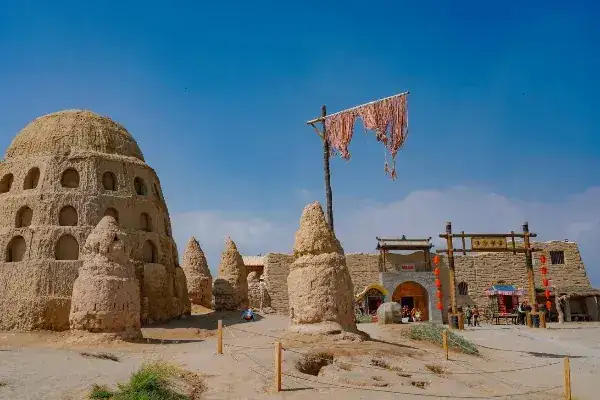
Haba Lake Tourism Area: National 4A scenic area in Yanchi County, covering 160,000 hectares. Part of Huamasi National Forest Park, featuring desert landscapes, grasslands, lakes, forests, and historical sites.
Tongxin Red Army Western Expedition Memorial Park: National 4A scenic area covering 325 mu, the only memorial dedicated to the Red Army's Western Expedition.
Ningxia Migration Museum: National 3A scenic area, 9,436.88 square meters, with 2,000+ exhibits on Ningxia's migration history.
Dong Fu (Dong Mansion): National-level protected cultural heritage site in Qingtongxia, built in 1905 for General Dong Fuxiang, the only preserved official mansion in Ningxia, with 116 rooms in a three-route, six-courtyard layout.
Famous People
Honorary Titles
Travel information can change. Check current opening hours, reservations and entry requirements before you travel.
Traveller discussion
Start the conversation with a helpful tip or a question.