
Shizuishan City
Shizuishan CityShizuishan City, a prefecture-level city under the Ningxia Hui Autonomous Region, is located at the northernmost tip of the autonomous region. It borders the Ordos Plateau to the east and sits at the northern end of the Yinch
Shizuishan City
Shizuishan City, a prefecture-level city under the Ningxia Hui Autonomous Region, is located at the northernmost tip of the autonomous region. It borders the Ordos Plateau to the east and sits at the northern end of the Yinchuan Plain, with the Yellow River flowing through the east and the Helan Mountains to the west. It has a typical temperate continental climate, with a total area of 5,310 square kilometers. As of March 2023, Shizuishan administers 2 districts and 1 county. As of the end of 2024, the permanent resident population was 739,400. On November 23, 1975, the Yinbei Prefecture was abolished and Shizuishan City was restored. The city is named after the "rock protruding like a beak" at the confluence of the Helan Mountains and the Yellow River. It has a long history, with the Hunhuai Barrier established during the Qin Dynasty (221–206 BC) and Lian County during the Western Han Dynasty (202 BC–220 AD), the first administrative establishment in the area. The city has rich cultural heritage, including Helan Mountain rock art, ancient Great Wall sections, Bei Wudang Shoufo Temple, Pingluo Yuhuang Pavilion, and Tianzhou Pagoda. It is situated between two national hundred-billion-ton coalfields and is an important node city in the Hubaoyinlan Economic Belt, Ningxia Yellow River Economic Zone, and Ningxia-Inner Mongolia-Shaanxi "Black Gold Triangle." The Baolan Railway, Beijing-Tibet Expressway, Wuma Expressway, National Highways 109 and 110 run through the city. The 5A-level scenic area Sand Lake and the national water conservancy scenic area Xinghai Lake are located here. In 2025, the gross regional product was 57.984 billion yuan, up 5.0%.
History
The area was collectively known as "Shuofang," the nomadic land of the Rongdi tribes, during the Spring and Autumn and Warring States periods through the Qin unification (221 BC).
During the Qin Dynasty (221–206 BC), Meng Tian led forces north against the Xiongnu and built the Hunhuai Barrier on the east side of the Yellow River, establishing the Hunhuai Commandant under Beidi Commandery, marking the beginning of administrative establishment in the area.
During the Han Dynasty (202 BC–220 AD), in the fourth year of Yuanshou (119 BC), Lian County was established in present-day Pingluo County, the first county-level administrative establishment in the area.
During the Tang Dynasty (618–907), the area was under Lingzhou Metropolitan Governor's jurisdiction. In 713, Dingyuan Army was established, later elevated to a county. In 893, it was elevated to Jingzhou.
During the Song Dynasty (960–1279), the area was under Lingzhou of Shaanxi Circuit, with Dingyuan Town established. During the Zhi Dao era (995–997), it was changed to Weiyuan Army.
During Western Xia (1038–1227), Dingyuan Town was occupied by the Tangut people in 1001. In 1036, it was renamed Dingzhou with Dingyuan County. In 1024, Western Xia built Shengkui City.
During the Ming Dynasty (1368–1644), the area was under Ningxia Guard of Shaanxi. Around 1405, Pinglu City was built, and in 1551 it became Pinglu Guard Thousand Household Office.
During the Qing Dynasty (1644–1912), the area was under Ningxia Prefecture of Gansu. In 1724, Pingluo County was established, and later Xinqu and Baofeng counties were added.
During the Republic of China, the area was under Ningxia Circuit of Gansu. In 1929, Ningxia Province was established. In 1942, Huinong County was carved from Pingluo, and Taole County was added. In 1945, the Third Inspectorate was established.
On September 25, 1949, the area was liberated. In 1958, the Ningxia Hui Autonomous Region was established. In 1960, the State Council formally decided to establish Shizuishan City, abolishing Huinong County. In 1972, Yinbei Prefecture was established. In 1975, it was abolished and Shizuishan City was restored under direct autonomous region jurisdiction, with the city government moved to Dawukou. In 2002, Shitanjing District was merged into Dawukou District. In 2004, Shizuishan District and Huinong County were merged into Huinong District, and Taole County was abolished.
Administrative Divisions
Evolution
In March 1960, the First People's Congress announced the establishment of Shizuishan City. In 1962, the two districts merged into one urban district. In 1963, Huangqu Bridge and Baofeng communes were transferred to Pingluo County, while Dawukou Town and Dawukou Commune were transferred from Pingluo to Shizuishan. In 1970, Shitanjing was elevated to a district. In 1972, Yinbei Prefecture was established. In 1973, Dawukou Town was elevated to a district. In 1976, the city suburbs were established. In 1981, the three districts were renamed Dawukou, Shizuishan, and Shitanjing. In 1987, the suburbs were abolished and Huinong County was restored.
Division Details
As of March 2023, Shizuishan administers 2 districts and 1 county. The City People's Government is seated at No. 51 Wuyue Road, Dawukou District.
Geographical Environment
Location and Boundaries
Shizuishan is located in the upper-middle reaches of the Yellow River, at the northern end of the Ningxia Hui Autonomous Region. It borders Ordos City of Inner Mongolia to the east across the Yellow River, the Helan Mountains and Alxa League of Inner Mongolia to the west, Otog Rear Banner of Inner Mongolia to the north, and Yinchuan's Xingqing District and Helan County to the south. It spans 88.8 km east to west and 119.5 km north to south, between 105°58'–106°39' east longitude and 38°21'–39°25' north latitude, with a total area of 5,310 square kilometers.
Topography
The city borders the Ordos Plateau to the east and the northern Yinchuan Plain to the west, with elevations between 1,090 and 3,475.9 meters. The terrain can be divided into four types: Helan Mountain area, alluvial fan at the eastern foot of the Helan Mountains, Yellow River alluvial plain, and Ordos Plateau. The highest peak of the Helan Mountains reaches 3,475.9 meters, covering 1,605.7 square kilometers (30.24% of the total area).
Climate
Shizuishan has a typical temperate continental climate with abundant sunshine, concentrated precipitation, strong evaporation, dry air, large temperature differences, and a short frost-free period. Summers are hot and brief, springs warm and windy, autumns cool and early, winters cold and long. The annual average temperature is 8.4–9.9°C. Annual precipitation is 167.5–188.8 mm, with evaporation of 1,708.7–2,512.6 mm, 10–14 times the precipitation.
Hydrology
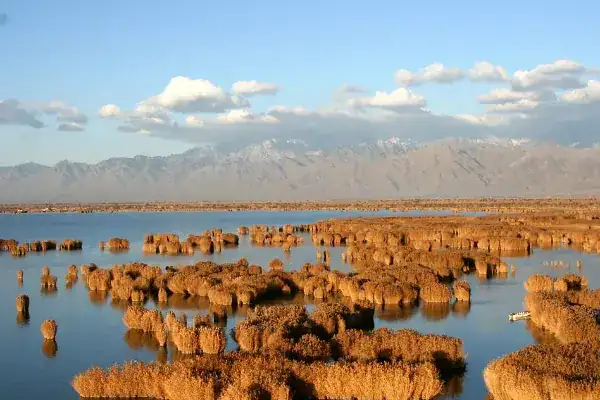
The surface water system consists of the Yellow River mainstream, first-order tributaries (Dousitu River, Shuidong Gully), Helan Mountain valleys, Yellow River diversion and drainage canal systems, and plain lowland lakes. Most water volume is Yellow River transit water. Groundwater is mainly recharged by Yellow River seepage and mountain rainfall.
Natural Resources
Water Resources
Total water resources: 1.0805 billion cubic meters/year, of which local production is only 158.5 million and Yellow River diversion is 922 million. Surface water resources: 966.6 million cubic meters/year. Groundwater average annual recharge: 566.8 million cubic meters.
Plant Resources
Natural arboreal forests cover 4,600 hectares, concentrated in the Helan Mountains above 1,500 meters, with species including Qinghai spruce, Chinese pine, juniper, gray elm, and mountain poplar. Natural shrub forests cover 7,720 hectares, with species including Nitraria, Mongolian almond, tamarisk, mountain elm, wild jujube, and Caragana. There are 259,114.4 hectares of grassland and 665 species of wild plants, with 4 species under national Class II and III protection.
Animal Resources
216 species of wild vertebrates in 5 classes, 40 orders, and 84 families, including 20 mammal species, 154 bird species, 11 amphibian/reptile species, and 42 fish species. Class I national protected species include spot-billed pelican and black stork. Class II protected species include white spoonbill, whooper swan, tundra swan, great eagle, blue eared pheasant, grey crane, great bustard, little bustard, stone marten, demoiselle crane, and argali.
Mineral Resources
Proven minerals include coal, silica, calcite, limestone, diabase, white sandstone, muscovite, clay, gold, copper, aluminum, and iron. Coal reserves total 2.5 billion tons (11 of 12 national coal types). "Taixi Black Gold" coal reserves reach 655 million tons, silica 500 million tons, and clay 13 million tons.
Politics
Population
Population Size
As of the end of 2024, the permanent resident population was 739,400, a decrease of 11,500. The urban population was 601,600, rural 137,800, with an urbanization rate of 81.36%. Birth rate: 7.11 per mille; death rate: 9.13 per mille; natural growth rate: -2.02 per mille.
Ethnic Composition
Shizuishan has Han, Hui, and other ethnic groups.
Economy
Overview
In 2025, the gross regional product was 57.984 billion yuan, up 5.0%. By industry: primary 4.554 billion, up 6.3%; secondary 26.964 billion, up 5.2%; tertiary 26.466 billion, up 4.4%. In 2024, GDP was 56.553 billion yuan, up 3.2%, with a structure of 7.8:47.4:44.8. Per capita GDP: 75,895 yuan, up 4.0%. Fixed-asset investment decreased 19.2%. General public budget revenue: 2.835 billion yuan, up 3.7%. General public budget expenditure: 12.36 billion, down 6.4%.
Primary Industry
Total agricultural, forestry, pastoral, and fishery output: 8.632 billion yuan, up 4.8%. Grain area: 1,078,400 mu, output 518,000 tons, up 0.6%. Vegetable area: 116,500 mu, output 395,300 tons. Cattle inventory: 211,000, up 3.0% (dairy cows 125,600, up 3.8%); beef output: 11,800 tons, up 27.6%; milk: 601,900 tons, up 14.2%. Sheep inventory: 607,900, down 11.7%; mutton: 12,700 tons, down 8.6%. Pigs: 28,200, down 27.4%; pork: 4,900 tons, up 8.7%. Poultry: 990,900, down 7.3%; poultry meat: 4,100 tons, up 12.6%; eggs: 9,100 tons, up 9.3%.
Secondary Industry
Total industrial added value: 23.656 billion yuan, up 3.6%. Above-scale industrial added value up 5.0%. Equipment manufacturing up 20.9% (9.7% of total); high-tech manufacturing up 29.6% (5.3%); "Six New" industries up 12.7% (41.4%); "8 supply chains" up 14.5% (38.4%). Above-scale enterprise revenue: 112.893 billion yuan, down 4.0%. Asset-liability ratio: 73.3%, down 0.1 percentage points. Construction output: 4.065 billion yuan, up 9.0%.
Tertiary Industry
Wholesale/retail: 3.635 billion, up 4.4%. Transportation/warehousing/postal: 3.018 billion, up 2.4%. Accommodation/catering: 677 million, up 4.0%. Finance: 2.706 billion, up 3.1%. Real estate: 1.688 billion, up 3.7%. For-profit services: 3.111 billion, down 1.9%. Non-profit services: 10.285 billion, up 5.1%. Total retail sales: 10.282 billion, up 2.5%. Foreign trade: 5.445 billion yuan, up 11.3% (exports 4.393 billion, up 8.4%; imports 1.052 billion, up 25.5%). Total deposits: 92.417 billion, up 2.9%. Total loans: 52.631 billion, down 4.5%. Insurance premiums: 2.576 billion, up 0.9%.
Social Affairs
Science and Technology
148 national high-tech enterprises, 18 autonomous region engineering research centers, 3 key laboratories, 98 technology innovation centers, 26 innovation teams, 227 nationally registered technology-based SMEs. 1,103 valid invention patents, up 29.9%. 1,462 patent authorizations (276 inventions, up 43.0%). Technology contract turnover: 605 million yuan, up 11.6%.
Education
3 higher education institutions (23,700 students, 4,600 graduated), 2 secondary vocational schools (9,600 students), 31 secondary schools (39,400 students), 64 primary schools (42,400 students), 2 special education schools (285 students), 96 kindergartens (16,400 children). Main universities: Ningxia Institute of Science and Technology, Ningxia University of Applied Science and Technology, Shizuishan Industry and Trade Vocational Technical College, Ningxia Health Vocational Technical College.
Culture
4 public libraries (928,500 volumes, 605,300 visitors), 4 cultural centers, 36 township cultural stations, 3 cultural heritage management institutions, 24 folk art institutions, 8 museums.
Healthcare
504 health institutions, including 33 hospitals, 455 grassroots health institutions, 13 professional public health institutions (4 CDCs). 7,501 health workers (2,787 physicians, 3,296 nurses). 5,322 beds (4,752 in hospitals).
Sports
4,166 sports venues covering 2,947,400 square meters (3.99 per capita), including 111 basic athletics venues, 2,650 ball game venues, 1 ice/snow venue, and 1,076 fitness trails.
Social Security
Pension insurance: 541,600, up 1.5% (enterprise 358,500, up 1.9%; urban-rural 152,100, up 0.5%; government 31,000, up 1.3%). Medical insurance: 718,200, down 1.8% (employee 241,100; urban-rural 477,100). Unemployment: 147,300, up 3.1%. Work injury: 153,900, up 0.3%. Maternity: 132,800, down 1.8%. 18 welfare/elderly care institutions with 4,253 beds (200 for children), caring for 1,276 people (24 children). Minimum living allowance: 25,500 people (urban 9,300; rural 16,200), totaling 166 million yuan.
Transportation
Overview
The mountain passes cutting through the Helan Mountains have historically been transportation corridors between the agricultural Central Plains and northern pastoral areas. The Yellow River at Huinong District has been a water-land dock connecting Ningxia with Gansu and Inner Mongolia since the early Qing Dynasty. The Baolan Railway, National Highways 109 and 110, and Wuma Expressway run through the city. Two Yellow River bridges at Huinong and Pingluo connect Ningxia and Inner Mongolia. Distance to Yinchuan: 81 km; to Yinchuan Hedong Airport: 100 km; to Beijing: 1,282 km; to Lanzhou: 529 km; to Baotou: 450 km.
In 2024, highway freight volume was 54.82 million tons, unchanged; freight turnover was 6.517 billion ton-km, down 0.7%.
Highways
National Highways 109, 110, 244. Provincial Highways 101, 301, 303. Expressways: Beijing-Lhasa (G6), Wuhai-Maqin (G18), Shizuishan-Yinchuan (S27), Shizuishan-Pingluo link (S10).
Railways
Baolan Railway, Baoyin High-Speed Railway, Pingru Railway. Stations: Shizuishan, Huinong South (HSR), Shizuishan South, Huinong, Dawukou, Xidatan (freight).
Public Transportation
Operated by Shizuishan Andao Public Transit Co., Ltd., with 332 employees, 230 buses (100 hybrid, 120 pure electric, 10 LNG), 19 routes (12 in Dawukou, 7 in Huinong). Pingluo County has 3 routes.
Scenic Spots
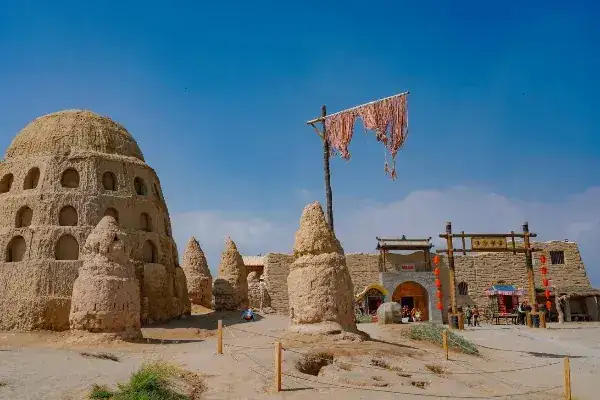
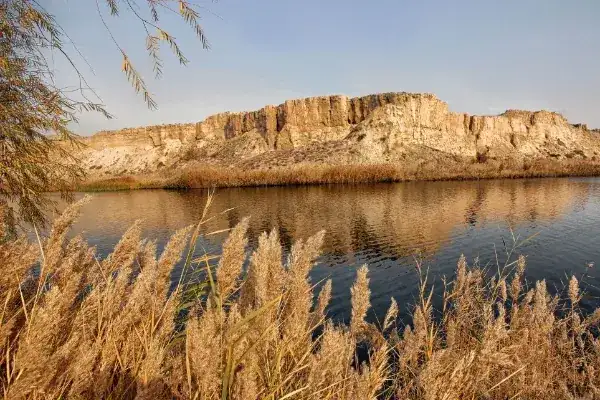
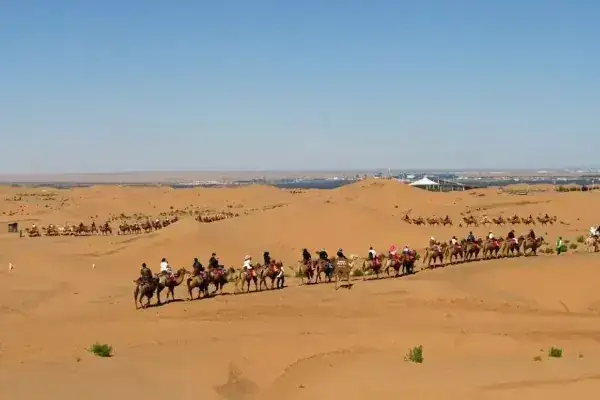
Sand Lake is located in Pingluo County, 42 km north of Yinchuan. The lake covers 45 square kilometers with an average depth of 2.2 meters, and the desert covers 22.52 square kilometers with dunes up to 100 meters. In 2007, it was designated as one of the first national 5A-level scenic areas and named a "National Civilized Scenic Tourism Demonstration Site." It was also named one of "China's Top Ten Charming Leisure Tourism Lakes" in 2010.
Yuhuang Pavilion, located north of Pingluo County town, is the largest Taoist temple in Ningxia. Built in 1875 and expanded in 1939, it covers 4,200 square meters with the highest building, the Three Mothers Hall, reaching about 26 meters. The complex includes the City God Hall, Guanyin Hall, Lady Hall, Three Pure Ones Hall, Three Mothers Hall, Yuhuang Hall, Dongbin Hall, Wenchang Pavilion, Guandi Pavilion, and Boundless Hall.
Bei Wudang Ecological Tourism Area is located 3 km from Dawukou at the eastern foot of the Helan Mountains, covering 2.21 square kilometers. Rated as a national 4A scenic area in 2020, it consists of a xerophytic botanical garden, Bei Wudang Shoufo Temple, and the Helan Mountain Ecological Museum. The temple is a millennium-old complex combining Confucianism, Buddhism, and Taoism, with Empress Dowager Cixi having inscribed "National Protection Longevity Buddha Zen Temple."
Famous People
Honorary Titles
Travel information can change. Check current opening hours, reservations and entry requirements before you travel.
Traveller discussion
Start the conversation with a helpful tip or a question.