
Yinchuan City
Yinchuan CityYinchuan City is a prefecture-level city and the capital of the Ningxia Hui Autonomous Region, abbreviated as "Yin," formerly known as "Xingqing Prefecture" and also called "Phoenix City." It is located in northwestern China, i
Yinchuan City
Yinchuan City is a prefecture-level city and the capital of the Ningxia Hui Autonomous Region, abbreviated as "Yin," formerly known as "Xingqing Prefecture" and also called "Phoenix City." It is located in northwestern China, in the middle of the Ningxia Plain, with terrain divided into mountains and plains. The climate is a typical mid-temperate continental climate, with a total area of 9,025.38 square kilometers. As of April 2024, Yinchuan administers 3 districts, 2 counties, and 1 county-level city. As of the end of 2024, the permanent resident population was 2,914,700. Human settlement dates back 30,000–40,000 years to the Shuidonggou Paleolithic site. After the Qin unification, it was part of Beidi Commandery. In 1001, Tangut leader Li Jiqian occupied the area, and Li Yuanhao established Western Xia with its capital at Xingqing Prefecture (present-day Yinchuan). In 1958, the Ningxia Hui Autonomous Region was established with Yinchuan as its capital. Yinchuan is designated by the State Council as an important central city in northwestern China, a national historical and cultural city, and a national comprehensive transportation hub. It is known as the "Lake City Beyond the Great Wall" and is home to the Western Xia Imperial Tombs and the Shuidonggou Paleolithic site. In 2025, the gross regional product was 303.352 billion yuan, up 5.3%.
Name Evolution
Yinchuan has been known as Phoenix City since ancient times. Legend says a phoenix flew from the Helan Mountains and, captivated by the area's beauty, transformed into the city of Yinchuan. The name "Yinchuan" first appeared in the "New Book of Tang - Geography." In 1753, Yinchuan Academy was established, the first semi-official institution to use "Yinchuan" as an alternative name for the Ningxia prefectural city. In 1944, the provincial capital was renamed Yinchuan, and in 1945, Yinchuan City was formally established.
History
Pre-Qin Period
The Shuidonggou Paleolithic site, 30,000–40,000 years old, is the earliest ancient human settlement in the Yinchuan area. During the Shang, Spring and Autumn, and Warring States periods, it was the territory of Northern Di, Western Rong, and Xiongnu nomadic tribes.
Qin to Northern and Southern Dynasties
After Qin Shi Huang unified the six states (221 BC), the area was part of Beidi Commandery. In 112 BC, Beidiannong City (also "Lu City") was built, marking the founding of Yinchuan. During the Northern and Southern Dynasties, it was called "Yinhan City." After Helian Bobo established the Great Xia, it was rebuilt as "Liziyuan," a royal garden. Northern Zhou established Huaiyuan Commandery and Huaiyuan County.
Sui-Tang to Song-Yuan Period
In 677, Huaiyuan County was flooded by the Yellow River and destroyed. The next year, a new city was built to the west (present-day Xingqing District). In 1001, Tangut leader Li Jiqian occupied the Yinchuan Plain. In 1020, his son Li Deming built a capital at Huaiyuan Town, renaming it "Xingzhou," later elevated to Xingqing Prefecture. In 1038, Li Yuanhao established Western Xia with its capital at Xingqing Prefecture. In 1288, the Yuan Dynasty established Ningxia Fu Route, the origin of the name "Ningxia."
Ming-Qing Period
The Ming Dynasty established Ningxia Garrison with seven guards, one of the "Nine Border Garrisons." The Qing Dynasty reorganized it as Ningxia Prefecture.
Republic of China Period
In 1912, Ningxia Circuit was renamed Shuofang Circuit. In 1929, Ningxia became an independent province. In 1944, the provincial government proposed establishing Yinchuan City. On April 18, 1947, Yinchuan City was formally established.
After the Founding of the People's Republic of China
In 1954, Ningxia Province was abolished, and Yinchuan became part of Yinchuan Special District, Gansu Province. On October 25, 1958, the Ningxia Hui Autonomous Region was established with Yinchuan as its capital. In 2002, the old urban, new urban, and suburban districts were reorganized into Xixia, Jinfeng, and Xingqing districts. Lingwu City was transferred from Wuzhong to Yinchuan's administration.
Administrative Divisions
As of April 2024, Yinchuan administers 3 districts (Xingqing, Jinfeng, Xixia), 2 counties (Yongning, Helan), and 1 county-level city (Lingwu). The City People's Government is seated at No. 166 Beijing Middle Road, Jinfeng District.
Natural Geography
Location
Yinchuan is located in the middle of the Ningxia Plain on the upper Yellow River, between 37°29'–38°52' north latitude and 105°48'–106°52' east longitude, with a total area of 9,025.38 square kilometers. It borders Wuzhong to the east across the Yellow River, the Helan Mountains and Alxa League (Inner Mongolia) to the west, Wuzhong to the south, and Shizuishan to the north.
Geology
The area belongs to the North China Stratigraphic Region, with Archean metamorphic complex and Lower Proterozoic metamorphic rocks forming the basement. The geological structure is complex, with well-developed uplifts, fault depressions, folds, and fractures.
Topography
The urban area is divided into mountains and plains, higher in the west and south, lower in the north and east. Six landform types from west to east: Helan Mountains, alluvial fan plain, alluvial plain, lacustrine plain, valley plain, and floodplain. Elevation: 1,010–1,150 meters. The Helan Mountains extend about 150 km, with the highest peak at 3,556 meters, serving as a natural barrier against cold air and sand from the northwest. About 70 km of the range lies within Yinchuan, covering 58,800 hectares.
Climate
Yinchuan has a typical mid-temperate continental climate: dry, strong evaporation, abundant sunshine, cold winters with little snow, windy springs, brief hot summers, concentrated autumn rain, large diurnal temperature ranges, and short frost-free periods. Annual average temperature: 8–9°C. Annual sunshine: 2,800–3,000 hours. Annual precipitation: about 200 mm, concentrated in July–September. Annual evaporation: about 1,595 mm.
Hydrology and Water Conservancy
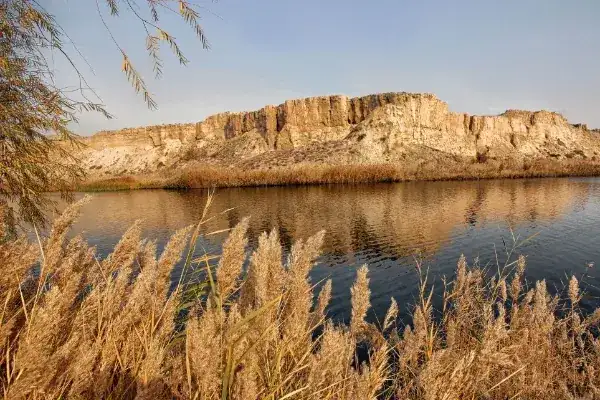
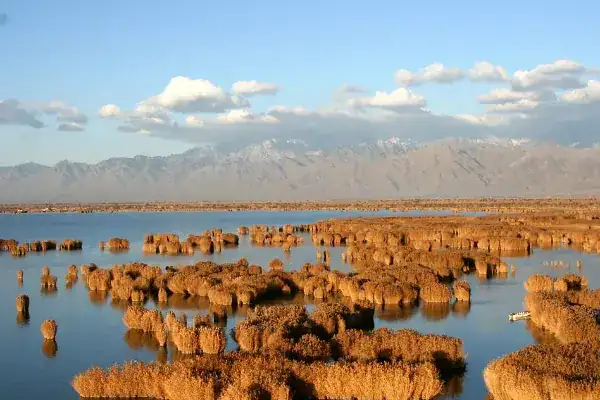
The Yellow River flows 83.8 km through Yinchuan (21% of its Ningxia section). The city has nearly 200 natural lakes, with 20+ over 100 hectares, including Mingcui Lake, Yuehai Lake, Hequan Lake, and Baohu Lake. Fourteen ancient Yellow River diversion canals have irrigated the area for over 2,000 years, diverting 3.5–4 billion cubic meters annually and irrigating 2.13 million mu of farmland.
Soil
Nine major soil types, 28 subtypes, 48 genera, and 500+ species. Gray calcic soil covers 35.7%, and irrigated silt soil covers 24.2% of the land area.
Natural Disasters
Main hazards include earthquakes, geological disasters, meteorological disasters, floods, droughts, and forest fires. In July 2018, heavy rainfall in the Helan Mountains caused flash floods, triggering a Yellow River flood (No. 2 of 2018) and requiring emergency rescue operations.
Natural Resources
Water Resources
Surface water is abundant, mainly from Yellow River transit water. The river flows 80+ km through Yinchuan, with annual diversion of billions of cubic meters through canals including Tanglai, Hanyan, Huinong, and Xigan.
Land Resources
Cultivated land: 138,628 hectares (1.0794 million mu), including 44.65% paddy fields, 54.60% irrigated land, and 0.75% dryland. Orchards: 22,222 hectares. Grassland: 261,333 hectares.
Biological Resources
The Helan Mountains have the city's only natural forest, 26,700 hectares with 22.8% forest coverage, including spruce, Chinese pine, and mountain poplar. 40+ wild medicinal plant species and 32 protected animal species including musk deer, red deer, blue eared pheasant, blue sheep, and fox. The eastern foothills of the Helan Mountains are one of the world's best grape-growing regions, comparable to Bordeaux. Yinchuan wetlands have 241 bird species (7 Class I and 20 Class II nationally protected), 255 vascular plant species, and 31 fish species.
Mineral Resources
Minerals include coal, hematite, limestone, dolomite, silica, phosphorite, and diabase. Helan stone is one of China's "Five Famous Inkstones." Lingwu has rich coal, petroleum, and natural gas reserves, with high-quality coal known for high calorific value, low ash, low sulfur, and low phosphorus.
Wind Power Energy
As of September 2021, clean energy equipment manufacturing output was 17.83 billion yuan, with 191 PV, wind, and biomass projects totaling 1,415.65 MW (38.7% of total installed capacity).
Population
Population Size
As of the end of 2024, the permanent resident population was 2,914,700, up 6,600. The urban population was 2,429,400 (83.35% urbanization rate, up 0.51 percentage points). The Hui population was 728,800 (25.00%). Birth rate: 9.79 per mille; death rate: 4.43 per mille; natural growth rate: 5.36 per mille.
Ethnic Groups
Yinchuan is a multi-ethnic immigrant city with all 56 ethnic groups. According to the Seventh Census: Han 2,145,863 (75.05%), minorities 713,211 (24.95%), including Hui 667,606 (23.35%).
Language
Yinchuan dialect belongs to the Lanyin Mandarin group. The formation of Yinchuan Mandarin was influenced by three waves of migration: Beijing immigrants (1952–1954), Shanghai and coastal factory workers (1956–1958, ~100,000 people), and Zhejiang educated youth (1956). Post-reform migration from northeast, Hebei, Henan, and Shandong further standardized Yinchuan Mandarin.
Religious Beliefs
All five major religions are present: Buddhism (introduced during the Jin Dynasty), Islam (Yuan Dynasty), Taoism, Christianity, and Catholicism (17th century). Major temples include Haibao Pagoda Temple and Chengtian Temple. Major mosques include Najiahu Mosque, Nanquan Mosque, and Xiguan Mosque.
Politics
Economy
Overview
Yinchuan is an important regional logistics node and "Belt and Road" node city, with manufacturing focused on new materials, new energy, new food processing, high-end equipment, and electronic information. In 2024, GDP was 293.953 billion yuan, up 5.4%. Structure: 3.5:46.7:49.8. Per capita GDP: 100,966 yuan, up 5.1%. General public budget revenue: 20.844 billion, up 5.4%. Fixed-asset investment up 8.6%.
Primary Industry
Total agricultural output: 21.171 billion yuan, up 5.4%. Grain area: 1,222,400 mu, output 701,900 tons. Vegetables: 1,535,300 tons, up 8.3%. Fruits: 223,900 tons, up 20.7%. Total meat output: 73,400 tons, up 16.2%. Milk: 1,589,700 tons, up 4.3%. Cattle inventory: 469,400 (dairy 299,600). Sheep: 982,500. Pigs: 107,800. Poultry: 1,903,900.
Secondary Industry
Total industrial added value: 122.344 billion yuan, up 8.5%. Above-scale industrial added value up 10.1% (mining up 15.0%, manufacturing up 10.6%, electricity/heat/gas/water up 4.5%). Above-scale enterprise revenue: 386.702 billion, down 12.3%. Profits: 20.282 billion, down 35.2%. 563 qualified construction enterprises, output 55.126 billion, up 5.2%.
Tertiary Industry
Services added value: 146.466 billion yuan, up 3.9%. Wholesale/retail: 18.086 billion, up 7.6%. Transportation: 9.82 billion, up 7.1%. Finance: 28.502 billion, up 8.8%. Total retail sales: 85.527 billion, up 6.1%. Foreign trade: 12.182 billion yuan, down 6.4%. Total deposits: 650.205 billion, up 7.5%. Total loans: 715.228 billion, up 2.6%. Insurance premiums: 25.518 billion, up 4.3%.
Social Affairs
Science and Technology
5,487 valid invention patents (17.35 per 10,000 people). Offshore incubators established in Beijing, Shanghai, Hangzhou, and Xi'an, with 30+ technology projects introduced to Yinchuan.
Education
17 regular higher education institutions (140,693 students), 16 secondary vocational schools (34,151 students), 30 high schools (67,046 students), 66 junior high schools (100,653 students), 193 primary schools (244,684 students), 4 special education schools (781 students), 450 kindergartens (95,985 children). Preschool gross enrollment: 109.1%.
Culture
223 art troupes, 8 cultural centers, 7 public libraries, 29 museums, 11 national-level protected cultural heritage sites. Radio and TV coverage: 100%.
News Media
Yinchuan Daily founded November 18, 2012. Yinchuan Evening News founded July 1, 1988. In 2021, the TV and radio stations merged into Yinchuan Broadcasting and Television Station. In 2016, Yinchuan News Media Group was established.
Healthcare
1,622 health institutions, including 121 hospitals. 19,379 beds (17,821 in hospitals). 33,515 health workers (12,106 physicians, 15,599 nurses). 8 CDCs, 8 maternal/child centers, 35 township health centers.
Sports
13 national championships, 13 gold, 10 silver, and 13 bronze medals in 2024.
Environment
In 2023, air quality excellent days: 294 (80.3%). PM2.5 average: within standards. Drinking water source compliance: 100%. Yellow River Yinchuan section: Class II water quality.
Social Security
Pension insurance: 1,724,800, up 3.6% (enterprise 1,308,200; urban-rural 349,500). Medical insurance: 2,201,400, up 1.2% (employee 987,400; urban-rural 1,214,000). Unemployment: 750,100. 6 elderly care institutions with 1,545 beds. 40,493 urban minimum living (98 million yuan); 27,326 rural minimum living (156 million yuan). 307 community service stations (100% coverage).
Transportation
Overview
Yinchuan is an important "Belt and Road" node. Yinchuan Hedong Airport entered the "10-million passenger" tier with 10.575 million passengers. The Yinxi and Yinlan high-speed railways connect Ningxia internally. "Eight horizontal, eighteen vertical" trunk road network in the urban area.
In 2024: railway passengers 6.7494 million, up 5.7%; railway freight 6.9062 million tons, down 3.8%; civil aviation passengers 4.2507 million, up 16.1%.
Highways
6 national highways, 125 km of expressways. National Highways 109 and 110, Qingyin, Fuyin, and Beijing-Tibet expressways. Total highway mileage: 7,832 km (451 km expressway). Rural road mileage: 4,226 km, with 100% village access.
Railways
Baolan and Tai-Zhong-Yin trunk railways, plus local railways. The Yinxi High-Speed Railway (Yinchuan-Xi'an) opened in December 2020. In 2023: railway passengers 6.3843 million, up 142.1%; freight 7.176 million tons, down 1.6%.
Aviation
Yinchuan Hedong International Airport: 4E-level, 19 km from city center. Opened September 6, 1997. Runway: 3,600 m × 45 m. In 2023: passengers 3.6625 million, up 111.2%; cargo 21,900 tons, up 53.1%.
Water Transport
8 water transport enterprises, 62 registered vessels, mainly for tourism.
Public Transportation
200 bus routes, 2,368 buses, 3,095.5 standard vehicles (16 per 10,000 people). 6,069 taxis. Annual ridership: 304 million. Free transfer within one hour, free for seniors 65+, military, disabled; 60% discount for students.
Culture
Overview
Yinchuan is a national historical and cultural city with 2,100+ years of history. Known as "China's Tourism Miniature Bonsai Garden," with dinosaur fossils, Shuidonggou Paleolithic site, Helan Mountain rock art, Western Xia tombs, and Zhenbeipu film city.
Folk Customs
Liaogan Festival (23rd of the first lunar month): People jump over bonfires to "burn away" illness and bad luck, then scatter embers to predict the year's harvest. Hui clothing differs mainly in headwear: men wear white or black caps, women wear head covers (black/white for elderly, blue for middle-aged, green for young women). Hui funeral customs emphasize rapid burial within 3 days, earth burial, and specific rituals including body washing at the mosque.
Traditional foods include Northwest Chinese cuisine (Qin-Long style) with official, merchant, and market dishes, plus Hui halal cuisine such as steamed lamb, hand-grabbed mutton, lamb offal soup, and pita bread soaked in lamb soup.
Traditional Villages
Yuanzi Village in Jinfeng District's Liangtian Town, an ecological resettlement village from the 1980s, was listed as a national traditional village in March 2023 and has received "China's Beautiful Leisure Village" honors.
Intangible Cultural Heritage
Regional Symbol
Scenic Spots
Overview
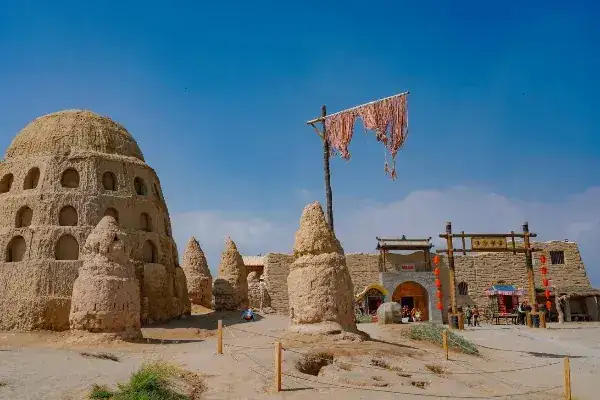
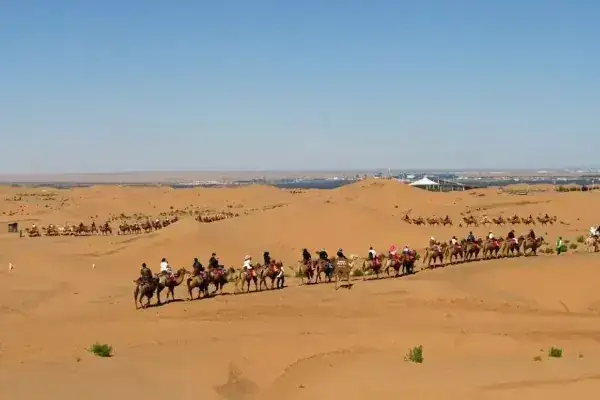
Yinchuan is a "China Excellent Tourist City." Western attractions include Helan Mountain Suyukou National Forest Park, Gunzhongkou, Helan Mountain rock art, Western Xia tombs, and Zhenbeipu Western Film City. Eastern attractions include Yellow River scenery and Hengcheng Ancient Ferry. Urban attractions include Chengtian Temple Pagoda, Haibao Pagoda, Yuhuang Pavilion, Bell-Drum Tower, and lakes including Mingcui, Baohu, and Yuehai.
In 2023: domestic tourists 41.9659 million (up 104.5%), inbound tourists 26,061 (up 3051.3%); domestic tourism revenue 37.699 billion yuan (up 181.1%); foreign exchange revenue 21.8932 million USD.
Important Scenic Spots
Western Xia Imperial Tombs: Located at the eastern foot of the central Helan Mountains, the largest, highest-ranking, and best-preserved Western Xia cultural site in China. Designated as a national-level protected cultural heritage site (1988), national scenic area, and national archaeological site park (2017). Listed on China's World Heritage tentative list (2012).
Western Xia Culture Park: National 4A scenic area at the foot of the Helan Mountains, themed on Western Xia culture with live performances and architectural reproductions.
Shuidonggou: National 5A scenic area, 7.8 square kilometers, 19 km west of Yinchuan. China's earliest excavated Paleolithic site, known as the "birthplace of Chinese prehistoric archaeology." National-level protected cultural heritage site (1988).
Local Specialties
18 China Famous-Special-Excellent-New agricultural products including Ningxia rice, Shangtan leeks, Lingwu long jujubes, and Helan line peppers.
Lingwu Long Jujube: National geographic indication product, a royal tribute since the Tang Dynasty (618–907) with 1,300 years of cultivation history. Elliptical, purple-red, thin-skinned, crisp and sweet.
Ningxia Rice: Protected as a national agricultural product geographic indication, with "full grains, clean color, oily luster, fragrant taste," selected for the EU-China "100+100" geographic indication mutual recognition list.
Helan Inkstone: One of China's four famous inkstones, from the Helan Mountains. Xixia District was named "China's Helan Inkstone Hometown" in 2017.
External Exchange
Famous People
Important Honors
Travel information can change. Check current opening hours, reservations and entry requirements before you travel.
Traveller discussion
Start the conversation with a helpful tip or a question.