
Haixi Mongolian and Tibetan Autonomous Prefecture
Haixi Mongolian and Tibetan Autonomous PrefectureHaixi Mongolian and Tibetan Autonomous Prefecture, abbreviated as "Haixi Prefecture," is an autonomous prefecture under Qinghai Province, with its capital seated in Delingha City. It is locat
Haixi Mongolian and Tibetan Autonomous Prefecture
Haixi Mongolian and Tibetan Autonomous Prefecture, abbreviated as "Haixi Prefecture," is an autonomous prefecture under Qinghai Province, with its capital seated in Delingha City. It is located in the northern part of the Qinghai-Tibet Plateau and western Qinghai Province, with a total area of 300,900 square kilometers. As of July 2026, Haixi administers 3 county-level cities and 3 counties. The commonly used languages are Mongolian, Tibetan, and Chinese. As of the end of 2025, the permanent resident population was 477,200. Haixi has a typical alpine arid continental climate, divided into the Qaidam Basin arid desert zone and the surrounding alpine cold zone. The terrain is high in the northwest and low in the southeast. In ancient times, Haixi was the land of the Western Qiang. During the Ming Dynasty (1368–1644), it was under four guards administered by Xining Guard. In the third year of Yongzheng of the Qing Dynasty (1644–1912) (1725), 9 Mongol banners were established. In 1930, Dulan County was established. On May 21, 1985, it was officially named "Haixi Mongolian and Tibetan Autonomous Prefecture." In 2005, the Qaidam Circular Economy Pilot Zone became one of the first 13 national circular economy pilot parks. In 2018, it became the first among the "Three Regions and Three Prefectures" to achieve overall poverty alleviation. In 2025, the gross regional product was 91.729 billion yuan, up 7.5%.
Name Evolution
The prefecture is named for being west of Qinghai Lake. It is also known as "Qaidam" because its main territory is the world-renowned "Treasure Bowl" Qaidam Basin. In 1725, 9 Mongol banners were established. In 1917, it came under the Dulan Council. In 1930, Dulan County was established. In 1952, the Dulan Mongolian-Tibetan-Kazakh Autonomous Region was established. In 1963, it was renamed "Haixi Mongolian, Tibetan, and Kazakh Autonomous Prefecture." In 1984, the Kazakh population was relocated to Xinjiang. In 1985, it was renamed "Haixi Mongolian and Tibetan Autonomous Prefecture."
History
Pre-Qin Period
In ancient times, Haixi was the land of the Western Qiang.
Qin-Han to Northern and Southern Dynasties
During the Han Dynasty, the eastern part was the territory of the Xianling Bihe Qiang tribes, and the western part belonged to the "Ruoqiang Kingdom." In 4 AD, Wang Mang established Xihae Commandery. During the late Eastern Jin Dynasty, the western part became Tuyuhun territory, and the eastern part was the Yifu State (later absorbed by Tuyuhun). Tuyuhun leader Shiyin built a city at Bailan (present-day Nomuhong area, Dulan County) around 452 AD.
Sui-Tang to Song-Yuan Period
In 609 AD, the Sui Dynasty (581–618) defeated Tuyuhun and established four commanderies. In 636, Tuyuhun became a Tang vassal. In 663, Tubo conquered Tuyuhun. During the Song Dynasty (960–1279), the western part was Sari Uyghur territory, and the eastern part was under the Tsongkha regime. During the Yuan Dynasty (1271–1368), the area was under the Tibetan Pacification Commissioner's Office.
Ming-Qing Period
In the early Ming Dynasty (1368–1644), the area was under four guards administered by Xining Guard. Around 1512, Eastern Mongol tribes entered and conquered the four guards. In 1637, the Western Mongol Khoshut tribe under Gushi Khan entered Qinghai. In 1725, the Qing Dynasty (1644–1912) established 9 Mongol banners. In 1757, the Panchen Lama established a banner at Bayan Tuhui. By the Guangxu era (1875–1908), Tibetan Gouli and Ri'an tribes settled in present-day Dulan County.
Republic of China Period
In 1912, the Qinghai Affairs Office was established. In 1917, Dulan Council was established. In 1930, Dulan County was established. In 1938, the Eighth Inspectorate was established at Chahamusu. From 1935–1941, some Kazakh people migrated from Xinjiang to the area.
After the Founding of the People's Republic of China
In September 1949, Qinghai was liberated. In November, Dulan County People's Government was established. In 1952, the Dulan Mongolian-Tibetan-Kazakh Autonomous Region was established. In 1954, it was reorganized as the prefecture-level "Haixi Mongolian-Tibetan-Kazakh Autonomous Region." In 1955, it was renamed "Haixi Mongolian-Tibetan-Kazakh Autonomous Prefecture." The Qaidam Working Committee was established in 1955, moved to Dachaidan in 1956, and reorganized as the Qaidam Administrative Committee in 1957. In 1959, the Haixi Prefecture government moved to Dachaidan. In 1963, the Qaidam Administrative Committee was abolished, and the area was named "Haixi Mongolian, Tibetan, and Kazakh Autonomous Prefecture." In 1966, the prefecture seat moved to Delingha. In 1984, the Kazakh population was relocated to Xinjiang. In 1985, it was renamed "Haixi Mongolian and Tibetan Autonomous Prefecture." In 1988, county-level Delingha City was established. In 2018, Mangya City was established from the merger of the Mangya and Lenghu administrative committees.
Administrative Divisions
As of July 2026, Haixi administers 3 county-level cities (Delingha, Golmud, Mangya) and 3 counties (Dulan, Ulan, Tianjun), plus the Dachaidan Administrative District. The Prefecture People's Government is seated at No. 16 Minxing Road, Delingha City.
Geographical Environment
Location
Haixi is located in the northern Qinghai-Tibet Plateau, western Qinghai Province, bordering Gansu to the north, Xinjiang to the west, Hainan and Haibei to the east, and Yushu and Guoluo to the south. Coordinates: 90°07'–99°46' east longitude, 35°01'–39°19' north latitude. Total area: 300,900 square kilometers. The Qaidam Basin covers 256,000 square kilometers (85.28%).
Topography
The prefecture is centered on the Qaidam Basin, surrounded by the Kunlun, Altun, and Qilian Mountains. Basin elevation: 2,675–3,200 meters; surrounding mountains: 3,500–4,500 meters. The terrain descends from the basin edges to the center in five concentric zones: mountains, hills, gobi, plains, and lakes.
Climate
Haixi has a typical alpine arid continental climate, divided into the Qaidam Basin arid desert zone and the surrounding alpine cold zone. The basin has less precipitation and higher temperatures than the surrounding mountains. Annual average wind speed: 3–4 m/s in the basin, 4+ m/s in the mountains. Elevation ranges from 2,675 to 6,860 meters.
Hydrology
There are over 160 rivers with a total drainage area of about 500 square kilometers, of which 40+ have perennial flow. 16 rivers have annual runoff exceeding 100 million cubic meters, including the Nalinggele, Buha, Qaidam, Shule, Golmud, Yuqia, Hulun, Wutumeiren, Dang, Tuotuo, and Halten rivers. There are over 90 lakes, with Qarhan Salt Lake being the largest at 5,856 square kilometers.
Soil
The main soil type is brown calcic soil, with cultivated varieties including thick yellow flat soil and sandy yellow flat soil. Salinized brown calcic soil is distributed around Chaka Salt Lake, Keke Salt Lake, and Dulan Lake. Most salinized areas have been returned to forest due to difficulty in desalinization.
Natural Resources
Water Resources
Total freshwater resources: 7.3118 billion cubic meters (surface water 6.9237 billion, groundwater 4.3905 billion, including 4.0024 billion overlap). 80% of precipitation is concentrated in June–September. There are 21 freshwater lakes, 1,854.88 square kilometers of glaciers with annual meltwater of 918 million cubic meters. Exploitable groundwater: 1.529 billion cubic meters.
Land Resources
In 2018, 544.1 square kilometers of green selenium-rich soil resources were discovered in Dulan, Golmud, Delingha, and Ulan, including 14,220 hectares of selenium-rich farmland and 40,200 hectares of selenium-rich forest and grassland, with an average selenium content of 0.4 mg/kg.
Mineral Resources
57 types of proven mineral reserves with 281 occurrences, including 72 large and 61 medium deposits. Main minerals include petroleum, natural gas, coal, salt, potassium, boron, lithium, magnesium, strontium, bromine, iodine, mirabilite, sulfur, chromium, lead-zinc, gold, silver, and asbestos. Salt, potassium, magnesium, lithium, strontium, asbestos, and mirabilite reserves rank first in China. There are 33 salt lakes, with Qarhan Salt Lake being China's largest and the world's second largest.
Biological Resources
96 species of wild animals, including 30+ under national Class I and II protection. Water birds include black-necked crane, swan, bar-headed goose, ruddy shelduck, and great black-headed gull. Mammals include wild camel, wild yak, wild ass, Tibetan antelope, white-lipped deer, red deer, argali, blue sheep, Tibetan gazelle, and goitered gazelle. 173 species of wild plants, including 27 medicinal species, 8 timber species, 45 forage species, and 18 sand-fixing species. 6 nature reserves covering 2,129,700 hectares.
Renewable Energy
The Qaidam Basin has nearly 100,000 square kilometers available for new energy development, with 3,500–5,000 annual usable wind hours. Solar resources are in China's Class A region, with a theoretical capacity of 3.5 billion kilowatts (90%+ of the provincial total). Two PV "leader" demonstration bases and a 10-million-kilowatt new energy industrial cluster have been built. Clean energy accounts for about 90% of total electricity consumption.
Oil is mainly distributed in the northwestern Qaidam Basin, and natural gas in the central-southern area. Proven petroleum reserves: 3.43 billion tons; natural gas: 250 billion cubic meters. It is one of China's four major natural gas areas.
35 salt lakes totaling about 31,800 square kilometers (26.5% of the Qaidam Basin), known as the "World of Salt."
Politics
Population
Population Size
As of the end of 2025, the permanent resident population was 477,200, up 4,100. The rural population was 94,300, down 800; the urban population was 382,900, up 4,900. The urbanization rate was 80.24%, up 0.34 percentage points. The registered population was 402,000, down 1,200. Birth rate: 7.04 per mille; death rate: 5.56 per mille; natural growth rate: 1.48 per mille.
Ethnic Groups
Haixi has 42 ethnic groups including Mongolian, Tibetan, Han, Hui, and Salar, with Mongolian and Tibetan as the main ethnic groups.
Language
The commonly used languages and scripts are Mongolian, Tibetan, and Chinese.
Religious Beliefs
Tibetans and Mongolians practice Tibetan Buddhism; Hui practice Islam.
Economy
Overview
In 2025, the gross regional product was 91.729 billion yuan, up 7.5%. By industry: primary 5.594 billion, up 5.8%; secondary 62.129 billion, up 9.1%; tertiary 24.005 billion, up 4.4%. Structure: 6.1:67.7:26.2. Per capita GDP: 193,031 yuan, up 6.8%. Fixed-asset investment up 7.8%. General public budget revenue: 20.161 billion yuan, down 5.8%. Local general public budget revenue: 8.152 billion, down 10.6%. General public budget expenditure: 19.828 billion, down 14.3%.
Primary Industry
Crop area: 1,128,200 mu, up 91,900. Grain: 340,200 mu (wheat 108,300; highland barley 134,800; quinoa 88,500). Cash crops: 788,000 mu, up 90,800 (oil 116,200; medicinal herbs 442,700 including goji berry 437,300; vegetables 30,500; forage 181,900). Grain output: 97,700 tons. Livestock: cattle 437,000; sheep 2,848,100; pigs 16,300; poultry 128,500. Total meat output: 47,800 tons. Milk: 5,516 tons. Eggs: 1,215 tons.
Secondary Industry
Above-scale industrial added value up 12.2%. By type: state-owned up 16.8%; joint-stock up 12.4%; foreign/HMT down 19.8%. By sector: mining up 0.9%; manufacturing up 17.8%; electricity/heat/gas/water up 7.0%. By industry: metal metallurgy up 50.2%; salt lake chemicals up 15.4%; new materials up 7.4%; new energy up 4.1%. Construction added value: 5.559 billion, up 8.5%. 70 qualified construction enterprises.
Tertiary Industry
Total retail sales: 10 billion yuan, up 1.6%. Urban: 9.1 billion, up 0.6%. Rural: 900 million, up 12.9%. Online retail: 2.634 billion, up 66.2%. Foreign trade: 430 million yuan, up 59.8% (exports 422 million, up 73.2%). Main exports: sodium carbonate (173 million), fused magnesia (144 million), goji berries (22 million), and quinoa seeds (first export). Total deposits: 90.867 billion, up 1.9%. Total loans: 53.744 billion, up 16.4%. Insurance premiums: 1.122 billion, up 2.5%.
Social Affairs
Science and Technology
24 scientific achievements. 361 valid invention patents (7.63 per 10,000 people, up 5.3%). 434 patent authorizations (38 inventions, 378 utility models, 18 designs). 892 trademark applications, 556 registered, 9,286 valid registrations.
Education
Preschool gross enrollment: 108.07%. Compulsory education consolidation: 98.07%. High school gross enrollment: 105.21%. 146 schools, 78,079 students (35 primary, 27 junior high, 10 high school, 2 special, 70 kindergartens, 2 vocational). 7,075 staff (5,705 full-time teachers).
Culture
13 art troupes, 8 cultural centers, 8 public libraries, 3 museums. Radio coverage: 99.57%, TV coverage: 99.39%.
Healthcare
523 health institutions, 3,157 beds. 28 hospitals (2,537 beds), 36 township health centers (233 beds), 55 community health centers, 6 maternal/child centers, 8 CDCs, 319 village clinics, 62 clinics. 2.2274 million outpatient visits, 48,600 discharges.
Sports
Sports venue area: 1,688,800 square meters (3.57 per capita). 1,576 venues. 50+ events held. 158 new social sports instructors, total 2,201 (4.64 per 1,000).
Social Security
Pension insurance: 349,400, up 9,100 (enterprise 187,500, up 8,500; urban-rural 128,000; government 34,000, up 700). Medical insurance: 415,000, up 2,200 (employee 171,500, up 4,900; urban-rural 243,400, down 2,700). Unemployment: 79,000, up 2,100. Work injury: 129,900, up 2,000. Maternity: 101,100, up 3,200. Urban minimum living: 35,100. Rural minimum living: 58,900. 41 elderly care institutions with 887 beds. 1 child welfare institution with 100 beds.
Transportation
Overview
3 airports, 3 railways, 4 national highways, 5 expressways, and 5 pipelines run through the prefecture. It is an important strategic support point for stabilizing Xinjiang and Tibet, and a comprehensive transportation hub in the western interior. Railway freight: 26.2589 million tons, up 8.5%. Expressway mileage: 1,763 km. Highway passenger volume: 7.0344 million, up 3.8%. Highway freight: 50.4248 million tons, up 9.1%. Civil aviation: 5,686 movements, 485,800 passengers, 2,121.4 tons cargo.
Highways
Chade Expressway, Liuge Expressway, and Dexiao Expressway converge within the prefecture. National highways form a circular road network.
Railways
Qinghai-Tibet Railway, Dunhuang Railway, and Golmud-Korla Railway pass through, with Delingha and Golmud stations. The Qinghai-Tibet Railway runs 536 kilometers through the prefecture.
Aviation
Haixi has Delingha Airport, Golmud Airport, and Mangya Huatugou Airport, with flights to Chengdu, Xining, Lhasa, and Beijing.
Humanities and History
Festivals and Customs
Mongolian Fire Worship Festival: In Dulan County, the Mongolian fire worship ceremony has been preserved. Family members offer the first portions of food, wine, and milk to the fire god, then kneel and recite prayers for abundant livestock and a good life.
Tibetan New Year: Celebrated with family gatherings, blessings, drinking, and dancing.
Intangible Cultural Heritage
226 intangible cultural heritage items registered, with 156 inheritors. 3 national-level items, 34 provincial-level items, 77 prefecture-level items. Mongolian embroidery was listed as national intangible cultural heritage in 2008.
Literature and Art
"Khan Qing Geller": A Mongolian heroic epic with unique local characteristics, performed in storytelling or speech form by folk artists, reflecting Mongolian history, social life, and production. Listed as national intangible cultural heritage in 2008.
Cultural Relics and Historic Sites
Scenic Spots
Overview
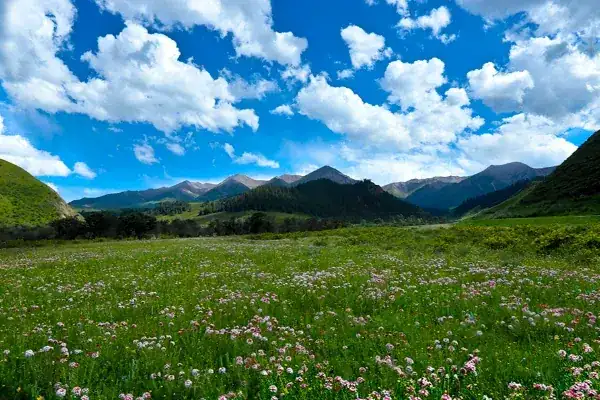
Haixi has diverse natural landscapes including mountains, grasslands, gobi, deserts, rivers, and lakes. Chaka Salt Lake, known as the "Mirror of the Sky," was named by National Travel Geography magazine as one of "55 Places You Must Visit in Your Lifetime" and "China's Most Beautiful Starry Sky."
Important Scenic Spots
Chaka Salt Lake: "Chaka" is Tibetan for "salt pond." Located near Chaka Town, Ulan County, with Olam Mountain to the south and Qinghai South Mountain to the north, separated from Qinghai Lake. Rivers including the Chaka, Mohe, and Xiao Chahamusu feed into the lake.
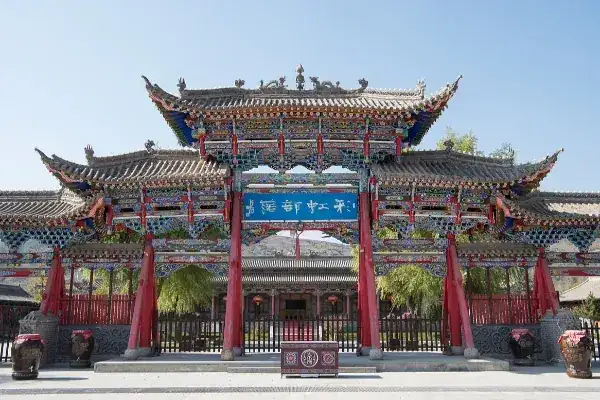
Wuji Longfeng Palace (Queen Mother of the West Temple): Located along National Highway 109, 110 km from Golmud. A Taoist temple on the Kunlun Mountains dedicated to the Three Holy Mothers, with statues of Jiang Ziya and other deities.
Tubo Tombs: Tang Dynasty Tibetan tombs near Reshui, 10 km from Dulan County. A national-level protected cultural heritage site with over 200 ancient tombs from the mid-to-late Tang Dynasty, containing animal bones and burial objects including wooden spoons, pottery, and leather.
Erlang Cave: Located 23 km southwest of Tianjun County. According to legend, King Gesar carved the cave with his sword after his nephew's death in battle, and spent 9 years and 9 days reciting 108 volumes of scriptures. Another legend says Erlang Shen hid here during his battle with Sun Wukong. The cave is inside a cone-shaped hill, 400 meters in circumference and 25 meters high.
Food and Specialties
Sanzi: Flour dough kneaded with salt water, rested, cut into strips, stretched thin, and deep-fried until golden and crispy.
Mongolian Open-Pot Mutton: Fresh mutton cooked in a large pot with coarse salt from Qarhan Salt Lake, eaten immediately upon boiling.
Xia Mianpian (Small Dough Flakes): The most common and unique home-style noodle dish in Qinghai, made by tearing small pieces of dough into boiling water.
Honorary Titles
In December 2018, designated by the Ministry of Agriculture and Rural Affairs as a second batch China Characteristic Agricultural Product Advantage Area.
On December 25, 2020, awarded the Blood Donation Advanced Province (City) Award.
On November 30, 2021, designated as a culture and tourism market credit economy development pilot area.
In 2022, selected for the "14th Five-Year Plan" "Zero-Waste City" construction list.
Travel information can change. Check current opening hours, reservations and entry requirements before you travel.

Traveller discussion
Start the conversation with a helpful tip or a question.