
Xining City
Xining CityXining City, formerly known as Qingtang City, Xiping Commandery, and Shanzhou, also known as the "Summer Capital," is a prefecture-level city and the capital of Qinghai Province, serving as the political, economic, scientific, ed
Xining City
Xining City, formerly known as Qingtang City, Xiping Commandery, and Shanzhou, also known as the "Summer Capital," is a prefecture-level city and the capital of Qinghai Province, serving as the political, economic, scientific, educational, cultural, transportation, and communication center of the province. As of June 2026, the city administers 5 districts and 2 counties, with a total area of 7,660 square kilometers. As of the end of 2025, the permanent resident population was 2,475,600. Xining is located in northwestern China, in eastern Qinghai Province, in the Huangshui River mid-valley basin. It is the eastern gateway to the Qinghai-Tibet Plateau, a must-pass on the ancient Southern Silk Road and the Tang-Bo Ancient Road, and has been a major transportation hub and military stronghold since ancient times, known as the "Key to the Western Sea" and "Throat of Qinghai-Tibet." It is one of the world's highest-elevation cities. Xining is designated by the State Council as an important central city in northwestern China, a national comprehensive transportation hub, a comprehensive service support base for the Qinghai-Tibet Plateau, and an international ecological tourism destination. Xining has a long history and culture, unique natural resources, and colorful folk customs. The name means "peace in the western frontier." It has received titles including National Hygienic City, China's Most Charming City (Top 200), China's Excellent Tourist City, National Forest City, National Civilized City, and Happiest City. In 2025, the gross regional product was 191.48 billion yuan, up 3.3%.
History
Xining is an ancient plateau city with a long history, part of the Yellow River basin culture. Archaeological sites such as ZhuJiazhai, Shenna, and Xixingyuan show human activity 4,000–5,000 years ago.
In ancient times, it was the nomadic land of the Xianling Qiang. During the Western Han Dynasty (202 BC–220 AD), the military post Xiping Pavilion was established. During the Shenjue era, it was part of Linqiang County under Jincheng Commandery.
During the Eastern Han Dynasty, Xiping Commandery was established. During the Eastern Jin Dynasty (317–420), Southern Liang briefly made it its capital. Northern Wei established Shanshan Garrison here. In 526, it was renamed Shanzhou.
In the third year of Yifeng of the Tang Dynasty (618–907) (678), Shancheng County was established. In 761, it fell to Tubo.
In the first year of Mingdao of the Song Dynasty (960–1279) (1032), the Tsongkha regime moved its capital here, renaming it Qingtang City. In the third year of Chongning (1104), it was renamed Xining Prefecture, marking the first use of the name "Xining."
In 1227, the Mongols conquered Western Xia and occupied Xining. In the Yuan Dynasty (1271–1368), it was under Gansu Province. In the Ming Dynasty (1368–1644), Xining Guard was established. In the Qing Dynasty (1644–1912), Xining Prefecture was established in 1725.
In 1913, the prefecture was abolished. In 1929, Qinghai Province was established with Xining as its capital. In 1946, Xining City was formally established. On September 5, 1949, Xining was liberated.
Administrative Divisions
Evolution
In 1960, Huangzhong, Datong, and Huzhu were placed under Xining. In 1962, they reverted to provincial jurisdiction. In 1966, Datong was returned to Xining. In 1985, Datong became Datong Hui and Tu Autonomous County. In 1986, Chengxi District was split into Chengxi and Chengbei districts. In 1999, Huangzhong and Huangyuan counties were transferred to Xining. In 2019, Huangzhong County was converted to Huangzhong District.
Division Details
As of June 2026, Xining administers 5 districts (Chengdong, Chengzhong, Chengxi, Chengbei, Huangzhong) and 2 counties (Huangyuan, Datong Hui and Tu Autonomous County). The city government is seated at No. 43 Nanguan Street, Chengzhong District.
Geographical Environment
Location
Xining is located in eastern Qinghai Province, northeastern Qinghai-Tibet Plateau, with a total area of 7,660 square kilometers and urban area of 476.5 square kilometers, between 100°52'–101°54' east longitude and 36°13'–37°28' north latitude.
Topography
The city runs east-west in a strip shape, with higher terrain in the southwest and lower in the northeast, surrounded by mountains on all sides.
Climate
Xining has a continental plateau semi-arid climate, with an average of 1,939.7 sunshine hours, annual average temperature of 7.6°C, maximum 34.6°C, minimum -18.9°C. Summer averages 17–19°C, making it a popular summer retreat, known as "China's Summer Capital."
Hydrology
The city sits at 2,261 meters elevation, with annual precipitation of 380 mm and evaporation of 1,363.6 mm. The Huangshui River and its tributaries, the Nanchuan and Beichuan rivers, converge in the urban area and flow eastward.
Natural Resources
Water Resources
Water resources are relatively scarce. The Huangshui River runs through the city, with total water resources of 131.4 billion cubic meters, local surface water of 1.293 billion, and groundwater of 8.94 billion.
Biological Resources
Wild medicinal plants include Cimicifuga, Saposhnikovia, Notopterygium, rhubarb, red peony, and codonopsis. Over 20 rare animal species include brown bear, blue sheep, white-lipped deer, red deer, musk deer, gazelle, and blue eared pheasant.
Mineral Resources
46 types of minerals have been discovered, including coal, iron, titanium, copper, lead, zinc, nickel, tungsten, gold, limestone, quartz, dolomite, and gypsum.
Population
As of the end of 2025, the permanent resident population was 2,475,600, down 1,300. The urban population was 2,009,700, up 8,600; the rural population was 465,900, down 9,900. The urbanization rate was 81.18%, up 0.39 percentage points.
Politics
Economy
Overview
In 2025, the gross regional product was 191.48 billion yuan, up 3.3%. By industry: primary 6.37 billion, up 6.1%; secondary 72.82 billion, up 2.3%; tertiary 112.29 billion, up 3.7%. Structure: 3.3:38.0:58.7. Fixed-asset investment decreased 19.1%. General public budget revenue: 21.34 billion, down 3.9%. Local general public budget revenue: 10.37 billion, down 22.9%. General public budget expenditure: 37.54 billion, down 6.4%. Per capita disposable income: 38,727 yuan, up 4.8% (urban 45,605; rural 19,369).
Primary Industry
Grain planted area: 61,000 hectares (wheat 37,500; highland barley 5,300; potato 15,900; beans 2,200). Cash crops: 63,200 hectares. Grain output: 241,000 tons, up 6,000. Oil output: 104,000 tons, up 3.2%. Cattle inventory: 499,000, up 29.2%; sheep: 890,000, up 1.9%; pigs: 95,000, up 15.0%; poultry: 553,000, up 34.0%. Total meat output: 67,000 tons, up 13.5%.
Secondary Industry
Total industrial added value: 59.53 billion yuan, up 3.1%. Above-scale industrial added value up 3.2% (mining up 75.0%; manufacturing up 3.9%; electricity/heat/gas/water up 1.1%). Xining Economic and Technological Development Zone accounted for 64.9% of above-scale industrial added value. 240 above-scale enterprises had revenue of 184.67 billion yuan, up 0.3%. Construction added value: 13.797 billion, down 0.7%.
Tertiary Industry
Transportation/warehousing/postal: 10.85 billion, up 8.8%. Finance: 20.37 billion, down 0.1%. Real estate: 13.63 billion, up 3.0%. IT: 4.94 billion, up 11.2%. Leasing/business services: 5.3 billion, up 15.6%. Accommodation/catering: 1.79 billion, up 2.2%. Wholesale/retail: 11.56 billion, up 0.1%. Express delivery: 68.57 million pieces, up 25.9%. Total retail sales: 66.34 billion, up 2.2%. Foreign trade: 5.64 billion yuan, up 14.8% (exports 4.94 billion, up 48.8%). Total deposits: 577.24 billion, up 4.7%. Total loans: 617.28 billion, up 1.9%. Insurance premiums: 8.35 billion, up 6.6%. Tourist arrivals: 38.595 million, up 21.2%. Tourism revenue: 40.61 billion yuan, up 20.1%.
Transportation
Highways
Railways
Railway lines: Lanqing Railway, Qinghai-Tibet Railway, Lanzhou-Xinjiang High-Speed Railway, Sichuan-Qinghai Railway. Major stations: Xining Station, Xining West Station.
Aviation
Xining Caojiabao International Airport (IATA: XNN, ICAO: ZLXN) is located in Huzhu Tu Autonomous County, Haidong City, 28 km from Xining center. It is a 4E-level civil international airport and an important transportation hub on the Qinghai-Tibet Plateau. In 2019, passenger throughput was 7,226,500, cargo throughput 41,000 tons, and 61,200 flight movements.
Social Affairs
Education
Preschool gross enrollment: 104.3%. Compulsory education consolidation: 99.0%. High school completion: 85.5%. Secondary vocational: 7,000 enrolled, 22,000 students, 6,000 graduated. Regular high school: 20,000 enrolled, 53,000 students, 16,000 graduated. Junior high: 31,000 enrolled, 89,000 students, 27,000 graduated. Primary: 26,000 enrolled, 170,000 students, 30,000 graduated. Kindergarten: 58,000 children.
Science and Technology
National and provincial funding of 590.42 million yuan, municipal S&T funding of 6.84 million. 746 research projects, 627 achievements. 25 municipal technology-based enterprises, 160 provincial, 2 "little giant" enterprises. 10 enterprises won Qinghai Provincial S&T Awards.
Culture
1 art troupe, 9 cultural centers, 76 cultural stations, 9 public libraries, 15 museums. Radio coverage: 99.7%, TV coverage: 99.9%.
Healthcare
2,186 health institutions, 22,000 beds. 79 hospitals (20,000 beds), 58 township health centers (1,039 beds), 132 community health centers, 9 maternal/child centers, 9 CDCs, 1,053 village clinics, 640 clinics. 16.58 million outpatient visits, 760,000 discharges.
Social Security
37,000 new urban jobs. Urban registered unemployment: 0.9%. 380,000 rural labor transfers. Pension insurance: 1.687 million, up 25,000 (enterprise 923,000, up 31,000; urban-rural 687,000; government 76,000, up 2,000). Medical insurance: 1.787 million, up 11,000. Work injury: 512,000, up 3,000. Maternity: 274,000, up 7,000. Urban minimum living: 17,000. Rural minimum living: 28,000. 15 elderly care institutions, 3,082 beds.
History and Culture
Religion
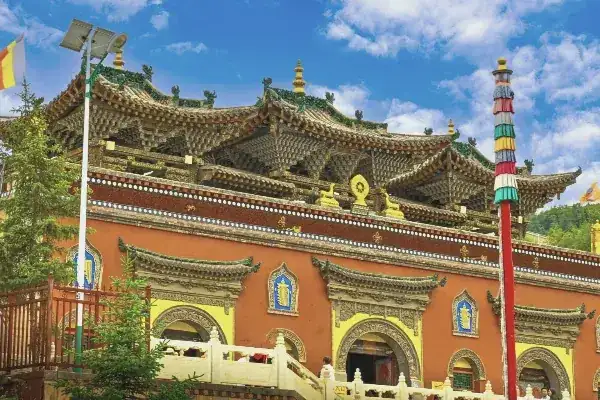
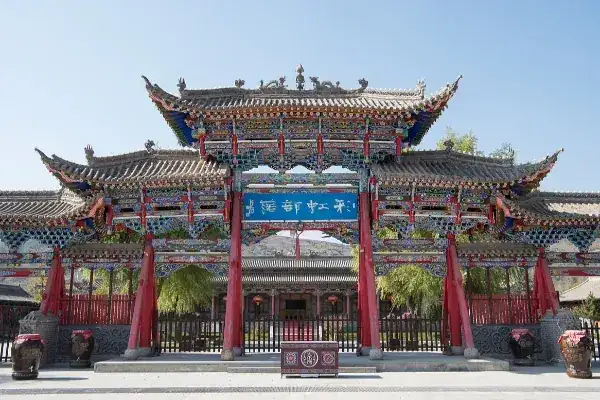
Buddhism, Islam, Taoism, Christianity, and Catholicism coexist. Tibetan Buddhism and Islam are particularly influential. Kumbum Monastery is one of the six major Tibetan Buddhist monasteries in China, and Dongguan Grand Mosque is one of the four great mosques in northwestern China.
Folk Arts
Dramas include Meihu opera, Pingxian opera, Tibetan opera, shadow play, Yu opera, and Qin opera. Folk arts include Pingxian, Yuexian, Daoqing, and Xianxiao. Music and dance include Han shehuo, Tu anzhao, Hui banquet dance, Salar wedding dance, and Tibetan Guozhuang dance.
Folk Songs
The main folk songs are "Hua'er" loved by Han, Hui, Tu, and Salar people, and "Yi" of Tibetans. Qinghai is the hometown of "Hua'er," a mountain song popular in Qinghai, Gansu, Ningxia, and Xinjiang, known as the "Soul of the Northwest."
Regional Culture
Xining is at the junction of the Loess Plateau and Qinghai-Tibet Plateau, a multi-ethnic city with distinctive ethnic and local cultural characteristics. The butter sculptures, applique, and murals of Kumbum Monastery are known as the "Three Artistic Wonders."
Origin of the Name
Xining was established as the military post Xiping Pavilion during the Western Han Dynasty. In 1104 (Northern Song), it was renamed Xining Prefecture, meaning "peace in the western frontier."
City Identity
On September 2, 2024, Xining officially released its snow leopard identity mark and city IP character. The "Snow Leopard Capital" logo combines the initial "X" of Xining with the Chinese character for "west," incorporating elements of the snow leopard, Qinghai-Tibet Plateau, ecological harmony, and Sanjiangyuan. The city IP character "Ningmeng" is inspired by the natural form and habits of the snow leopard.
Scenic Spots
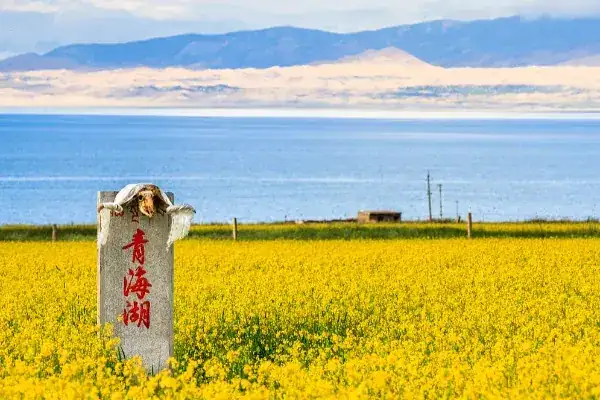
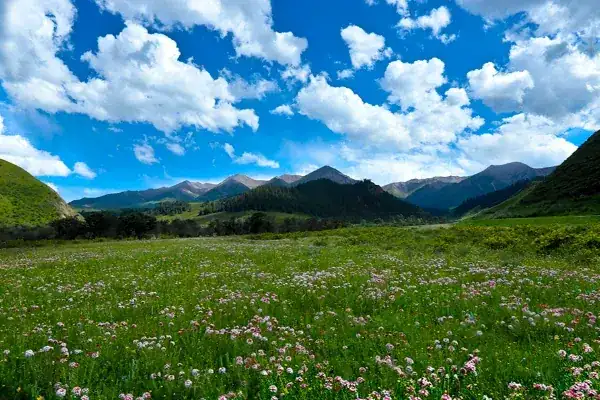
As of the end of 2025, Xining has 44 5A-level scenic areas and 40 star-rated hotels. Xining is an ancient city with over 2,100 years of history. The ancient "Eight Scenes of Xining" include: Stone Gorge Clear Breeze, Golden Goose Dawn, Wen Peak Emerald, Phoenix Terrace Clouds, Dragon Pool Moonlight, Huangshui Spring Surge, Five Peaks Waterfall, and North Mountain Mist and Rain.
Sister Cities
Famous People
Zhao Leji, male, Han, born March 1957 in Xi'an, Shaanxi, born in Xining, Qinghai. Currently a member of the Standing Committee of the Political Bureau of the CPC Central Committee and Chairman of the Standing Committee of the 14th National People's Congress.
Honorary Titles
Travel information can change. Check current opening hours, reservations and entry requirements before you travel.
Traveller discussion
Start the conversation with a helpful tip or a question.