
Gannan Tibetan Autonomous Prefecture
Gannan Tibetan Autonomous PrefectureGannan Tibetan Autonomous Prefecture, abbreviated as "Gannan," is an autonomous prefecture under Gansu Province. Located in southwestern Gansu at the transitional zone between the northeastern edge of the
Gannan Tibetan Autonomous Prefecture
Gannan Tibetan Autonomous Prefecture, abbreviated as "Gannan," is an autonomous prefecture under Gansu Province. Located in southwestern Gansu at the transitional zone between the northeastern edge of the Qinghai-Tibet Plateau and the western Loess Plateau, it serves as a convergence zone of Tibetan and Han Chinese cultures and a water conservation area for the Yellow and Yangtze rivers. It borders Dingxi and Longnan to the east, Aba Tibetan and Qiang Autonomous Prefecture of Sichuan to the south, Guoluo and Huangnan Tibetan Autonomous Prefectures of Qinghai to the west, and Linxia Hui Autonomous Prefecture to the north, with a total area of approximately 45,000 square kilometers. As of July 2026, it administers one county-level city and seven counties. The permanent resident population was 669,100 at end-2025. The Gannan Tibetan Autonomous Region was established in 1953 and reorganized as Gannan Tibetan Autonomous Prefecture in 1955. Dubbed "the window to the Qinghai-Tibet Plateau" and "the springboard for Tibetan modernization" by sociologist Fei Xiaotong, the prefecture is a national ecological function zone and ecological civilization pioneer demonstration area, with vast grasslands at an average elevation of 2,960 meters, average temperature of 1.7 degrees Celsius, and a typical continental climate. Elevations range from 4,920 meters at the highest to 1,172 meters at the lowest. In 2025, the regional GDP reached 27.562 billion yuan (approximately $3.80 billion), up 5.4% year-on-year.
History
Human activity in the Sanhe-Yijiang river basin dates to the Neolithic Age. During the Qin Dynasty, parts were under Lintao County. In the Western Han, the east belonged to Longxi Commandery and the north to Jincheng Commandery, with Baishi and Qiangdao counties established. The Sui Dynasty saw Lintao, Fuhan, and Xinchang commanderies governing parts of present-day Gannan. In the early Tang, the area encompassed Taozhou, Fangzhou, and Diezhou, with the northwest under Tuyuhun and Tubo influence. The Yuan Dynasty placed it under the Bureau of Buddhist and Tibetan Affairs; the Ming under Shaanxi Regional Military Commission. Under Qing Emperor Qianlong, most territory belonged to Gongchang Prefecture, with Xiahe managed by Xunhua.
In 1913, prefectures were replaced by circuits. Lintan, Zhouqu, and Xiahe counties, plus present-day Zhuoni (including parts of Diebu and Zhouqu), fell under Gansu. Xiahe County was formally established in 1928, and Zhuoni Administrative Bureau in 1937. In September 1949, Lintan and Zhuoni were liberated, followed by Xiahe on September 20 and Zhouqu on December 10. In 1952, the Gannan Tibetan Autonomous Region Provisional Working Committee was established. The autonomous region was formally founded in October 1953 and reorganized as an autonomous prefecture in December 1955. In October 2024, a new founding anniversary holiday was designated to be observed on the day following the National Day holiday, effective from 2025.
Administrative Divisions
Division History
In November 1953, Xiahe County, Zhuoni Autonomous Region, Lintan County, and various Tibetan districts and townships were incorporated into the autonomous region. In August 1955, Zhuoni was reorganized as a county, and Maqu, Luqu, and Zhouqu counties were established, bringing the total to six. In 1959, Luqu and Maqu merged into Taojiang County, Zhuoni merged into Lintan, and Xiahe was renamed De'ulu City. In January 1962, the original structure was restored with the addition of Diebu County, totaling seven counties. Hezuo City was established in June 1996.
Division Details
As of July 2026, the prefecture administers one county-level city and seven counties: Hezuo City, Lintan County, Zhuoni County, Diebu County, Zhouqu County, Xiahe County, Maqu County, and Luqu County. The prefectural government is seated at No. 96 Renmin Street, Hezuo City.
Geography
Location
Gannan lies in the upper reaches of the Yangtze and Yellow rivers between 100 degrees 45 minutes 45 seconds and 104 degrees 45 minutes 30 seconds east longitude, and 33 degrees 6 minutes 30 seconds and 35 degrees 34 minutes north latitude. It spans 360.7 km east-west and 270.9 km north-south, with a total area of 38,521 square kilometers.
Geology
The area belongs to the Western Qinling fold belt, with geological structures primarily trending east-west. The strata fall within the Bayankala-Qinling stratigraphic region, subdivided into four sub-regions based on stratigraphic distribution, lithofacies, and geochronological characteristics.
Topography
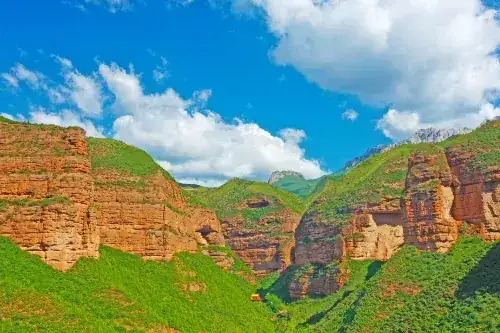
The south features the Diemian mountainous area, the east has hilly terrain, and the west consists of flat grasslands. The terrain is higher in the northwest and lower in the southeast, with elevations ranging from 4,920 meters at the highest to 1,172 meters at the lowest.
Climate
Gannan has a continental seasonal climate at the northeastern edge of the Qinghai-Tibet Plateau, with abundant sunlight, insufficient heat, significant vertical variation, and notable geographic precipitation differences. Most areas have long winters with no summer, and brief, connected spring and autumn. In 2022, average temperatures ranged from 3.2 to 14.7 degrees Celsius, and precipitation from 329.3 to 581.2 mm.
Hydrology
Major rivers include the Yellow River, Tao River, Daxia River, and Bailong River, belonging to the Yellow River and Yangtze River systems. Maqu, Luqu, Zhuoni, Lintan, and Xiahe counties fall within the Yellow River basin; Diebu and Zhouqu within the Yangtze basin. Gannan is the source area of the Tao, Daxia, and Bailong rivers, with the eastern mountain-valley terrain providing rich hydropower potential.
Soil
The soil exhibits clear vertical distribution with 13 soil groups, 27 subgroups, and 40 soil genera, including 13 cultivated soil genera and 21 soil species.
Natural Resources
Water Resources
In 2022, total water resources amounted to 6.99 billion cubic meters. Total consumption was 82.45 million cubic meters, up 2.0% year-on-year, with agricultural use at 46.67 million, industrial 2.08 million, urban domestic 10.25 million, rural domestic 15.57 million, and ecological use at 3.98 million cubic meters.
Land Resources
As of 2019, the prefecture had 139,559 hectares of cultivated land, 1,213,587 hectares of forest, 1,766,166 hectares of grassland, and 384,030 hectares of wetland. Urban, rural, and mining land totaled 19,416 hectares, transportation land 12,716 hectares, and water and hydraulic facilities land 41,017 hectares.
Biological Resources
The forests harbor 1,820 plant species, including fir, pine, cypress, birch, and poplar, with over 20 protected species. Over 643 medicinal plant species include cordyceps, wild codonopsis, and Min fritillary. The area hosts 314 wildlife species, with 143 under national protection, including giant pandas, sika deer, Tibetan antelope, snow leopards, and black-necked cranes. The black-necked crane population exceeds 500, accounting for 6.3% of the global total. Notable livestock breeds include Hequ horses, Oula sheep, Ganjia sheep, and yaks, known as "boats of the plateau."
Mineral Resources
The prefecture has discovered 42 mineral types, with 23 having proven reserves. Uranium, arsenic, and peat rank first in the province; gold and iron second; lead and antimony third. Fifteen minerals are currently under development, including gold, silver, copper, lead, zinc, antimony, iron, coal, limestone, quartzite, gypsum, and granite.
Population
At end-2025, the total registered population was 747,800, an increase of 600 from the previous year. The Tibetan population was 437,900, up 2,800, accounting for 58.55% of the total. The permanent resident population was 669,100, with 311,800 urban residents (46.6%). The birth rate was 8.59 per thousand, death rate 7.48 per thousand, and natural growth rate 1.11 per thousand.
Politics
The prefecture is governed by the Chinese Communist Party Gannan Prefectural Committee and the Prefectural People's Government, seated in Hezuo City. The current deputy secretary of the prefectural Party committee and governor is Yang Wu, a Tibetan born in June 1972 in Diebu.
Economy
Overview
In 2025, the regional GDP reached 27.562 billion yuan (approximately $3.80 billion), up 5.4% at constant prices. The primary industry contributed 4.976 billion yuan (approximately $686 million), up 4.8%; the secondary industry 4.532 billion yuan (approximately $625 million), up 5.8%; and the tertiary industry 18.054 billion yuan (approximately $2.49 billion), up 5.4%. Per capita GDP was 41,304 yuan (approximately $5,698), up 5.3%. The industrial structure ratio shifted from 17.0:17.0:66.0 in 2024 to 18.1:16.4:65.5. Fixed asset investment declined 1.0%. General public budget revenue was 1.450 billion yuan (approximately $200 million), down 1.0%; general public budget expenditure was 22.706 billion yuan (approximately $3.13 billion), up 0.8%.
Primary Industry
Agriculture, forestry, and animal husbandry value-added reached 5.285 billion yuan (approximately $729 million), up 5.0%. Sown area was 1.3639 million mu, up 1.4%. Grain output was 130,700 tons, up 2.1%; Chinese-Tibetan medicinal herbs reached 77,100 tons, up 11.2%. Livestock inventory stood at 2.75 million head, including 1.219 million cattle and 1.329 million sheep. Total meat production was 120,600 tons, up 7.2%; milk output was 66,000 tons.
Secondary Industry
Industrial value-added reached 2.991 billion yuan (approximately $413 million), up 8.5%. Above-scale industrial value-added grew 8.3%, with manufacturing up 1.3% and power, heat, gas, and water up 15.8%. Industrial profits totaled 2.078 billion yuan (approximately $287 million), up 81.5%. Construction value-added was 1.544 billion yuan (approximately $213 million), up 1.1%, with 111 qualified enterprises.
Tertiary Industry
Wholesale and retail value-added reached 995 million yuan (approximately $137 million); finance 1.416 billion yuan (approximately $195 million); real estate 1.059 billion yuan (approximately $146 million); and other services 13.44 billion yuan (approximately $1.85 billion). Total retail sales of consumer goods were 5.628 billion yuan (approximately $776 million), down 1.0%. Import and export value was 67.02 million yuan (approximately $9.25 million), up 66.3%, with exports surging 383.1%. Financial institution deposits reached 54.733 billion yuan (approximately $7.55 billion), up 6.3%; loans 31.856 billion yuan (approximately $4.39 billion), up 7.8%. Insurance premium income was 872 million yuan (approximately $120 million), up 1.0%.
Social Services
Science and Technology
In 2025, 10 provincial science and technology projects were approved. Technical contract transactions reached 260 million yuan (approximately $35.9 million), with 113 patents granted, including 11 invention patents. The prefecture's first provincial-level plateau biodiversity key laboratory was approved for construction.
Education
The prefecture had 727 schools of all types with 128,856 students, including 58,071 in primary schools and 30,100 in junior high. Preschool gross enrollment rate was 96.55%, nine-year compulsory education retention rate 99.43%, and high school gross enrollment rate 97.30%. Higher education institutions include Gansu Normal University for Nationalities and the Tibetan Medicine College of Gansu University of Chinese Medicine.
Culture
The prefecture had 9 art performance troupes, 9 cultural centers, 28 museums, and 9 public libraries. The bilingual Tibetan-Chinese Gannan Daily published 2.95 million copies. Comprehensive radio and TV coverage both reached 100%.
Healthcare
There were 934 medical and health institutions, including 32 hospitals, with 7,471 health technical personnel and 4,200 beds.
Sports
The prefecture had 3,692 sports venues covering 1.5011 million square meters, with 2,324 social sports instructors. Major events included the "Nine Colors of Gannan Cup" football tournament, the Gannan Tibet cycling race, and the Maqu Gesar horse racing festival.
Social Security
By end-2025, 33,200 people participated in enterprise employee basic pension insurance, 392,000 in urban-rural resident pension, 88,500 in urban employee medical insurance, and 612,700 in urban-rural resident medical insurance. Subsistence allowances covered 40,983 rural and 8,830 urban recipients. Temporary assistance was provided to 18,300 person-times. The prefecture operated 20 elderly care institutions with 2,938 beds.
Transportation
National Highway 213, multiple provincial highways, and expressways including Linhe, Wangxia, Zhuohe, and Hesai cross the prefecture. The Lanzhou-Hezuo and Xi'an-Chengdu railways also pass through. Gannan Xiahe Airport, a domestic regional airport near Kuosetang Village in Xiahe County, was the first civilian airport in Gansu's ethnic minority areas, with a total investment of approximately 710 million yuan (approximately $97.9 million), a 4C-class runway of 3,200 meters, and an elevation of 3,189 meters. As of end-2025, the prefecture had 165,100 motor vehicles, including 91 buses and 1,381 taxis.
History and Culture
Intangible Cultural Heritage
Four items are listed as national intangible cultural heritage: Gannan Tibetan folk songs (project II-115), Labrang Monastery Buddhist music "Dordol" (II-138), Gannan Tibetan medicine (IX-9), and Gannan Tibetan thangka painting (VII-14), all inscribed in 2008.
Customs
Gannan Tibetans traditionally wear loose-fitting sheepskin Tibetan robes that serve as clothing by day and bedding by night. The Amdo Tibetan diet includes butter tea, tsampa, yogurt, meat dumplings, and hand-grabbed mutton. Herders live in black tents woven from yak hair, while farmers occupy adobe houses. Tents feature a central earthen stove, with sleeping quarters on both sides and a shrine area displaying brass and silver offering bowls and butter lamps. Funeral customs include four types: earth burial, water burial, cremation, and sky burial, with sky burial being the most prevalent. Social customs emphasize respect for elders, hospitality, and mutual gift-giving during festivals and important occasions. Various dietary and behavioral taboos are observed, reflecting both practical hygiene and religious beliefs, including prohibitions on using knives to slaughter livestock and consuming meat from horses, dogs, and birds of prey.
Festivals
Major festivals include the Spring Festival, June Gathering, April Buddhist Month, May Dragon Boat Festival, and October Butter Lamp Festival, with Spring Festival and June Gathering being the most celebrated.
Scenic Spots
Labrang Monastery, located in Xiahe County, is one of the six major monasteries of the Gelug school of Tibetan Buddhism. Founded in 1709 during the Qing Dynasty, it covers 866,000 square meters with over 400,000 square meters of buildings and features the world's longest prayer corridor at 3.5 km. It was designated a Major Historical and Cultural Site Protected at the National Level in 1982. The Galuotian Grand House in Lintan County, built in 1943, follows the traditional Tibetan architectural style of "no wood visible outside, no earth visible inside" and was designated a national-level protected site in 2019. The Ranao Ruins in Diebu County, a 500,000-square-meter Neolithic site of Majiayao and Qijia cultures, has yielded painted pottery and stone tools of significant research value.
Specialty Products
Maqu yak, Maqu Oula sheep, Gannan yak milk powder, Diebu morel mushrooms, Diebu Juma pork, and Ganjia Tibetan sheep are recognized specialty products, several holding national geographic indication protection status.
Notable People
Yang Wu, male, Tibetan, born June 1972 in Diebu, Gansu, currently serves as deputy secretary of the prefectural Party committee and governor of the prefecture.
Honorary Titles
In 2022, Gannan was selected as a national agricultural green development pioneer zone. In August 2023, it was named a Gansu food safety demonstration city. In January 2024, it was designated as a national ethnic unity and progress demonstration zone.
Travel information can change. Check current opening hours, reservations and entry requirements before you travel.

Traveller discussion
Start the conversation with a helpful tip or a question.