
Linxia Hui Autonomous Prefecture
Linxia Hui Autonomous PrefectureLinxia Hui Autonomous Prefecture, abbreviated as "Linxia Prefecture," historically known as Hezhou, is an autonomous prefecture under Gansu Province. It is one of two Hui autonomous prefectures in China and o
Linxia Hui Autonomous Prefecture
Linxia Hui Autonomous Prefecture, abbreviated as "Linxia Prefecture," historically known as Hezhou, is an autonomous prefecture under Gansu Province. It is one of two Hui autonomous prefectures in China and one of two ethnic autonomous prefectures in Gansu. Located in western China, in the central-southwest of Gansu Province along the upper reaches of the Yellow River, it has a total area of 8,169 square kilometers. The southwest mountainous region is cold and humid, the northeast is arid, and the valley areas are temperate. As of July 2026, the prefecture administers one county-level city and seven counties. As of the end of 2025, the permanent population was 2.0715 million. Linxia was a key hub on the southern route of the ancient Silk Road, an important station on the Tang-Tubo Ancient Road, and a center for the tea-horse trade. Known as the "Western Dry Port" and praised with the saying "East has Wenzhou, West has Hezhou," Linxia borders Lanzhou and adjoins Tibetan areas, serving as a vital economic corridor connecting inland China with Tibetan regions. It is one of the important birthplaces of Chinese civilization, with inhabitants dating back over 5,000 years. Since the Qin and Han dynasties, counties, prefectures, and commanderies were established here. Originally called Fuhun, it was later renamed Hezhou. It is one of the regions with the most concentrated Neolithic culture sites and archaeological excavations in China, with Majiayao Culture, Banshan Culture, and Qijia Culture sites scattered throughout. Because the "Painted Pottery King" housed in the National Museum was unearthed in Linxia, it is known as the "Hometown of Chinese Painted Pottery." It also features the World Cultural Heritage Binglingsi Grottoes and the World Intangible Cultural Heritage folk song "Hua'er," earning it the title "Hometown of Chinese Hua'er." In 2025, the prefecture's GDP reached 54.66 billion CNY (approximately $7.59 billion USD), up 5.6% year-on-year.
History
During the Spring and Autumn Period, Linxia was the land of the Qiang and Rong peoples; at the end of the Warring States Period, it belonged to the ancient Yongzhou. Under the Qin Dynasty, it was initially the fief of the Han-Qiang marquis, and later Fuhun County was established. In the early Western Han, the area included Daxia County, Fuhun County, and Baishi County under Longxi Commandery. Throughout subsequent dynasties, the region saw numerous administrative changes, with Hezhou as its recurring name.
During the Sixteen Kingdoms Period (344 AD), Hezhou was first established as a prefecture-level administrative unit. The Northern Wei set up Fuhun Garrison in 445 AD, renamed Hezhou in 492 AD. Under the Sui Dynasty, Fuhun Commandery was established, later renamed Hezhou in 583 AD. During the Tang Dynasty (618 AD), Hezhou was placed under the Longyou Circuit. In 762 AD, it became Tibetan territory, still called Hezhou. Under the Northern Song, Wang Shao captured Hezhou in 1073 AD. The Yuan Dynasty established Hezhou Route in 1269 AD. The Ming Dynasty set up Hezhou Guard in 1371 AD and Hezhou Prefecture in 1373 AD. The Qing Dynasty initially maintained both the prefecture and guard systems. In 1726 AD, the Hezhou Guard was abolished; in 1762 AD, Lintao Prefecture was relocated to Lanzhou and renamed Lanzhou Prefecture, with Hezhou under its jurisdiction.
After the Republic of China was established in 1912, the prefecture-county system was abolished and replaced with Daohe County under Lanchang Circuit. In 1928, it was renamed Linxia County. On August 22, 1949, Linxia was liberated. The Linxia Special District was established, governing eight counties. In 1950, Linxia City was established. After several administrative reorganizations, Linxia Hui Autonomous Prefecture was officially established on November 19, 1956. In 1973, Linxia City was abolished and merged into Linxia County. In 1983, Linxia City was restored as a county-level city.
Administrative Divisions
As of July 2026, Linxia Hui Autonomous Prefecture administers one county-level city and seven counties: Linxia City, Linxia County, Kangle County, Yongjing County, Guanghe County, Hezheng County, Dongxiang Autonomous County, and Jishishan Bonan-Dongxiang-Salar Autonomous County. The prefecture has 123 townships and towns, 7 sub-districts, 1,089 administrative villages, and 106 communities. The prefectural government is located at No. 8 Hongyuan Road, Linxia City.
Geography
Location
Linxia Hui Autonomous Prefecture is located along the upper Yellow River in the central-southwest of Gansu Province. Its geographic coordinates are 102 degrees 41 minutes to 103 degrees 40 minutes east longitude and 34 degrees 57 minutes to 36 degrees 12 minutes north latitude. It faces Dingxi City across the Tao River to the east, borders Qinghai Province by Mount Jishi to the west, adjoins Gannan Tibetan Autonomous Prefecture by Mount Taizi to the south, and borders Lanzhou City along the Huangshui River to the north. Total area: 8,169 square kilometers.
Topography
The prefecture sits at the transition zone between the Loess Plateau and the Qinghai-Tibet Plateau, and between the Central Plains agricultural region and western pastoral areas. The terrain is high in the southwest and low in the northeast, forming a tilted basin with an average elevation of 2,000 meters.
Climate
The northeast has a cold-temperate semi-arid climate, while the southwest has a cold-temperate semi-humid climate. The annual average temperature ranges from 6.0 to 9.9 degrees Celsius, with extremes of 40.7 and -32.2 degrees Celsius. Annual precipitation ranges from 286.1 to 617.1 mm, distributed more in the south than the north. Annual evaporation ranges from 1,191.1 to 1,584.6 mm. Frost-free period lasts 139 to 178 days.
Hydrology
The entire prefecture belongs to the Yellow River basin. The Yellow River enters from the northwest and flows 124 km through the northern part. There are 6 first-order tributaries including the Tao River, Daxia River, and Huangshui River, plus 18 second- and third-order tributaries. The three major reservoirs of Liujiaxia, Yanguoxia, and Bapanxia are all within the prefecture.
Natural Resources
Mineral Resources
The prefecture sits at the intersection of the West Qinling and Qilian Mountain polymetallic mineralization belts. A total of 43 mineral types have been discovered, accounting for 25% of Gansu's known mineral species. These include 17 metallic minerals (iron, manganese, copper, gold, etc.), 2 energy minerals (coal and peat), and 24 non-metallic minerals. Over 80 mineral deposits have been identified, with non-metallic minerals such as construction sand, cement limestone, and brick clay having the largest development scale.
Water Energy Resources
The prefecture's multi-year average total water resources amount to 956 million cubic meters, accounting for 3.31% of Gansu's total. The per capita water resource is 450 cubic meters. The theoretical hydropower potential is 2.255 million kilowatts.
Population
Population Data
According to the seventh national census, as of November 1, 2020, the permanent population was 2,109,750. As of the end of 2025, the permanent population was 2.0715 million, a decrease of 27,800 from the previous year. The urban population was 892,500, with an urbanization rate of 43.09%, up 1.34 percentage points. The birth rate was 10.10 per mille, death rate 9.51 per mille, and natural growth rate 0.59 per mille.
Ethnic Composition
Linxia is home to 42 ethnic groups including Hui, Han, Dongxiang, Bonan, and Salar. The Dongxiang and Bonan peoples are unique to Gansu and primarily concentrated in Linxia.
Politics
The prefecture is governed by the Linxia Hui Autonomous Prefecture People's Government, which exercises autonomous rights under China's regional ethnic autonomy system. The prefectural administrative system includes legislative authority for regulations specific to the Hui ethnic community.
Economy
Overview
In 2025, the GDP reached 54.66 billion CNY (approximately $7.59 billion USD), up 5.6%. The primary industry contributed 9.60 billion CNY (approximately $1.33 billion USD, up 5.2%), the secondary industry 11.23 billion CNY (approximately $1.56 billion USD, up 9.0%), and the tertiary industry 33.83 billion CNY (approximately $4.70 billion USD, up 4.7%). The three-sector ratio was 17.6:20.6:61.8. Per capita GDP was 26,209 CNY (approximately $3,640 USD), up 6.4%.
Fixed-asset investment decreased 11.6%, with infrastructure investment growing 10.6% and private investment growing 16.6%. General public budget revenue was 2.53 billion CNY (approximately $351 million USD, up 7.9%), with tax revenue of 1.74 billion CNY. General public budget expenditure was 32.35 billion CNY (approximately $4.49 billion USD), down 15.8%, with livelihood expenditures of 26.77 billion CNY.
Primary Industry
In 2025, the grain planting area was 1.884 million mu, with grain output of 760,600 tons, up 0.38%. Vegetable output reached 524,300 tons (up 4.06%), Chinese medicinal herbs 71,300 tons (up 7.82%), and oil crop output 55,100 tons (down 1.57%). Total meat output was 87,400 tons (up 6.18%), including beef at 22,300 tons and mutton at 38,700 tons. Milk output reached 46,700 tons (up 20.95%).
Secondary Industry
In 2025, total industrial value-added was 5.23 billion CNY (approximately $726 million USD, up 20.1%). Above-scale industrial value-added grew 10.1%. By sector, mining fell 67.1%, manufacturing fell 7.8%, while power, heat, gas, and water supply grew 41.2%. Construction value-added was 6.01 billion CNY (approximately $835 million USD, up 0.7%), with 181 qualified construction enterprises.
Tertiary Industry
In 2025, wholesale and retail trade value-added reached 4.05 billion CNY (up 8.0%), transportation, warehousing, and postal services 1.12 billion CNY (up 2.7%), accommodation and catering 1.31 billion CNY (up 5.6%), and finance 3.20 billion CNY (up 3.4%). Total retail sales of consumer goods reached 16.44 billion CNY (approximately $2.28 billion USD, up 5.4%). Goods import and export totaled 110.02 million CNY (approximately $15.3 million USD, up 7.6%).
Financial institution deposits reached 113.40 billion CNY (approximately $15.75 billion USD, up 4.0%), with household deposits of 86.93 billion CNY. Loan balances totaled 84.27 billion CNY (approximately $11.70 billion USD, up 8.5%). Insurance premium income was 1.63 billion CNY (approximately $226 million USD, up 1.3%).
Social Affairs
Science and Technology
In 2025, 157 scientific and technological achievements were registered. Patent grants totaled 217, down 38.0%. Technology contracts valued at 540 million CNY were signed, up 11.5%. The prefecture implemented 234 science and technology projects, including 25 national and provincial-level projects.
Education
As of the end of 2025, the prefecture had 1,881 schools of all types, including 749 kindergartens, 1,013 primary schools, 66 junior high schools, 21 senior high schools, 11 secondary vocational schools, and 1 higher vocational college. There were 35,500 full-time teachers and 245,200 primary school students enrolled.
Culture
The prefecture has 9 media centers and 46 broadcasting relay stations. Radio coverage reached 99.32% and television coverage 99.34%.
Healthcare
As of the end of 2025, the prefecture had 1,813 medical institutions, including 8 prefecture-level and 47 county-level institutions, 1,102 village clinics, and 39 private hospitals. There were 18,634 professional health workers, including 5,899 licensed physicians and 8,412 registered nurses. Medical institutions had 17,757 beds. Annual outpatient visits totaled 8.4723 million.
Sports
The prefecture has 8,718 sports venues covering 4.8484 million square meters, with per capita sports area of 2.31 square meters.
Social Security
As of the end of 2025, 2.036 million people participated in urban employee pension insurance, 1.4167 million in urban-rural resident pension insurance, and 2.1304 million in basic medical insurance. Urban and rural minimum living allowance covered 40,100 and 292,600 people respectively. Temporary assistance was provided to 170,000 people with 221 million CNY in relief funds. The prefecture has 17 elderly care institutions with 1,810 beds and 4 children's welfare institutions with 729 beds.
Transportation
Highways
National Highway 213 and Provincial Highway 309 cross the prefecture. Expressways connect Lanzhou to Linxia, and Linxia to Hezuo. In 2025, highway freight transport totaled 104.794 million tons (up 11.9%) and passenger transport 38.944 million (up 0.4%).
Railways
The Lanzhou-Hezuo Railway is a key national project and the starting section of the Lanzhou-Guangzhou high-speed rail corridor. It serves Linxia Station and Linxia South Station, and will significantly improve the prefecture's transportation upon operation.
Water Transport
As of July 2026, the prefecture has 20 operating water routes totaling 169.5 km. The Yellow River flows through Jishishan, Linxia, Dongxiang, and Yongjing counties, with 148 km now fully navigable. The prefecture has 340 registered vessels, with annual passenger throughput of 720,000 and cargo throughput of 445,000 tons.
Aviation
Linxia Airport is a key project listed in China's 13th Five-Year Plan for civil aviation. Designed for 400,000 annual passengers and 1,200 tons of cargo by 2030, it features a 3,200-meter runway and 5,500-square-meter terminal. The estimated investment is approximately 1.63 billion CNY (approximately $226 million USD), with a four-year construction period.
Historical Culture
Linxia Hua'er is a high-pitched mountain folk song originating in Linxia, with distinctive ethnic and regional characteristics. It takes love as its main theme while broadly depicting social life across eras. Hezhou Xianxiao is a local narrative singing tradition drawing from classical novels and historical tales such as Romance of the Three Kingdoms and Journey to the West.
The Hui people in Linxia traditionally marry within Islam, though Hui men may marry non-Muslim women who follow Hui customs. Wedding customs include proposal, engagement gifts, and the grand ceremony. Major Islamic festivals celebrated include Eid al-Fitr, Eid al-Adha, and Mawlid.
Scenic Spots
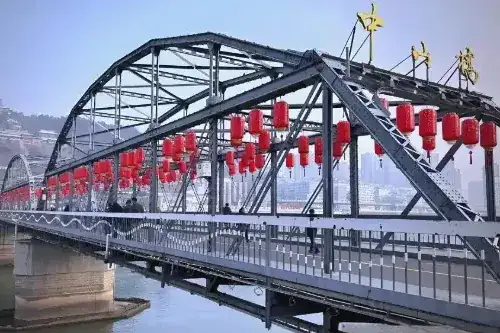
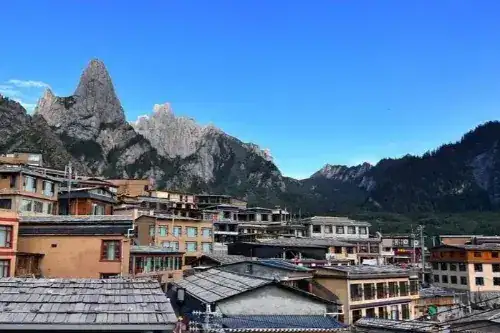
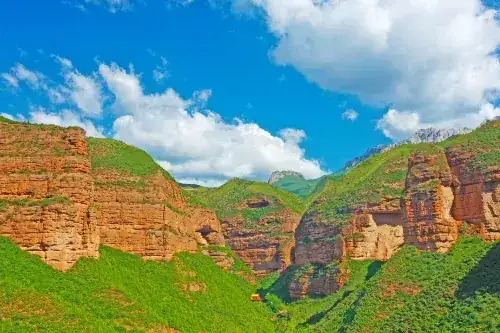
The prefecture has 107 tourist attractions, including 17 national A-level sites. Key natural attractions include the Yellow River Three Gorges, Songmingyan, Lianhua Mountain, and Dundun Gorge. Cultural sites include the Binglingsi Grottoes, Qijia Culture ruins, and Bafang Shisan Xiang (Eight Blocks and Thirteen Alleys). As of the end of 2023, the prefecture had 42 A-level scenic areas, including one 5A site (Binglingsi World Cultural Heritage Tourism Area) and eleven 4A sites. Jishiguan, historically known as Linjin Pass, is the foremost of the 24 Hezhou passes. Songmingyan Scenic Area covers about 33 square kilometers in Hezheng County. The Yellow River Three Gorges Scenic Area covers 214 square kilometers in Yongjing County and was rated a national 4A attraction in 2007.
Specialties and Cuisine
Linxia cuisine dates to the Tang and Song dynasties. Signature dishes include hand-grabbed mutton, clear-water beef ribs, stir-fried chicken, and Yellow River carp. Noodle dishes include Hezhou sliced noodles, beef ramen, and fried pastries. Hezhou buns are filled with minced beef or mutton mixed with chives or radish, steamed and drizzled with pepper oil. Fried pastries are made from flour, sugar, and food coloring, deep-fried in oil.
Hezhou painted pottery includes basins, pots, jars, and urns from the Majiayao, Qijia, Xindian, and Siwa cultures. The Majiayao double-eared painted pottery urn is a national first-class cultural relic. Hezhou brick carving, originating in the Northern Song and maturing in the Ming and Qing, features motifs of plum, orchid, bamboo, chrysanthemum, landscapes, and flowers.
Famous Figures
Wang Hong (1413-1488), a jinshi who served as Minister of War. Zhu Gui (1778-1842), a military officer who died heroically in the First Opium War. Ma Fulu (1854-1900), a martial arts jinshi who fell in the Eight-Nation Alliance battle. La Shijun (1865-1946), a juren who served in Sichuan and Gansu. Ma Fuchen (1879-1968), who held posts including vice governor of Qinghai. Ma Hongbin (1884-1960), who served as acting chairman of Gansu Province. Ma Dunjing (1908-1972), a Nationalist lieutenant general. Lu Ruilin (1912-1999), a PLA major general. Huang Dekui (1910-1992), a PLA major general.
Honorary Titles
The prefecture has been recognized as one of China's most beautiful tourism cities and the most charming tourism city of 2019. In 2018, it was selected for the first batch of "Intangible Cultural Heritage + Poverty Alleviation" key support areas. In 2020, it received the National Voluntary Blood Donation Award. In 2021, it was rated as a provincial-level holistic tourism demonstration zone. In 2022, it was named a Gansu Provincial Food Safety Demonstration City.
Travel information can change. Check current opening hours, reservations and entry requirements before you travel.
Traveller discussion
Start the conversation with a helpful tip or a question.