
Dingxi City
Dingxi CityDingxi City, commonly known as "Longzhong," is a prefecture-level city under Gansu Province, China. Located in the inland heartland, it features complex terrain and significant climate variation — dry and rain-scarce in the centr
Dingxi City
Dingxi City, commonly known as "Longzhong," is a prefecture-level city under Gansu Province, China. Located in the inland heartland, it features complex terrain and significant climate variation — dry and rain-scarce in the central-northern parts, cold and humid in the south. The climate spans southern temperate semi-humid to mid-temperate semi-arid zones, with pronounced continental monsoon characteristics. Elevation ranges from 1,420 to 3,941 meters, annual precipitation 350–600 mm, and average annual temperature 7°C. The total area is 19,600 square kilometers. As of January 2026, Dingxi administers 1 district and 6 counties, with a registered population of 3.003 million and a resident population of 2.474 million. The Dingxi dialect belongs to the Longzhong sub-group of Zhongyuan Mandarin. In 2025, Dingxi achieved a regional GDP of 79.39 billion yuan (approximately $10.95 billion USD), up 6.9% year-on-year at constant prices. Dingxi is a key node city on the Gansu section of the Silk Road Economic Belt and a central city in the Longzhong region. It is an important hub of the ancient Silk Road and the Tang-Tubo Ancient Road, and a key node of the Belt and Road Initiative and the New Western Land-Sea Corridor. The city is a major distribution center for calligraphy and painting, a national pilot zone for traditional Chinese medicine (TCM) industry development, and one of the first national potato seed production bases. Its six pillar industries include TCM, potato deep processing, non-ferrous metallurgy, new building materials, equipment manufacturing, and energy, with emerging industries in cloud computing, new energy, and new materials.
Origin of the Name
The name "Dingxi" originated when a settlement near Lanzhou called Xitoucheng (present-day Sanjiaocheng in Yuzhong) was designated "Dingxi City," meaning "pacifying the western frontier." Later, Xitoucheng was renamed Tongyuan Jun, and the name Dingxi was transferred to Nuzha Fort, which was renamed Dingxi City — the earliest origin of the name.
Historical Evolution
Qin, Han to Northern and Southern Dynasties
In 279 BCE, Longxi Commandery was established with its seat at Didao (present-day Lintao), governing all of present-day Dingxi. Named "Longxi" because the seat lay west of the Longshui River, the area subsequently belonged to Longxi and Qinzhou. During the Sixteen Kingdoms period, Dingxi successively belonged to Former Liang, Later Liang, Former Zhao, Later Zhao, Former Qin, and Later Qin. During the Northern and Southern Dynasties, Dingxi was divided between Qinzhou and Hezhou. In 530 CE, Weizhou was established.
Sui, Tang to Song and Yuan Dynasties
In 618 CE, Lintao Commandery was renamed Minzhou. In 742, Minzhou became Hezheng Jun, then restored in 758. In 761, Tibetan forces captured Minzhou, and Tibetan rule lasted over 300 years. In 1081, Song forces recovered the area, and Emperor Shenzong bestowed the name "Dingxi City." In 1216, Dingxi County was elevated to Dingzhou. Under the Yuan Dynasty, Dingxi belonged to Shaanxi Province. In 1352, due to an earthquake, Dingzhou was renamed Andingzhou.
Ming and Qing Dynasties
In 1377, the prefecture was downgraded to a county. Under the Qing Dynasty, Dingxi belonged to Gongchang Prefecture under Shaanxi. In 1914, Anding County was renamed Dingxi County. In 1936, it fell under the First Administrative Inspectorate of Gansu. In September 1949, the Huining Prefecture was renamed Dingxi Prefecture.
After the Founding of the People's Republic of China
In 1949, the Dingxi Special District was established, governing seven counties. In 1950, Jingning, Haiyuan, and Xiji counties were transferred to Pingliang Special District. In 1956, Gaolan County and several others were incorporated into Dingxi. In 1958, Baiyin City was established from parts of Gaolan and Jingyuan. By 1970, the Dingxi Special District was renamed Dingxi Prefecture, with Yuzhong and Gaolan transferred to Lanzhou. On April 4, 2003, Dingxi Prefecture was dissolved and the prefecture-level Dingxi City was established, comprising Tongwei, Longxi, Weiyuan, Lintao, Zhang, and Min counties plus the newly created Anding District.
Administrative Divisions
As of January 2026, Dingxi City administers 1 district and 6 counties: Anding District, Tongwei County, Longxi County, Weiyuan County, Lintao County, Zhang County, and Min County, comprising 119 townships, 3 sub-districts, 1,888 villages, and 101 communities. The municipal government is seated at No. 1 Anding Road, Anding District.
Physical Geography
Location and Extent
Dingxi is located in central Gansu Province, historically known as "Longzhong." It borders Tianshui to the east, Lanzhou to the west, Baiyin to the north, and Longnan to the south, also adjacent to Gannan and Linxia prefectures. It lies between 34°26′–35°35′N and 103°52′–105°13′E, with a total area of 19,600 square kilometers.
Climate
Dingxi features complex terrain and significant climate variation. The central-northern areas are dry with little rain, while the south is cold and humid. The climate spans southern temperate semi-humid to mid-temperate semi-arid zones, with pronounced continental monsoon characteristics. Average annual temperature ranges from 5.8°C to 7.8°C, with extreme highs of 33.0°C–36.1°C and extreme lows of −29.7°C to −22.6°C. Annual precipitation is 387–561 mm, with annual sunshine of 2,114–2,433 hours.
Geology
Dingxi is situated on the northeastern margin of the Qinghai-Tibet Block, spanning the South Qilian miogeosynclinal fold belt and the northern Qinling Hercynian fold belt. Stratigraphic development is controlled by the "Longxi Old Land," with the northern part under the North China Plate and the southern part within the West Qinling orogenic belt.
Topography and Landforms
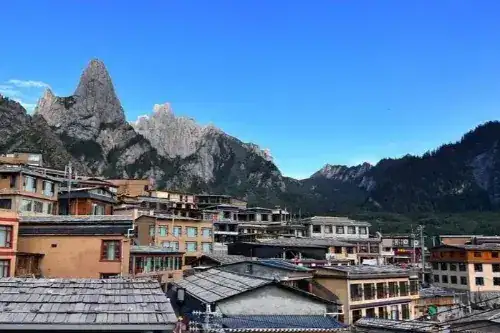
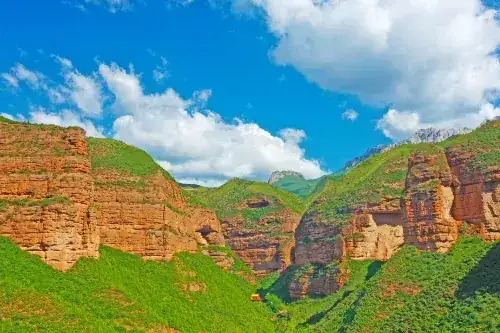
Influenced by the Qinling, Qilian folds, Liupan Mountain ranges, and the Loess Plateau, Dingxi's landscape features rolling hills and crisscrossing gullies. Four main landform types are distinguished: the central-northern Loess Plateau hilly-gully region, the West Qinling mountain area, valley terraces, and the karst landscape around Guiqing Mountain and Zheyang Mountain in Zhang County, dating back approximately 280–230 million years (Permian period).
Hydrology and Water Conservancy
Dingxi's rivers belong to the Yellow River and Yangtze River basins, with four water systems. The Yellow River basin covers 98.9% of the total area. The city has 11 reservoirs, 31 hydropower stations, and 247 channels. The Tao River Phase I Anding District irrigation project covers a designed area of 122,500 mu, bringing effective irrigation area to 143,500 mu.
Soils
Dingxi's soils are classified into 15 soil groups, 30 sub-groups, and 57 soil genera.
Natural Disasters
Dingxi's main natural disasters include earthquakes, debris flows, soil erosion, and landslides. On November 13, 2003, an earthquake in Buzi Township, Min County, affected 5 townships, causing 1 death and 133 injuries, with direct economic losses of 65.79 million yuan (approximately $9.1 million USD). A debris flow on May 7, 2002, in Zhang County killed 14 and injured 5, with direct losses of 3.184 million yuan (approximately $439,000 USD). Dingxi is among the most severely eroded areas in the Yellow River basin.
Natural Resources
Water Resources
Dingxi has scarce water resources, with per capita annual availability of just over 600 cubic meters and 140 cubic meters per mu of farmland. The north is extremely water-deficient, while the south has relatively abundant, better-quality water. The Yellow River basin catchment area is 20,106.37 square kilometers (98.9%).
Land Resources
As of end-2021, Dingxi had 827,050.55 hectares of cultivated land (94.87% dryland), 427,931.64 hectares of forest land, 433,445.53 hectares of grassland, and 15,195.18 hectares of wetlands. Urban-rural and industrial-mining land totaled 93,260.34 hectares, and transportation land 32,558.31 hectares.
Mineral Resources
Gold deposits are mainly in the Lu'erkan and Suolong areas of Min County, with proven resources of about 40 tons. Antimony in Min County totals 30,000 tons. Iron in Min and Longxi counties totals 880,000 tons. Rock salt in Zhang County's Yanjing Township exceeds 12 million tons. Four geothermal water resource points have been discovered.
Biological Resources
Dingxi has over 500 plant genera across 107 families, including grain crops, wild plants, forage grasses, trees, fruit trees, and medicinal herbs, with 289 medicinal plant species. The city harbors 300+ animal species, including 272 bird species and 70 mammal species. Rare protected animals include forest musk deer, snow leopard, blue eared pheasant, and golden pheasant. Four provincial-level and one national-level nature reserve have been established, including Guiqing Mountain and Shuangyan reserves.
Politics
The municipal government operates under the leadership of the CPC Dingxi Municipal Committee and the Dingxi Municipal People's Government, seated in Anding District.
Population
Population Size
As of end-2025, Dingxi's resident population was 2.4533 million, down 20,700 from the previous year. The urban population was 1.0901 million (urbanization rate 44.43%), and the rural population 1.3632 million. The birth rate was 8.27 per thousand, death rate 9.17 per thousand, and natural growth rate −0.9 per thousand.
Ethnic Groups
As of 2022, Dingxi has 39 ethnic groups including Han, Hui, Tibetan, and Dongxiang, with a total minority population of 36,900.
Language
The Dingxi dialect belongs to the Longzhong sub-group of Zhongyuan Mandarin, featuring 25 initials, 31 finals, and 3 tones (lacking the rising tone), which is relatively stable and follows identifiable patterns.
Religious Beliefs
Religions practiced include Daoism, Buddhism, Islam, Protestantism, and Catholicism. Daoism originated in the Eastern Han Dynasty, with 3,272 practitioners and 14 temples by end-2003. Buddhism was introduced during the Northern and Southern Dynasties, with 42 temples and 18,585 followers. Islam arrived during the Yuan Dynasty. Protestantism first reached Minzhou in the late Qing Dynasty, with 14,010 followers. Catholicism was introduced in 1917, with 404 followers by end-2003.
Economy
Overview
In 2025, Dingxi achieved a regional GDP of 79.39 billion yuan (approximately $10.95 billion USD), up 6.9% year-on-year. The primary sector added 13.0 billion yuan ($1.79 billion USD, +5.5%), secondary 17.74 billion yuan ($2.45 billion USD, +11.9%), and tertiary 48.65 billion yuan ($6.71 billion USD, +5.7%). Per capita GDP was 32,226 yuan ($4,445 USD, +7.5%). The industrial structure ratio was 16.4:22.3:61.3. General public budget revenue was 3.30 billion yuan ($455 million USD), and expenditures 32.70 billion yuan ($4.51 billion USD). Urban per capita disposable income was 37,012 yuan ($5,105 USD, +6.6%); rural per capita disposable income 13,012 yuan ($1,795 USD, +7.4%). Fixed asset investment grew 6.2%, with private investment up 29.7%.
Primary Industry
In 2025, total crop planting area reached 8.958 million mu (+2.2%). Grain crops covered 6.039 million mu with total output of 1.667 million tons (+1.2%). Potato, TCM herbs, and vegetables — the three signature industries — covered 2.636 million, 1.738 million, and 632,000 mu respectively. Large livestock inventory was 544,000 heads, with total meat output of 105,000 tons (+6.8%).
Secondary Industry
In 2025, industrial value-added reached 11.08 billion yuan ($1.53 billion USD, +18.3%), with above-scale industrial value-added growing 14%. Key sectors included pharmaceuticals (+7.9%), non-metallic mineral products (+20.3%), and non-ferrous metallurgy (+16.3%). Above-scale industrial revenue was 35.15 billion yuan ($4.85 billion USD, +19%), with profits of 760 million yuan ($105 million USD, +108.4%). Power generation was 4.428 billion kWh (+3.9%), aluminum output 395,000 tons (+4.8%), and cement 3.159 million tons (−16.5%). Construction value-added was 6.71 billion yuan ($926 million USD, +3.3%).
Tertiary Industry
In 2025, wholesale and retail value-added reached 7.70 billion yuan ($1.06 billion USD, +8.1%), accommodation and catering 2.40 billion yuan ($331 million USD, +9.2%), and finance 5.04 billion yuan ($695 million USD, +5.7%). Total retail sales of consumer goods were 29.18 billion yuan ($4.02 billion USD, +7.5%). Import-export value was 940 million yuan ($130 million USD, +84.4%). Tourism received 27.19 million visitors (+10.5%) with revenue of 16.23 billion yuan ($2.24 billion USD, +14.6%). Financial institution deposits reached 165.28 billion yuan ($22.80 billion USD) and loans 123.59 billion yuan ($17.05 billion USD). Postal volume was 75.234 million items (+14.2%), and telecom business volume 2.10 billion yuan ($290 million USD).
Economic Functional Zones
As of April 2023, Dingxi has 3 economic development zones, 1 industrial park, and 3 industrial concentration zones, hosting 1,386 enterprises. The Gansu Dingxi Economic Development Zone (Dingxi High-Tech Zone), established in 1992, covers 32.6 square kilometers with a "one zone, four parks" layout, focusing on green food processing, new materials, and new energy.
Social Affairs
Education
As of end-2025, Dingxi had 1,269 schools with 471,340 students and 41,504 staff. Preschool gross enrollment rate was 99.9%, nine-year compulsory education consolidation rate 100%, and high school gross enrollment rate 99.3%. The college admission rate reached 93.1%, with 22,047 students admitted to higher education institutions. Compulsory education funding of 810 million yuan ($112 million USD) was implemented.
Science and Technology
In 2025, 91 provincial-level and 67 municipal-level scientific achievements were registered. Technology contracts totaled 1,516 (+22.5%) with transaction value of 3.93 billion yuan ($542 million USD, +6.4%). Patent grants totaled 564, with 334 effective invention patents — 1.35 per 10,000 population.
Culture
As of end-2025, Dingxi had 8 art performance troupes, 8 public libraries, 8 cultural centers, 122 township cultural stations, and 1,897 rural bookstores. Broadcasting coverage reached 99.4% and television coverage 99.3%.
Healthcare
As of end-2025, Dingxi had 2,854 medical institutions, including 64 hospitals and 2,768 grassroots facilities. Health technicians numbered 23,489, including 9,584 practicing physicians. Total beds numbered 21,000, with annual outpatient visits of 11.711 million and 640,000 discharges.
Sports
In 2025, public sports venue area reached 6.403 million square meters, with 2.6 square meters per capita. At provincial youth championships, Dingxi athletes won 124 medals, including 34 gold, 44 silver, and 46 bronze.
Social Security
As of end-2025, 249,700 people participated in urban employee basic pension insurance (+3,869), and 1.6514 million in urban-rural resident pension insurance. Basic medical insurance participants totaled 2.5411 million. Urban minimum living allowance covered 19,000 people, rural minimum 241,000, and rural special assistance 17,800. There were 45 residential social service institutions with 3,623 beds.
Transportation
Overview
Dingxi is strategically positioned at the intersection of the Lanzhou-Xi'an, Guantian, and Chengdu-Chongqing economic zones. The Lanzhou-Chongqing Railway and Baoji-Lanzhou High-Speed Railway connect Dingxi to Lanzhou in 30 minutes, Xi'an in 3 hours, and Chengdu in 6 hours. As of end-2025, the city had 424,000 civilian motor vehicles (+4.6%).
Highways
In 2023, total highway mileage reached 12,900 kilometers, including 518 kilometers of expressways and 10,023 kilometers of rural roads.
Railways
Dingxi is served by the Baoji-Lanzhou High-Speed Railway, Lanzhou-Chongqing Railway, and Longhai Railway. The Baoji-Lanzhou High-Speed Railway's Dingxi section is 134.2 kilometers long, with 41 bridges and 32 tunnels, and two stations: Dingxi North and Tongwei. It opened on July 9, 2017.
Public Transit
In 2019, Dingxi's "Smart Bus" system covered all 6 bus routes with 129 buses in the urban area.
Culture and History
Overview
With over 2,200 years of history since the establishment of Longxi Commandery under the Qin Dynasty, Dingxi is an important birthplace of Yellow River civilization, the naming site of Majiayao Culture, and a root-seeking site for the Li clan. It is an intersection of prehistoric Qijia, Siwa, and Xindian cultures. The Warring States Qin Great Wall stretches 300 kilometers westward from Lintao County. Notable relics include Xinmang weights and measures, Tang Dynasty sculptures, and Ming Dynasty painted wooden boards, plus the Longxi Weiyuan Tower, Weiyuan Baling Bridge, and the Wang family Yuan Dynasty tomb complex in Zhang County.
Festivals and Customs
The Qingmiao Festival in Min County's Suolong Township is a unique folk sacrificial temple fair, designated as a national intangible cultural heritage in 2014. The Lazha Festival in southern Lintao is a Bon religion festival dating back 4,000 years. The "Nine Palaces and Eight Trigrams Lantern Festival" in Mawu Township, Min County, was listed as a provincial intangible cultural heritage in 2006.
Literature and Arts
Badang Dance is a traditional dance in Min County performed in ancient Qiang language with hand-held "Badang drums." Dingxi paper-cutting is a folk art with bold, romantic, and symbolic designs. Tongwei Shadow Play features a distinctive singing style unique to the Longzhong region.
Cultural Relics and Historic Sites
As of 2024, Dingxi had 1,238 immovable cultural relics, including 8 national key protected units, 59 provincial-level, 34 municipal-level, and 269 county-level protected units.
Intangible Cultural Heritage
Dingxi's intangible cultural heritage includes Min County Hua'er, Erlang Mountain Hua'er Festival, Tao inkstone making, Badang Dance, Tongwei Little Qu Opera, and Lintao Diaochan Legend, among others. As of August 2018, 4 projects were listed as national-level, 34 as provincial, 192 as municipal, and 205 as county-level intangible cultural heritage. Min County Hua'er was inscribed on the UNESCO Representative List of the Intangible Cultural Heritage of Humanity. The Tao inkstone (Taohe green stone inkstone) is one of China's famous inkstones, with over 1,300 years of history dating to the Tang Dynasty.
Scenic Spots
Overview
Dingxi has rich tourism resources and has received titles including "Top Ten Summer Resort Cities in China," "Best Wellness and Leisure Tourism City," and "Most Beautiful Green Leisure Tourism City." Key attractions include the national 4A-level Guiqing Mountain and Zheyang Mountain in Zhang County, Weiyuan River Source Grand Scenic Area, Red Tourism sites at the Bangluo Meeting Memorial in Tongwei and Minzhou Meeting Memorial in Min County, and the "Longxi Tang" cultural-historical site.
Key Attractions
Notable attractions include Guiqing Mountain (known as "Guiqing Fairyland," a provincial nature reserve since 1991 covering 36 square kilometers with over 500 medicinal plant species and 20+ nationally protected animal species), Zheyang Mountain, Weiyuan River Source, and the Wang family Yuan Dynasty tomb complex in Zhang County.
Local Cuisine and Specialties
Dingxi's large temperature differences and abundant sunlight produce high-starch, finely textured potatoes, creating the famous "Dingxi Broad Noodles." Longxi Cured Meat features lean meat "bright as red clouds" and fat "crystalline as agate," best enjoyed stuffed in flatbread. Angelica (Danggui) from Min County is used in Angelica Stewed Lamb, a warming winter dish. Other specialties include Wild Mushroom and Angelica Stewed Chicken from Weiyuan, Blood Pancake, Dingxi Noodle Soup, Min County Beef and Lamb Noodle Flakes, and Buckwheat Dumplings.
External Relations
Dingxi has established sister city relationships with Guigang City (August 2009), Bozhou City (April 2012), Liangshan Yi Autonomous Prefecture (November 2017), and Fuzhou City (April 2021).
Notable Figures
Xian Hui, female, of Hui ethnicity, born March 1958, a native of Dingxi, currently serves as Vice Chairwoman of the 14th National Committee of the Chinese People's Political Consultative Conference, and was a member of the 19th CPC Central Committee.
Major Honors
Dingxi has received numerous honors, including the National "Chang'an Cup" for Public Security (2017), "Provincial Civilized City" (2020), National Double Support Model City (2020, 2025), "National Voluntary Blood Donation Advanced City" (2020), "National Anti-Drug Demonstration City" (2021), "Provincial Global Tourism Demonstration Area" (2021), and Gansu Province Food Safety Demonstration City (2022).
Travel information can change. Check current opening hours, reservations and entry requirements before you travel.
Traveller discussion
Start the conversation with a helpful tip or a question.