
Jiuquan
JiuquanJiuquan, formerly known as Suzhou, is a prefecture-level city in Gansu Province, located in the northwestern part of the province between 92°23′–100°21′E and 38°05′–42°43′N. It covers an area of 192,000 square kilometers and has a ty
Jiuquan
Jiuquan, formerly known as Suzhou, is a prefecture-level city in Gansu Province, located in the northwestern part of the province between 92°23′–100°21′E and 38°05′–42°43′N. It covers an area of 192,000 square kilometers and has a typical temperate continental climate. As of June 2026, Jiuquan administers 1 district, 4 counties, and 2 county-level cities, with the municipal government headquartered at No. 29 Fukang Road, Suzhou District. As of end-2025, the permanent population was 1.0482 million. The prefecture-level city was first established in 1958, reorganized as Jiuquan Prefecture in 1969, and re-established as a prefecture-level city in June 2002. Jiuquan sits at the junction of Gansu, Xinjiang, Qinghai, and Inner Mongolia, serving as a key node on the Eurasian transit corridor. It is the birthplace of Dunhuang art and home to Silk Road culture, aerospace culture, frontier culture, and ethnic culture. In 2025, Jiuquan achieved a regional GDP of 110.36 billion yuan (approximately $15.3 billion), growing 6.3% year-on-year.
Name Origin
The name "Jiuquan" (literally "Wine Spring") derives from the Book of Han: Treatise on Geography, which states: "Beneath the city lies a golden spring whose water tastes like wine, hence it is called Jiuquan." A folk legend holds that the Western Han general Huo Qubing, after defeating the Xiongnu at Jiuquan, was rewarded with a vat of wine by Emperor Wu. Believing the victory belonged to all his soldiers and that the wine was too little to share individually, he poured it into a spring by the city so all could drink together. The spring became known as the "Wine Spring," and the name was later adopted for the place. In 121 BCE, Emperor Wu of Han established Jiuquan Commandery.
History
Pre-Qin Period
The Jiuquan area is one of the earliest regions in China with evidence of human activity, dating back over 10,000 years to the Paleolithic Age. During the Xia, Shang, and Western Zhou periods, the area was inhabited primarily by the Qiang and Rong peoples. During the Spring and Autumn and Warring States periods, it was grazing land for the Yuezhi, Wusun, and Xiongnu.
Qin-Han to Southern and Northern Dynasties
In 221 BCE, Qin Shi Huang unified China, but his rule did not extend to the Jiuquan area. During the early Western Han, the region was controlled by the Xiongnu. In 121 BCE, General Huo Qubing recovered the Hexi Corridor, bringing it under Han rule. Emperor Wu established Wuwei and Jiuquan commanderies, and in 111 BCE, Zhangye and Dunhuang commanderies were carved out, collectively known as the "Four Hexi Commanderies." During the Eastern Jin, the area was successively ruled by the Former Liang, Former Qin, Later Liang, Western Liang, and Northern Liang. In 400 CE, Li Hao established the Western Liang with its capital at Dunhuang, later relocating to Jiuquan in 405 CE.
Sui-Tang to Song-Yuan Period
In 583 CE, the Sui established Jiuquan Garrison under Ganzhou. In 602 CE, it was renamed Suzhou Prefecture, marking the origin of Jiuquan being called Suzhou. During the Tang, Suzhou administered three counties. After the An Lushan Rebellion, the area fell to the Tibetans in 766 CE, and later to the Guiyi Army and Uyghur regimes. In 1036, Western Xia forces captured Suzhou. In 1226, the Mongols took control, and in 1271, the Suzhou Route was established under the Yuan Dynasty.
Ming-Qing Period
In 1372, Ming forces pacified the Hexi Corridor and established military garrisons including Suzhou Guard. During the Qing Dynasty, the area was reorganized into prefectures and counties. In 1772, the Ansu Circuit was established, overseeing Suzhou and Anxi direct-controlled prefectures.
Republic of China Period
In 1912, Suzhou and Anxi prefectures were replaced by the Ansu Circuit. In 1936, Jiuquan became the seat of the Seventh Administrative Inspectorate, governing seven counties.
Post-PRC Establishment
On September 25, 1949, Jiuquan County was peacefully liberated. The Jiuquan Administrative Inspectorate was established on October 1, governing six counties and the Subei administration. Over the following decades, boundaries were repeatedly reorganized. In 1958, the prefecture-level city of Jiuquan was established. In 1969, it became Jiuquan Prefecture. On June 18, 2002, the State Council approved the establishment of the current prefecture-level city of Jiuquan, with Suzhou District carved from the former county-level Jiuquan. In 2006, Anxi County was renamed Guazhou County.
Physical Geography
Location
Jiuquan is located at the western end of the Hexi Corridor, between the Altun Mountains, Qilian Mountains, and Mazongshan (Beishan) ranges. It borders Zhangye to the east, Qinghai to the south, Xinjiang to the west, and Inner Mongolia (and partially Mongolia) to the north. The city extends approximately 680 km east-to-west and 550 km north-to-south, covering 192,000 square kilometers—42% of Gansu Province's total area.
Climate
Jiuquan falls mostly within the cold-temperate arid climate zone. The western area is warm-temperate arid, while the southern Qilian Mountains are alpine semi-arid to semi-humid. The average annual temperature is 8.2°C. July is the hottest month at 23.4°C; January the coldest at −9.3°C. Extreme temperatures recorded: 43.1°C (Dunhuang, July 2016) and −37.1°C (Mazongshan, December 2002). Annual precipitation averages 81.8 mm, ranging from 44.6 mm in Dunhuang to 189.3 mm in Subei—the lowest in Gansu. Annual evaporation ranges from 2,100 to 3,300 mm. Annual sunshine averages 3,215 hours.
Topography
The terrain slopes from southwest to northeast, divided into the Beishan mountain area, the Hexi Corridor, and the Qilian Mountains. The highest point is the main summit of the Altun Mountains at 5,808 m in Aksai County; the lowest is the northern Jinta Basin at 921 m. Major intermontane basins include the Sugan Lake Basin, Shibaocheng Basin, and Changma Fort Basin.
Hydrology
Rivers belong to three systems—the Shule, Heihe, and Sugan Lake—all originating from Qilian and Altun glaciers. Total annual runoff is approximately 3.75 billion cubic meters. The city has 78 reservoirs of various sizes. Major water projects include the Hongshuihe Reservoir (total investment 798 million yuan, approximately $110.8 million) and the Shule River comprehensive diversion project (investment 210 million yuan, approximately $29.2 million).
Natural Disasters
Jiuquan is located in a climate-sensitive and ecologically fragile zone. Meteorological hazards include rainstorms, blizzards, cold waves, gales, sandstorms, droughts, hail, and frost. Geological hazards include rockfalls, landslides, and ground subsidence. In August 2022, severe rainfall caused flooding in Jinta County, affecting 24,000 people across eight townships, destroying 2,515 homes, and causing direct economic losses of 283 million yuan (approximately $39.3 million).
Natural Resources
Water Resources
The city's total water resources amount to 4.103 billion cubic meters, with surface water at 3.954 billion and net groundwater at 149 million. Utilizable water totals 3.086 billion cubic meters. As of end-2023, per capita water resources were 2,958.7 cubic meters.
Land Resources
As of 2024, Jiuquan has 460,040 hectares of arable land, 7,724,400 hectares of grassland, and 1,159,670 hectares of forest. Forest coverage stands at 5.55%.
Mineral Resources
Jiuquan is a major mining city in Gansu, with 97 discovered mineral types—73 with proven reserves. A total of 415 deposits have been identified, including 88 precious metal sites and 172 non-metal sites. Resources ranking first in the province include chromium, vanadium, tungsten, niobium-tantalum, rubidium, scandium, asbestos, andalusite, kyanite, magnesite, phosphorus, graphite, limestone, and quartzite. Proven reserves include 600 million tons of coal, 220 million tons of iron, 1,272 million tons of graphite, and 155 tons of gold.
Biological Resources
The city has 565 species of wild vascular plants across 61 families, with 10 species under national key protection. Approximately 445 species of terrestrial wildlife have been recorded across 68 families, including 86 nationally protected species such as snow leopards, wild asses, Przewalski's horses, wild camels, and black-necked cranes. There are 29 nature reserves and parks covering 4.55 million hectares (27.11% of the city's territory).
Renewable Energy
Jiuquan is one of China's richest areas for wind and solar resources, designated as a national Class II wind energy zone and Class I solar energy zone. Guazhou and Yumen are known as the "World Wind Storehouse" and "World Wind Gap." Theoretical wind energy reserves reach approximately 200 million kW, with 100 million kW developable. Solar energy theoretical reserves reach 2 billion kW, with 1 billion kW developable. Approximately 40,000 square kilometers of unused state land is available for new energy development.
Administrative Divisions
As of June 2026, Jiuquan administers 1 district, 4 counties, and 2 county-level cities: Suzhou District, Yumen City, Dunhuang City, Jinta County, Guazhou County, Subei Mongolian Autonomous County, and Aksai Kazakh Autonomous County. The municipal government is located at No. 29 Fukang Road, Suzhou District.
Politics
The city operates under the standard Chinese political system with a municipal Party Committee, People's Congress, and People's Government.
Population
As of end-2025, Jiuquan's permanent population was 1.0482 million, of whom 725,500 were urban residents (urbanization rate: 69.21%, up 0.96 percentage points). Births totaled 6,100 (birth rate: 5.87‰), deaths 7,900 (death rate: 7.51‰), and the natural growth rate was −1.64‰.
Ethnic Composition
Jiuquan has historically been a multi-ethnic settlement area. As of 2024, 41 ethnic minority groups totaling 64,000 people live in the city, including Mongolian, Kazakh, Dongxiang, Hui, Tibetan, and Yugur. The city has two ethnic autonomous counties and seven ethnic minority townships. Subei Mongolian Autonomous County and Aksai Kazakh Autonomous County have been recognized as national demonstration areas for ethnic unity.
Economy
Overview
Jiuquan is the core city of the Hexi Corridor Economic Belt and a designated national regional logistics hub. Its four pillar industries are new energy and equipment manufacturing, modern chemicals, deep-processing of mineral products, and nuclear-related industries. In 2025, regional GDP reached 110.36 billion yuan (approximately $15.3 billion), up 6.3%. In 2024, the primary sector contributed 14.83 billion yuan ($2.06 billion, +7.3%), the secondary sector 47.76 billion yuan ($6.63 billion, +10.3%), and the tertiary sector 41.58 billion yuan ($5.78 billion, +5.2%). Per capita GDP was 99,992 yuan (approximately $13,888). Fixed asset investment grew 1.6%. Urban per capita disposable income was 52,554 yuan ($7,300, +5.5%); rural per capita disposable income was 28,895 yuan ($4,013, +5.9%). General public budget revenue was 7.01 billion yuan ($973 million, +8.3%); general public budget expenditure was 23.65 billion yuan ($3.28 billion).
Primary Industry
Jiuquan is a typical irrigated and oasis agricultural area. It has established two national-level modern agriculture demonstration zones and a national modern seed industry park. Key sectors include modern seed breeding, efficient vegetables, specialty forestry, and green livestock. Over 200 Gobi facility agriculture demonstration bases have been built, with total area exceeding 200,000 hectares. The city is one of China's most important seed breeding and export bases, with flower and vegetable seed production accounting for over 50% of the national total. In 2025, grain output was 587,000 tons (+1.3%), cotton 37,000 tons (+6.2%), and sheep holdings reached 9.68 million (+5%). Total meat production was 157,000 tons (+7.1%).
Secondary Industry
The city's "433" modern industrial system is built around four pillar industries, three traditional industries, and three emerging industries. In 2025, total industrial value added reached 42.09 billion yuan (+8.3%), with above-scale industrial value added growing 10.2%. Total installed power generation capacity reached 480.42 million kW (+18.2%), including 228.3 million kW wind and 141.35 million kW solar. Construction industry value added was 8.13 billion yuan (+1.3%).
Tertiary Industry
Jiuquan is developing a modern service industry system, advancing both producer and consumer services. The Dunhuang cultural tourism economic circle is a key initiative, with projects including the Mogao Caves Digital Exhibition Center (Phase II) and the Xuanquanzhi heritage site. In 2025, wholesale and retail value added was 7.48 billion yuan (+5.5%), accommodation and catering 2.36 billion yuan (+8.6%), and finance 5.83 billion yuan (+10.4%). Total retail sales of consumer goods reached 37.69 billion yuan ($5.23 billion, +6.7%). Import and export totaled 1.49 billion yuan ($207 million, −7.9%). The city received 72.637 million tourists (+21%), generating tourism revenue of 64.37 billion yuan ($8.94 billion, +29.4%).
Economic Zones
Jiuquan has four provincial-level or above development zones and three municipal-level zones, with nearly 4,000 industrial enterprises (387 above-scale). The Jiuquan Economic and Technological Development Zone, established in 2000 and upgraded in 2006, covers 102.1 square kilometers across three parks and is the nation's largest onshore wind power equipment manufacturing base. In 2022, the city's development zones generated a GDP of 22.32 billion yuan, accounting for 26.54% of the city's total economy. Jiuquan is also home to the Jiuquan Satellite Launch Center (Dongfeng Aerospace City)—China's earliest, largest, and (as of 2026) only comprehensive launch facility for human spaceflight, embodying the "Two Bombs, One Satellite" and crewed spaceflight spirit.
Social Services
Education
In 2025, Jiuquan had 13,571 students in regular higher education, 23,676 in senior high schools, 29,935 in junior high schools, and 63,503 in primary schools. The nine-year compulsory education retention rate was 99.8%, and gross senior high school enrollment was 97.03%. Jiuquan Vocational and Technical College, founded in 2001, is a national high-level vocational institution.
Science and Technology
In 2025, 306 scientific achievements were registered, with 943 patents granted (125 inventions). Technology contracts totaling 65.4 billion yuan were signed, up 6.8%.
Culture
As of end-2025, the city had 8 cultural centers, 35 museums and memorials, 8 public libraries (1.237 million volumes), and comprehensive broadcasting coverage. The Jiuquan Municipal Museum, opened in December 2015, is a national second-class museum covering 17,400 square meters.
Healthcare
The city had 994 medical institutions, including 38 hospitals and 939 grassroots facilities. There were 11,430 health professionals and 8,651 beds. Jiuquan People's Hospital, founded in 1951, is the region's sole comprehensive Grade III-A hospital.
Social Security
As of end-2025, 239,600 people participated in urban employee basic pension insurance, 440,200 in urban-rural resident pension, and 944,100 in basic medical insurance. The city had 477 home and community elderly care service facilities.
Environmental Protection
In 2025, Jiuquan had 304 days of good air quality (90.4% compliance rate). Drinking water and surface water quality compliance were both 100%. Urban sewage treatment rate was 99.49%, and harmless waste disposal rate was 100%. Green space ratio in built-up areas was 37.9%, with per capita park green space of 22.68 square meters.
Transportation
Overview
Jiuquan has historically been a strategic transportation hub. The Lanzhou-Xinjiang high-speed railway, Beijing-Xinjiang Expressway, Lianyungang-Horgos Expressway, and other major corridors traverse the city. Air service connects to over 30 major cities via the Dunhuang Mogao and Jiayuguan-Jiuquan airports. In 2025, highway freight volume was 40 million tons (+0.4%), passenger volume 25.76 million (−4.7%). Total highway mileage reached 17,948 km, including 982.9 km of expressways. Civil vehicle ownership reached 305,000 (+5.1%).
Highways
The city has formed a comprehensive road network with expressways as the backbone, national and provincial highways as arteries, and rural roads as the base. All counties are connected by expressway, and 100% of administrative villages have paved road access. As of end-2024, total highway mileage was 17,832 km.
Railways
The Lanzhou-Xinjiang Railway and Dunhuang Railway traverse Jiuquan. In December 2021, the Jiuquan-Ejina Banner railway opened, connecting all counties by rail. Dunhuang Station began high-speed service in 2019.
Aviation
Jiayuguan-Jiuquan Airport, located about 13 km from Jiayuguan and 27 km from Jiuquan, handled a record 701,500 passengers in 2024. Dunhuang Mogao International Airport, opened in 1982, connects Dunhuang to 14 major Chinese cities and serves as a primary diversion airport for Urumqi International.
Public Transit
As of 2023, Jiuquan had 23 bus routes with a total network length of 183.24 km. Old city network coverage reached 95.28%, new city coverage 88.27%. Bus stop coverage within 500 m reached 97.3%. The city has been advancing rural transit integration, with 138 rural vehicles converted to bus operation and 19 demonstration routes established, achieving a 65.89% rural transit rate.
History and Culture
Overview
Jiuquan is the birthplace of Dunhuang art and the hometown of "Iron Man" Wang Jinxi. It has nurtured the "Iron Man Spirit," "Manned Spaceflight Spirit," and "Mogao Spirit," where Silk Road culture, Great Wall culture, frontier culture, ethnic culture, and Red culture converge.
Language
The Jiuquan dialect belongs to the Hexi sub-group of Lanyin Mandarin within the Northwestern Mandarin family. It is broadly similar to Standard Mandarin but has notable differences in vocabulary and tonal patterns, with only three tones compared to Mandarin's four.
Religion
All five major religions—Buddhism, Daoism, Islam, Catholicism, and Protestantism—are practiced in Jiuquan. As of 2017, the city had 101 approved religious activity venues and 167 clergy members. Buddhism was introduced to the area earlier than to central China, with monks from Central Asian kingdoms passing through Jiuquan en route to the capital. Daoism arrived during the late Eastern Han. Islam spread to the Hexi region after the Tang-Song period, with Kazakh migrants bringing the faith to Aksai in the 1930s.
Cultural Heritage
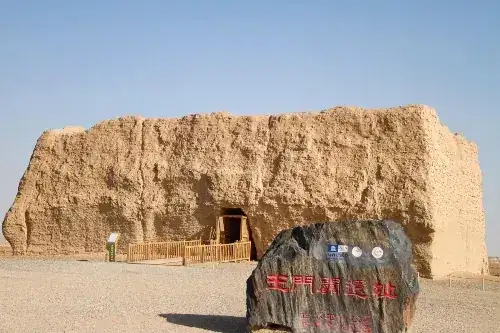
As of 2023, Jiuquan had 1,393 immovable cultural heritage sites, including 5 World Cultural Heritage sites (Mogao Caves, Han Great Wall, Suoyang City, Xuanquanzhi, and Yumen Pass), 22 national key protected units, and 65 provincial-level units. The city has 6 national intangible cultural heritage items (including luminous cup carving, Hexi precious scrolls, and Dunhuang folk opera), 45 provincial items, 403 municipal items, and 662 county-level items.
Traditional Villages
As of 2024, Jiuquan has 5 national traditional villages: Buzi Village in Suoyang Town (Guazhou County), and Dongqu Village, Tieren Village, Zehu Village, and Shuixia Village in Yumen City. These villages preserve traditional rural architecture and cultural landscapes characteristic of the Hexi Corridor.
Scenic Attractions
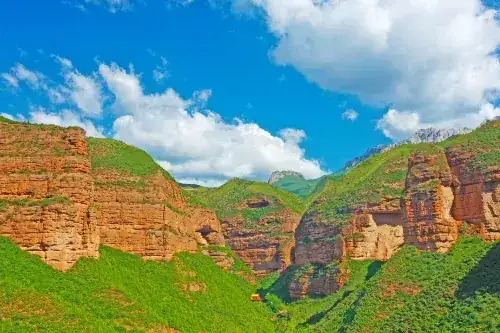
Jiuquan is a national excellent tourism city and one of western China's most internationally influential tourism destinations. As of mid-2024, the city had 54 A-level tourist attractions: one 5A (Dunhuang Mingsha Mountain and Crescent Lake), sixteen 4A, thirty-five 3A, one 2A, and one 1A. The region's landscapes feature mountain ranges, vast Gobi deserts, and connected basins forming a distinctive northwestern vista.
External Exchange
On April 27, 2016, Jiuquan established a sister-city relationship with Yangjiang, Guangdong Province.
Notable Figures
Jiuquan has produced numerous prominent historical and contemporary figures, including Wang Jinxi (the "Iron Man" and model worker of the Daqing oil fields), and various cultural, military, and political figures throughout its long history.
Major Honors
Jiuquan has been awarded the National Double Support Model City, Top 100 Prefecture-Level City Brand City, and designation as one of China's first batch of pilot cities for collaborative pollution reduction and carbon innovation.
Travel information can change. Check current opening hours, reservations and entry requirements before you travel.
Traveller discussion
Start the conversation with a helpful tip or a question.