
Zhangye
ZhangyeZhangye, formerly known as Ganzhou, is a prefecture-level city in Gansu Province, China, located in the northwestern part of the province at the midpoint of the Hexi Corridor. It borders Wuwei and Jinchang to the east, Jiayuguan and
Zhangye
Zhangye, formerly known as Ganzhou, is a prefecture-level city in Gansu Province, China, located in the northwestern part of the province at the midpoint of the Hexi Corridor. It borders Wuwei and Jinchang to the east, Jiayuguan and Jiuquan to the west, Qinghai Province to the south, and Inner Mongolia to the north. As of February 2026, Zhangye administers 1 district and 5 counties, with a total area of 38,600 square kilometers. As of end-2025, the permanent population was 1.0911 million. The local dialect belongs to the Lanyin subgroup of the Qinlong cluster within the Northwestern sub-dialect zone of Northern Chinese dialects. Zhangye has a temperate continental climate, featuring three major ecosystems: the Qilian Mountain water conservation zone, the Heihe River oasis, and desert gobi. The landscape includes snow-capped glaciers, forest grasslands, the colorful Danxia landform, fertile farmland, wetlands, and desert dunes. Human activity in Zhangye dates back over 5,000 years. During the pre-Qin period, the Ruoshui River basin was inhabited by the Yuezhi people. In 111 BCE, the Western Han Dynasty established Zhangye Commandery. In 1985, the county was upgraded to a city under Zhangye Prefecture. In March 2002, Zhangye Prefecture was converted to a prefecture-level city, and the former Zhangye City became Ganzhou District. Zhangye has been a key commercial hub on the Silk Road since ancient times and an important comprehensive transportation hub in northwest China, earning the titles "Jiangnan Beyond the Great Wall" and "Golden Zhangye." Zhangye boasts profound cultural heritage and rich cultural landscapes, designated as a National Historical and Cultural City and an Outstanding Tourism City of China, with 1,270 immovable cultural relics, 5 national-level intangible cultural heritage items, and attractions such as the Qilian Mountain Grassland and Zhangye Danxia. The economy centers on modern agriculture, eco-industry, tourism, digital economy, exhibition industry, and modern services. In 2025, Zhangye's GDP reached 73.435 billion yuan (approximately $10.2 billion), a year-on-year increase of 7.7%.
Name Origin
In 111 BCE (the sixth year of the Yuanding era of the Western Han), Zhangye Commandery was established by partitioning Jiuquan Commandery. The name derives from the phrase "extending the empire's arm to open the route to the Western Regions."
Historical Evolution
Pre-Qin Period
Archaeological evidence indicates human activity in Zhangye over 5,000 years ago. During the pre-Qin period, the Ruoshui River basin was inhabited by the Yuezhi, a branch of the Western Rong people. During the Spring and Autumn period, the Yuezhi and Wusun grazed here.
Qin-Han to Northern and Southern Dynasties
In the early Western Han, the area belonged to the Xiongnu. Emperor Wu of Han established Zhangye Commandery, signifying "extending China's arm and severing the Xiongnu's right flank to open the route to the Western Regions." In 115 BCE, Jiuquan Commandery was first established. In 111 BCE, the western portion was partitioned to create Dunhuang Commandery, while the area east of Yanzhi Mountain was separated to form Zhangye Commandery, which administered counties including Zhangye, Gucang, Xiutu, Wuwei, and others. During the Jin Dynasty, the commandery seat was moved to the east bank of the Heihe River to present-day Zhangye city, renamed Yongping County. The Former Liang, Former Qin, Later Liang, and Northern Liang all established capitals here.
In 444 CE, the Northern Wei reorganized commanderies and counties into military garrisons. The Western Liang Prefecture governed four garrisons including Wuwei and Dunhuang, with Zhangye Military subordinate to Wuwei Garrison. In the later Northern Wei, garrisons were converted to prefectures, and Zhangye retained the Western Liang Prefecture structure. In 554 CE, the Western Wei renamed Western Liang Prefecture as Ganzhou, governing three commanderies.
Sui-Tang to Song-Yuan Period
In 583 CE, Emperor Wen of Sui merged counties and abolished commanderies. Ganzhou was reorganized to directly administer Jiuquan, Shandan, and Fulu counties. In the later Sui, Ganzhou was renamed Zhangye Commandery. During the Tang Dynasty, it served as the seat of Ganzhou Zhangye Commandery. In 781 CE, after the Tibetan Empire occupied the Hexi region, Ganzhou was placed under the Wuwei Military Garrison.
During the Five Dynasties, Ganzhou was inhabited by the Uyghurs. The Western Xia occupied Ganzhou and established the Gansu Military Supervision Office. During the Yuan Dynasty, two provincial-level administrations were established: the Gansu Route General Administration in 1264, renamed Ganzhou Route in 1271, and the Gansu Branch Secretariat in 1281, governing seven routes and two directly administered prefectures.
Ming-Qing Period
The Ming Dynasty established the Left and Right Guards of Ganzhou under the Shaanxi Regional Military Commission. In 1372, General Feng Sheng captured Ganzhou and established the Gansu Guard in Zhangye. In 1392, the Shaanxi Regional Military Commission was moved to Zhangye, overseeing twelve guards. During the Yongle reign, the Gansu Military Town was established in Zhangye.
The Qing Dynasty established Zhangye County as the seat of Ganzhou Prefecture. In 1658, the Gansu Governor moved from Ganzhou to Liangzhou. In 1725, the Shaanxi Regional Military Commission was abolished and Ganzhou Prefecture was established, with Ganzhou Guard converted to Zhangye County. By 1750, Ganzhou Prefecture administered two counties (Zhangye and Shandan), one sub-county (Dongle), and one sub-prefecture (Fuyi).
Republic of China Period
In 1913, the Republic abolished prefectures and retained circuits. Ganzhou Prefecture was dissolved, and Fuyi and Dongle were redesignated as counties. In 1929, Fuyi County was renamed Linze County and Dongle County was renamed Minle County. In 1936, Gansu was divided into seven administrative districts.
After the Founding of the People's Republic
After 1949, Zhangye successively belonged to the Wuwei and Zhangye Special Districts. In 1970, Zhangye Special District was renamed Zhangye Prefecture, administering five counties and Sunan Yugur Autonomous County. In 1985, the county was upgraded to a city under Zhangye Prefecture. In March 2002, Zhangye Prefecture was converted to a prefecture-level city, with the former Zhangye City becoming Ganzhou District. The city now administers Ganzhou District, Linze County, Gaotai County, Shandan County, Minle County, and Sunan Yugur Autonomous County. In 2003, townships were consolidated from 93 to 57.
Physical Geography
Location and Territory
Zhangye is located in western Gansu at the midpoint of the Hexi Corridor, between 97°23'38"–102°37'57"E and 37°51'24"–39°53'19"N. It has a total area of 38,600 square kilometers, bordering Wuwei and Jinchang to the east, Jiayuguan and Jiuquan to the west, Qinghai to the south, and Inner Mongolia to the north.
Climate
Zhangye has a temperate continental arid climate characterized by abundant sunlight, large diurnal temperature ranges, frequent wind and sand, strong solar radiation, and low unevenly distributed precipitation. Springs warm quickly; summers are dry and hot with concentrated rainfall; autumns are brief; winters are cold and long. The average annual temperature is 7.8°C, with extreme minimums reaching -28.2°C and extreme maximums of 39.8°C. The frost-free period averages 146 days. Annual sunshine totals 3,076 hours, and annual precipitation ranges from 112.3 to 354 mm.
In 2025, the average temperature was 7.9°C, down 0.5°C from the previous year. Annual sunshine totaled 2,947.1 hours, up 42.2 hours. Annual precipitation was 216.9 mm, up 19.5 mm.
Geology
Zhangye sits at the transitional boundary between the Qinghai-Tibet Plateau and the Inner Mongolia Plateau, with complex geological structures and intense neotectonic movement. Its geological evolution traces back over 2 billion years to the Proterozoic era. After multiple tectonic movements, magmatic activities, and metamorphism, the mountains on both sides of the corridor were uplifted while the central subsided.
The structural position is at the first-order boundary where the Qinghai-Tibet Plateau descends to the Inner Mongolia Plateau. Three tectonic units are present: the Alxa paleocontinental block, the North Qilian paleo-oceanic plate, and the South Qilian paleocontinental plate. Since the Quaternary, neotectonic movement has caused the Qilian, Longshou, Dahuangshan, and Yumushan mountains to rise sharply, forming young, steep mountain ranges and subsiding fault basins.
Topography
Zhangye is located at the intersection of the Qinghai-Tibet and Mongolian plateaus. The Qilian Mountains lie to the south, the Heli and Longshou Mountains to the north, and the Heihe River runs through the entire area. The terrain is high in the north and south, low in the center, sloping from southeast to northwest. Elevation ranges from 1,284 to 5,564 meters. The south features the Qilian Mountain water conservation zone; the center is an oasis plain formed by Heihe River alluvial deposits; the north presents desert landscapes along the Heli and Longshou mountains, serving as a natural barrier against the southward advance of the Badain Jaran Desert.
Hydrology and Water Conservancy
Zhangye has 40 inland rivers with annual runoff exceeding one million cubic meters, belonging to three major water systems: the Shiyang, Heihe, and Shule rivers. The Heihe River is the most important, with a main stream length of 299 kilometers within Zhangye's jurisdiction and a natural drop of over 3,000 meters. Total annual river runoff is 2.475 billion cubic meters, with the Heihe main stream accounting for 1.58 billion cubic meters.
As of 2022, Zhangye had 280 rural drinking water safety projects, 61 reservoirs with a total storage capacity of 358.3492 million cubic meters, and groundwater electromechanical well metering installation rate exceeding 95%.
Soil
Zhangye has 21 soil types, 55 subtypes, 74 soil genera, and approximately 96 soil species. Zonal soils include gray-brown desert soil, gray calcic soil, chestnut calcic soil, black calcic soil, and alpine soil. Non-zonal soils include meadow soil, swamp soil, saline soil, and aeolian sandy soil. Cultivated soils are concentrated in the corridor oasis areas.
Natural Disasters
Areas at the northern foot of the Qilian Mountains, including Sunan and Minle, face multiple geological hazards including debris flows, landslides, collapses, ground subsidence, and ground fissures. There are 233 identified geological hazard risk points, mainly concentrated in Sunan Yugur Autonomous County and Minle County. On July 2, 2023, flash floods triggered by sudden rainfall in the Pingshanhu Mongolian Township of Ganzhou District trapped two tourists.
Natural Resources
Water Resources
Zhangye's average annual precipitation is 110 mm with evaporation of 1,400 mm, creating an overall water shortage. The net groundwater resource not overlapping with surface water totals 175 million cubic meters, with total usable water resources of 2.65 billion cubic meters. Per capita water resources are 1,250 cubic meters, and per mu (0.067 hectares) only 327 cubic meters, representing 75% and 19% of China's national averages, respectively.
Land Resources
As of end-2023, Zhangye had wetland area of 196,914.29 hectares, cultivated land of 368,737.64 hectares, orchard land of 10,648.91 hectares, forest land of 396,625.63 hectares, and grassland of 1,916,193.57 hectares.
Mineral Resources
Zhangye has diverse and widely distributed mineral resources, with 285 mineral occurrences discovered. A total of 64 mineral types have been identified, with 43 having proven reserves. Iron, tungsten, molybdenum, mirabilite, fluorite, attapulgite, and cement limestone reserves rank first in Gansu Province. Iron and tungsten account for over 93% and 90% of the province's proven reserves, respectively. In 2022, newly discovered reserves included 450 million tons of coal, 3 million tons of iron ore, 9 million tons of copper, and 4 tons of gold.
Renewable Resources
Zhangye is rich in hydropower, solar, wind, and biomass energy. Renewable energy accounts for 75.8% of total installed power capacity. Most areas including Gaotai, Linze, Ganzhou, Shandan, and Minle are solar energy-rich zones, with total solar radiation exceeding 6,100 megajoules per square meter. Total developable hydropower resources reach 4,500 megawatts.
Biological Resources
Zhangye hosts over 1,000 plant species, including 25 aromatic plants, over 40 ornamental plants, over 80 medicinal plants, and over 20 sand-fixing plants. The Zhangye Heihe Wetland Reserve contains 439 plant species across 66 families, including 1 national Class I protected species and 8 Class II protected species. The Qilian Mountain National Park Zhangye section has 1,501 wild vascular plant species, including 17 national Class II protected species. As of 2020, forest area reached 5.923 million mu (approximately 395,000 hectares) with 15.65% coverage, and usable grassland area totaled 21.5 million mu.
Zhangye has 262 species of wild animals, including 59 mammal and 203 bird species. Nationally protected species include the snow leopard, wild ass, and brown bear (17 mammal species) and the black stork, white-tailed sea eagle, and whooper swan (38 bird species). There are 22 national Class I and 64 Class II key protected wildlife species.
Zhangye has designated 10 nature protected areas, including 1 national park, 2 national-level nature reserves, and 5 national nature parks. The Zhangye National Wetland Park, covering 1,347.6 hectares in the northern suburbs of Ganzhou, was approved by the National Forestry and Grassland Administration and rated as a AAAA tourist attraction in 2011.
Administrative Divisions
As of February 2026, Zhangye administers 1 municipal district (Ganzhou) and 5 counties (Linze, Gaotai, Shandan, Minle, and Sunan Yugur Autonomous County). The municipal government is seated at No. 679 South Ring Road, Ganzhou District.
Politics
The city operates under the leadership of the CPC Zhangye Municipal Committee and the Zhangye Municipal People's Government, with corresponding people's congress and political consultative conference bodies.
Population
Population Size
As of end-2025, the permanent population was 1.0911 million, a decrease of 8,700 from the previous year. The urban population was 633,200, with an urbanization rate of 58.03%, up 1.74 percentage points. There were 7,400 births (birth rate 6.75 per thousand) and 8,800 deaths (death rate 8.03 per thousand), resulting in a natural growth rate of -1.27 per thousand.
Ethnic Groups
As of January 2024, Zhangye has 39 ethnic groups totaling 1.13 million people, including the Yugur, Tibetan, Mongolian, and Hui peoples. The Yugur are China's only ethnic group concentrated solely in this area, and one of China's smallest ethnic groups. Ethnic minority counties and townships cover 24,800 square kilometers, accounting for 64% of the city's total area.
Language
The Zhangye dialect belongs to the Lanyin subgroup of the Qinlong cluster within the Northwestern sub-dialect zone of Northern Chinese dialects, divided into three dialect areas: Zhangye, Shandan, and Luocheng. The dialect features clear phonetic systems, rich vocabulary, and ancient pronunciation characteristics. It lacks rhotacization, instead using zi-suffix and er-suffix, with many dialect words formed through connected speech changes.
Religious Beliefs
Zhangye is a multi-religious, multi-sectarian region with all five major religions present: Islam, Buddhism, Daoism, Catholicism, and Protestantism. Daoism and Buddhism spread to the Hexi region after the Eastern Han Dynasty. Islam entered via the Silk Road during the Two Song dynasties. A Catholic church was built in Zhangye during the Yuan Dynasty, and Protestantism arrived in the northwest in the latter half of the 19th century. Among believers, Buddhists are the most numerous, followed by Muslims, Catholics, and Protestants.
Economy
Overview
Zhangye's economy centers on six sectors: modern agriculture, eco-industry, tourism, digital economy, exhibition industry, and modern services. In 2025, the GDP reached 73.435 billion yuan (approximately $10.2 billion), up 7.7%. The primary industry added value of 18.445 billion yuan ($2.56 billion, up 5.9%); the secondary industry 14.873 billion yuan ($2.07 billion, up 9.6%); and the tertiary industry 40.118 billion yuan ($5.57 billion, up 7.9%). Per capita GDP was 67,033 yuan (approximately $9,310), up 8.3%.
General public budget revenue was 3.895 billion yuan (approximately $541 million), up 7.3%. General public budget expenditure was 19.385 billion yuan (approximately $2.69 billion). Urban residents' per capita disposable income was 37,787 yuan ($5,248), up 4.2%; rural residents' was 23,531 yuan ($3,268), up 7.1%. Fixed asset investment grew 4.6%.
Primary Industry
Zhangye's agriculture focuses on grain cultivation and animal husbandry, complemented by specialty crops. It has developed six "million-scale" industries: 1 million mu of corn seed production, 1 million mu of vegetables, 1 million head of cattle, 1 million mu of forage grass, 6 million sheep, and 1 million mu of specialty crops. In 2025, grain was planted on 3.1783 million mu with output of 1.559 million tons. Vegetable output was 2.3662 million tons. Meat production reached 209,500 tons, and milk production 420,000 tons.
Secondary Industry
Zhangye promotes new-type industrialization focusing on comprehensive energy, new materials, and deep processing of agricultural products. In 2025, total industrial value added was 10.208 billion yuan ($1.42 billion), up 13.4%. Above-scale industrial value added grew 12.8%. By sector: mining grew 8.7%, manufacturing 7.0%, and power/heat/gas/water supply 29.4%. Above-scale industrial profits were 373 million yuan ($51.8 million), down 45.1%. Construction value added was 4.805 billion yuan ($667 million), up 2.1%.
Tertiary Industry
Zhangye drives tertiary industry development through cultural tourism, with value-added growth ranking first in Gansu Province. In 2025, wholesale and retail trade value added reached 7.065 billion yuan ($981 million, up 12.4%); transportation, warehousing, and postal services 3.178 billion yuan ($441 million, up 0.2%); accommodation and catering 1.813 billion yuan ($252 million, up 6.5%); finance 4.201 billion yuan ($584 million, up 2.9%); and real estate 2.724 billion yuan ($378 million, up 2.7%). Total retail sales of consumer goods reached 28.973 billion yuan ($4.02 billion, up 6.8%). Import and export totaled 550 million yuan ($76.4 million, up 33.7%).
Zhangye received 50.805 million tourists in 2025, up 15.1%, with tourism spending of 36.752 billion yuan ($5.10 billion, up 19.8%). Inbound tourists totaled 74,400, up 45.5%. Year-end financial institution deposit balances reached 136.074 billion yuan ($18.9 billion), up 7.9%; loan balances 92.646 billion yuan ($12.87 billion), up 3.2%. Postal revenue was 453 million yuan ($63 million, up 15.2%); telecom revenue 1.23 billion yuan ($171 million, up 5.1%).
Economic Functional Zones
Zhangye has 1 national-level economic and technological development zone, 4 provincial-level industrial parks, and 1 provincial-level industrial cluster, forming a "2+4" development pattern. The Zhangye Economic and Technological Development Zone, upgraded to national level in March 2013, is adjacent to the Lanzhou-Xinjiang Railway, G30 Expressway, and National Highway 227. It hosts 524 enterprises across five pillar industries: agricultural product processing, nonferrous metallurgical new materials, new energy and equipment manufacturing, biopharmaceuticals and chemicals, and modern services.
Social Undertakings
Education
In 2025, Zhangye had 0.85 million general college/university admissions, 0.61 million graduates, and 2.82 million enrolled. Secondary vocational education had 0.23 million admissions and 0.69 million enrolled. Senior high schools had 1.04 million admissions and 2.78 million enrolled. Junior high schools had 1.21 million admissions and 3.81 million enrolled. Primary schools had 1.19 million admissions and 7.34 million enrolled. The nine-year compulsory education retention rate was 100%, and the gross senior high school enrollment rate was 96.98%. Zhangye Middle School, founded in 1917, covers nearly 400 mu with over 12,000 square meters of buildings.
Healthcare
As of end-2025, Zhangye had 1,391 medical and health institutions, including 43 hospitals (23 general, 5 traditional Chinese medicine, 11 specialty) and 1,325 grassroots medical institutions. There were 13,400 health professionals including 5,200 licensed physicians and 6,000 registered nurses, with 11,400 hospital beds. The Hexi University Affiliated Zhangye People's Hospital, the city's largest Grade-3A hospital, was founded in 1956 and merged into Hexi University in 2014.
Science and Technology
In 2025, Zhangye registered 52 municipal-level scientific achievements. Patent grants totaled 893, down 36.9%, including 71 invention patents. Effective invention patents reached 505, with 4.59 per 10,000 population. Technology contracts totaling 2,673 were signed, up 246.7%, with a transaction value of 5.387 billion yuan ($748 million), up 6.57%.
Culture
As of 2022, Zhangye had 7 libraries, 7 cultural centers, 7 archives, and 9 museums, with nearly 200 public cultural spaces. All towns had comprehensive cultural stations, with 883 grassroots cultural service centers. The Zhangye City Library, founded in 1956 with 10,038.5 square meters, holds over 330,000 volumes and has been rated a National First-Class Library four times.
Sports
As of end-2025, Zhangye had 5,529 sports venues covering 3.275 million square meters. The city won 89 medals including 16 gold. There are 10 large public sports venues and 10 ice-skiing venues. The Zhangye National Fitness Center Stadium, built in May 2010, covers 8,727 square meters with a total investment of 30.6 million yuan ($4.25 million).
Social Security
In 2025, Zhangye added 19,600 urban jobs, including 7,300 re-employed. The city transferred 281,100 surplus rural laborers. As of end-2025, 232,500 people participated in urban employee basic pension insurance; 665,800 in urban-rural resident basic pension; and 1,150,900 in basic medical insurance. The city had 13,100 urban minimum living standard recipients and 50,900 rural recipients.
Environmental Protection
By 2024, Zhangye had fully completed the Qilian Mountain ecological remediation tasks and was successfully designated a National Ecological Civilization Construction Demonstration City. The "one park, four belts" initiative completed 2.334 million mu of afforestation and restored 3.76 million mu of degraded grassland. In 2025, all 14 surface water assessment sections met or exceeded Class III water quality standards. After removing dust weather effects, the air quality excellent rate was 98.7%.
Transportation
Overview
Zhangye is an important node city on the Silk Road Economic Belt and a key comprehensive transportation hub in northwest China. In 2025, highway freight transport turnover was 3.378 billion ton-kilometers, up 2.0%; passenger transport turnover was 935 million person-kilometers, up 23.2%. Zhangye Airport handled 297,000 passengers, up 3.9%. Total highway mileage reached 14,100 kilometers. Civil vehicle ownership was 303,700, up 4.7%.
Highways
Zhangye has formed a "four horizontal, nine vertical, thirteen connecting" road network centered on the city. The G30 Lianhuo Expressway and National Highways 312 and 227 traverse the city, and the G0611 Zhang-Bian Expressway is open to traffic. As of 2024, highway mileage reached 14,504 kilometers with a road network density of 37.57 km per 100 square kilometers.
Railways
Zhangye is served by the Lanzhou-Xinjiang Railway and Lanzhou-Xinjiang High-Speed Railway. Major stations include Minle, Shandan Junmachang, Zhangye West (HSR), Linze, and Gaotai. Total railway operating mileage within Zhangye is 496 kilometers, including 262 km of high-speed rail. Zhangye Station, built in 1955 and managed by the Lanzhou Railway Bureau, is a Class-2 station 547 km from Lanzhou.
Aviation
Zhangye has built 9 general aviation airports of three categories, including Gansu's first general aviation airport: the Zhangye Danxia General Aviation Airport. The flight area is rated 4C, capable of handling Airbus A320 and Boeing 737-800 and smaller aircraft. The Zhangye Ganzhou Airport, located 24 km from the city center, is a 4C-class dual-use (civil-military) highland airport at 1,588.5 meters elevation. With a 4,189-square-meter terminal, it can handle 243,000 annual passengers and 1,723 tons of cargo. Flight routes connect Beijing, Shanghai, Chongqing, Guangzhou, Chengdu, Xi'an, and Lanzhou.
Public Transportation
Zhangye has achieved 100% township passenger station coverage and 100% village bus connectivity. As of 2024, the city had 12 Class-3+ passenger stations, 25,000 commercial vehicles, 317 passenger routes, 54 bus routes with 414 buses, 1,958 taxis from 15 companies, and 607 tourist coaches from 25 companies. The Zhangye Passenger Transport Center Station, completed in 2019, covers 70,666.67 square meters with 224 parking spaces.
Culture
Overview
Zhangye is a major town on the ancient Silk Road, playing an important role in cultural and economic exchange between central China and the Western Regions. It features unique Yugur, Mongolian, and Tibetan cultural traditions, and is designated as a National Historical and Cultural City and Outstanding Tourism City of China.
Cuisine
Zhangye's culinary traditions are closely tied to its history as a frontier zone of ethnic mingling. The diet emphasizes quick preparation and consumption, a habit rooted in the need for sustenance during territorial defense. Beef and mutton remain staples. Ganzhou Saomian is a famous traditional Han Chinese snack and essential breakfast item, known for its "thin, bright, and chewy" noodles served in seasoned chicken soup. It was listed as a municipal intangible cultural heritage in 2015.
Local Specialties
Zhangye grapes benefit from the unique advantages of the 38°N latitude, making Zhangye a premium grape production base in China, with 69,500 mu planted and annual output of 66,000 tons. Shandan mutton, known for its tender texture and lack of gamey flavor, has received National Geographic Indication protection and was included in the "Ganwei" brand catalog.
Customs
Yugur wedding customs are an important part of Yugur folk culture, encompassing ancient language, folk songs, myths, and traditional ceremonies including shamanistic and Buddhist elements. The elaborate wedding involves over a dozen procedures and 28 etiquettes spanning three days, distributed primarily in Minghua, Dahe, Huangcheng, and Kole townships of Sunan Yugur Autonomous County.
Zhangye maintains the custom of visiting ancestral graves on New Year's Eve to deliver "New Year's food." The local shehuo (community fire) tradition features diverse performances including yanggezi (a percussion-accompanied group dance), lion dancing, dragon lanterns, stilt walking, and the "medicine peddler" who delivers auspicious verses. Yanggezi, the core of Zhangye shehuo, has 72 choreographic patterns.
Cultural Relics
Zhangye has 1,270 immovable cultural relics, ranking first in Gansu Province. These include 20 national key protected units, 38 provincial-level units, and 344 county-level units, plus 30 cave temples and cliff carvings. State-owned collections total 12,027 items, including over 2,780 precious artifacts.
Intangible Cultural Heritage
As of September 2022, Zhangye had 5 national-level intangible cultural heritage items (Hexi Baojuan, Yugur costume, Yugur wedding customs, Yugur folk songs, and Ganzhou Xiaodiao), 33 provincial items, 128 municipal items, and 417 county-level items, with 5 national, 73 provincial, 394 municipal, and 744 county-level heritage bearers.
Art
Zhangye's dance traditions date back over 2,000 years to 135 BCE. Six major folk dances are practiced: Taiping Yangge, Yak-running Dance, Yellow Deer Dance, Bowl-topping Dragon Lantern Dance, Bowl-topping Dance, and Taiping Cart Dance. Ganzhou Xiaodiao is a folk music form with over 4,000 years of history, featuring simple yet beautiful melodies divided into "Hua'er" (youth songs), minor tunes, work songs, festival songs, and drinking songs.
Scenic Spots
Overview
Zhangye has rich and diverse tourism resources covering all landscape types except marine, including glacier snow mountains, forest grasslands, wetland reeds, oasis farmland, colorful Danxia, canyon lakes, and gobi desert. As of 2022, the city had 41 national A-level tourist attractions, including 1 AAAAA and 19 AAAA-level sites, with AAAA+ ranking second among the five northwest provinces.
Important Scenic Spots
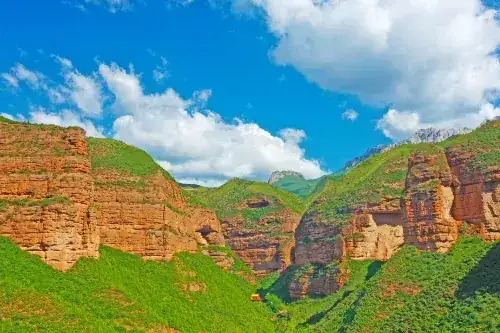
The Seven-Color Danxia Scenic Area, located in Linze and Sunan counties at 2,000–3,800 meters elevation, covers over 300 square kilometers. Formed from Cretaceous "red beds" 135 million to 65 million years ago, it is the world's only and China's unique colorful hill landform, designated a World Geopark and AAAAA tourist attraction.
The Great Buddha Temple, built in 1098 CE during the Western Xia, houses China's largest indoor reclining Buddha statue. The complex spans over 30,000 square meters and is a national key cultural relic protection unit and AAAA attraction.
The Liyuankou Battle Memorial Hall, built in 1986 in Linze County covering 250,000 square meters, is the largest Red Western Route Army memorial on the Hexi Corridor, holding over 190 precious artifacts.
The Sunan Yugur Folk Resort Area, a AAAA attraction in Hongwansi Town, integrates natural scenery, cultural landscapes, ethnic customs, and religious culture.
The Shandan Military Horse Farm, located at the northern foot of the Qilian Mountains' Hanlong Ridge, spans Gansu and Qinghai provinces with over 2,100 years of history as the world's oldest and Asia's largest horse farm.
External Exchange
Zhangye maintains friendly exchanges and sister-city relationships with multiple domestic and international cities, promoting cultural, economic, and educational cooperation.
Famous Figures
Notable historical figures from Zhangye include prominent officials, scholars, and military leaders throughout Chinese history, contributing to the city's rich cultural legacy.
Major Honors
Zhangye has been designated a National Historical and Cultural City, an Outstanding Tourism City of China, a National Ecological Civilization Construction Demonstration City, and has received numerous provincial and national honors for its cultural heritage, tourism development, and environmental protection achievements.
Travel information can change. Check current opening hours, reservations and entry requirements before you travel.
Traveller discussion
Start the conversation with a helpful tip or a question.