
Lanzhou City
Lanzhou CityLanzhou City, abbreviated as "Lan" and "Gao," also known by its ancient name Jincheng (Golden City), is a prefecture-level city and the capital of Gansu Province, China. It is designated by the State Council as an important cent
Lanzhou City
Lanzhou City, abbreviated as "Lan" and "Gao," also known by its ancient name Jincheng (Golden City), is a prefecture-level city and the capital of Gansu Province, China. It is designated by the State Council as an important central city in western China, a national comprehensive transportation hub, an advanced manufacturing base in the Northwest, and a regional center for scientific and technological innovation. Located in northwest China and central Gansu Province, Lanzhou is the geometric center of China's land territory. It borders Wuwei and Baiyin to the north, Dingxi to the east, and Linxia Hui Autonomous Prefecture to the south. As of June 2026, Lanzhou administers five districts and three counties, with a total area of 13,085.6 square kilometers. As of end-2025, the resident population was 4.4514 million, an increase of 14,900 over the previous year. Lanzhou has a temperate semi-arid climate with mountains, hills, intermontane basins, and river valleys. The city is the political, cultural, economic, and educational center of Gansu Province, and a historic city along the Yellow River with over 2,200 years of urban history. In 2025, Lanzhou's regional GDP reached 390.361 billion yuan (approximately $53.8 billion USD), up 5.5% year-on-year.
Name and Etymology
Lanzhou was anciently called Jincheng (Golden City), reportedly because gold was discovered when the city walls were first built. Another explanation references the idiom "jincheng tangchi" (a city of gold with a moat of boiling water), symbolizing impregnability. In 583 CE, Emperor Wen of Sui renamed Jincheng Commandery as Lanzhou, after Gaolan Mountain south of the city.
Historical Evolution
Pre-Qin Period
Human habitation in the Lanzhou area dates back to the late Paleolithic period, approximately 15,000 years ago. Between 5,000 and 4,000 years ago, the area was in the Majiayao and Qijia cultural periods. During the Xia, Shang, and Zhou dynasties, the area was pastoral land of the Qiang and Rong peoples.
Qin-Han to Northern and Southern Dynasties Period
In 214 BCE, the Qin Dynasty established Yuzhong County near present-day Donggang Town in Chengguan District, marking the earliest administrative establishment in the Lanzhou area. In 121 BCE, General Huo Qubing campaigned westward against the Xiongnu and established Jincheng County. In 81 BCE, the Western Han established Jincheng Commandery. During the Eastern Han, the commandery seat was repeatedly relocated due to Qiang rebellions. During the Sixteen Kingdoms period, the area was successively held by Former Liang, Former Qin, Later Liang, Southern Liang, Later Qin, and Western Qin.
Sui-Tang to Song-Yuan Period
In 581 CE, Emperor Wen of Sui established Lanzhou, named after Gaolan Mountain. The Sui Dynasty's Lanzhou roughly corresponded to the present-day city boundaries. During the Tang Dynasty, Lanzhou was renamed Jincheng Commandery and then back to Lanzhou. In 763 CE, the Tibetan Empire occupied Lanzhou. During the Northern Song, the Tangut Western Xia seized Lanzhou in 1036, and the Song recaptured it in 1081. The Mongol Yuan Dynasty took Lanzhou in 1234.
Ming-Qing Period
In 1369, the Ming Dynasty established Lanzhou Guard. In 1479, Lan County was elevated to Lanzhou. During the Qing Dynasty, Lanzhou became the seat of the Governor-General of Shaanxi-Gansu in 1764, making it the political center of northwest China.
Republic of China Period
In 1913, Lanzhou and Gongchang prefectures were merged into Lanshan Circuit. In July 1941, Lanzhou City was formally established. On August 26, 1949, Lanzhou was liberated and elevated to a prefecture-level city as the provincial capital.
After the Founding of the PRC
After 1949, Lanzhou was designated as one of the nation's key industrial bases. Administrative adjustments continued through the 1950s-1980s. In 2012, the State Council approved the establishment of Lanzhou New Area, the fifth national-level new area and the first in northwest China.
Physical Geography
Location and Boundaries
Lanzhou is located in northwest China, central Gansu Province, at the geometric center of China's land territory, between 102°35'58"–104°34'29"E and 35°34'20"–37°07'07"N. The total area is 13,085.6 square kilometers.
Climate
Lanzhou has a temperate semi-arid climate with abundant sunshine, distinct seasons, and low precipitation. The average annual temperature is 10.9°C, with extremes ranging from -21.7°C to 39.8°C. Average annual sunshine reaches 2,374 hours, the frost-free period is 172 days, and average annual precipitation is approximately 300 mm, concentrated in July-September.
Geology
The land surface is mostly covered by Quaternary loose sediments, with bedrock exposed in the southern, western, and northern mountain areas. Lanzhou sits on the Qilian-Qinling tectonic suture zone between the North and South China plates.
Topography
Lanzhou lies at the transition between the western Loess Plateau and the Qinghai-Tibet Plateau. The terrain features mountains, hills, intermontane basins, and river valleys, generally higher in the west and south, lower in the northeast. The Yellow River flows from southwest to northeast through the city. Most of the area consists of loess-covered hills and basins at 1,500-2,000 m elevation, including the Qinwangchuan and Yuzhong fault basins.
Hydrology
Rivers in Lanzhou belong to the Yellow River basin, with a total river length of 1,179.7 km. Major tributaries include the Huangshui, Zhuanglang, and Wanchuan rivers. Lanzhou has 15 reservoirs, including the Gaoya Reservoir, an artificial lake formed in 1958.
Soils
Lanzhou has ten soil types across seven soil orders. Sierozem accounts for 67.15% of the total soil area, followed by chestnut soil (8.73%), gray-cinnamon soil (7.34%), and black-loom soil (6.91%).
Natural Disasters
Due to its topography and location on the Qilian seismic belt, Lanzhou experiences droughts, floods, hailstorms, earthquakes, and geological hazards including landslides, collapses, and debris flows. Droughts and floods occur every year. Lanzhou has 2,463 registered geological hazard points threatening 514,000 people.
Natural Resources
Water Resources
Lanzhou's water resources exist as precipitation, surface water, and groundwater. Average annual precipitation is 4.518 billion cubic meters, surface water totals 33.1984 billion cubic meters (including 2.014 billion cubic meters of locally generated water and 32.997 billion cubic meters of inflow), and groundwater resources total approximately 960 million cubic meters.
Land Resources
As of 2019, Lanzhou had 260,417.29 hectares of arable land (390,630 mu), of which 68.65% is dryland. Forest land covers 148,080.21 hectares, and grassland 710,282.28 hectares.
Mineral Resources
Lanzhou has relatively rich mineral resources, primarily coal and nonmetals. As of 2015, 37 types of minerals had been discovered at 274 locations. Coal reserves total 743,047.16 kilotons. Nonmetallic minerals include cement-grade limestone, metallurgical quartzite, and calcareous limestone.
Biodiversity
Lanzhou has approximately 600 species of wild plants, with 40% having economic value. Medicinal herbs such as licorice (gancao), angelica (danggui), and codonopsis (dangshen) are found in the area. The city has 435 species of terrestrial vertebrates across 4 classes and 88 families, including 17 species under Class I national protection (e.g., desert cat, Alpine musk deer, golden eagle) and 72 under Class II protection. Lanzhou has two national nature reserves (Xinglongshan and Liancheng) and three national forest parks.
Administrative Divisions
As of June 2026, Lanzhou administers five districts (Chengguan, Qilihe, Xigu, Anning, and Honggu) and three counties (Yongdeng, Gaolan, and Yuzhong), comprising 14 townships, 47 towns, 53 sub-district offices, 450 communities, and 733 villages. The municipal government is located at 637 South Binhe East Road, Chengguan District.
Politics
Lanzhou is the capital of Gansu Province. The municipal people's government administers the city's districts and counties.
Population
Population Size
As of end-2025, Lanzhou's resident population was 4.4514 million, an increase of 14,900. The urbanization rate was 86.37%. The birth rate was 4.34 per thousand, death rate 8.38 per thousand, and natural growth rate -4.04 per thousand. The registered (hukou) population was 3.3935 million.
Ethnic Groups
Lanzhou has been a multi-ethnic city throughout history. All 56 ethnic groups of China are represented. Ethnic minorities total 227,700 (5.22% of the population). The Hui are the largest minority group, followed by Dongxiang, Tibetan, Manchu, and Mongolian. Muslim ethnic groups account for over 80% of the minority population.
Language
Lanzhou dialect, locally called "Lanzhou hua," belongs to the Lan-Yin Mandarin group of Northern Chinese dialects. It has 25 initials (three more than Standard Mandarin) and 32 finals (four fewer than Standard Mandarin). Notable features include the broader use of the plural marker "men" and a preference for the "ba" construction over double-object sentences.
Religious Beliefs
All five major religions—Buddhism, Daoism, Islam, Catholicism, and Protestantism—are practiced in Lanzhou. As of 2019, approximately 504,000 believers (11.4% of the population) included 126,000 Buddhists, 150,000 Daoists, 200,000 Muslims, 5,000 Catholics, and 23,000 Protestants. The city has 424 approved religious activity venues. Buddhism entered Lanzhou via the Silk Road during the Western Han. Daoism arrived during the Wei-Jin period. Islam spread to Lanzhou during the Ming Dynasty.
Economy
Overview
Lanzhou was designated as a key national industrial base after 1949, developing major enterprises in petrochemicals, equipment manufacturing, biopharmaceuticals, and new materials during the First Five-Year Plan, Second Five-Year Plan, and Third Front Construction periods. The city's four advantageous industries are advanced petrochemicals, equipment manufacturing, biomedicine, and green metallurgy.
In 2025, Lanzhou's regional GDP reached 390.361 billion yuan (approximately $53.8 billion USD), up 5.5%. The primary, secondary, and tertiary sectors contributed 7.529 billion yuan ($1.04 billion USD), 126.924 billion yuan ($17.5 billion USD), and 255.908 billion yuan ($35.3 billion USD), growing 5.3%, 5.9%, and 5.2% respectively. The three-sector ratio was 1.93:32.51:65.56. Per capita GDP was 87,841 yuan (approximately $12,116 USD), up 5.1%.
General public budget revenue was 26.091 billion yuan ($3.6 billion USD), up 3.57%. Urban residents' per capita disposable income was 52,660 yuan (approximately $7,263 USD), up 4.3%; rural residents' per capita disposable income was 21,319 yuan (approximately $2,940 USD), up 6.5%.
Primary Industry
Lanzhou's primary industry is led by grain, vegetables, livestock, and agricultural processing, with four advantageous sectors: highland summer vegetables, lily, rose, and traditional Chinese medicinal herbs. In 2025, grain output was 364,800 tons (up 1.85%), vegetable output 2.4813 million tons (up 4.78%), and milk output 99,000 tons (up 10.67%).
Secondary Industry
The secondary industry features advanced petrochemicals, equipment manufacturing, biomedicine, and green metallurgy. Lanzhou Petrochemical and other enterprises have formed specialty clusters in synthetic resins, synthetic rubber, and catalysts. In 2025, industrial value-added reached 93.453 billion yuan ($12.9 billion USD), up 8.3%. Total power generation capacity reached 10,432 MW, including 2,750.5 MW of solar (up 47.34%).
Tertiary Industry
The tertiary industry centers on finance and information services, with key sectors in commerce, logistics, tourism, financial services, and cultural services. In 2025, wholesale and retail value-added grew 13.5%; finance value-added reached 41.541 billion yuan ($5.7 billion USD). Total retail sales of consumer goods reached 147.43 billion yuan (approximately $20.3 billion USD), up 0.7%. Foreign trade totaled 14.3 billion yuan (approximately $1.97 billion USD), up 49.1%. Tourism revenue reached 100.012 billion yuan (approximately $13.8 billion USD), up 22.48%, with 129 million domestic visitors. Foreign direct investment utilized $49.77 million.
Economic Functional Zones
As of 2023, Lanzhou has nine industrial parks, including two national-level zones (Lanzhou High-tech Zone and Lanzhou Economic Zone) and five provincial-level zones. The Lanzhou High-tech Zone, established in 1991, was among the first batch of 27 national high-tech development zones and the first in Gansu. The Lanzhou Economic Zone, founded in 1993 and elevated to national level in 2002, covers 9.53 square kilometers and was expanded to a "one zone, six parks" layout of 265.32 square kilometers.
Social Services
Education
In 2025, Lanzhou had 70,000 graduate students enrolled, 454,700 undergraduate and junior college students, and 296,200 primary school students. Lanzhou University, founded in 1909, was the first modern institution of higher education in northwest China. It was designated as a Project 211 and Project 985 university and selected as a world-class university (Class A) in 2017.
Healthcare
As of end-2025, Lanzhou had 2,664 medical institutions, including 122 hospitals and 62 health centers, with 53,100 health professionals and 36,000 beds. The First Hospital of Lanzhou University, founded in 1948, is a large comprehensive Class III Grade A hospital with 2,786 beds and over 4,100 staff.
Media
Radio coverage reached 99.88% and television coverage 100% of the population. The Lanzhou Evening News was founded in 1980. Reader magazine, founded in 1981, is known as "the spiritual reader of the Chinese people" and is China's leading journal brand, with cumulative circulation exceeding 2.1 billion copies.
Science and Technology
Lanzhou is a national research and education base with 84 "New Four Forces" research institutions, over 1,200 research organizations, 11 national key laboratories, and 41 academicians. In 2025, patent grants totaled 6,470, with 14,305 valid invention patents (32.24 per 10,000 population). Technology contract transactions reached 8.214 billion yuan ($1.13 billion USD).
Cultural Affairs
Lanzhou has 9 public libraries and 9 cultural centers. The Gansu Provincial Museum, established in 1939, holds over 80,000 precious artifacts including 686 Grade I items.
Sports
Lanzhou has 13,232 sports venues with a total area of 10.9336 million square meters, or 2.47 square meters per capita. In 2025, the city won 385 medals including 170 gold.
Environmental Protection
In 2025, Lanzhou's air quality excellent rate was 85.5%, up 3.3 percentage points. Average annual temperature was 11.4°C, and annual precipitation 442.1 mm.
Social Security
As of end-2025, 1.264 million people participated in urban employee pension insurance and 3.4828 million in basic medical insurance. The city had 114 community service stations and 793 elderly care facilities.
Transportation
Overview
Lanzhou has been a major commercial hub and transportation fortress since ancient times. It is one of China's 12 main transportation hubs and 21 national logistics node cities. Five major railway lines converge here, and Lanzhou Zhongchuan International Airport connects to over 30 cities. In 2025, freight transport totaled 172.916 million tons, and passenger transport 72.8848 million trips.
Highways
As of end-2025, Lanzhou had 9,671.38 km of highways (up 2.1%), of which 9,331.25 km were classified roads.
Railways
Lanzhou has nine trunk railway lines totaling 771 km, including 153 km of high-speed rail with direct connections to 22 provincial capitals. Lanzhou West Station, opened in 2014, is the largest railway passenger hub in western China with 13 platforms and 28 tracks across 260,000 square meters.
Aviation
Lanzhou Zhongchuan International Airport, located 71.8 km north of the city, opened in 1970. Its Phase III expansion, designed for 38 million annual passengers and 300,000 tons of cargo, opened in March 2025. In 2024, it handled 17.001 million passengers and 86,000 tons of cargo.
Water Transport
The Yellow River Lanzhou section has 118.4 km of navigable waterways, with 27 docks and 3 water bus routes covering 20.1 km.
Public Transit
Lanzhou's main urban area has 538 roads totaling 760 km, including 13 bridges across the Yellow River. As of end-2025, civilian vehicle ownership reached 1.4559 million (up 4.75%). The city operates 134 urban bus routes with 2,390 vehicles, carrying 477 million passengers annually. Lanzhou Metro operates two lines (Line 1 and Line 2), with a 2023 ridership of 105.6361 million. The city also has 12,455 cruise taxis and ride-hailing services from 17 companies.
Culture and Humanities
Overview
Lanzhou has over 2,200 years of urban history, earning the titles "Silk Road Hub, Yellow River Pearl, Western Summer Palace, Waterwheel Capital, and Famous City of Fruits." The Taiping Drum, stilt walking, Yellow River waterwheel crafting, and Lanzhou drum music are national intangible cultural heritage items. Shichuan Town's pear orchard is certified by Guinness as the "World's Largest Ancient Pear Orchard."
Cuisine
Lanzhou cuisine is primarily noodle-based, with rice as a secondary staple. The most famous dish is Lanzhou beef noodles, created in the Guangxu reign period by Hui elder Ma Baozi. The noodles feature five characteristics: clear broth, white radish, red chili oil, green cilantro, and yellow noodles. Other specialties include cold noodles, niangpi (steamed wheat skin), tianpeizi (sweet fermented oats), and milk-egg rice wine.
Customs
Traditional Lanzhou wedding customs include the groom's family presenting a young goat to the bride's family. The "combing" ritual involves symbolic blessings for fertility and fortune. Funeral customs have evolved from traditional earth burials to a mix of cremation and burial since the 1960s. Shehuo (community fire performances) are held across the city, with unique local variations including the Taifu lantern and rolling lantern performances in Hejiaying Village.
Arts
Local folk arts include Lanzhou gourd carving, Taiping drum, and drum music. The Yellow River waterwheel crafting, drum music, Taiping drum, and Yongdeng stilt walking are on the national intangible cultural heritage list. In 2005, Lanzhou was named China's Qin Opera development base.
City Symbols
Lanzhou's city logo uses the Chinese character "Lan" formed by three strokes in blue (sky), yellow (Yellow River), and green (land), symbolizing harmony of heaven, earth, and humanity. The city tree is the pagoda tree (guohuai), and the city flower is the rose, specifically the Kushui rose from Yongdeng County's Kushui Town, one of China's four major rose varieties.
Eight Views of Lanzhou
The "Eight Views" tradition evolved from twelve views in the Ming Dynasty to ten views in the early Qing, settling into eight by the Daoguang era: Lanshan Misty Rain, Pear Blossom Radiance, Temple Morning Bell, River Tower Vista, Wuquan Flying Waterfall, Lotus Pond Moonlight, White Tower Mountain Ranges, and Rainbow Bridge Spring Flood.
Historical Sites
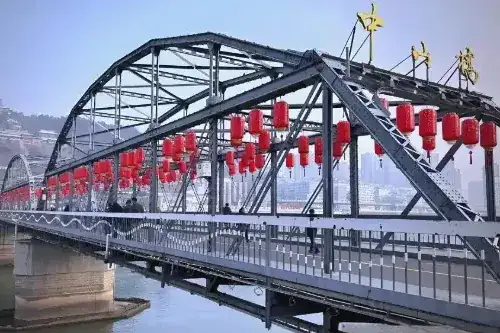
Lanzhou has 9 national-level and 45 provincial-level protected cultural heritage sites. Notable sites include the Yellow River Iron Bridge ("First Bridge of the Yellow River"), built in 1909 by a German firm; Hongcheng Gansi Temple (built 1492, Ming Dynasty); Jintian Daoist Temple (built 1400); and the Lanzhou Prefecture City God Temple (originally Song Dynasty, rebuilt in Qing).
Intangible Cultural Heritage
As of June 2024, Lanzhou has 5 national-level, 42 provincial-level, and 77 municipal-level intangible cultural heritage representative projects, with 6 national, 41 provincial, and 113 municipal-level inheritors. The city has established a heritage museum and 44 training centers, cultivating over a thousand inheritors.
Scenic Spots
Overview
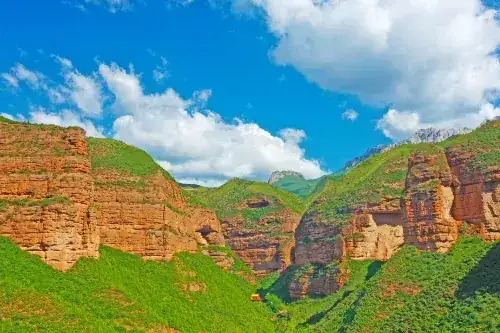
Lanzhou has 38 featured tourist attractions, including Wuquan Mountain, Baita Mountain, Shifogou, the Lu Tusi Yamen, Hekou Ancient Town, Qingcheng Ancient Town, Shuimo Danxia, and the Yellow River Tower. As of January 2024, the city has 10 AAAA-level and 22 AAA-level scenic areas. In the first half of 2024, Lanzhou received 57.3415 million tourists (up 42.98%), generating 38.623 billion yuan (approximately $5.3 billion USD) in tourism spending (up 72.05%).
External Relations
International Sister Cities
Lanzhou maintains international sister-city relationships, fostering exchanges in culture, education, and commerce.
Domestic Sister Cities
Lanzhou has established domestic sister-city partnerships with multiple Chinese cities.
Notable Figures
Lanzhou has produced many notable historical and contemporary figures across politics, military, academia, and the arts.
Major Honors
Lanzhou has received numerous national and provincial honors recognizing its contributions to urban development, environmental protection, and cultural preservation.
Travel information can change. Check current opening hours, reservations and entry requirements before you travel.
Traveller discussion
Start the conversation with a helpful tip or a question.