
Shangluo
ShangluoShangluo, also known as Hecheng (Crane City), Shangluo, or Shangzhou, is a prefecture-level city in southeastern Shaanxi Province, at the southern foot of the Qinling Mountains, bordering Hubei and Henan provinces. It covers a total
Shangluo
Shangluo, also known as Hecheng (Crane City), Shangluo, or Shangzhou, is a prefecture-level city in southeastern Shaanxi Province, at the southern foot of the Qinling Mountains, bordering Hubei and Henan provinces. It covers a total area of 19,292 square kilometers and administers 1 district and 6 counties. As of the end of 2025, the resident population was 2,005,100. The northern part has a warm temperate climate and the southern part a subtropical climate. The terrain is classified into river valley plains, low mountains, and mid-level mountains, with higher elevations in the northwest and lower in the southeast. Human activity dates back to the Paleolithic Age. During the Qin dynasty through the Three Kingdoms period, Shangxian and Shangluo counties constituted the present-day Shangluo area. In 2002, the prefecture-level city of Shangluo was established. The city's four pillar industries are specialty agriculture (mushrooms, fruits, medicinal herbs, livestock, tea), emerging industries, rural tourism, and processing. Zhashui wood ear was selected as a national "Three Products, One Standard"model case. In 2025, GDP reached 82.392 billion yuan (approximately US$11.6 billion), up 5.8%. Shangluo was designated a "National Forest City" in 2019.
Name Origin and Evolution
According to the Records of the Grand Historian, Xie, a son of Emperor Ku, assisted Yu the Great in flood control and was enfeoffed at Shang—the earliest state name for this area. The name "Shangluo" derives from Shang Mountain and the Luo River. During the Spring and Autumn and Warring States periods, the area was called "Shangyu" (combining Shang and the neighboring Yu). Duke Xiao of Qin enfeoffed Wei Yang (Shang Yang) here, hence the name "Lord of Shang" or "Shang Yang." During the Sui dynasty, Emperor Wen renamed the area Shangluo—the first use of the combined name.
Historical Evolution
Pre-Qin Period
Human activity in Shangluo dates back over one million years to the Paleolithic Age. During the Neolithic period, early inhabitants settled along the Luo River, Dan River, Jinqian River, Qianyou River, and Xun River. During the Xia dynasty, Xie was enfeoffed here for his flood control contributions. The area belonged to Jin during the Spring and Autumn period and to Qin during the Warring States period.
Qin, Han, through Northern and Southern Dynasties
From the Qin dynasty through the Three Kingdoms (221 BCE–280 CE), Shangxian and Shangluo counties constituted the area. In 266 CE, the Western Jin established Shangluo Commandery. During the Northern Wei, Luozhou was established at Shangluo City with five commanderies. In 578 CE, the Northern Zhou renamed Luozhou as Shangzhou.
Sui, Tang, through Song and Yuan
In 583 CE, the Sui dynasty retained Shangzhou. In 618 CE, the Tang established Shangzhou under the Shannan Circuit. During the Five Dynasties, the administrative system followed the Tang model. The Northern Song retained Shangzhou under the Yongxing Circuit. During the Southern Song, the area was contested between Song and Jin forces. In the Yuan dynasty, Shangzhou was initially under Anxi Circuit, later under Fengyuan Circuit, and directly governed Luonan County.
Ming and Qing
The Ming retained Shangzhou. In 1374, due to low population, it was downgraded to a county. In 1475, Shang County was elevated back to Shangzhou under Xi'an Prefecture, with the addition of Shanyang and Shangnan counties. The Qing retained the Ming system. In 1725, Shangzhou was elevated to a directly administered prefecture.
Republic of China
In 1913, Shangzhou was abolished and replaced with Shangxian, Luonan, and Zhashui counties under Guanzhong Circuit, and Shanyang, Shangnan, and Zhen'an under Hanzhong Circuit. In 1935, the Fourth Administrative Inspectorate was established in Shangxian, governing 6 counties. On July 13, 1949, the Shangxian People's Government was established.
After the Founding of the People's Republic of China
In 1950, the Shangluo Sub-district Commissioner's Office was established, governing 7 counties. In 1958, Danfeng and Zhashui counties were temporarily abolished. In 1964, the rare character the archaic character Luo was changed to the standard character Luo with State Council approval. In 1988, Shangxian was converted to county-level Shangzhou City. In 2002, the prefecture-level city of Shangluo was formally established, with the former Shangzhou City renamed Shangzhou District.
Physical Geography
Location and Boundaries
Shangluo is in southeastern Shaanxi at the southern foot of the Qinling Mountains, bordering Hubei and Henan. It is between 108°34′20″–111°1′25″E and 33°2′30″–34°24′40″N, spanning 229 km east-west and 138 km north-south, covering 19,292 square kilometers.
Climate
The north has a warm temperate climate and the south a subtropical climate. The average annual temperature is 7.8°C–13.9°C (maximum 37°C–40.8°C, minimum −11.8°C to −21.6°C). Average annual precipitation is 710–930 mm, concentrated from April to October (85%–89%). Annual sunshine is 1,860–2,130+ hours, with a frost-free period of 210 days.
Geology
Shangluo has intense structural deformation with well-developed folds and faults, extensive igneous rocks, and complete sedimentary strata. The city straddles two first-order tectonic units: the southern margin of the North China Platform and the Qinling Fold System, separated by the Tieluizi-Sanyao Fault.
Topography and Landforms
Shangluo is a mountainous city dominated by mid-level and low mountains. The highest point is Niubeiliang on the Qinling main ridge in Zhashui County (2,802.1 m), and the lowest is the Dan River valley near Shangxilou in Shangnan County (215.4 m), a relative elevation difference of 2,578 m. The terrain is classified into valley plains (2.86%), low mountains (70.86%), and mid-level mountains (16.28%).
Hydrology
Shangluo has over 72,500 rivers and tributaries, with 5 rivers having catchment areas exceeding 1,000 km². Major rivers include the Luo River, Dan River, Jinqian River, Qianyou River, and Xun River. The Luo River belongs to the Yellow River Basin (15% of total area), while the rest belong to the Yangtze River Basin (85%). As of 2016, the city had 52 reservoirs with total capacity of 143.15 million cubic meters and 85 hydropower stations with installed capacity of 70,799 kW.
Soil
Shangluo has 8 soil types, 18 subtypes, 45 soil groups, and 138 soil varieties. Cinnamon soil covers 11%, brown earth 26.62%, and yellow-brown earth 53.91% of the total soil area.
Natural Disasters
Major natural disasters include droughts, floods, hail, and frost. In July 2021, Luonan County experienced severe flooding that affected 69,762 people across 16 towns, collapsed 25 houses, damaged 792 households, and disrupted roads, power, and communications to multiple towns.
Natural Resources
Water Resources
In 2020, average precipitation was 746.8 mm (14.407 billion cubic meters), and total water resources were 3.577 billion cubic meters, 26.3% below the multi-year average.
Land Resources
As of 2022, Shangluo had 118,100 hectares of cultivated land, 21,900 hectares of orchard land, 1,698,000 hectares of forest land, 15,200 hectares of grassland, and 2,400 hectares of wetland.
Mineral Resources
Shangluo has 61 discovered mineral varieties (43.6% of Shaanxi's total). The northern area is the Xiao Qinling metallogenic belt (gold, molybdenum, jade); the central area is the North Qinling belt (gold, copper, fluorite, graphite); and the southern area is the South Qinling belt (iron, gold, vanadium, silver, tungsten, barite). As of 2022, newly proven reserves include iron (12.2349 million tons), copper (14,000 tons), vanadium (1.6218 million tons), molybdenum (221,600 tons), and gold (73.77 tons).
Biodiversity
Shangluo is known as the "Crossroads of Northern and Southern Flora" and the "Treasury of Northern and Southern Biological Species." The city has 1,012 species of seed plants across 123 families and 494 genera, including 460+ medicinal species. Forest coverage is 66.5%. The city has 1,192 types of Chinese medicinal herbs. Wildlife includes 50+ mammal species, 40+ common bird species, and 10+ fish and amphibian species. Twenty-four species are under national protection, including Class I protected takin and black stork. The city has 4 nature reserves, including the Danfeng Wuguanhe National Nature Reserve (9,029 hectares) protecting rare aquatic animals including giant salamander.
Administrative Divisions
As of October 2024, Shangluo administers 1 district (Shangzhou) and 6 counties (Luonan, Danfeng, Shangnan, Shanyang, Zhen'an, and Zhashui). The municipal government is at No. 26, 9th Floor, Municipal Administrative Center, Minzhu Road, Shangzhou District.
Politics
Population
Population Size
At the end of 2023, registered population was 2,469,700 (1,307,500 males). Resident population was 2,012,500, a decrease of 8,100. The birth rate was 6.08‰, death rate 8.23‰, and natural growth rate −2.15‰. The urbanization rate was 51.59%.
Ethnic Groups
Shangluo has 27 ethnic minorities totaling 12,670 people (0.52% of the population), predominantly Hui (11,618). There are 2 Hui ethnic towns (Xikou and Maoping in Zhen'an County) and 10 ethnic villages.
Language
Shangluo's dialects are extremely complex. North of the Dan River valley, the "local dialect" belongs to the northwestern dialect group; south of it, the "Xiahu dialect" belongs to the southwestern dialect group. The east shows central-southern dialect influences from Henan, and the west shows minor Bashu dialect influences from Sichuan.
Religious Beliefs
All five major religions are present: Buddhism, Protestantism, Islam, Daoism, and Catholicism. Buddhism was introduced during the Eastern Han (67 CE). Islam was introduced during the Tang dynasty via the Silk Road. The number of believers is relatively small.
Economy
Overview
Shangluo's economy is based on agriculture, industry, and tourism. Zhashui wood ear was selected as a national "Three Products, One Standard" model case. In 2023, GDP grew 4.1%, with the primary industry accounting for 15.5%, secondary industry 28.2%, and tertiary industry 56.3%. Per capita GDP was 41,443.6 yuan (approximately US$5,830).
Primary Industry
Shangluo had 72 agricultural products listed in the national catalogue of premium specialty products—the most of any prefecture-level city nationwide. In 2023, total agricultural output was 23.986 billion yuan. Grain sown area was 2.3947 million mu with output of 505,400 tons.
Secondary Industry
Manufacturing is the leading secondary industry. In 2023, above-scale industrial added value grew 8.3%, with mining up 29.6% and manufacturing up 7.0%. The three pillar industries—modern materials, modern pharmaceuticals, and green food—saw output growth of 19.4%, 19.9%, and 3.7% respectively. Construction industry output was 15.602 billion yuan.
Tertiary Industry
In 2023, postal industry revenue was 543 million yuan (up 20.5%), with express delivery volume of 12.3641 million pieces (up 27.7%). Total retail sales reached 21.962 billion yuan (up 6.6%). Total import-export value was 1.715 billion yuan. Tourism grew significantly, with visitor numbers up 75.2% and revenue up 82.5%. Financial institution deposits reached 173.78 billion yuan and loans 99.664 billion yuan.
Social Affairs
Education
Shangluo has 1 undergraduate institution (Shangluo University) with 12,000 students, 1 vocational college, 17 high schools, 145 junior high schools, 7 secondary vocational schools, 309 primary schools, and 470 kindergartens.
Healthcare
The city has 2,717 health institutions including 67 hospitals and 123 township health centers, with 17,386 beds and 17,438 health personnel. Shangluo Central Hospital, founded in 1939, is a Grade III-A hospital with 1,800 planned beds.
Science and Technology
In 2023, 121 high-tech enterprises and 518 technology-based SMEs were registered. Technology contract transactions totaled 436 million yuan. Patent grants reached 507, including 49 invention patents.
Culture
Radio coverage is 98.82% and TV coverage 99.25%. Shangluo Huagu modern drama Ruohe won the highest "Wenhua Award" at the 10th Shaanxi Arts Festival. The city has 2 public libraries and multiple cultural centers, including the first self-service "City Study Room" in southern Shaanxi.
Sports
Shangluo hosted the National Beach Volleyball Championship and other major events. Two national-level permanent sports training bases are located in the city. The Shangluo Gymnasium has 4,100 seats.
Environmental Protection
In 2023, Shangluo had 334 excellent air days, with the air quality composite index ranking first in the province. The city was designated as China's first "Beautiful China · Deep Breathing Capital" and included in the first batch of climate ecological product value realization pilot cities.
Social Security
In 2023, 16,000 new urban jobs were created. Basic medical insurance covered 2.1697 million people, and pension insurance covered 1.625 million people. Urban low-income assistance covered 11,200 people and rural assistance 147,700 people.
Transportation
Overview
Shangluo is at the junction of Hubei, Henan, and Shaanxi provinces, within the Qinling Mountains. As of 2021, the highway network totaled 20,359.09 km. Shangluo was the first prefecture-level city in Shaanxi to have all counties connected by expressway, with 6 expressway corridors forming a "three vertical, two horizontal, two bypass" framework.
Highways
The highway network includes 493.18 km of expressways, 1,885.14 km of national/provincial highways, and 17,980.77 km of rural roads. 100% of administrative villages have paved roads and bus service.
Railways
Three railways serve Shangluo: the Nanjing-Xi'an, Xi'an-Chongqing, and Xi'an-Ankang railways, with 6 stations including Shangluo, Yanchuan, Danfeng, Shangnan, Zhen'an, and Zhashui. The Xi'an-Ankang High-Speed Railway passes through Zhashui and Zhen'an counties.
Aviation
Danfeng General Airport is Shangluo's only airport, a 622-mu facility with 286 million yuan investment, offering emergency rescue, aerial seeding, tourism, flight training, and weather modification services.
Public Transit
As of October 2022, Shangluo has 100 pure electric ride-hailing vehicles, 265 pure electric buses, and 60 bus routes, with 65% urban-rural transit integration within the 20 km city radius.
Culture
Overview
Shangluo sits at the cultural crossroads of Qin and Chu, where "Yellow River culture" brought by immigrants from the north and "Yangtze River culture" brought by immigrants from the south converge. Local performing arts include Qin opera, Huagu (flower drum), Daoqing, and Erhuang. In 1985, Shangluo was named the "Hometown of Drama" by the Shaanxi Provincial Department of Culture.
Cuisine
Shangzhou big stew (dahuiicai), Shangzhi pork, Luonan hot tofu, Zhen'an taro with cured meat, and Zhen'an chestnut-braised chicken are signature dishes. Shangzhi pork uses a fern-like plant (shangzhi) dried and layered over braised pork belly. Shangzhou big stew is a soul food of locals, made with pork bone broth and carrots.
Local Specialties
Shangluo specialties include Shaanxi black wood ear, Shanyang dragon whisker grass, Shangzhi, Zhen'an chestnuts, Shangluo walnuts, and Danfeng wine. Shangluo walnuts are known for large size, thin shells, and high oil content—walnut is the city tree. Danfeng wine has over 100 years of history since 1911 and was recognized as a "China Time-Honored Brand" in 2024. Zhashui potato cakes (yangyu ciba) are made by pounding steamed potatoes in stone troughs and are listed as provincial intangible cultural heritage.
Customs
Lantern snatching is a fun Lantern Festival activity where a masked person steals a flower lantern, delivers it to a young couple's home for fertility blessings, followed by 100 days of "lantern watching" as a form of prenatal education. City God Temple Fair on the 8th of the fourth lunar month is both a religious celebration and a pre-harvest trade fair.
Arts
Shangluo has rich theatrical traditions including Qin opera, Shangluo Huagu (national intangible cultural heritage since 2006), Shangluo Daoqing, Luonan Jingban storytelling (national intangible cultural heritage since 2011), and Zhen'an shadow puppetry. Zhen'an clay sculpture is a municipal intangible cultural heritage.
City Symbols
The city tree is the walnut tree (Juglans regia), and the city flower is the forsythia (Forsythia suspensa), widely distributed across the city's 6 counties and 1 district with a total area of 522,000 mu.
Historical Sites
As of February 2022, Shangluo has 6 national-level and 50 provincial-level protected cultural relic units. The Donglongshan Site, discovered in 1997, yielded artifacts from the Xia, Shang, and Zhou periods, filling the gap between Longshan and Erlitou cultures—named as a new cultural type: "Donglongshan Culture."
Intangible Cultural Heritage
As of May 2024, Shangluo has 3 national-level and 31 provincial-level intangible cultural heritage projects, including Shangluo Huagu, Shangluo Daoqing, and Luonan Jingban storytelling.
Scenic Spots
Overview
As of 2021, Shangluo has 27+ A-level scenic areas, including 1 5A-level (Jinsi Grand Canyon), 14 4A-level, and 27 3A-level. In 2023, tourism numbers and revenue grew 75.2% and 82.5% respectively. Zhujiawan was named "World's Best Tourism Village" by the UN World Tourism Organization.
Key Attractions
Jinsi Grand Canyon National Forest Park: A 5A-level scenic area in southeastern Shangnan County, featuring five scenic areas with 100+ attractions across 20.5 km of canyons—the most complete gorge geological structure in the Qinling region.
Niubeiliang National Forest Park: A 4A-level park in Zhashui County at 1,000–2,802 m elevation, 42 km from Xi'an, with dense primeval forest and waterfalls.
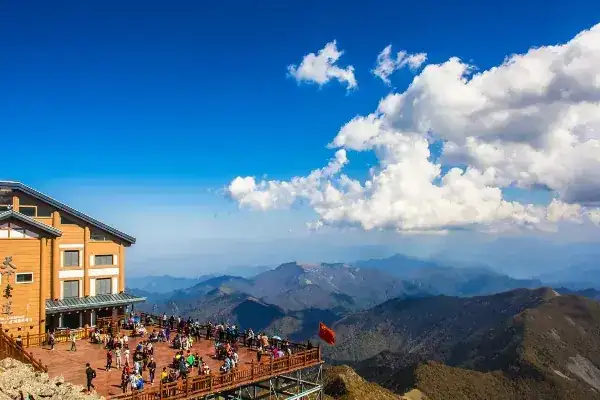
Tianzhu Mountain National Forest Park: A 4A-level park in Shanyang County with main peak at 2,074 m, known as the "Little Wudang of the Northwest" for its Daoist heritage.
Zhashui Karst Cave: A 4A-level scenic area with 118 karst caves, 82 km from Xi'an.
Tayun Mountain: A 4A-level scenic area in Zhen'an County with Daoist architecture dating to the Ming Zhengde reign.
Dan River Rafting: A 4A-level scenic area, known as "China's Best Rafting Destination."
Manyangguan Ancient Town: A 4A-level scenic area at the Shaanxi-Hubei border, with the best-preserved Qing dynasty caravan guild hall complex in Shaanxi.
Muwang National Forest Park: A 4A-level park in Zhen'an County covering 3,616 hectares with diverse landscapes of forests, rhododendrons, peaks, and rock formations.
External Relations
International Exchange
Domestic Exchange
Notable Figures
Honorary Titles
Travel information can change. Check current opening hours, reservations and entry requirements before you travel.
Traveller discussion
Start the conversation with a helpful tip or a question.