
Yulin City
Yulin CityYulin, also known as "Camel City," is a prefecture-level city in Shaanxi Province, a provincial sub-center city, located at the northernmost tip of Shaanxi at the junction of five provinces/regions: Shaanxi, Gansu, Ningxia, Inner
Yulin City
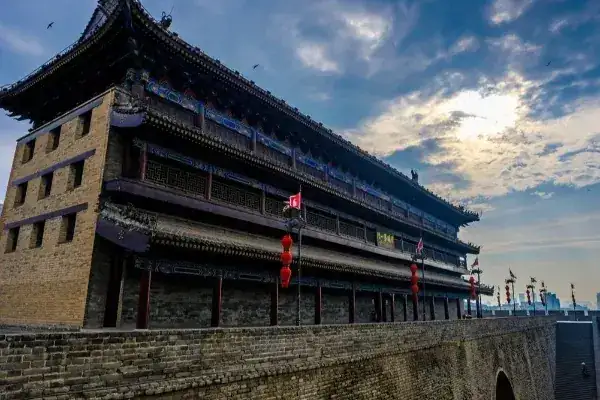
Yulin, also known as "Camel City," is a prefecture-level city in Shaanxi Province, a provincial sub-center city, located at the northernmost tip of Shaanxi at the junction of five provinces/regions: Shaanxi, Gansu, Ningxia, Inner Mongolia, and Shanxi. Total area: 42,920 square kilometers. The city administers 2 districts, 1 county-level city, and 9 counties, with 155 townships, 29 sub-districts, and 2,967 administrative villages. The permanent resident population was 3,616,500 (2024). The municipal government is in Yuyang District. The terrain descends from west to east, with the highest point at Weiliang in southern Dingbian (1,907m) and the lowest at 560m where the Wuding River enters the Yellow River in Qingjian. Three landform types: sandy grassland, loess hills and ravines, and ridge-shaped low mountain hills. During the Ming Dynasty, Yulin Guard was established in 1471 during the Chenghua reign, and Yulin Prefecture was established during the Yongzheng reign of the Qing Dynasty. In 2000, the prefecture was converted to a city. The city has a "Three Horizontals, Five Verticals" trunk railway network, and Yuyang 4E-level airport is Shaanxi's second-largest aviation hub. Notable sites include Zhenbei Platform, the Yulin Ancient City, and the Yulin Desert National Forest Park. The city holds titles including National Famous Historical and Cultural City, National Health City, National Forest City, and National New Energy Demonstration City. In 2024, GDP was 754.868 billion yuan, with per capita GDP of 208,995 yuan.
History
According to historical records, during the Xia (c. 2070-1600 BCE) and Shang dynasties, parts of Yulin (Shenmu, Fugu, Jiaxian) were in the Yongdi tribe territory. During the Zhou Dynasty (1046-256 BCE), it was part of Baidi in Yongzhou. During the Spring and Autumn period (770-476 BCE), it belonged to Jin; during the Warring States period (475-221 BCE), to Wei. After Qin unified China, it was part of Shang Commandery.
During the Eastern Jin Dynasty (317-420), the Xiongnu leader Helian Bobo established the Great Xia State at Tongwancheng (present-day Baichengzi in Jingbian). In 427, the Northern Wei (386-534) destroyed Great Xia and established Tongwan Garrison, renamed Xiazhou in 488.
During the Sui Dynasty (581-618), four prefectures were maintained. In the early Tang period, the area was occupied by the local strongman Liang Shidu, who declared himself the "Liang State" and usurped the imperial title. In 628, the Tang Dynasty (618-907) defeated Liang and restored the Yin, Sui, and Xia prefectures under Guannei Circuit. In 724, Linzhou was established in the northeast.
During the Five Dynasties period (907-960), various prefectures were maintained. During the Northern Song (960-1127), the area belonged to Yongxing Army Circuit, with Suizhou and Youzhou occupied by Western Xia. After Emperor Gaozong fled south, the area fell to the Jin Dynasty. During the Yuan Dynasty (1271-1368), Suidezhou and Jiazhou belonged to Yan'an Circuit.
In 1408, during the Ming Dynasty, Yulin Fort was built at present-day Hongshan (Xiongshi Gorge), and the name "Yulin" first appeared in history - named because the local soil was especially suitable for growing elm (yu) and willow (liu) trees. In 1471, Yulin Guard was established along the Great Wall. During the Yongzheng reign of the Qing Dynasty, Yulin Prefecture was established.
In 1937, the Shaan-Gan-Ning Border Region government was established. On June 1, 1949, Yulin City was peacefully liberated. In 1950, two special districts (Suide and Yulin) were established. In 1956, the Suide Special District was merged into Yulin. In 2000, the prefecture was converted to the prefecture-level Yulin City, with the former county-level Yulin City becoming Yuyang District.
Administrative Divisions
Divisional History
In December 2015, Hengshan County became Hengshan District. In April 2017, Shenmu County became the county-level Shenmu City, administered by Yulin.
Division Details
As of end 2023: 2 districts (Yuyang, Hengshan), 9 counties (Shenmu, Fugu, Jiaxian, Wubao, Qingjian, Zizhou, Suide, Mizhi, Jingbian, Dingbian), 1 county-level city (Shenmu). Government: Yuyang District.
Geographical Environment
Location and Boundaries
Northernmost Shaanxi, at the junction of five provinces/regions, between 36°57'-39°35'N and 107°28'-111°15'E. Bordered by the Yellow River and Shanxi to the east, Ningxia and Gansu to the west, Inner Mongolia to the north, and Yan'an to the south. Total area: 42,920 km². Terrain divided by the Great Wall: sandy grassland in the north, loess hills and ravines in the south. Average elevation: 1,220m.
Geology
Belongs to the Ordos Platform Syncline of the Sino-Korean Paraplatform. An ancient platform with no magmatic activity and very few earthquakes.
Landforms
Terrain descends from west to east. The highest point is Weiliang (1,907m) in southern Dingbian; the lowest at 560m in Qingjian. Three landform types: sandy grassland (northern Mu Us Desert margin, 18,026 km², 42% of area, dotted with lakes), loess hills and ravines (southern, 24,894 km², 58%), and ridge-shaped low mountain hills (southwestern Baiyushan area, 5,000 km², 11.55%).
Climate
Warm temperate to mid-temperate semi-arid continental monsoon climate. Four distinct seasons, large diurnal temperature differences, short frost-free period. Average annual temperature: 8°C. Average annual precipitation: ~400 mm. Yulin has the longest sunshine hours in Shaanxi: 2,593.5-2,914.4 hours annually.
Hydrology
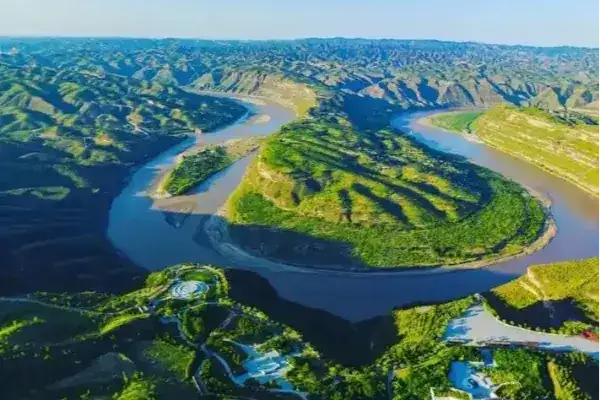
53 rivers flow into the Yellow River, all relatively short. Main rivers: Huangfu, Qingshui, Gushan, Shimachuan, Kuye, Tuwei, Jialu, and Wuding rivers. Tributaries form a dendritic pattern.
Natural Resources
Overview
22 mineral types discovered, including national strategic minerals (coal, oil, natural gas) and advantageous rock salt. Proven coal: 152.7 billion tonnes (82% of provincial); oil: 360 million tonnes (core of the Shaan-Gan-Ning oil field); natural gas: 1.18 trillion m³ (core of China's largest onshore gas field); rock salt: 887.2 billion tonnes (~26% of national, 96% of provincial). Total mineral potential value exceeds 46 trillion yuan (1/3 of national total).
Mineral Resources
Coal: predicted reserves 280 billion tonnes, proven 149 billion tonnes (1/5 of national, 86.2% of provincial). Every square meter of Yulin's 43,578 km² contains 6 tonnes of coal on average. "Three lows, one high": ultra-low ash, ultra-low sulfur, ultra-low phosphorus, medium-high calorific value - the highest quality environmental thermal coal in China.
Oil: predicted 1 billion tonnes, proven 360 million tonnes. Natural gas: predicted 6 trillion m³, 4 proven fields, 1.18 trillion m³ proven. Rock salt: predicted 6 trillion tonnes, proven 885.7 billion tonnes (~26-52% of national), the largest rock salt mining area in China, with average grade 96.47-98.16%.
Population
Population Numbers
As of end 2024: 3,616,500. Birth rate: 7.8 per mille; death rate: 7.15 per mille; natural growth rate: 0.65 per mille. Urban: 2,331,900 (64.48%); rural: 1,284,600 (35.52%).
Ethnic Composition
35 ethnic minorities (4,890 people) across 12 counties/districts, with Han as the main ethnic group.
Politics
Current Leadership
Sister Cities
Economy
Overview
In 2024, GDP was 754.868 billion yuan (up 6%). Primary: 31.794 billion (up 3.6%); secondary: 522.048 billion (up 6.4%, with above-designated-size industry +8.2%); tertiary: 201.026 billion (up 5.8%). Per capita disposable income: 33,731 yuan (up 5.8%); urban: 44,993 yuan; rural: 19,610 yuan.
Primary Industry
In 2023: agricultural output 55.658 billion yuan (up 4.6%). Grain sown area: 732,790 hectares; grain output: 2.5392 million tonnes (up 0.6%). Afforestation: 1.3192 million mu (up 20%).
Secondary Industry
In 2023: 1,005 above-designated-size industrial enterprises. Revenue: 674.67 billion yuan (down 13.6%); profits: 203.38 billion (down 24.3%). Construction: output 52.333 billion (up 9.6%). Yulin National High-Tech Industrial Development Zone: upgraded to national level in 2012. The Yulin National Energy and Chemical Industry Base is part of the Shaanbei Energy and Chemical Base, one of China's national-level energy and chemical bases, covering Yulin and Yan'an (80,000 km²).
Tertiary Industry
In 2023: retail sales 77.243 billion yuan (up 5.2%). Import/export: 5.773 billion (up 73.7%); exports: 4.858 billion (up 83.5%). Financial deposits: 879.19 billion (up 11.8%); loans: 335.185 billion (up 10.3%). 10 securities companies; 40 insurance companies with premiums of 9.129 billion (up 14.4%).
Transportation
Overview
Yulin is on the new Eurasian Continental Bridge and at the intersection of the Baotou-Xi'an Railway and Taiyuan-Zhongwei-Yinchuan Railway, plus the Qingyin and Baomao expressways. Annual freight capacity exceeds 300 million tonnes. "Three Horizontals, Five Verticals" railway network: 1,369 km. Expressways: 1,157 km, county-wide coverage. Yuyang 4E-level airport: Shaanxi's second-largest, serving 26 major domestic cities with 5 international routes.
Highways
As of end 2023: total mileage 35,849.13 km (1,156.68 km expressways, 1,086.38 km national, 597.72 km provincial, 33,008.35 km rural). Freight: 312.36 million tonnes (up 10.4%); passengers: 8.0812 million (up 12.4%).
Railways
5 main lines: Baotou-Xi'an (864 km total, ~300 km in Yulin), Taiyuan-Zhongwei-Yinchuan (751 km, ~277 in Yulin), Shenmu-Shuozhou (274 km, 100 in Yulin), Jingshen (233 km, coal transport), and Hongning (43 km). In 2023: rail freight 298.006 million tonnes (up 5.2%); passengers 5.353 million (up 99.3%).
Aviation
Yulin Yuyang Airport: Shaanxi's second-largest aviation hub, 4C-level regional airport. Opened April 10, 2008, 15.5 km northwest of the city. In 2012, became the second regional airport in northwest China to exceed 1 million annual passengers. In 2023: 2.2369 million passengers (up 164.5%); cargo 12,088.94 tonnes (up 250.4%).
Social Undertakings
Education
As of end 2024: 1,217 schools (4 higher education, 22 secondary vocational, 41 general high, 164 junior high, 291 primary, 681 kindergartens, 14 special education). 749,900 students (86,500 high school, 34,900 vocational, 170,900 junior high, 334,800 primary, 121,800 preschool, 1,163 special education). 55,683 full-time teachers.
Science and Technology
In 2023: 100 registered science achievements (59 at domestic leading level), 5 provincial science awards. 3,580 patents authorized (303 invention). Technology contracts: 1.535 billion yuan.
Culture
In 2023: 9 performing troupes, 48 theaters/cinemas, 13 cultural centers, 13 public libraries, 201 cultural stations, 40 museums/memorials. Broadcasting coverage: 99.68%.
Healthcare
As of end 2024: 3,712 medical institutions (112 hospitals, 22 community centers, 206 township health centers, 2,486 village clinics). 23,698 beds. 31,591 health workers. 4 Class III general hospitals, 17 Class II. Employee medical insurance: 605,000; resident medical: 3.0001 million.
Sports
Per capita sports area: 2.49 m². 43 public sports venues. In 2024: 242 mass sports events, 9 competitive sports events. 1,149 athletes at provincial championships: 127 gold, 121.5 silver, 137 bronze. Sports lottery: 1.135 billion yuan. In February 2026, Shaanxi's first Winter Games will be held in Yulin.
Social Security
As of end 2023: urban employee pension 577,800; work injury 736,800; unemployment 377,900; resident pension 1,791,700. 102 welfare institutions with 12,216 beds. Minimum living allowance: 166,800 people (125,700 rural, 41,100 urban). Urban standard: 780 yuan/month; rural: 5,640 yuan/year.
Historical Culture
Cultural Heritage
Intangible Cultural Heritage
Folk Customs
Yulin has 12 counties, traditionally divided into "North 6" and "South 6" counties. North 6 (Yulin, Hengshan, Shenmu, Fugu, Jingbian, Dingbian) have the Great Wall crossing their territory and Mu Us Desert sand dunes. South 6 (Suide, Mizhi, Qingjian, Wubao, Jiaxian, Zizhou) are inside the Great Wall in the loess hilly region. Northern customs reflect grassland/nomadic culture: residents eat fried rice, dairy products, hand-grabbed mutton, drink liquor, wear leather. Southern customs reflect Yellow River/settled culture: residents live in cave dwellings (yaodong), eat coarse grains, wear cloth clothing, and follow agricultural lifestyles.
Cuisine
Northern residents eat fried rice, milk tea, butter, yellow rice with sour cabbage. Western Sanbian residents favor oat noodles, buckwheat dishes, lamb. Regional specialties: Zizhou fruit-filled pastries, Mizhi donkey intestines, Suide black powder rolls, Zhenchuan dry oven cakes, Jiaxian horseshoe crisp, Yulin fried soy milk, Shenmu vermicelli, Qingjian pancakes, Fugu fruit leather. Also: lamb offal soup, bean pulp rice, Pin San Xian, yellow wine.
City Assessment
Emperor Wuzong of Ming, while stationed in Yulin, told his attendants: "Yulin is truly a little Beijing!" The "History of Ming" records Yulin's extraordinary loyalty: "Yulin is a great garrison of the realm, its troops the finest, its generals the most numerous." In 1643, when surrounded by Li Zicheng's army, Yulin resisted for 12 days without a single defection, and the entire city died for the cause. In 1675, the Kangxi Emperor bestowed the inscription "Twice Defending the Lone City, A Thousand Years of Loyalty and Valor." In 1938-1939, the writer Lao She described the city as having "the appearance of Beijing."
Scenic Spots
Food and Specialties
Food
Local specialties: lamb series (roast whole lamb, braised lamb, lamb offal soup), buckwheat series (buckwheat noodles), millet, tofu series, potato series, and Hongjiannao specialty boiled fish.
Specialties
Yulin Red Dates: A famous Shaanxi traditional specialty - large fruit, small pit, thin skin, thick flesh, crisp texture, sweet juice, high sugar content, bright red color, excellent quality. Average single fruit weight 12.6g, up to 35g.
Yulin Potatoes: Yulin is the famous "Hometown of Potatoes" - annual production exceeds 1.5 billion kg. Red-skinned and white-skinned varieties with strong disease resistance, high yields, and 2% higher starch content than other regions.
Yulin Mung Beans: Large, uniform, excellent color - a famous brand in domestic and international markets, with thousand-grain weight of 6.6-7.6g.
Hengshan Cashmere Goats: Developed since 1979 by crossbreeding Liaoning white cashmere goats (sire) with northern Shaanxi black goats (dam), producing high-yield, fine-fiber, stable, adaptable white cashmere goats.
Buckwheat: Yulin's loess plateau is a famous buckwheat production area in Shaanxi.
Haihong Fruit: A traditional tree in Fugu County, a rare world species. The fruit is brightly colored, sweet-sour, nutrient-rich with high calcium content - "the King of Calcium." 15,067 mu with 200,000 trees bearing fruit, producing 1,500-2,000 tonnes annually. Products include beverages, dried fruit, canned goods, and wine.
Famous Figures
Honorary Titles
Travel information can change. Check current opening hours, reservations and entry requirements before you travel.

Traveller discussion
Start the conversation with a helpful tip or a question.