
Hanzhong
HanzhongHanzhong, abbreviated as "Han," is a prefecture-level city in southwestern Shaanxi Province, China. It borders Ankang to the east, Longnan City of Gansu Province to the west, Guangyuan City and Bazhong City of Sichuan Province to th
Hanzhong
Hanzhong, abbreviated as "Han," is a prefecture-level city in southwestern Shaanxi Province, China. It borders Ankang to the east, Longnan City of Gansu Province to the west, Guangyuan City and Bazhong City of Sichuan Province to the south, and Baoji City and Xi'an City to the north. The municipal area covers 27,097 square kilometers. As of August 2025, Hanzhong administers 2 districts and 9 counties. As of the end of 2024, the resident population was 3,159,400, with an urbanization rate of 55.19%. The terrain is high in the north and south, low in the middle, primarily consisting of mountains, hills, and flatlands, between 105°29′14″–108°16′49″E and 32°08′52″–33°52′46″N, in the northern subtropical climate zone. The city has a long history traceable to the Paleolithic Age. During the Qin dynasty, Hanzhong Commandery was established. The city was liberated on December 6, 1949, and became a prefecture-level city on February 21, 1996. Hanzhong is a traditional agricultural city, with equipment manufacturing, modern materials, and green food and pharmaceuticals as its three pillar industries. Named after the Han River, the city has been known since ancient times as "Tianhan" and "Land of Abundance." In 1994, Hanzhong was designated a National Historical and Cultural City. In the first three quarters of 2023, Hanzhong's GDP reached 140.159 billion yuan (approximately US$19.7 billion). In 2024, GDP grew by 6.2%.
Name Origin and Evolution
Hanzhong is named after the Han River. In 451 BCE, the State of Chu established Hanzhong Commandery in the middle reaches of the Han River at Ankang. In the early Eastern Han dynasty, the commandery seat was relocated to the present area, retaining the name Hanzhong. In 312 BCE, the State of Qin occupied the area and continued the name. The name was used through the Han dynasty and Northern and Southern Dynasties until the Sui dynasty. In 581 CE, Emperor Wen changed the name to Hanchuan Commandery to avoid the taboo of his father's name. The Tang dynasty restored Liangzhou and then Hanzhong Commandery. In 784 CE, Emperor Dezong renamed Liangzhou as Xingyuan Prefecture. This name was used through the Five Dynasties and Yuan dynasty. In 1370, the Ming dynasty restored the name Hanzhong Prefecture, which was retained through the Qing dynasty. In 1926, the prefecture was abolished and Hanzhong Circuit was established. After the founding of the PRC, it became Hanzhong Special District in 1954, Hanzhong Prefecture in 1968, and the prefecture-level city of Hanzhong in 1996.
Historical Evolution
Pre-Qin Period
Human activity in the Hanzhong area dates back one million years. During the Xia through Western Zhou periods, the State of Bao existed within the territory. During the Spring and Autumn and Warring States periods, the area was known as Nanzheng and belonged successively to the states of Ba, Shu, and Qin. In 312 BCE, King Huiwen of Qin established Hanzhong Commandery.
Qin, Han, through Northern and Southern Dynasties
In 221 BCE, Qin Shi Huang divided the empire into 36 commanderies, with Hanzhong as one. During the early Western Han, Liu Bang was enthroned as King of Han at Nanzheng, then used five years to conquer Chu and establish the Han dynasty, taking the name from the region. During the Eastern Han, Zhang Lu ruled Hanzhong and renamed it Hanning Commandery. In 215 CE, Cao Cao conquered Zhang Lu and restored the name Hanzhong. In 219 CE, Liu Bei captured Hanzhong. During the Three Kingdoms period, Wei conquered Shu in 263 CE and divided the area into Liang and Yi provinces. During the Northern and Southern Dynasties, Hanzhong belonged successively to Liu Song, Xiao Qi, Northern Wei, Xiao Liang, Western Wei, and Northern Zhou.
Sui, Tang, through Song and Yuan
During the Sui dynasty, the area retained Liang, Xing, and Yang prefectures, later changed to Hanchuan, Shunzheng, and Yangchuan commanderies. The Tang dynasty established the Liangzhou Military Governor's office. In 627 CE, Hanzhong was placed under the Shannan Circuit. In 784 CE, Liangzhou was renamed Xingyuan Prefecture, setting a precedent in Chinese history of naming a prefecture after an emperor's reign era. During the Five Dynasties, Former Shu, Later Tang, and Later Shu successively held Hanzhong. In the Yuan dynasty, Xingyuan Circuit was established at Hanzhong, marking the beginning of Hanzhong's affiliation with Shaanxi.
Ming and Qing
In April 1370, the Ming general Xu Da captured Xingyuan, and the area was renamed Hanzhong Prefecture. During the Qing dynasty, the Shaan-An Circuit was established at Hanzhong, governing Hanzhong and Xing'an (present-day Ankang) prefectures.
Republic of China
In 1913, Hanzhong Circuit was established, governing 25 counties. In 1928, the circuit was abolished. In 1935, the Sixth Administrative Inspectorate of Shaanxi was established.
After the Founding of the People's Republic of China
Hanzhong was liberated on December 6, 1949. On February 21, 1996, Hanzhong Prefecture was abolished and the prefecture-level city of Hanzhong was established, administering 11 counties and districts. In 2017, Nanzheng County was converted to a district. As of the end of 2020, the city administered 152 towns, 25 subdistricts, 1,894 administrative villages, and 293 urban communities.
Administrative Divisions
As of August 2025, Hanzhong administers 2 districts (Hantai and Nanzheng) and 9 counties (Chenggu, Yang, Xixiang, Mian, Ningqiang, Lueyang, Zhenba, Liuba, and Foping). The municipal government is seated at No. 43 Minzhu Street, Hantai District.
Physical Geography
Location and Boundaries
Hanzhong is located in southwestern Shaanxi Province, between 105°29′14″–108°16′49″E and 32°08′52″–33°52′46″N. It is bounded by the Qinling Mountains to the north and Micang Mountains to the south, with the upper Han River valley in the middle. It borders Ningshaan, Shiquan, Hanyin, and Ziyang counties of Ankang to the east; Hui, Cheng, Kang, and Liangdang counties of Longnan, Gansu to the west; Qingchuan, Wangcang, and Chaotian districts of Guangyuan, Nanjiang and Tongjiang of Bazhong, and Wanyuan of Dazhou in Sichuan to the south; and Feng, Taibai counties of Baoji and Zhouzhi County of Xi'an to the north. The city spans 261.5 km east-west and 192.6 km north-south, covering 27,246 square kilometers.
Climate
Hanzhong is in China's northern subtropical climate zone, divided by the 800 m elevation line of the Qinling and Micang Mountains into subtropical and warm temperate zones. The climate features short spring and autumn, long winter and summer, four distinct seasons, mild winters without severe cold, and summers without extreme heat. The multi-year average temperature is 13.8°C, with winter averaging 3.4°C and summer averaging 23.5°C. Average annual precipitation is about 900 mm. The prevailing wind is from the east, with an average wind speed of 1.1 m/s.
Geology
Hanzhong's geological structure consists of two major units: the Hanzhong Fault Depression and the South Qinling Variscan Fold Belt. The Hanzhong Fault Depression is on the northern margin of the Yangtze paraplatform, about 200 km long and 10–25 km wide, with a basement of late Proterozoic intrusives and a Quaternary sedimentary cover. The South Qinling Variscan Fold Belt features complex folds and steeply dipping strike faults trending northeast-east to southwest-west.
Topography and Landforms
Hanzhong's landscape consists of low terrace flatlands (10.2%), broad valley hills (14.6%), and Qinling low mountains (75.2%). The terrain rises in steps from south to north, with the lowest point at 478 m and the highest at 2,038 m, a difference of 1,551 m.
Hydrology and Water Resources
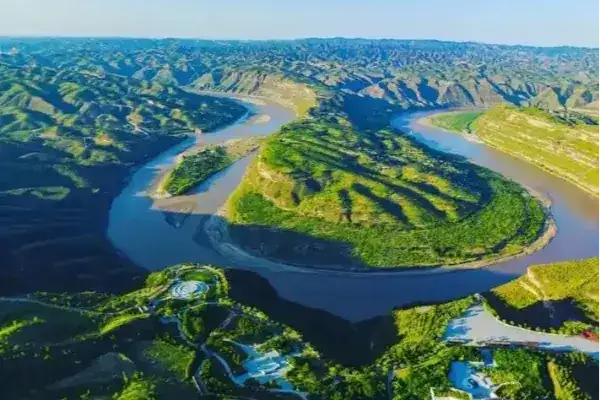
The Han River (also called Hanshui) originates from Bozhong Mountain in Ningqiang County and is a major tributary of the Yangtze. It flows through Hanzhong for 27.4 km. As of 2022, the city has 354 reservoirs—1 large, 10 medium, and 343 small—including Shimen Reservoir with a total capacity of 109.8 million cubic meters.
Shimen Reservoir, at the mouth of the Bao River valley, was built 1969–1979. Its concrete double-curvature arch dam is 88 m high with a crest arc length of 254 m. The reservoir's irrigation system includes three main canals totaling 87 km, serving 402,000 mu of effectively irrigated land.
Soil
Hanzhong has 10 soil types, 21 subtypes, 38 soil groups, and 97 soil varieties within the yellow-brown earth zone. Paddy soils cover 50.09% of the soil area, yellow-cinnamon soils 26.20%, yellow-brown earths 14.4%, and brown earths 6.33%.
Natural Disasters
Hanzhong's main natural disasters are floods and droughts, occurring in alternating patterns due to the city's position in the East Asian monsoon zone with the Qinling Mountains as the natural climatic divide. In July 2023, Zhenba County experienced a severe rainstorm with over 100 mm of precipitation in 3 hours, causing flash floods that damaged 80 roads, 66 households, and affecting 5,637 people—a disaster described as occurring once in 50 years.
Natural Resources
Mineral Resources
Hanzhong has 93 proven mineral varieties, with 63 having established reserves. Total reserve potential value is 147.815 billion yuan. Major minerals include iron (349.97 million tons), copper (86,477 tons), coal (5.558 million tons), and cement limestone (1.379 billion tons). Four mineral distribution zones are identified: the Ningqiang-Lueyang-Mian multi-metal belt, the Hantai-Chenggu quartz area, the Xixiang granite and gypsum area, and the Zhenba-Nanzheng energy mineral prospect area.
Land Resources
As of 2022, Hanzhong had 3.933 million mu of cultivated land, 544,700 mu of orchard land, 33.3343 million mu of forest land, 109,800 mu of grassland, and 28,000 mu of wetland.
Water Resources
As of 2023, Hanzhong's multi-year average total water resources amount to 14.625 billion cubic meters, primarily from rainfall and surface runoff. Average annual precipitation is 908 mm (24.74 billion cubic meters), concentrated in July–October. Average surface runoff is 14.41 billion cubic meters, with groundwater resources of 3.175 billion cubic meters.
Forest and Grassland Resources
As of 2022, Hanzhong has 20,300 square kilometers of forest land, a forest coverage rate of 63.79%, and timber stock of 150 million cubic meters. The city has 4 national forest parks (Liping, Tiantai, Wulongdong, Zibaishan) and 5 provincial forest parks. Main timber species include spruce, fir, hemlock, Chinese fir, Huashan pine, and Chinese pine. Specialty forest products include Gastrodia elata, tea, citrus, walnut, tung oil, raw lacquer, wood ear, shiitake, eucommia bark, magnolia bark, gallnut, and chestnut.
Biodiversity
Hanzhong has rich plant resources across six floristic regions, with 282 families, 1,160 genera, and 2,942 species of higher plants. Seventy-four species are listed as national or provincial key protected plants. The city has 618 species of terrestrial vertebrates, including 405 bird species, 142 mammal species, 27 amphibian species, and 44 reptile species. One hundred twenty-seven species are under national or provincial protection, including 28 Class I protected species such as golden snub-nosed monkey, giant panda, takin, clouded leopard, leopard, South China tiger, and forest musk deer.
The city has 8 national nature reserves, including the Shaanxi Hanzhong Crested Ibis National Nature Reserve, which protects the crested ibis and its habitat across 375.49 square kilometers in Chenggu and Yang counties.
Population
Population Size
As of the end of 2024, Hanzhong's registered population was 3,761,800, with resident population at 3,159,400. The birth rate was 6.88‰, death rate 9.05‰, and natural growth rate −2.17‰. The urbanization rate was 55.19%. The age structure was: 0–14 years 15.84%, 15–64 years 64.17%, and 65 years and above 19.99%.
Ethnic Groups
Hanzhong's population is predominantly Han Chinese, with over twenty ethnic minorities including Hui, Miao, Qiang, Mongolian, Zhuang, Tujia, Korean, Bai, Yi, Dong, Tibetan, and She.
Language
Hanzhong is a major dialect contact zone, with features of both Central Plains Mandarin (Qin-Long and Guanzhong subgroups) and Southwestern Mandarin (Sichuan-Guizhou and northern Hubei subgroups), as well as Jianghuai Mandarin, Gan, and Xiang dialects. This complexity results from historical administrative changes and centuries of immigration from the northwest, Sichuan, Hubei, Anhui, and Jiangsu.
Religious Beliefs
Hanzhong has all five major religions—Buddhism, Daoism, Islam, Catholicism, and Protestantism—with over 340 religious activity venues. Hanzhong is one of the birthplaces of Daoism, where Zhang Daoling's "Five Pecks of Rice" movement was propagated. Buddhism flourished during the Sui and Tang dynasties. Catholicism was introduced during the Chongzhen reign of the Ming dynasty by French missionary Fang Dewang. Protestantism was introduced in the 1920s.
Politics
Economy
Overview
In 2024, Hanzhong's GDP grew by 6.2%. The primary industry grew by 3.6%, secondary industry by 8.5%, and tertiary industry by 5.7%. The private economy accounted for 58.2% of GDP. Fixed asset investment grew by 11.7%. General public budget revenue was 5.755 billion yuan. Per capita disposable income was 28,685 yuan (approximately US$4,040), up 6.1%. Urban residents' per capita disposable income was 42,987 yuan (approximately US$6,060), and rural residents' was 16,482 yuan (approximately US$2,320).
Primary Industry
Hanzhong's primary industry focuses on grain and oil, vegetables, and livestock, with tea, Chinese medicinal herbs, and edible mushrooms as key industries. In 2024, total agricultural, forestry, animal husbandry, and fishery output was 53.396 billion yuan, up 3.9%. Grain sown area was 3.8097 million mu, with tea gardens at 1.189 million mu and Chinese medicinal herbs at 1.3765 million mu.
Secondary Industry
In 2024, above-scale industrial added value grew by 8.9%, with manufacturing up 11.4%. Pharmaceutical manufacturing grew by 53%, metal products by 48.5%, and non-ferrous metal smelting by 33.5%. High-tech manufacturing grew by 35.8%. Construction industry added value grew by 11.2%.
Tertiary Industry
In 2024, total retail sales of consumer goods reached 70.249 billion yuan, up 8.9%. Online retail by above-scale enterprises reached 1.292 billion yuan, up 26.0%. Total import-export value was 2.505 billion yuan, down 36.9%. Financial institution deposits reached 365.31 billion yuan and loans 150.233 billion yuan. Insurance premium income was 7.812 billion yuan.
Social Affairs
Education
As of the end of 2024, Hanzhong had 3 regular higher education institutions with 52,100 students, 14 secondary vocational schools, 213 secondary schools, 401 primary schools, 781 kindergartens, and 8 special education schools. Shaanxi University of Technology, formerly Hanzhong University founded in 1958, is the city's key university with 23,000 students across two campuses.
Science and Technology
In 2024, 146 new high-tech enterprises and 293 new technology-based SMEs were added. Technology contracts totaling 3.497 billion yuan were signed. Patent grants reached 1,606, including 269 invention patents. Effective registered trademarks reached 29,650, with 28 geographical indication trademarks.
Culture
As of the end of 2024, Hanzhong had 5 public theaters, 29 cinemas, 12 public libraries, 12 cultural centers, 177 cultural stations, and 27 museums. The Hantai District Library, established in 1957, holds 270,000 volumes including 21,000 ancient thread-bound books, and was rated a National First-Class Library.
Healthcare
As of the end of 2024, Hanzhong had 3,644 health institutions with 28,200 beds and 28,475 health personnel. Hanzhong Central Hospital, founded in 1965, is the city's largest Grade III-A hospital with 1,900 beds and about 3,000 staff.
Sports
As of the end of 2024, Hanzhong had 8.955 million square meters of sports area, 17 stadiums, 12 municipal sports clubs, and 43 municipal sports organizations. The Hantai District Sports Center covers 228.66 mu with a standard 400 m track and football field.
Social Security
In 2024, 39,000 new urban jobs were created. Basic medical insurance covered 3.305 million people. There were 1,473 elderly care facilities with 30,800 beds. Urban low-income assistance covered 12,600 people and rural assistance 129,800 people.
Urban and Rural Development
In 2024, Hanzhong implemented 476 urban renewal projects, renovated 230 old residential communities, and treated 208 urban waterlogging hazard points. County-level economy grew by 6.3%, ranking among the top in the province for three consecutive years. Rural revitalization efforts included 84 provincial demonstration villages and 151 municipal key villages.
Transportation
Overview
Hanzhong is at the geographic center of China, at the junction of the Guanzhong-Tianshui, Chengdu-Chongqing, and Jianghan economic circles. It has a comprehensive transportation network of 1 airport, 3 railways (Xi'an-Chengdu HSR, Yangpingguan-Ankang, Baoji-Chengdu), 4 expressways (Beijing-Kunming, Shiyan-Tianshui, Yinchuan-Kunming, Xi'an-Zhenba), 5 national highways, and 11 provincial highways.
Highways
As of 2021, Hanzhong's highway network totaled 23,726 km with a density of 85.5 km/100 km². All counties are connected by Grade II highways. National highways G108, G316, and G210 pass through the city.
Railways
Three railways serve Hanzhong: the Yangpingguan-Ankang, Baoji-Chengdu, and Xi'an-Chengdu High-Speed Railway, with a total in-boundary length of 653 km. The Xi'an-Chengdu HSR has 5 stations in Hanzhong. Hanzhong Railway Station, built in 1971, is a Class I station with 5 platforms and 14 tracks.
Aviation
Hanzhong Chenggu Airport is a Grade 4C military-civilian dual-use airport in Liulin Town, Chenggu County, 18 km from the city center. With a 2,500 m × 45 m runway, it handles Boeing 737 and Airbus 320 aircraft. As of 2021, it operated routes to 15 cities covering 6 major economic zones.
Public Transit
As of 2021, Hanzhong operated 98 bus routes with 766 buses, with 81% using clean energy. The city had 1,640 taxis and 613 new charging piles. Bus stop coverage within 500 m was 100% in the city center. The transit card system is interoperable with 310 cities nationwide.
Culture
Overview
Hanzhong is a National Historical and Cultural City and the birthplace of Han culture, with over 2,400 years of history since the establishment of commandery governance. Notable historical sites include Ancient Han Terrace, Altar of Appointment, Zhang Liang Temple, and Lingya Temple cliff carvings.
Cuisine
Hanzhong cuisine is rice-based, supplemented by wheat, millet, beans, corn, and potatoes. Locals favor spicy and sour flavors, with nearly every household making pickled vegetables and fermented vegetable water. Signature foods include:
Songhua preserved eggs: A traditional specialty with a tea-brown translucent appearance resembling amber, decorated with pine-branch patterns, with the saying "no banquet is complete without Songhua eggs."
Ningqiang walnut flatbread: A provincial intangible cultural heritage, made with walnut paste and sesame on thrice-fermented dough, once served as a tribute to the imperial court.
Lueyang pot tea: A municipal intangible cultural heritage, a traditional tea snack made by boiling tea leaves with flour paste, oil, and spices in small pots.
Xixiang beef jerky: A provincial intangible cultural heritage, a halal specialty from Xixiang County with hundreds of years of history, known for its reddish-brown color and unique flavor.
Hanzhong rice noodles (mianpi): Originating from the Qin-Han period, made by soaking and grinding rice, steaming into thin sheets, then cutting into strips. The preparation technique is listed as a provincial intangible cultural heritage.
Hanzhong vegetable tofu: Also called vegetable tofu porridge, a home-style dish made by curdling soy milk with fermented vegetable water.
Local Specialties
As of 2022, Hanzhong has 24 geographical indication trademarks, including Hanzhong Xianhao tea, Hanzhong Chaoqing tea, Hanzhong giant salamander, Chenggu citrus, Yang County black rice, and Yang County red rice, ranking second in Shaanxi Province.
Customs
Hanzhong has rich festival culture, with Spring Festival, Dragon Boat Festival, and Mid-Autumn Festival being the most important. The Lantern Festival (15th of the first lunar month) is celebrated with opera performances, lantern displays, dragon boats on stilts, dragon lanterns, lion dances, shehuo folk performances, and fireworks. New brides traditionally return to their parents' homes to "avoid the lanterns." On the evening of the Lantern Festival, candles are lit at ancestral graves and at all doorways.
City Symbols
The city tree of Hanzhong is the Han osmanthus (Osmanthus fragrans), a centuries-old tree at Shengshui Temple in Nanzheng. The Han osmanthus is notable for having 5–7 petals per flower (2–3 more than ordinary osmanthus) and blooming twice annually.
The city flower is the dry lotus (Magnolia soulangeana), with a single ancient specimen over 400 years old preserved at the Wuhou Shrine in Mian County, successfully propagated since 1985.
Historical Sites
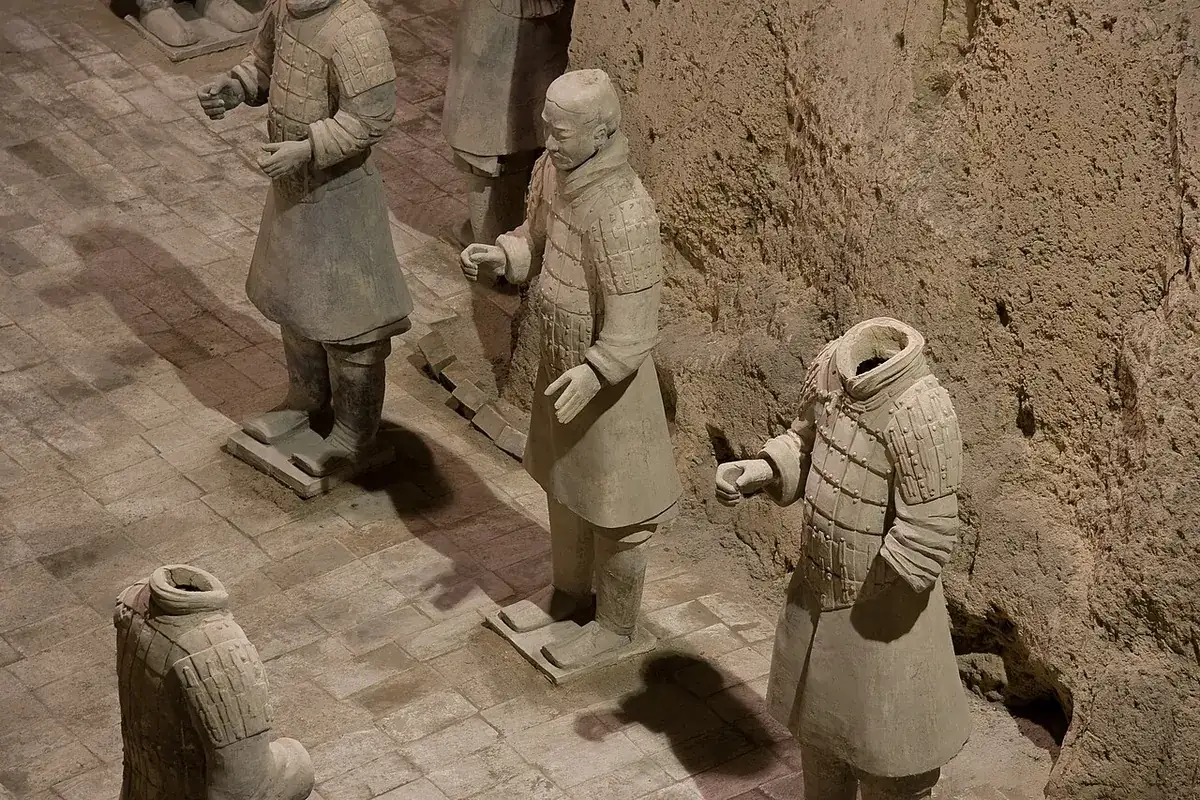
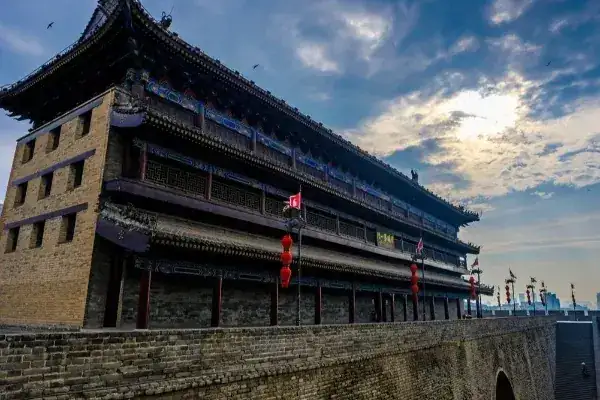
As of 2022, Hanzhong has 4,188 immovable cultural relic sites, including 290 protected at various levels (20 national key, 83 provincial, and 187 municipal/county-level).
Intangible Cultural Heritage
As of 2023, Hanzhong has 505 intangible cultural heritage projects, including 1 world cultural heritage and 8 national-level projects, with 356 representative inheritors and 10 provincial-level workshops. Hanzhong's intangible cultural heritage features the distinctive characteristics of blending northern and southern, Qin and Shu traditions.
Scenic Spots
Overview
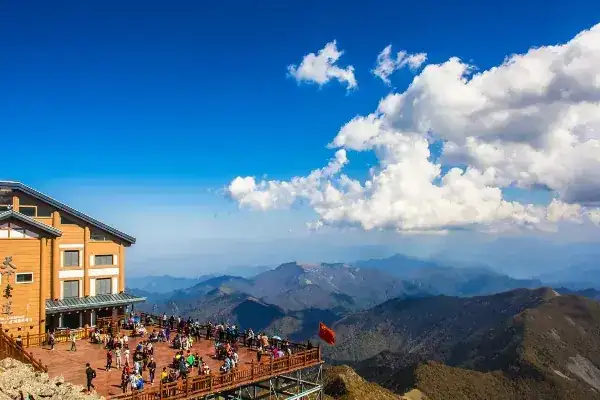
As of 2022, Hanzhong has 34 national A-level scenic areas, including 17 4A-level and 16 3A-level, plus 1 provincial tourism resort, 7 all-for-one tourism demonstration zones, and 6 national rural tourism key villages. The city has 29 travel agencies, 25 star-rated hotels, and 24 museums.
Key Attractions
External Relations
In January 2022, Hanzhong held a friendly exchange video conference with Changnyeong County, Gyeongsangnam-do, South Korea, signing an intent to establish sister city relations. In September 2023, the Hanzhong Culture and Tourism Bureau participated in cultural tourism exchanges in Uzbekistan and Kazakhstan. In November 2023, the Hanzhong Merchants Association signed a business cooperation framework agreement with Malaysia's IQI.
Notable Figures
Hanzhong has been a strategic military center throughout history. It was the birthplace of the Western Han dynasty under Liu Bang, and the military base for Chancellor Zhuge Liang's Northern Expeditions. Notable figures who left their mark in Hanzhong include Zhang Liang, Han Xin, Xiao He, Zhang Lu, Zhuge Liang, Cao Cao, Liu Bei, Xiahou Yuan, and Li Zicheng. Hanzhong is also the birthplace of Zhang Qian, the diplomat who pioneered the Silk Road, and Li Gu, a principled Han dynasty minister. Cai Lun, inventor of papermaking, is buried in Yang County, Hanzhong.
Important Honors
Travel information can change. Check current opening hours, reservations and entry requirements before you travel.
Traveller discussion
Start the conversation with a helpful tip or a question.