
Xianyang
XianyangXianyang, also known as Qindu (Capital of Qin) and Weicheng, is a prefecture-level city in Shaanxi Province, China, located in the central Guanzhong Plain. It is the site of China's geodetic origin point and the geometric center of
Xianyang
Xianyang, also known as Qindu (Capital of Qin) and Weicheng, is a prefecture-level city in Shaanxi Province, China, located in the central Guanzhong Plain. It is the site of China's geodetic origin point and the geometric center of the country's territory. Situated between 107°38′–109°10′E and 34°9′–35°34′N, it borders Tongchuan and Weinan to the east, Baoji to the west, Qingyang and Pingliang of Gansu Province to the north, and Xi'an to the south, with a total area of 10,191.5 square kilometers. As of October 2025, Xianyang administers 3 districts, 9 counties, and 2 county-level cities, with the municipal government at No. 1 Weiyang Middle Road, Qindu District. As of the end of 2025, the resident population was 4,037,700. The local dialect belongs to the Central Plains Mandarin Guanzhong subgroup. Xianyang has a continental monsoon climate with four distinct seasons. The terrain is high in the north and low in the south, with loess plateau and plains as the main landforms, and all rivers belong to the Wei River system of the Yellow River Basin. Known as "China's First Imperial Capital," Xianyang was the capital of the Qin dynasty—China's first feudal empire—and a key center for over ten dynasties including Han and Tang. It is the first station of the ancient Silk Road and a core segment of the Guanzhong Plain city cluster. Its agricultural strengths include vegetables, apples, poultry, and hogs; industrial strengths include electronic information manufacturing; and service strengths include modern logistics and cultural tourism. In 2025, Xianyang's GDP reached 310.453 billion yuan (approximately US$43.7 billion).
Name Origin and Evolution
The name Xianyang dates to the 12th year of Duke Xiao of Qin (350 BCE). Duke Xiao moved his capital from Liyang (present-day Wutun area, Yanliang District, Xi'an) to this location. In ancient Chinese, "yang" means the south side of a mountain or the north bank of a river. Since the city is south of Jiuzong Mountain and north of the Wei River—both positions being "yang"—the name combines both, hence "Xianyang" (literally "all yang"). An alternative theory, based on the Records of the Grand Historian and pottery inscriptions excavated from the Qin capital, suggests that Shang Yang established "Xianheng" and "Yangli" here, and in 350 BCE, Duke Xiao combined the two names into "Xianyang."
Historical Evolution
Pre-Qin Period
Xianyang's administrative history began in the Xia dynasty. By the 11th century BCE, the western part was the fiefdom of the Youti clan, the southeastern part was under the Youhu clan, and the north was inhabited by primitive tribes. During the Western Zhou dynasty, after King Wu defeated the Shang in 1066 BCE, Xianyang was near the dual capitals of Feng and Hao. During the Eastern Zhou, Xianyang was Qin territory, and in 350 BCE, Duke Xiao built walls and established the city.
Qin, Han, through Northern and Southern Dynasties
In 221 BCE, Qin Shi Huang unified China, proclaimed himself the First Emperor, and made Xianyang the capital. After Qin's fall, Xiang Yu divided the area into the three states of Yong, Zhai, and Sai ("Three Qin"). In 205 BCE, Liu Bang "reconquered the Three Qin" and reorganized the territory. During the Western Han, nine of eleven emperors were buried on the Xianyang plateau. During the Three Kingdoms period, the area was under Wei. The Northern and Southern Dynasties saw frequent changes of rule among Former Zhao, Later Zhao, Former Qin, Later Qin, Northern Wei, Western Wei, and Northern Zhou.
Sui, Tang, through Song and Yuan
The Sui dynasty abolished the commandery system and established prefectures and counties. In 618 CE, the Tang dynasty established the Jingji Circuit. In 627 CE, Xianyang was placed under the Shannan Circuit. In 784 CE, Emperor Dezong renamed the area Xingyuan Prefecture. During the Five Dynasties, Former Shu, Later Tang, and Later Shu successively controlled the area. In the Yuan dynasty, Xingyuan Circuit was established, beginning Xianyang's affiliation with Shaanxi.
Ming and Qing
In 1370, the Ming dynasty renamed the area Xianyang Prefecture. The Qing retained this structure. In 1725, Qianzhou and Binzhou were elevated to directly administered prefectures. Notable cultural developments include the 1542 compilation of the Shaanxi Provincial Gazetteer by Ma Li of Sanyuan—the earliest surviving provincial gazetteer—and the 1593 construction of Chongwen Pagoda in Jingyang, the tallest surviving pagoda in Shaanxi at 83 meters. In 1635, Li Zicheng's rebel forces captured Xianyang.
Republic of China
From 1935 to 1940, Shaanxi established administrative inspectorates. The Tenth Inspectorate was headquartered in Xianyang, governing 10 counties. In the winter of 1935, after the Red Army arrived in northern Shaanxi, the Guanzhong Special Area was established within the Shaanxi-Gansu-Ningxia Border Region, governing revolutionary base counties.
After the Founding of the People's Republic of China
In 1950, the Xianyang Special District was established. In 1952, county-level Xianyang City was created. In 1983, Xianyang Prefecture was abolished and the prefecture-level city of Xianyang was established. In 1986, Weicheng District was established. In 1997, the Yangling Agricultural High-tech Demonstration Zone was established as a provincial-level entity. In 2017, the Xi-Xian New Area was given full administrative authority over parts of Xianyang. In 2018, Bin County was converted to county-level Binzhou City.
Physical Geography
Location and Boundaries
Xianyang is at China's geographic center—the site of the country's geodetic origin point. Located in the central Guanzhong Basin, it spans 149.4 km north-south and 139.7 km east-west, covering 10,191.5 square kilometers.
Climate
Xianyang is in the warm temperate zone with a continental monsoon climate. Average annual precipitation is 537–650 mm, with summer being the wettest season (196–273 mm) and winter the driest (15.5–21.0 mm). The average annual temperature is 9.0°C–13.2°C, with the south averaging 4.2°C warmer than the north. The extreme maximum is 41.7°C and extreme minimum −18.6°C. Average annual sunshine is 2,017.2–2,346.9 hours, with June–August accounting for about 32%. The frost-free period is 172–223 days.
Geology
Xianyang's geological strata begin from the Cambrian period, with the northern area belonging to the Shaanxi-Gansu-Ningxia Basin and the southern area to the Fen-Wei Graben system, separated by the Beishan fault zone along the Liangshan-Jiuzongshan-Cuoyashan line.
Topography and Landforms
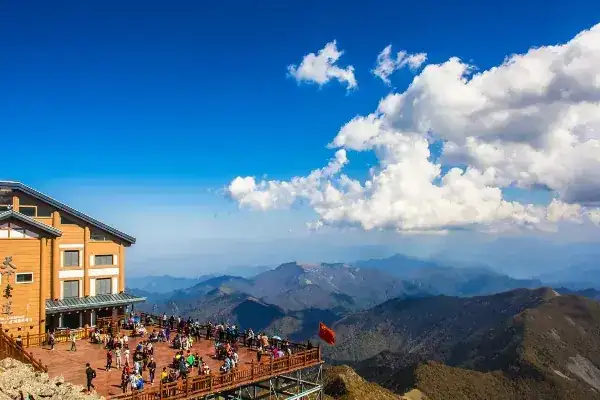
The terrain is high in the north and low in the south, rising in steps from river terraces to loess tablelands to mountains. The north belongs to the Weibei Loess Plateau, the south to the Wei River Basin (Guanzhong Plain). The highest point is Shimen Mountain Peak in Xunyi County (1,885.3 m), and the lowest is the Qing River exit in Sanyuan County (362 m). Eleven mountain ridges are concentrated in the central-northern area, including Cuoyashan, Bijia Mountain, Beizhong Mountain, Jiuzong Mountain, and Wufeng Mountain.
Hydrology
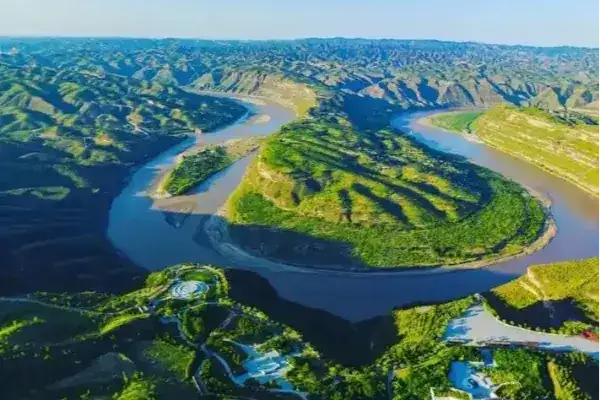
Xianyang has over 5,400 rivers and channels, with 158 having catchment areas exceeding 10 km². All rivers belong to the Wei River system of the Yellow River Basin. The Wei River flows 91.5 km through the city, and the Jing River 262.3 km. The famous confluence of the Wei and Jing rivers creates the idiom "Jing-Wei distinct" (clear vs. muddy water).
Soil
Xianyang has 12 soil types, 33 subtypes, and 72 soil groups. The main types are black earth soil (15.28% of total soil area), lou soil (28.95%, the main farmland soil in the southern plain), cinnamon soil, yellow loessial soil, and red clay soil.
Natural Disasters
Major meteorological disasters include droughts, floods, strong winds, hail, and frost, with droughts and floods causing the widest damage. In 2021, the Wei River experienced its third-largest flood on record at the Xianyang hydrological station, reaching 6,050 m³/s—the largest since 1982, approaching a 20-year flood.
Natural Resources
Water Resources
Xianyang is one of Shaanxi's more water-scarce areas, with per capita water resources of only 264.6 cubic meters—far below the international absolute water scarcity threshold of 500 cubic meters. Total water resources in 2022 were 743 million cubic meters.
Land Resources
As of 2022, Xianyang had 290,976.40 hectares of cultivated land, 178,619.29 hectares of orchard land, 322,606.96 hectares of forest land, 61,080.71 hectares of grassland, and 3,505.41 hectares of wetland.
Mineral Resources
Xianyang has 24 discovered mineral varieties. The most economically valuable is coal, with proven reserves of 10.1 billion tons concentrated in Binzhou, Changwu, Xunyi, Chunhua, and Yongshou. Limestone reserves are estimated at 300 billion cubic meters, with calcium carbonate content above 97%. Other resources include geothermal energy, mineral water, and brick clay. As of June 2023, the city had 116 mining enterprises.
Forest and Grassland Resources
As of 2023, Xianyang has 4.9485 million mu of forestry land, 3.6195 million mu of forest, a forest coverage rate of 38.81%, and timber stock of 14.52 million cubic meters. The city has 5 national wetland parks and 3 nature reserves.
Biological Resources
Xianyang is in the Palearctic floristic region, with dominant species including Chinese pine (Pinus tabulaeformis) and Chinese arborvitae (Platycladus orientalis). The city has identified 23,073 ancient and notable trees, including 43 specimens over 1,000 years old. About 140 bird species and 40+ mammal species are found here, including nationally protected species such as golden leopard, great bustard, black stork, and golden eagle.
Medicinal Resources
Xianyang has 626 species of Chinese medicinal herbs, with the most from the legume, aster, and grass families. Major species include astragalus, rehmannia, isatis root, glehnia, seabuckthorn, and jujube. Cultivated species include eucommia, achyranthes, angelica, and Gastrodia elata.
Geothermal Resources
As of 2022, Xianyang has underground hot water reserves of 250 billion cubic meters across 1,000 km². The geothermal water is rich in radon, sulfur, lithium, and strontium, meeting premium medical mineral water standards. In 2006, Xianyang was named China's first "Geothermal City" by the Ministry of Land and Resources.
Administrative Divisions
As of October 2025, Xianyang administers 3 districts (Qindu, Weicheng, Yangling), 9 counties (Wugong, Xingping, Jingyang, Sanyuan, Liquan, Qian, Yongshou, Binzhou, Changwu, Xunyi, Chunhua), and 2 county-level cities. The municipal government is at No. 6 Weiyang Middle Road.
Politics
Population
Population Size
As of the end of 2025, Xianyang's resident population was 4,037,700, a decrease of 42,900. The urbanization rate was 62.83%. The birth rate was 4.58‰, death rate 8.31‰, and natural growth rate −3.73‰. In the 2020 census, the sex ratio was 103.45 (male:female), with 17.43% aged 0–14, 61.07% aged 15–59, and 21.50% aged 60 and above.
Ethnic Groups
Xianyang is a multi-ethnic area with 36 ethnic groups, predominantly Han Chinese. Ethnic minorities total about 12,000, mostly Hui, distributed across the city's counties and districts.
Language
Most of Xianyang's dialects belong to the Central Plains Mandarin Guanzhong subgroup, with some areas in the Qin-Long subgroup. Major dialect points include city dialect, Yaodian dialect, Xingping dialect, Wugong dialect, Liquan dialect, Qianxian dialect, Yongshou dialect, Nanbin and Beibin dialects (Binzhou), Changwu dialect, Xunyi dialect, Chunhua dialect, Jingyang dialect, and Sanyuan dialect.
Religious Beliefs
All five major religions are present in Xianyang—Catholicism, Protestantism, Buddhism, Daoism, and Islam. Catholicism was introduced in the late Ming dynasty, with the Vatican establishing a diocese in Sanyuan in 1931, building the largest church in Guanzhong at the time. As of 1994, there were 47 Catholic churches with 34,055 believers, 91 Protestant activity sites with 28,135 believers, 16 Buddhist temples, 8 Daoist temples, and 7 mosques.
Economy
Overview
Xianyang is a core segment of the Guanzhong-Tianshui Economic Zone and the Xi'an-Xianyang International Metropolis. The Xianyang High-tech Zone is a national-level high-tech development zone and western China's only national display device industrial park. In 2025, GDP reached 310.453 billion yuan (approximately US$43.7 billion), up 5.5%. Per capita GDP was 76,482 yuan (approximately US$10,707). Fixed asset investment grew 5.7%. General public budget revenue was 11.817 billion yuan. Per capita disposable income was 33,775 yuan (approximately US$4,740), with urban residents at 49,332 yuan (approximately US$6,940) and rural residents at 18,849 yuan (approximately US$2,650).
Primary Industry
Xianyang is a national large-scale commodity grain, apple, and vegetable production base. In 2025, total agricultural, forestry, animal husbandry, and fishery added value was 48.031 billion yuan. Grain sown area was 5.2425 million mu with total output of 1.826 million tons. Apple orchards covered 2.5016 million mu with output of 4.9091 million tons. The city has cultivated regional brands including "Xianyang Malan Red Apple" and "Xianyang Fu Tea," with 100+ agricultural product brands including 13 National Geographic Indication products.
Secondary Industry
Xianyang is northwestern China's largest electronic industrial base and an important energy-chemical and textile industrial base in Shaanxi. In 2025, total industrial added value grew 8.2%, with above-scale industrial added value up 9.0%. Energy industry added value grew 12.3% and non-energy industry 4.3%. The construction industry's total output was 94.812 billion yuan.
Tertiary Industry
E-commerce, modern logistics, and cultural tourism are Xianyang's service sector strengths. In 2025, wholesale and retail added value was 38.34 billion yuan (up 7.2%), transportation and warehousing 11.093 billion yuan (up 12.0%), and finance 14.27 billion yuan. Total retail sales of consumer goods reached 96.574 billion yuan (up 7.0%). Postal industry revenue was 5.911 billion yuan (up 45.3%), with express delivery volume of 924 million pieces (up 85.8%). Financial institution deposits reached 582.831 billion yuan and loans 341.961 billion yuan. Insurance premium income was 10.38 billion yuan.
Social Affairs
Education
As of the end of 2025, Xianyang had 263 secondary schools, 22 secondary vocational schools, 466 primary schools, and 621 kindergartens. Northwest A&F University, located in Yangling, is a Ministry of Education-affiliated "985" and "211" university, with 14 disciplines in ESI global top 1%.
Healthcare
Xianyang had 4,264 health institutions in 2025, including 163 hospitals (6 Grade III-A), with 32,771 beds and 42,946 health personnel. Xianyang First People's Hospital, founded in 1939, is a Grade III-A comprehensive hospital with 1,500 beds and 2,200 staff.
Science and Technology
In 2025, 4,710 patents were granted, including 1,050 invention patents. The city was approved as a national SME digital transformation pilot city.
Culture
Xianyang has 41 museums, 14 cultural centers, 14 public libraries (2.3017 million volumes), and comprehensive radio/TV coverage of 99.9%. Xianyang Museum, established in 1962 at the Ming dynasty Confucian Temple site, is a national second-class museum with over 160,000 cultural relics.
Sports
In 2025, Xianyang held 191 sporting events, with 100% coverage of the urban "15-minute fitness circle."
Social Security
In 2025, 45,032 new urban jobs were created. Basic pension insurance covered 980,100 urban workers and 2.2782 million rural residents. Basic medical insurance covered 3.8141 million people. The city provided temporary assistance to 20,142 people and disability benefits to 39,516 disabled residents.
Transportation
Overview
Xianyang is at China's geographic center, approximately 500 km from nine provincial capitals. It has 2 high-speed railways (Xi'an-Baoji and Yinchuan-Xi'an), 4 conventional railways, 11 expressways, and Xi'an Metro Line 1 extending into the city. Xi'an Xianyang International Airport—one of China's top 10—is less than 20 km from downtown.
Highways
As of the end of 2025, Xianyang's highway network totaled 17,638 km, including 597 km of expressways. All counties are connected by expressway, and 100% of administrative villages have paved roads.
Railways
Xianyang has 2 high-speed railways and 4 conventional railways, with 35 operating stations (14 passenger, 21 freight). Xianyang Station, built in 1936, is a Class II station on the Longhai and Xiantong lines.
Aviation
Xi'an Xianyang International Airport is a Grade 4F airport with two runways (3,000×45 m and 3,800×60 m), capable of handling A380 aircraft. It has 3 terminals totaling 350,000 m², 127 parking stands, and 44 boarding bridges. In 2023, the airport handled 41.3712 million passengers (ranking 9th nationally), 265,800 tons of cargo (13th), and 310,500 aircraft movements (8th).
Public Transit
As of the end of 2025, Xianyang had 804 public buses (780 pure electric) and 1,719 taxis, with annual ridership of 102.7 million.
Culture
Overview
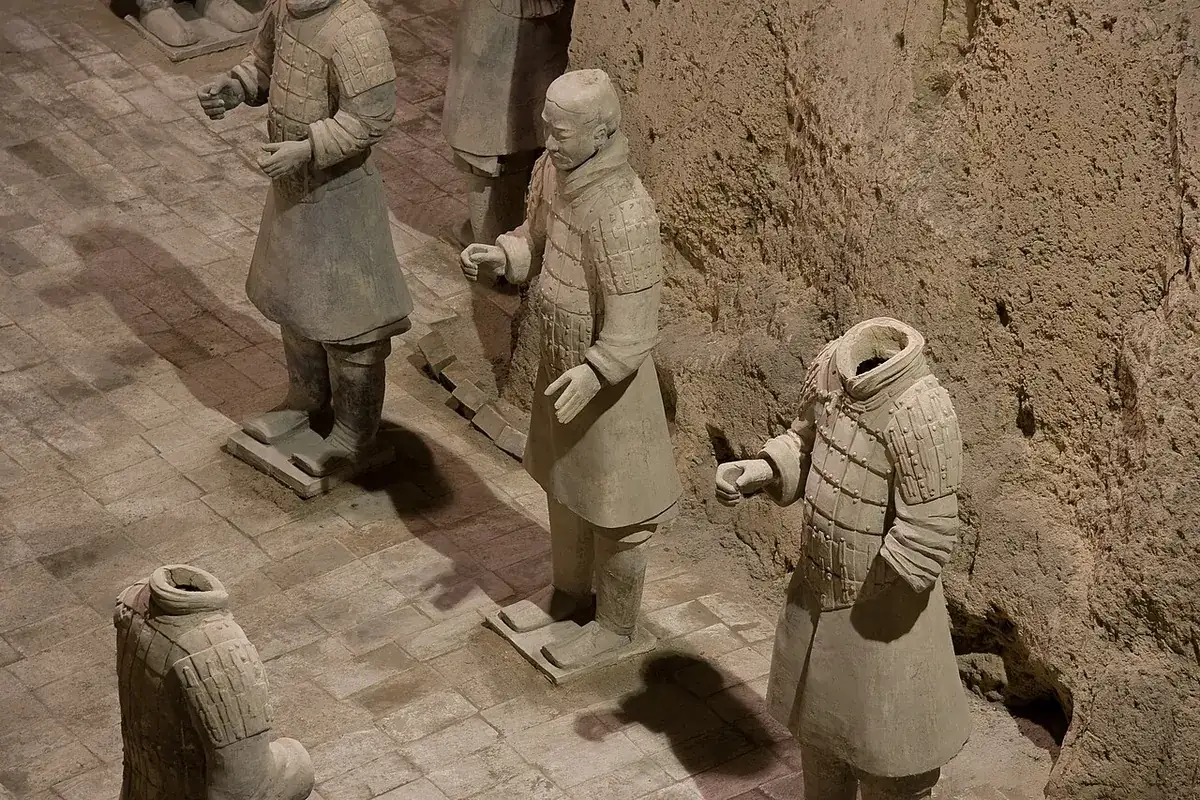
Xianyang is a National Historical and Cultural City—the first station of the ancient Silk Road and the birthplace of Qin-Han culture. Known as "China's First Imperial Capital" and "China's Pyramid Capital," it has 5,313 cultural relic and tourism sites. From the Western Zhou through the Tang dynasty, 27 emperors were buried in Xianyang, including 9 of 11 Western Han emperors and 9 of 18 Tang dynasty mausoleums. The city has 4 national-level and 68 provincial-level intangible cultural heritage projects.
Cuisine
Noodles are Xianyang's signature cuisine. In 2019, Xianyang was named the "International Capital of Noodle Cuisine" by the World Federation of Chinese Cuisine. Signature dishes include Huitong noodles, blood-ribbon noodles, flag-flower noodles (qihuamian), four-edge noodles, and sour soup noodles. Flag-flower noodles, with a 700-year history in Wugong County, are named for their parallelogram-shaped egg and scallion pieces resembling small flags. Xingping cloud bread (yunyunmo), also called "glasses bread," is a crispy local snack.
Customs
Binzhou Lamp Mountain Festival is a Lantern Festival tradition over 1,300 years old, listed as national intangible cultural heritage in 2014. During the festival (14th–16th of the first lunar month), over 1,000 oil lamps are lit in cliff-face niches at Huaguoshan in Binzhou, forming patterns of temples, pagodas, the Big Dipper, and archways.
Xianyang folk shehuo is a seasonal folk art performance with a long history, featuring xinzi (acrobatic tableaux), stilt walking, bamboo horse dancing, lion dances, and dragon lanterns. The dagá ("Xianyang golf") is a traditional bat-and-peg game popular south of the Wei River.
Arts
Xianyang has a long musical tradition, with the Music Bureau (yuefu) established during the Qin dynasty. Folk music includes suona wind music, pipe wind music, and percussion music. The city also has a rich tradition of dance, acrobatics, and storytelling (quyi).
Local Specialties
Traditional Dwellings
Southern Xianyang features the distinctive Guanzhong "half-roof" houses (fangzi banbian gai), where neighboring houses share a back wall and rainwater flows into each family's own courtyard. Northern Xianyang has traditional cave dwellings (yaodong), including cliff-side, sunken courtyard, and independent brick types. Well-preserved "landlord manors" from the Ming and Qing include Tangjia Manor in Xunyi and Zhoujia Manor in Sanyuan.
Historical Sites
As of 2023, Xianyang has 5,313 cultural relic and tourism sites, including 1,037 ancient ruins, 1,135 ancient tombs, 247 ancient buildings, and 340 protected units at various levels (22 national, 93 provincial). Notable sites include the Qin Xianyang City ruins, Zhengguo Canal headworks, Western Han Ganquan Palace ruins, Maoling Mausoleum (Emperor Wu of Han), Zhaoling Mausoleum (Emperor Taizong of Tang), and the Great Buddha Grottoes in Binzhou.
Intangible Cultural Heritage
As of 2022, Xianyang has 4 national-level, 68 provincial-level, 198 municipal-level, and 497 county-level intangible cultural heritage projects, with 2 national and 34 provincial representative inheritors.
National Historical and Cultural Villages
Boshe Village in Sanyuan County is a national historical and cultural village with 1,600+ years of history, known as China's "Museum of Rammed Earth Architecture." It has 780 cave dwelling courtyards, including 225 sunken courtyard type, making it the premier underground cave dwelling village in China.
Traditional Villages
As of 2023, Xianyang has 13 national-level and 30 provincial-level traditional villages.
Scenic Spots
Overview
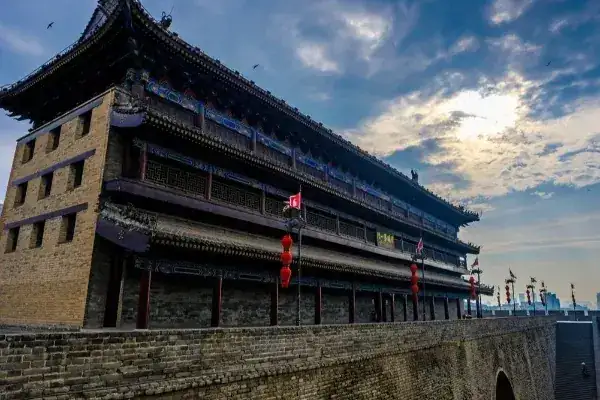
Xianyang is a major tourism destination, designated as one of China's first Excellent Tourism Cities in 1998. As of March 2024, the city has 48 A-level scenic areas (1 5A-level, 10 4A-level, 28 3A-level), including the Qianling Mausoleum Museum, Maoling Museum, and Zhaoling Museum. In 2023, Xianyang received 87.9885 million domestic tourists (up 151.1%), generating tourism revenue of 56.512 billion yuan (up 211.4%).
Major Attractions
External Relations
Xianyang has established cooperation and trade relations with 106 countries and regions, and has sister city relationships with 12 cities in 7 countries along the "Belt and Road," including Le Mans (France) and Uiseong-gun (South Korea).
Notable Figures
Ancient
Modern and Contemporary
Honorary Titles
Travel information can change. Check current opening hours, reservations and entry requirements before you travel.
Traveller discussion
Start the conversation with a helpful tip or a question.