
Baoji City
Baoji CityBaoji, historically known as Chencang, Yongzhou, Yongcheng, Zhouyuan, Western Guo, Western Qi, Qiyang, Xifu, Yangping, and Fengxiang, is a prefecture-level city in Shaanxi Province, located in the western part of the Guanzhong Pla
Baoji City
Baoji, historically known as Chencang, Yongzhou, Yongcheng, Zhouyuan, Western Guo, Western Qi, Qiyang, Xifu, Yangping, and Fengxiang, is a prefecture-level city in Shaanxi Province, located in the western part of the Guanzhong Plain, at the source of the Jialing River. It borders Xianyang and the Yangling Demonstration Zone to the east, Hanzhong to the south, and Tianshui and Pingliang of Gansu Province to the northwest. The Qinling Mountains screen the south, the Wei River flows through the center. The climate is warm temperate semi-humid with four distinct seasons. Total area: 18,117 square kilometers. As of April 2025, the city administers 4 districts and 8 counties. As of the end of 2024, the permanent resident population was 3,253,700. In 757 CE, the city was renamed Baoji ("Precious Chicken") after a legendary stone rooster crowed on Jifeng Mountain during the An Lushan Rebellion. The famous stratagem "openly repair the plank road, secretly cross at Chencang" originated here. Baoji is recognized as the earliest birthplace of the term "China" (found in the inscription on the He Zun bronze vessel), the birthplace of the Yan Emperor (Shennong), and an important birthplace of the Zhou and Qin dynasties, with a city history dating to 762 BCE. It is the vice-center city of the Guanzhong-Tianshui Economic Zone and the second-largest city in Shaanxi. The city is a major western industrial hub, high-end equipment manufacturing base, new materials R&D base, and "China's Titanium Valley." In 2025, GDP was 264.887 billion yuan, up 6.0%.
History
Baoji is the birthplace of the Yan Emperor (Shennong). According to pre-Qin and Han Dynasty texts, over 5,000 years ago, the Yan Emperor was born along the Jiang River. After the Yan Emperor's power declined, the Yellow Emperor (Huangdi) replaced him after the Battle of Banquan, and the two tribes merged, defeating Chiyou at the Battle of Zhuolu, laying the foundation for Chinese civilization. The Baoji area has yielded numerous late Yangshao culture sites (e.g., Beishouling, Fulinbao), consistent with the legendary era of the Yan Emperor.
Baoji is an important birthplace of the Zhou and Qin dynasties. In the 11th century BCE, the Zhou ancestor Gu Gong Danfu led his people to Zhouyuan at the foot of Mount Qi (present-day Qishan County), establishing the earliest Zhou capital, Qiyi, over 3,200 years ago. In 770 BCE, the Zhou court moved east, and Duke Xiang of Qin was enfeoffed for escorting the king, establishing the State of Qin. In 762 BCE, the Qin established their capital at the confluence of the Qian and Wei rivers (present-day Chencang District). In 677 BCE, the Qin capital moved to Yongcheng (present-day Fengxiang District), where 18 Qin rulers reigned for 294 years. Under Duke Mu of Qin (659-621 BCE), the state expanded westward, "opening a thousand li of territory and dominating the Western Rong." After Qin Shi Huang unified China in 221 BCE, the area was under the Neishi territory.
Through the Han, Three Kingdoms, Jin, Northern and Southern Dynasties, Sui, and Tang dynasties, the area was administered under various commanderies and prefectures. In 757 CE, during the An Lushan Rebellion, the city was renamed Baoji after a miraculous stone rooster. In 1949, Baoji City was established. In 2003, Baoji County was abolished and Chencang District was established. In 2021, Fengxiang County became Fengxiang District.
Administrative Divisions
As of April 2025: 4 districts (Jintai, Weibin, Chencang, Fengxiang), 8 counties (Qishan, Fufeng, Mei, Long, Qianyang, Linyou, Feng, Taibai). Government: Chencang Avenue Administrative Center, Shilipu Sub-district, Jintai District.
Geographical Environment
Location and Boundaries
Western Guanzhong, Shaanxi, between 106°18'-108°03'E and 33°35'-35°06'N. East-west: 156.6 km; north-south: 160.6 km. Total area: 18,117 km².
Landforms
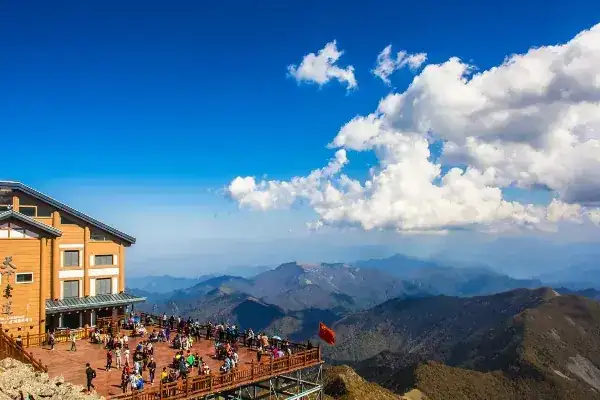
Located at the junction of the Qinling tectonic system and other structural systems, with three geological units: the Qinling fold belt (south), the Weihe rift basin (center), and the Ordos Platform Syncline (north). Mountains 56%, hills 26.5%, plains 17.5% ("six parts mountain, one part water, three parts field"). The Qinling main peak, Mount Taibai (3,771.2m), is the highest peak in mainland China east of the Qinghai-Tibet Plateau.
Climate
Warm temperate semi-humid climate controlled by monsoon circulation. Four distinct seasons. Average annual sunshine: 1,860-2,250 hours. Average annual temperature: 7.6-12.9°C. Average annual precipitation: 590-900 mm (highest in the Guanzhong region).
Hydrology
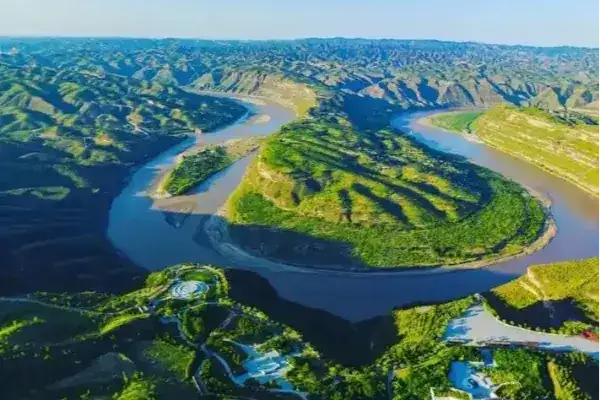
Rivers divided by the Qinling range into the Yellow River and Yangtze River systems. The Yellow River system is centered on the Wei River (206.1 km within the city, 3.551 billion m³ average annual runoff). The Yangtze system is centered on the upper Jialing River (72 km within the city, 5.627 billion m³ average annual runoff).
Natural Resources
Water Resources
Groundwater: ~756 million m³ extractable. The Yinjia-Jiqing project (1999) supplies 9.125 million m³/year; the Fengjiashan Phase II (2006) supplies 29.2 million m³/year. Total controllable water resources: 1.1 billion m³.
Plant Resources
2,100+ resource plant species (1,550+ seed plants on Mount Taibai alone). 1,000+ economic plant species. 510+ medicinal plant species on Mount Taibai. Vegetation types: deciduous broadleaf forest, coniferous-broadleaf mixed forest, coniferous forest, and alpine meadow, ascending with elevation in the Qinling Mountains.
Animal Resources
National Class I protected: 10 species including giant panda, golden snub-nosed monkey, takin, clouded leopard, leopard, crested ibis, great bustard, black stork, and white-shouldered eagle. National Class II protected: 18 species. 322 bird species (76 nationally protected).
Mineral Resources
190 mineral occurrences, 45 mineral types. Metallic: iron, copper, lead-zinc, nickel, gold, silver, tungsten, molybdenum, mercury, pyrite. Non-metallic: limestone, marble, dolomite, silica, refractory clay, fluorite, phosphorite, quartzite. 29 types listed on the provincial reserves table, 94 mining areas. Top 3 by value: cement limestone, phosphorus, and coal.
Population
As of end 2024: 3,253,700. Urban population: 62.16%. Birth rate: 8.01 per mille; death rate: 8.51 per mille; natural growth rate: -0.5 per mille.
Politics
Economy
Overview
In 2024: GDP grew 5.6%. Primary +3.4%; secondary +5.5%; tertiary +6.1%. Structure: 9.1:41.8:49.1. Private economy: 53.7% of GDP. Fiscal revenue: 29.908 billion (up 5.6%); local revenue: 10.871 billion (up 6.1%); expenditure: 44.855 billion (up 7.1%). Fixed asset investment grew 11.6%; industrial investment +22.9%; high-tech investment +18.3%.
Primary Industry
In 2024: agricultural output 42.02 billion yuan (up 3.5%). Grain sown area: 4.576 million mu; grain output: 1.4911 million tonnes (up 1.2%). Fruits: 1.7694 million tonnes (apples 889,400; kiwi 731,100, up 7.7%). Vegetables: 1.8955 million tonnes.
Secondary Industry
In 2024: above-designated-size industry grew 7.9%. Mining +14.1%; manufacturing +7.8%; utilities +1.7%. 19 of 34 industry categories grew. Key growth: automobile manufacturing +27.8%; transport equipment manufacturing +22.2%; coal mining +19.1%; beverages +27.0%. Construction: 299 qualified enterprises.
Tertiary Industry
In 2024: retail sales grew 6.4%. Import/export: 8.808 billion yuan (down 14.5%); exports: 7.861 billion (up 9.1%). Financial deposits: 447.046 billion (up 5.8%); loans: 281.814 billion (up 5.2%). 136 financial institutions. Insurance premiums: 9.258 billion (up 4.4%). Securities trading: 456.43 billion (up 42.7%).
Social Undertakings
Education
As of end 2024: 7 higher education institutions (64,100 students), 37 general high schools (60,600), 21 vocational (24,600), 132 junior high (114,800), 320 primary (214,600), 507 kindergartens (79,500), 6 special education (1,452).
Science and Technology
As of end 2024: 953 technology-based SMEs, 887 high-tech enterprises, 90 gazelle enterprises. 349 innovation platforms (18 national, 110 provincial). 30 incubators (4 national, 10 provincial). 47 maker spaces (1 national, 12 provincial). Technology contracts: 510, valued at 5.434 billion yuan.
Culture
As of end 2024: 16 performing venues, 14 cultural centers, 13 public libraries, 116 cultural stations, 1,375 community cultural centers. 36 museums/memorials (2 national Class I, 2 Class II, 5 Class III). Museum visitors: 3.3036 million.
Healthcare
As of end 2024: 2,862 medical institutions (108 hospitals, 150 township health centers, 1,656 village clinics). 34,478 health workers (12,122 physicians, 14,761 nurses). 30,899 beds.
Sports
In 2024: hosted 10+ international/national events including the China (Baoji) International Badminton Masters, National Gateball Championship, and Baoji Marathon. 731 mass sports events with 457,100 participants. Athletes won 10 gold, 4 silver, 4 bronze at international/national competitions; 116 gold, 118 silver, 120 bronze at provincial championships. 2 athletes competed at the Paris Olympics.
Social Security
As of end 2024: employee pension 904,300; resident pension 1,658,800; work injury 440,100; unemployment 259,500; employee medical 625,500; resident medical 2,529,900. 57 elderly care institutions with 13,982 beds. Urban minimum living: 6,010 households/9,197 people (662 yuan/month); rural: 40,633 households/88,245 people (5,964 yuan/year). Temporary assistance: 17,200 person-times.
Transportation
Baoji is at the junction of Shaanxi, Gansu, Ningxia, and Sichuan provinces, at the transportation center of Xi'an, Chengdu, Lanzhou, and Yinchuan. The Longhai, Baocheng, and Baozhong railways converge here, making Baoji a major railway hub on the New Eurasian Continental Bridge. The highway network features the G30 expressway as the main axis, with the "Three Horizontals, Five Verticals, One Ring" network. In 2013, the Baoji-Xi'an high-speed railway opened.
Historical Culture
Overview
Baoji is recognized as the earliest birthplace of the term "China" - the inscription on the He Zun bronze vessel, excavated here, contains the first known use of "Zhongguo" (China) as a fixed term. The city is the birthplace of the Yan Emperor, the cradle of the Zhou and Qin dynasties, and home to "Baoxue" (Baoji Studies). With 8,000 years of civilization and 2,770+ years of city history, Baoji is hailed as "the hometown of China, the birthplace of the Yan Emperor, the hometown of bronzes, the sacred land of Buddha bones, the hometown of folk art, and the birthplace of Zhou-Qin civilization." Over 50,000 bronze artifacts have been unearthed, including the He Zun, Mao Gong Ding, and Da Yu Ding. The Famen Temple, established in the Eastern Han Dynasty (25-220 CE), enshrines the Buddha's finger bone relic. The city is the birthplace of the Zhou ritual culture system and the Daoist Longmen Sect (founded by Qiu Chuji at Longmen Cave in Long County).
Cultural Heritage
As of end 2024: 514 intangible cultural heritage items (6 national, 67 provincial, 143 municipal). 3,476 cultural relic sites (27 national key, 103 provincial, 389 county-level). 543,150 movable cultural artifacts (11,089 precious, including 539 Class I).
Name Origin
Two legends explain the name "Baoji" (Precious Chicken). In 757 CE, during the An Lushan Rebellion, Emperor Xuanzong fled through Chencang and was saved by two divine roosters that led him to safety and turned to stone. He exclaimed, "Chencang is a precious land, the mountain birds are divine chickens!" The city was renamed Baoji. Another legend tells of a hunter from Chencang who captured a mythical beast, only to discover two children who transformed into divine chickens - one flying to Nanyang (later reincarnated as Emperor Guangwu of Han) and the other to the mountaintop, becoming a stone chicken.
City Culture
City identity slogan: "See China, Visit Baoji" (To see China, visit Baoji). This slogan derives from the fact that the term "China" first appeared as a fixed word combination on the He Zun bronze vessel unearthed in Baoji. The city logo incorporates the initials of "Baoji" with the Qinling Mountains and Wei River as backdrop, featuring taotie (bronze) motifs in red and yellow.
Scenic Spots
As of end 2022: 53 A-level scenic areas (2 5A, 16 4A, 31 3A, 4 2A). 1 national ski tourism resort, 1 national night culture and tourism consumption cluster, 1 national tourism resort. Mount Taibai (3,767m) is the Qinling main peak, known as a "biological gene bank" and "geological museum" for its vertical species distribution and rare Quaternary glacier relics.
Local Specialties
Baoji (also called Xifu) cuisine has evolved over a millennium, incorporating imperial, ethnic, and regional flavors. Notable: Qishan saozi noodles, Baoji rolled flatbread (ganmianpi), tofu pudding pita bread, steamed flatbread, braised flatbread, sesame cold flatbread, Xifu pulled noodles (designated a "Famous Chinese Dish"), Wenwang flatbread, golden coin meat, cured donkey meat, donkey meat pita bread, and pork pita bread. Specialties: shadow puppets, farmer paintings, Fengxiang straw weaving, New Year woodblock prints, horse spoon masks, Feng County Sichuan pepper, Qishan vinegar, kiwi fruit, wood ear mushrooms, walnuts, ginseng, Taibai shiitake mushrooms, and Fuji apples.
Famous Figures
Ancient
Modern
Honorary Titles
Birthplace of the Yan Emperor, Hometown of Bronzes, Hometown of Chinese Folk Art (Shehuo), Hometown of Clay Sculpture, Birthplace of Zhou-Qin Civilization, Eastern Buddhist Capital, Hometown of Folk Arts and Crafts. Birthplace of the idiom "openly repair the plank road, secretly cross at Chencang." Birthplace of the proverb "Jiang Taigong fishing - willing fish take the bait."
Sister Cities
Travel information can change. Check current opening hours, reservations and entry requirements before you travel.
Traveller discussion
Start the conversation with a helpful tip or a question.