
Shannan City
Shannan CityShannan City (Shannan), historically known as "Yarlung," is a prefecture-level city under the Tibet Autonomous Region. Located between 90°14'–94°22' east longitude and 27°08'–29°47' north latitude, in the middle-lower Yarlung Ts
Shannan City
Shannan City (Shannan), historically known as "Yarlung," is a prefecture-level city under the Tibet Autonomous Region. Located between 90°14'–94°22' east longitude and 27°08'–29°47' north latitude, in the middle-lower Yarlung Tsangpo valley south of the Gangdise-Nyenchen Tanglha Mountains. It borders Lhasa to the north, Xigaze to the west, Nyingchi to the east, and India and Bhutan to the south. Total area: 79,090 square kilometers. It has 600+ km of border with Bhutan and is a strategically important southwest frontier. As of April 2023, it administers 1 district, 10 counties, and 1 county-level city. As of end 2023, the permanent resident population was 353,700. Shannan is the birthplace of Tibetan culture, where the first Tibetan king Nyatri Tsenpo unified yak-herding tribes. In 2024, the gross regional product was 30.442 billion yuan, up 5.8%.
Name Evolution
"Shannan" means "south of the mountains," referring to the area south of the Gangdise-Nyenchen Tanglha Mountains. Historically known as "Yarlung." Archaeological evidence shows Tibetan ancestors lived in the Yarlung River valley millions of years ago.
History
In the 2nd century, Nyatri Tsenpo from the Bomi area was elected king by 12 Bon practitioners, becoming Tibet's first Tsenpo (king). In the 6th century, the Yarlung tribe became Tibet's most powerful. In the 7th century, Songtsen Gampo unified Tibet and moved the political center from Qonggyai to Lhasa. In the early 8th century, King Trisong Detsen was born in what is now Shannan, and Tubo reached its peak. In 869, a major civilian uprising swept the area. In 1354, Changchub Gyaltsen established the Phagmodrupa Dynasty. In 1642, the 5th Dalai Lama established the Ganden Phodrang government. In 1751, the Kashag established Nyezong. In 1912, the Tibetan government established the Lhoka Chikyab (Shannan Commissioner). In 1956, the Shannan Chikyab Office was established. In 2016, Shannan Prefecture was abolished and prefecture-level Shannan City was established with Naidong District.
After the Founding of the People's Republic of China
In 1952, Shannan came under the Jiangzi Sub-committee. In 1956, the Shannan Chikyab Office was established. In 1959, the Shannan Commissioner's Office was established. In 2016, Shannan City was formally established.
Natural Geography
Location
Shannan is south of the Gangdise-Nyenchen Tanglha Mountains, in the middle-lower Yarlung Tsangpo valley, between 90°14'–94°22' E and 27°08'–29°47' N, spanning 418 km east-west and 317 km north-south. Total area: 79,090 square kilometers.
Climate
Plateau temperate semi-arid monsoon climate with distinct dry and wet seasons. Annual precipitation: 200–500 mm, concentrated June–September. Annual sunshine: 2,600–3,300 hours. Annual average temperature: 5.6°C. Extreme maximum: 31°C, minimum: -27°C. About 70 windy days per year.
Topography
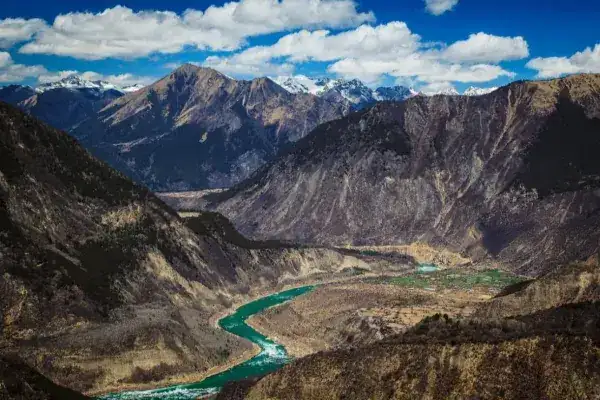
High mountains in the south and west, with numerous lakes and rivers including the Yarlung River, Yamzho Yumco, and Zhêgu Lake. The Yarlung Tsangpo flows eastward through the entire territory. Average elevation: 3,700 meters (3,500–4,500 m range). Highest: Kula Kangri at 7,554 meters; lowest: Subansiri valley at 110 meters.
Hydrology and Water Conservancy
The Yarlung Tsangpo flows 424 km through 7 counties. 41 perennial rivers with total river area of 38,000 square kilometers. Theoretical hydropower potential: 35.1 million kilowatts (183,000 kW developed). Yamzho Yumco pumped-storage hydroelectric station is operational. Six cascade hydropower stations planned on the middle Yarlung Tsangpo with total capacity of 3.36 million kW.
Natural Resources
Water Resources
355 rivers with drainage areas over 50 km² (104 over 200 km²), 125 lakes (24 over 1 km²). Lake storage: 17 billion cubic meters. Groundwater: ~23 billion cubic meters. Annual runoff: 70.6 billion cubic meters. Theoretical hydropower: 23.89 million kilowatts.
Land Resources
Cultivated: 64,600 hectares. Forest: 3,677,300 hectares. Grassland: 2,888,500 hectares. Wetland: 94,500 hectares. Water: 325,900 hectares.
Mineral Resources
37 proven mineral types with 108 occurrences. Main minerals: chromite (Luobusha is China's largest chromite base), lead-zinc, gold, copper. Proven reserves: chromite 4.31 million tons, lead-zinc 2.3 million tons, gold 58 tons, copper 1.36 million tons. The Zhaxikang survey area discovered beryllium-tin-tungsten polymetallic ore with beryllium potential exceeding 500,000 tons.
Biological Resources
Plant resources include forage plants (78.2% of total), flowering plants (Yunnan-Tibet magnolia, rhododendron, Meconopsis), 1,000+ medicinal plant species (Cordyceps, Fritillaria, snow lotus, Rhodiola, Gastrodia), and fungi (Cordyceps, matsutake, monkey head mushroom). Forest: 1,307,000 hectares (within control line), coverage 24.79%.
Wildlife: birds include common merganser, mallard, ruddy shelduck, snow pigeon, pheasant, magpie, and woodpecker. Mammals include wolf, fox, Tibetan fox, wild boar, blue sheep, wild ass, and Himalayan marmot.
Administrative Divisions
Division Details
As of April 2023: 1 district (Naidong), 10 counties (Chanang, Gonggar, Sangri, Qonggyai, Qusum, Comai, Lhozhag, Gyaca, Lhunze, Nagarze), and 1 county-level city (Tsona). The City People's Government is at No. 13 Naidong Road, Zetang Street, Naidong District.
Politics
Leadership
Population
Population Size
According to the Seventh Census (November 1, 2020): 354,035 (up 7.61% from 2010). Age: 0–14: 68,060 (19.22%); 15–59: 245,617 (69.38%); 60+: 40,358 (11.40%). As of end 2023: 353,700. Birth rate: 7.33 per mille; death rate: 5.98 per mille; natural growth rate: 1.35 per mille. Urbanization rate: 33.24%.
Ethnic Groups
Tibetan: 318,250; other minorities: 3,928; Han: 31,857 (2020 Census).
Language
Shannan belongs to the U-Tsang dialect area. Tibetan script was created in the early 7th century with 4 vowel symbols and 30 consonant letters.
Religious Beliefs
Most residents practice Tibetan Buddhism, with some Bon influence. Tibetan Buddhism absorbed many characteristics of the indigenous Bon religion, including polytheism, religious taboos, and death concepts.
Economy
Overview
In 2024, the gross regional product was 30.442 billion yuan, up 5.8%. General public budget revenue: 2.14 billion, up 6.5%. Above-scale industrial added value: 3.303 billion, up 7%. Total retail sales: 8.581 billion, up 6.9%. Urban per capita disposable income: 51,224 yuan, up 6.4%. Rural: 23,346 yuan, up 7.6%.
Primary Industry
Total agricultural output (2023): 2.12 billion yuan, up 16.4%. Grain area: 370,000+ mu. Grain output: 168,500 tons. Livestock inventory: 1,270,000 head. Meat: 25,400 tons. Milk: 73,600 tons. Eggs: 6,000 tons.
Secondary Industry
Total industrial added value (2023): 2.79 billion yuan, up 17.9%. Above-scale: 2.728 billion, up 14.7%. Manufacturing: 704 million (25.8% share, up 51.9%). Electricity/heat/gas/water: 1.396 billion (51.2% share, up 14.6%). Mining: 628 million (23% share, down 9.7%). Energy generation: 6.4 billion kWh. Cement: 1.4815 million tons. Chromite: 180,500 tons. Lead-zinc: 474,000 tons.
Tertiary Industry
Total retail sales (2022): 4.4 billion yuan, down 38.6%. Tourism (2023): 6.2228 million visitors, up 100.6%. Tourism revenue: 2.512 billion yuan, up 89.8%. Wholesale/retail: 1.745 billion, up 12.1%. Transportation: 453 million, up 23.8%. Finance: 2.8 billion, up 4.5%. IT: 1.896 billion, up 5.3%.
Social Affairs
Education
464 schools, 62,873 students (7,005 high school, 12,051 junior high, 4,250 vocational, 27,370 primary, 12,097 kindergarten, 100 special education). 5,927 full-time teachers. Preschool enrollment: 97.39%. Primary: 100%. Junior high: 106.94%. High school: 97.01%.
Healthcare
763 health institutions: 34 hospitals, 82 health centers, 13 CDCs, 12 maternal/child centers, 94 clinics. 1,834 beds (888 municipal, 499 county, 207 township, 240 private). 3,838 health workers (1,045 municipal, 797 county, 748 township, 1,103 village, 145 private).
Science and Technology
R&D expenditure: 3.3 trillion yuan (2.64% of GDP). Hubei science and technology aid projects achieved breakthroughs: plateau egg-laying hens (95.6% peak rate, 210+ eggs/year), high-yield rapeseed (10% increase), specialty vegetables (chili 2,400 kg/mu, tomato 4,500 kg/mu), and walnut post-harvest processing (0.5 yuan/jin price increase).
Culture
1 professional art troupe (62 members), 13 county art troupes (311 members), 12 county cultural centers (124 staff). Radio coverage: 99.49%, TV coverage: 99.63%. 4,400+ grassroots performances benefiting 452,000 people.
Social Security
8,376 people received assistance totaling 5.2227 million yuan. 6,701 new urban jobs (up 11.4%). Zero-employment families eliminated. 3.1381 million yuan in job stabilization funds, protecting 2,203 positions. Urban per capita disposable income (2023): 48,126 yuan, up 6.4%. Rural: 21,691 yuan, up 9.3%. Urban-rural ratio: 2.22:1, narrowing by 0.06.
Transportation
Overview
In 2019: passengers 1.133 million (down 20.6%), freight 2.928 million tons (up 6.4%). Total highway mileage: 8,322.68 km with 904 bridges.
Highways
National Highways 219, 349, 560 fully connected. National Highway 695 under construction. The Lhasa-Xigaze Airport Expressway and Lhasa Gonggar Airport external traffic improvement projects are advancing. 470 transportation projects implemented, 204 completed, 1,752.66 km of new roads.
Railways
The Lhasa-Nyingchi Railway (Tibet's first electrified railway, 435.48 km, 160 km/h design speed) passes through Shannan with 5 stations above 3,200 meters: Shannan, Gonggar, Chanang, Sangri, and Gyaca.
Aviation
Lhasa Gonggar Airport: Located in Gonggar County, at 3,569.5 meters. 4E-level, 4,000 m runway. 16 check-in counters, 15 security channels. In 2018: 36,173 flights, 4,353,948 passengers, 36,320.4 tons cargo.
Shannan Lhunze Airport: Located 11 km west of Lhunze County. 4C-level, 4,500 m runway, 6,000 m² terminal, 7 stands.
Public Transportation
Total civilian vehicles: 60,358 (39,401 passenger, 19,329 freight, 131 special purpose, 1,397 motorcycles, 100 trailers).
Culture
Overview
722 cultural heritage sites (18 national-level, 108 autonomous region-level, 248 county-level, 414 other). 205 intangible cultural heritage items (15 national, 43 autonomous region, 34 municipal, 113 county-level).
Food
Traditional Tibetan breakfast: yak beef Tibetan noodles, Tibetan hotpot, butter tea stir-fried dough, yogurt rice, and Tibetan fried noodles.
Local Specialties
Lhunze Black Highland Barley: Named for its black-purple husk and grain skin, a local variety developed under Lhunze County's unique climate.
Changguo Red Potato: Unique variety from Changguo Township, 50g average weight, thin dark red skin, white flesh. High in calcium, vitamin C, starch, and protein. Won gold at the 2007 Hunan Agricultural Expo.
Menyu Buddha Bud (Yuluo Gangji Tea): Round, tight, smooth tea with alpine aroma and mellow taste. Rich in amino acids (17.9–19.1%), tea polyphenols (20.9–22.1%).
Naidong Highland Barley: Plump, milky yellow grains, 6–9 mm long, 38–42g per 1,000 grains. Protein: >=8.5g/100g, starch: >=50.0g/100g, calcium: >=24.0mg/100g.
Gyaca Walnut: Thin shell, smooth appearance, white plump kernel. Fat: >=40.0%, protein: >=12.0g/100g, oleic acid: >=20.0%, linoleic acid: >=46.0%.
Customs
Chemar Box: Displayed during Tibetan New Year with barley and tsampa, symbolizing favorable weather and prosperity. People carry it while visiting during New Year.
Lhagari Pulu: Handwoven Tibetan woolen fabric, used in daily life and as fashion elements in handbags and clothing.
Art
Jiuhe Drok Dance: Traced to the mid-8th century when Samye Monastery was under construction. Performers danced at night with bonfires and drums to frighten away demons, becoming a well-known dance for warding off evil and praying for auspiciousness.
Naisa Mask Carving: Skilled artisans give new life to carefully selected wood through carving.
Intangible Cultural Heritage
Tibetan Pangden and Carpet Weaving: JeDEXiu Town in Gonggar County is known as the "Hometown of Pangden." Products are sold domestically and exported to India, Nepal, Bhutan, and Western Europe.
Tibetan Opera (Yarlung Tashi Shelpa): Outstanding representative of white-mask Tibetan opera, performed at the Lhasa Shoton Festival since the 5th Dalai Lama's time.
Tibetan Opera (Qonggyai Kadrup Tashi Pendun): Known for unique singing style and "Nine-fold Auspicious" dance, with all-male cast.
Shannan Monpa Opera: Monba ethnic opera from the Himalayan southeast slope, using Tibetan scripts. Performed for 7 consecutive days during Tibetan New Year.
Shannan Changguo Drok Dance: Waist drum dance originating from the 8th century, performed at Samye Monastery's construction to ward off demons.
Lhoba Ethnic Clothing: Made from plant fiber cloth (dashu tree bark), in black, red, and white. No collar, sleeves, or pockets; worn day and night, doubled as blanket and food container.
Tibetan Clothing: Includes Cuomei Zhazha costume, historically prized since the 7th century Tubo period.
Cham (various types): Including Lakang Cham, Qude Temple A-Cham, Monba Ba-Cham, and Samye Monastery Cham.
Tibetan Medicine (Shannan Herbal Bath): Traditional health practice using hot springs or herbal baths for treating cold, wind, swelling, and promoting blood circulation. "Five-Flavor Ganlu" bath is the basic formula.
Tibetan Incense Making (Mindroling Monastery), Wool Textile (Zhetel), Wood Carving (Tibetan Chanang), and Monba Sama Folk Song: All listed as national intangible cultural heritage in 2021.
Cultural Relics and Historic Sites
Tibetan King Tombs: Located in Qonggyai County, the burial site of Tibetan kings including Songtsen Gampo, at the ancestral heartland of the Yarlung tribe.
Samye Monastery: Tibet's first monastery, built in the 8th century by King Trisong Detsen and Padmasambhava. Named from the king's exclamation "Samye!" (meaning "beyond imagination") upon seeing the temple's illusion. Total area: ~25,000 square meters, built on the model of the Indian Odantapuri Monastery, also interpreted as a mandala layout.
Jiru Lhakhang: Built in the early 8th century by King Tride Tsugten, 30 km north of Zetang. National-level protected site (1984). Contains precious Tubo-period artifacts including Tang Dynasty-style thangka and palm-leaf scriptures.
Jiedun Shuzong Ruins: Located on a cliff in Lhozhag County at 3,300 meters, with a 60-meter vertical secret water passage.
Scenic Spots
Sea Buckthorn Forest: In Tsona City's Qüzhuomu Township, 2,000+ mu of ancient sea buckthorn forest, the world's oldest, largest, and highest. Trees up to 15 meters tall, 4.5 meters in girth. Rated "China's Most Beautiful Sea Buckthorn" in 2018.
Baiyu Gully Primeval Forest: In Qusum County, described as "paradise for explorers," satisfying most people's imagination of nature.
Budanla Mountain: At ~5,088 meters, the last natural barrier for Indian warm currents along the Yarlung Tsangpo. The west face features steep cliffs; the east face is forested. Features Qusum earth forest landscape and Sewu hot springs.
Famous People
Nima: Male, Tibetan, born May 1945 in Qonggyai County, fifth batch national-level intangible cultural heritage inheritor.
Tsangyang Gyatso (1683–1706): Monba ethnicity, the 6th Dalai Lama, renowned Tibetan poet and political figure.
Important Honors
Fourth batch National Ecological Civilization Construction Demonstration City (2020). Ping'an China Construction Demonstration City (2021). "14th Five-Year" "Zero-Waste City" (2022). Tenth batch National Ethnic Unity and Progress Demonstration Zone (2023). Fourth batch city 15-minute convenient living circle pilot (2024). National Double Support Model City (2025).
Travel information can change. Check current opening hours, reservations and entry requirements before you travel.
Traveller discussion
Start the conversation with a helpful tip or a question.