
Xishuangbanna Dai Autonomous Prefecture
Xishuangbanna Dai Autonomous PrefectureXishuangbanna Dai Autonomous Prefecture, commonly abbreviated as "Xishuangbanna," is an autonomous prefecture under Yunnan Province of the People's Republic of China. Located between 21°10′–22°40′N and
Xishuangbanna Dai Autonomous Prefecture
Xishuangbanna Dai Autonomous Prefecture, commonly abbreviated as "Xishuangbanna," is an autonomous prefecture under Yunnan Province of the People's Republic of China. Located between 21°10′–22°40′N and 99°55′–101°50′E, it lies on the tropical northern fringe south of the Tropic of Cancer. It borders Pu'er to the northeast and northwest, Laos to the southeast, and Myanmar to the southwest, covering an area of 19,096 square kilometers. As of end-2025, the permanent population was 1.359 million. The prefecture administers one county-level city and two counties, with its seat in Jinghong. The region is home to 13 ethnic groups, with Dai being the predominant minority. The climate features high temperatures, abundant rainfall, distinct wet and dry seasons, and minimal seasonal variation. The Lancang River and Nanpan River are the two major waterways. Xishuangbanna's specialty industries include Pu'er tea, natural rubber, and tropical agriculture. It is China's only tropical rainforest reserve, preserving the most intact tropical ecosystem in the country, and is renowned as the "Kingdom of Plants," "Kingdom of Animals," and "Biological Gene Bank." In 2025, the prefecture achieved a GDP of 94.083 billion yuan (approximately 13.07 billion US dollars), up 4.4% year-on-year.
Etymology
"Xishuangbanna" derives from the Dai language: "xishuang" means twelve, and "banna" refers to an administrative unit responsible for feudal tax collection (literally "twelve thousand rice fields"), signifying twelve administrative regions.
History
Pre-Qin to Three Kingdoms and Jin Dynasties
Before and during the Three Kingdoms and Jin Dynasties, the Xishuangbanna area belonged to Yongchang Commandery. The territories of ancient southern kingdoms such as Nanzhao and Dali took shape after the eighth century. During this period, the region was under the political, economic, and cultural influence of southern states while maintaining exchanges with the Central Plains civilization.
Northern and Southern Dynasties
During the Northern and Southern Dynasties, twelve Dai tribes known as "Lexishuangbang" in the Xishuangbanna area pledged allegiance to the imperial court. From the 8th to 10th centuries, the Mengle polity was under the jurisdiction of the Yansheng Military Commission of Nanzhao. In 1160, Dai chieftain Paya Zhen unified Mengle under the Dali Kingdom's authority.
Song, Yuan to Ming and Qing Dynasties
After the Yuan dynasty conquered the Song, Yunnan was established as a province, and the Mengle area was called "Cheli Route." The tusi (native chieftain) system was implemented. In 1296, the Cheli Military-Civilian Administration was established. In 1570, the pacification commissioner divided the administered territory into twelve "banna," creating the name "Xishuangbanna." In 1895, under the Sino-French supplementary border treaty, France ceded several areas to French Indochina, reducing the twelve banna to eleven.
Republic of China Period
In 1912, the Pusi Frontier Administration Bureau was established, dividing Xishuangbanna into eight administrative districts. In 1927, seven counties were formally established under Pu'er Circuit.
After the Founding of the People's Republic of China
On February 17, 1950, Xishuangbanna was fully liberated. On January 23, 1953, the Xishuangbanna Dai Autonomous Region was established with its seat at Yunjinghong. In June 1955, it was upgraded to an autonomous prefecture. In 1973, the prefecture was placed under direct provincial administration, separating from Simao Prefecture. In 1993, Jinghong County was abolished and replaced by Jinghong City.
Administrative Divisions
As of October 2025, Xishuangbanna administers one county-level city (Jinghong) and two counties (Menghai and Mengla), comprising 30 townships, 5 sub-districts, 211 administrative villages, and 170 communities. The prefecture seat is in Jinghong.
Physical Geography
Location and Extent
Xishuangbanna is located between 21°10′–22°40′N and 99°55′–101°50′E, on the tropical northern fringe south of the Tropic of Cancer. It covers 19,096 square kilometers and shares a 966.3-kilometer border with Laos and Myanmar.
Climate
Xishuangbanna has a tropical monsoon climate. The Ailao and Wuliang mountain ranges to the north block cold air from the south, while proximity to the Indian Ocean and Bay of Bengal brings warm, moist southwest monsoons. The climate is warm and humid year-round, with no distinct seasons—only dry (November–April) and wet (May–October) seasons. In 2023, annual rainfall ranged from 627.5 to 1,196.6 mm across counties, with average temperatures between 19.6°C and 25.6°C.
Geological Structure
The prefecture's geology is complex, with strata mainly composed of limestone, granite, and schist. The area lies along the southward extension of the Hengduan mountain fault system, with metamorphic rock highlands flanking both sides and Mesozoic sedimentary deposits in the central basin.
Topography
The terrain slopes from north to south, with higher elevations on both sides and lower terrain in the middle. The eastern Wuliang mountain range traverses Jinghong and Mengla at elevations of 1,000–1,500 m. The western Nu mountain remnants cover Menghai County at 1,500–2,000 m. The central area features broad valleys cut by the Lancang River and its tributaries, at 500–1,000 m elevation. The highest point is Huazhuliangzi in Menghai County at 2,429 m; the lowest is the confluence of the Lancang River and Nanla River at 477 m.
Hydrology
The prefecture has 2,761 rivers with a total channel length of 12,177 km. Major water conservancy projects under construction include the Meng'a Reservoir and Manxian Reservoir. The Meng'a Reservoir will have a total storage capacity of 11.127 million cubic meters.
Soils
The prefecture's soils include seven soil types, 18 subtypes, and 85 soil species. The main types are lateritic red earth, brick-red earth, red earth, and paddy soil. Paddy soil accounts for 52.72% of arable land.
Natural Disasters
Xishuangbanna faces flood risks, geological hazards, and tropical climate-related disasters. Heavy monsoon rains cause river flooding and flash floods. The region has 152 geological hazard sites (135 landslides, 9 collapses, and 8 debris flows), threatening 2,524 households and assets valued at 370.82 million yuan (approximately 51.5 million US dollars). Agricultural pests and diseases, including planthoppers and fall armyworm, are also significant concerns.
Natural Resources
Water Resources
The prefecture's average annual surface water resource is 10.262 billion cubic meters, with per capita water resources of 7,703 cubic meters—approximately four times the national average. Surface water supplies 99.9% of total water consumption.
Land Resources
According to the third national land survey: arable land totals 115,971.20 hectares (173,960 mu); garden land 610,624.73 hectares (915,940 mu); forest land 1,077,645.38 hectares (1,616,470 mu); and grassland 10,308.94 hectares (154,600 mu).
Mineral Resources
The prefecture has identified 26 mineral types across 350 deposits. Major reserves include coal (26.7978 million tons), iron ore (165.9819 million tons), salt ore (1,576.4513 million tons), and others including copper, lead, zinc, tin, gold, silver, and rare earths.
Biodiversity
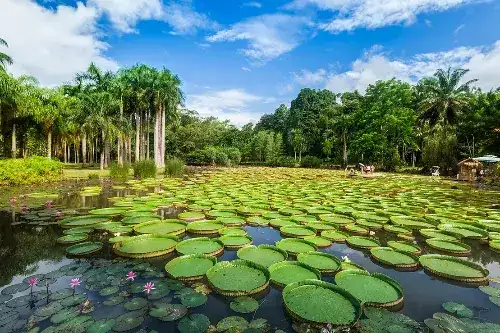
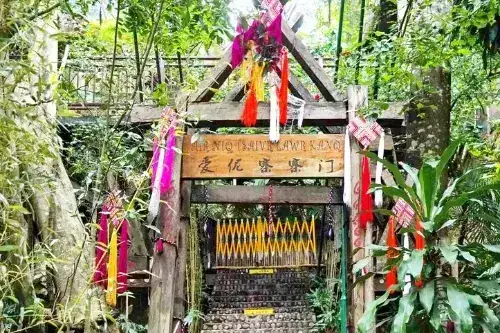
Xishuangbanna's tropical rainforests harbor over 5,000 species of higher plants, including 153 endemic species and 178 nationally protected rare and endangered species. The region also hosts 756 species of wild animals (25.3% of the national total), including 108 mammal species and 427 bird species. It is home to China's largest wild Asian elephant population. The prefecture contains six national-level and provincial-level nature reserves covering 622,800 mu, including the Xishuangbanna National Nature Reserve (200,000 hectares, established 1958) and the Naban River National Nature Reserve.
Population
Population Size
As of end-2025, the permanent population was 1.359 million, including 733,000 urban residents. The birth rate was 6.16 per mille, death rate 7.50 per mille, with a natural growth rate of -1.34 per mille. The urbanization rate reached 53.93%.
Ethnic Groups
In 2023, 13 ethnic groups resided in Xishuangbanna. Of the 1.0245 million registered population, ethnic minorities numbered 795,300 (77.6%), including 333,900 Dai (32.6%), 212,100 Hani (20.7%), and 25,800 Jinuo (2.5%)—the last ethnic group officially recognized by the State Council.
Languages
The Dai language belongs to the Zhuang-Dai branch of the Sino-Tibetan family. The Dai people use four writing systems: Dai Le, Dai Na, Dai Beng, and Jinping Dai scripts. Other ethnic groups maintain their own languages, including Hani, Lahu, Yao, Miao, and Wa.
Religion
Major religions include Buddhism, primal religions, Islam, Christianity, and Taoism. Theravada Buddhism was introduced between the 3rd and 6th centuries CE and became the primary faith of the Dai and Bulang peoples.
Politics
The prefecture operates under China's autonomous prefectecture governance system, with the Dai Autonomous Prefecture People's Congress and People's Government administering regional affairs.
Economy
Overview
Xishuangbanna is an agricultural prefecture with traditional pillars in rubber, grain, sugar, and tea, complemented by growing tourism. In 2025, the GDP reached 94.083 billion yuan (approximately 13.07 billion US dollars), up 4.4%. The three-sector structure was 21.1:23.0:55.9, with per capita GDP of 69,821 yuan (approximately 9,700 US dollars).
Primary Industry
In 2025, total agricultural, forestry, pastoral, and fishery output value reached 33.631 billion yuan (approximately 4.67 billion US dollars), up 4.4%. Grain output was 507,700 tons; dry rubber 375,300 tons; tea 72,300 tons; and fruit 1.5157 million tons. Rubber cultivation covered 4.7425 million mu.
Secondary Industry
In 2025, industrial value-added reached 9.351 billion yuan (approximately 1.30 billion US dollars), up 6.5%. Above-scale industrial value-added grew 8.2%. Total power generation reached 7.966 billion kWh, up 28.5%, with solar power growing 75.9%. Construction industry value-added reached 12.269 billion yuan (approximately 1.70 billion US dollars).
Tertiary Industry
In 2025, above-scale service industry revenue reached 6.353 billion yuan (approximately 882 million US dollars), up 3.7%. The prefecture received 72.9294 million domestic and international tourists (up 3.5%), with total tourism spending of 80.789 billion yuan (approximately 11.22 billion US dollars). Retail sales reached 43.724 billion yuan (approximately 6.07 billion US dollars). Port import-export trade totaled 74.303 billion yuan (approximately 10.32 billion US dollars). Local general public budget revenue was 3.992 billion yuan (approximately 554 million US dollars), and expenditure 14.56 billion yuan (approximately 2.02 billion US dollars). Financial institution deposits reached 113.569 billion yuan (approximately 15.77 billion US dollars) and loans 90.942 billion yuan (approximately 12.63 billion US dollars). Insurance premium income was 2.547 billion yuan (approximately 354 million US dollars).
Social Services
Education
In 2025, the prefecture enrolled 3,570 students in regular higher education, 7,869 in regular senior high schools, 16,247 in junior high schools, and 15,506 in primary schools, with 31,967 children in preschool education.
Healthcare
The prefecture had 869 medical institutions, including 45 hospitals, 813 grassroots health facilities, and 10 public health institutions. It employed 12,977 health professionals, including 4,554 licensed physicians, and maintained 8,652 beds.
Media
Xishuangbanna Radio and Television Station, formed in 2012 by merging the former TV and radio stations, operates two TV channels, two radio frequencies, and multiple platforms, broadcasting in Dai and Hani languages.
Science and Technology
In 2025, science and technology expenditure reached 63 million yuan (approximately 8.75 million US dollars), with 17 new national high-tech enterprises recognized. The prefecture held 429 valid patents.
Culture
By end-2025, the prefecture had 4 performing arts troupes, 5 public libraries, 4 cultural centers, and 3 museums, with library collections totaling 314,800 volumes.
Sports
In 2025, prefecture athletes won 30 gold, 31 silver, and 14 bronze medals at provincial and above competitions.
Environmental Protection
The prefecture completed 3,560 hectares of afforestation. Total energy consumption was 2.3754 million tons of standard coal, up 3.8%.
Social Security
In 2025, per capita disposable income was 31,218 yuan (approximately 4,336 US dollars), up 4.7%—urban 42,681 yuan (approximately 5,928 US dollars), rural 22,428 yuan (approximately 3,115 US dollars). Per capita consumption expenditure was 25,997 yuan (approximately 3,611 US dollars). Urban unemployment insurance covered 99,700 people; urban workers' basic pension insurance 262,700; and urban-rural residents' basic medical insurance 841,900.
Transportation
Overview
Xishuangbanna's strategic location borders Laos and Myanmar, with a 966.29-kilometer boundary line. It possesses seven national-level ports—Banna Airport, railway port, Jinghong Port, Guanlei Port, Mohan, Daluo, and Mengman—forming a comprehensive water, land, air, and rail transport network. The Lancang-Mekong River connects six nations. The China-Laos Railway's Xishuangbanna section spans 214.28 km with five stations.
Highways
As of September 2023, the prefecture had 9,224.064 km of highways, including 414.333 km of expressways and 42.699 km of first-class roads.
Railways
The China-Laos Railway serves Xishuangbanna, connecting to Kunming and beyond. In 2023, the Xishuangbanna section dispatched 4.36 million passengers and 4.628 million tons of freight, growing 153% and 77.7% respectively.
Aviation
Xishuangbanna Gasa International Airport, operational since April 7, 1990, was designated a Class-I port airport in 1997. In 2023, it handled over 6 million passengers and 14,200 tons of cargo (up 80.9%).
Water Transport
As of 2020, the prefecture had 194 km of navigable waterways, 23 docks, and 45 berths. Jinghong Port is a national Class-I port with international shipping routes to Laos, Myanmar, and Thailand.
Public Transportation
By November 2022, the prefecture had 4 bus companies, 4 taxi companies, and 58 ride-hailing platforms, operating 174 buses, 689 taxis, and 1,247 ride-hailing vehicles. Jinghong ran 74 new-energy buses on 11 routes. The prefecture operated 183 rural bus routes with 545 vehicles, achieving 100% coverage of towns and villages.
Culture and Humanities
Overview
Xishuangbanna's cultural identity centers on diverse ethnic customs, distinctive cuisine, and tropical rainforest landscapes.
Cuisine
Dai cuisine features roasting, frying, steaming, mincing, and pickling methods, with flavors characterized as aromatic, crispy, sour, spicy, and fresh. Rice is the staple, complemented by pork, poultry, vegetables, and wild plants.
Customs
Major Dai festivals include Songkan Bimai (Water-Splashing Festival), Khao Watsa (Closing Door Festival), and Awk Watsa (Opening Door Festival). Hani (Akha) festivals include Gatangpa and Yekuzha. Traditional Dai clothing includes collarless jackets for men and tube skirts for women. Tattooing is a widespread male custom. Dai stilt houses (ganlan style) feature two-story structures with livestock below and living quarters above. Buddhist temple architecture features multi-eaved, multi-pitched tiled roofs.
Art
Dai literature developed through both oral and written traditions, influenced by early adoption of Dai script. Narrative epics originated from ancient folk songs, evolving from simple work songs to complex narrative poems such as "Phoenix Love Song." Professional singers called "zanha" still perform oral epics today.
Local Specialties
Key products include Pu'er tea, natural rubber, tropical fruits, and Dai brocade (daijin), a traditional handwoven textile recognized as national intangible cultural heritage.
Historical Sites
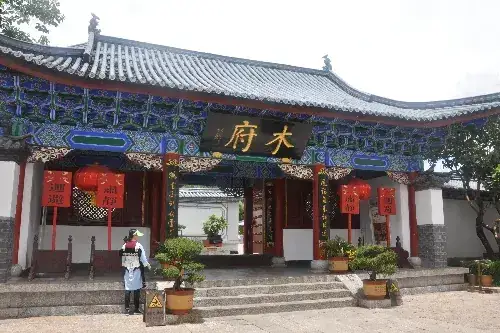
The prefecture has 75 immovable cultural relics (including 5 national-level protected sites), 3 museums, and 3,550 cataloged movable artifacts. Notable sites include Jingzhen Octagonal Pavilion (Menghai County, national heritage site since 1988), Manfeilong Stupa (Jinghong, built 1204), Manduan Buddhist Temple (Menghai, built 950), Manchunman Buddhist Temple (Jinghong, rebuilt 1260), and Li Dingguo Shrine (Mengla, commemorating the Ming-Qing general).
Intangible Cultural Heritage
By end-2023, Xishuangbanna had 209 intangible cultural heritage projects (including 12 national-level), 4 provincial cultural ecology protection zones, 455 heritage bearers (including 9 national-level), and 56 transmission centers.
Scenic Spots
Overview
Xishuangbanna is a national-level scenic area, national ecological demonstration zone, UNESCO Biosphere Reserve network member, and UNWTO sustainable tourism observatory. Tourism development began in the early 1980s, making it one of China's earliest ethnic tourism destinations. By end-2023, the prefecture had 19 A-level scenic areas (including 14 at 4A or above), 4 tourist resorts, and 4 national rural tourism villages.
Main Attractions
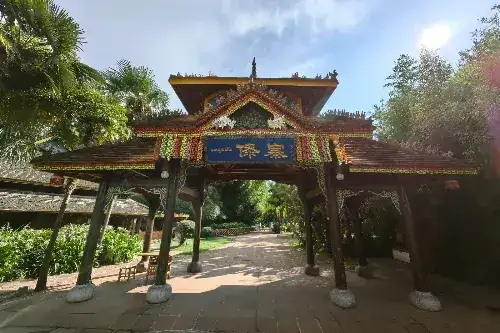
Key attractions include the tropical rainforest reserves, the Xishuangbanna Tropical Botanical Garden, Manfeilong White Stupa, Jingzhen Octagonal Pavilion, and the Dai cultural villages of Ganlanba (Olive Dam).
External Relations
The prefecture maintains cross-border cooperation with Laos and Myanmar through its seven national ports, particularly the Mohan port on the China-Laos Railway and the Jinghong Port on the Lancang-Mekong River.
Notable Figures
Notable historical figures associated with Xishuangbanna include Paya Zhen, the 12th-century unifier of Mengle, and Li Dingguo, the Ming-Qing general who resisted the Qing dynasty and died in Mengla in 1662.
Key Contributors
Cai Xitao, a prominent botanist, made significant contributions to Xishuangbanna's agricultural development in the 1960s. He introduced double-cropping early rice experiments in Menglun, developed improved rice varieties, and promoted tropical fruit, rubber, and tea cultivation. He was affectionately called "Cai Bota" by local people of all ethnic groups.
Major Honors
Xishuangbanna holds designations as a national scenic area, national ecological demonstration zone, UNESCO Biosphere Reserve, and UNWTO tourism sustainability observatory. Jinghong was among the first batch of "China Excellent Tourism Cities" in 1999.
Travel information can change. Check current opening hours, reservations and entry requirements before you travel.
Traveller discussion
Start the conversation with a helpful tip or a question.