
Qiannan Buyei and Miao Autonomous Prefecture
Qiannan Buyei and Miao Autonomous PrefectureQiannan Buyei and Miao Autonomous Prefecture, abbreviated as "Qiannan," is an autonomous prefecture under Guizhou Province, located in central-southern Guizhou. It borders Qiandongnan to the east,
Qiannan Buyei and Miao Autonomous Prefecture
Qiannan Buyei and Miao Autonomous Prefecture, abbreviated as "Qiannan," is an autonomous prefecture under Guizhou Province, located in central-southern Guizhou. It borders Qiandongnan to the east, Guangxi to the south, Anshun and Qianxinan to the west, and Guiyang to the north. Situated on the slope from Guizhou Plateau to Guangxi Hills, terrain is higher in the north and lower in the south, in the East Asian monsoon zone. Total area: 26,200 square kilometers. As of end 2025: 2 county-level cities, 9 counties, 1 autonomous county. Permanent resident population: 3,489,700. Established August 8, 1956. Qiannan was an important passage on the Southern Maritime Silk Road. It features the World Natural Heritage Libo Karst ("Emerald on the Earth's Belt"), the "China Sky Eye" (FAST radio telescope), and the Pingtian Tiankeng group. In 2025, the gross regional product was 200.849 billion yuan, up 4.2%.
History
Since ancient times, the area was inhabited by minority peoples. During the Yin and Zhou periods, it belonged to Zangke and Yelang states. After the Tang Dynasty (618–907), the central government established various administrative systems. During the Yuan Dynasty (1271–1368), the chieftain system was implemented. During the Ming (1368–1644), "replacing chieftains with officials" (gaituguiliu) reforms began. In 1949, Dushan Special District was established. In 1956, Qiannan Buyei and Miao Autonomous Prefecture was established, seated at Duyun. In 1958, Duyun County became Duyun City. In 1996, Fuquan County became county-level Fuquan City.
Administrative Divisions
As of end 2025: 2 county-level cities (Duyun, Fuquan), 9 counties (Libo, Guiding, Weng'an, Dushan, Pingtang, Luodian, Changshun, Longli, Huishui), and 1 autonomous county (Sandu Shui Autonomous County). The Prefecture People's Government is at No. 14 Huandong Middle Road, Duyun City.
Geographical Environment
Location
Qiannan is in southern Guizhou, between 106°12'–108°18' east longitude and 25°04'–27°29' north latitude, spanning 207.9 km east-west and 269.4 km north-south. Libo County is Guizhou's closest point to the sea (390 km to Guangxi's Fangchenggang). Total area: 26,200 square kilometers.
Topography
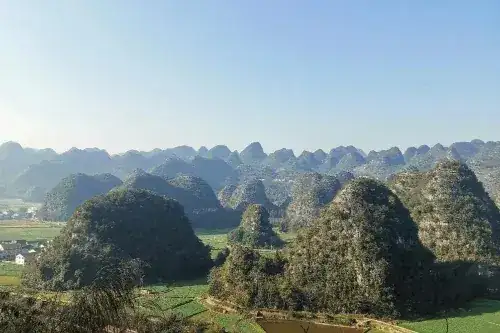
Transition zone from Guizhou Plateau to Guangxi Hills, higher in the north. Highest: Doupeng Mountain at 1,961 m; lowest: Luodian Hongshui River exit at 242 m. Average elevation: 997 m. Karst landforms are widely developed, with peak forests, peak clusters, sinkholes, caves, and underground rivers. 6 landform types: high mountains, medium mountains, low mountains, hills, and basins.
Climate
Diverse climate with regional and vertical variations. East Asian monsoon zone, closest to the sea in Guizhou. Abundant heat from ocean currents. Frost-free period: 292 days. Annual sunshine: ~30%. Annual average temperature: 13.6–19.6°C, increasing southward and eastward. Annual precipitation: 1,200+ mm, one of Guizhou's rainiest areas.
Hydrology
Source area for Yangtze and Pearl River systems. 117 medium and small rivers totaling 5,000+ km. Rivers often flow through karst caves, alternating between surface and underground sections. 2 rivers over 5,001 km² drainage area (Wujiang and Hongshui River). Karst features cause dramatic seasonal water fluctuations.
Natural Resources
Water Resources
Total drainage area: 26,193.2 km² (Yangtze 7,586.9; Pearl River 18,606.3). Theoretical hydropower potential: 4.208 million kilowatts (developable: 1.805 million kW). 137 hydropower stations built (783,000 kW), 10 under construction (413,000 kW). Development utilization rate: 66.4%.
Plant Resources
1,384 plant species in 170 families and 744 genera (86.8% of Guizhou's families, 54% of genera, 27.9% of species). Many ancient and relict species preserved due to southern location escaping glaciation. 45 rare species under national protection (12 Class II, 11 Class III).
Animal Resources
484 vertebrate species: 235 birds (58.1% of Guizhou's total), 98 fish (51.6%), 73 mammals (54.5%), 55 reptiles (55.6%), 23 amphibians (38.3%). 34 rare species (56.7% of provincial total): 6 Class I protected (South China tiger, clouded leopard, leopard, serow, goral, Chinese merganser), 10 Class II.
Mineral Resources
50+ proven mineral types. Phosphorus: 4.432 billion tons (20.1% of national reserves). Coal: 171 million tons. Antimony: 79,100 tons. Zinc: 298,000 tons. Crystal: 800,000 tons. Iron ore: 95.28 million tons.
Population
As of end 2025: 3,489,700 (down 11,500). 43 ethnic groups with minorities at 59.05%. Buyei distributed across all counties; Miao mainly in Huishui, Duyun, Sandu, Fuquan, Guiding, and Longli; Shui mainly in Sandu, Libo, Duyun, and Dushan; Maonan in Pingtang, Dushan, and Huishui; Yao in Libo.
Ethnic Composition
As of end 2025: 3,489,700 (down 11,500). 43 ethnic groups with minorities at 59.05%.
Politics
Economy
Overview
In 2025, the gross regional product was 200.849 billion yuan, up 4.2%. By industry: primary 31.04 billion (15.4%), secondary 59.371 billion (29.6%), tertiary 110.437 billion (55.0%). Per capita GDP: 57,460 yuan. Fixed-asset investment down 15% (industrial 52.4% share, private 42.6%, industrial 59.4%, high-tech 9.3%). General public budget revenue: 13.328 billion, up 3.8%. General public budget expenditure: 50.366 billion, up 0.1%.
Primary Industry
Total agricultural output: 52.521 billion yuan, up 3.9%. Grain area: 4.0103 million mu. Grain output: 1.3119 million tons, up 1.7%. Chinese medicinal herbs: 336,700 tons. Vegetables and mushrooms: 5.766 million tons. Tea: 68,400 tons. Fruit: 1.7133 million tons. Meat: 263,100 tons. Pig inventory: 2.1054 million. Forest coverage: 63.0%. Fishery: 27,000 tons.
Secondary Industry
Industrial added value: 49.072 billion yuan, up 9.4%. Above-scale industrial added value up 14.5% (mining up 10.0%; manufacturing up 18.0%; electricity/gas/water up 4.9%). Chemical manufacturing up 24.6%. Above-scale sales rate: 98.9%. Profits: 8.627 billion, up 27.5%. Revenue: 111.338 billion, up 16.0%. Construction added value: 10.353 billion, down 11.8%.
Tertiary Industry
Total retail sales: up 1.9% (urban up 1.8%; rural up 2.3%). Foreign trade: 3.798 billion yuan, up 39.1% (imports 1.196 billion, up 398.3%; exports 2.602 billion, up 4.5%). Total deposits: 235.98 billion, up 4.0%. Total loans: 289.594 billion, up 4.3%.
Social Affairs
Education
64,739 staff (49,026 full-time teachers). Preschool: 16,179 staff (8,262 teachers). Primary: 19,459 staff (16,553 teachers). Junior high: 11,743 staff (10,132 teachers). High school: 8,259 staff (6,649 teachers). Vocational: 2,021 staff (1,791 teachers). Special education: 297 staff (243 teachers). Higher education: 6,656 staff (5,329 teachers).
Culture
13 public libraries, 13 museums/memorials, 13 cultural centers, 342 indoor sports venues. Radio and TV coverage: 99.8%. National Class I libraries: Duyun City Library and Weng'an County Library.
Healthcare
2,228 health institutions: 122 hospitals, 200 health centers. 26,111 beds (22,506 hospitals, 2,666 health centers). 30,641 health workers (11,251 physicians, 13,663 nurses, 1,230 pharmacists, 2,344 technicians).
Sports
97 awards in international and national competitions (up 61.7%). 292 provincial medals. 1.3606 million fitness participants (up 0.5%).
Social Security
Pension: 2.7944 million. Unemployment: 259,900. Work injury: 464,900. Medical insurance: 3.8697 million. Maternity: 279,900. Urban minimum living: 46,700 people (288 million yuan). Rural minimum living: 135,200 people (673 million yuan).
Transportation
Overview
Railways: Guiyang-Guangzhou HSR, Shanghai-Kunming HSR, Xiangqian, Qiangui, and Zhuliu railways. Highways: National Highways 321 and 210, plus 6 expressways. 858 km of expressways. All counties connected by expressway, all townships by asphalt roads, all villages by road. 3 inland river ports (Wujiang, Jiangjiehe, Hongshuihe) connect to Yangtze and Pearl rivers. Libo Airport offers flights to Guiyang, Guangzhou, Changsha, and Sanya. 1 hour drive to Guiyang Longdongbao International Airport.
Highways
Total mileage: 27,080 km (1,578 km expressway, up 7.6%). Highway passengers: 16.9 million. Highway freight: 167.81 million tons. Expressway network includes Lanhai, Hukun, Xiarong, Yinbai, Huixing, and Daoxin routes. "County-to-county expressway" achieved December 31, 2015.
Railways
312 km of operating railways (15.2% of Guizhou's total). Qiangui, Hukun (Zhuliu double-track), and Guangxi-Libo railways. Guiyang-Guangzhou HSR (152 km in Qiannan) and Hukun passenger line (63.6 km) under construction.
Aviation
Libo Airport: Opened November 7, 2007. 2,300 m runway, 3,334 m² terminal, designed for 220,000 annual passengers. Expansion started April 29, 2020. Duyun to Guiyang Longdongbao International Airport: 120 km, accessible via HSR (direct station at Longdongbao).
History and Culture
Cultural Relics
5 national-level, 56 provincial-level, 50 prefectural-level, and 267 county-level protected cultural heritage sites.
Folk Customs
Festivals: Buyei "March 3rd," "June 6th," "Gengjian Festival"; Miao "April 8th," New Crop Festival, Miao New Year; Shui Duan Festival, Mao Festival, Jingxia Festival; Maonan Torch Festival; Yao Panwang Festival. Traditional dances: Buyei rice-pounding dance, Miao "Moon Stomping," Shui bronze drum dance. Traditional sports: dragon boat racing, martial arts, horse racing, monkey drum, spinning tops.
Crafts
Miao batik (Song Dynasty tribute), Dong brocade, embroidery, ethnic costumes and jewelry. Bamboo weaving (traditional craft of Buyei, Miao, Shui, and Yao peoples). Paper cutting (unique to Shui communities). Ethnic architecture: stilt houses (Miao, Dong, Shui, Yao), Drum Towers, Flower Bridges.
Scenic Spots
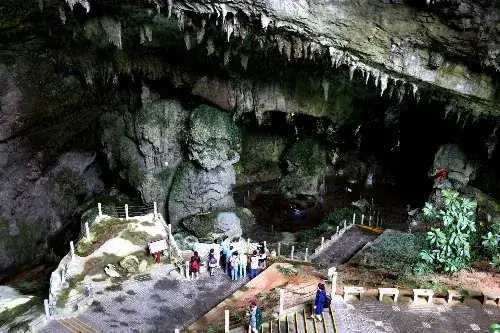
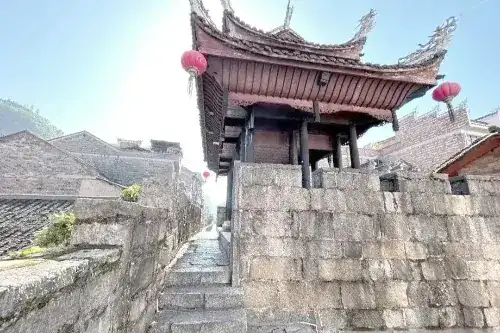
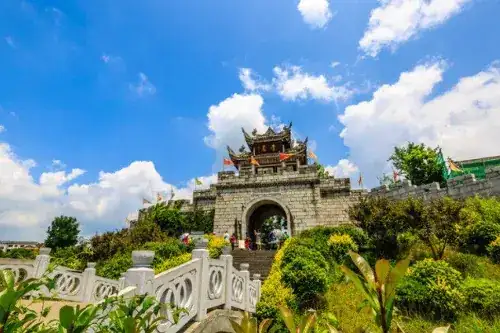
As of end 2025: 1 5A, 16 4A, 48 3A scenic areas. World Natural Heritage: Libo Karst. 5A: Libo Zhangjiang Scenic Area. 4A: Pingtang Zhangbu "Hidden Character Stone," Weng'an Caotang Ancient Town, Longli Wushan Gorge, Fuquan Ancient City. 1 national nature reserve: Maolan Karst Forest. 4 national scenic areas. 5 national forest parks. 1 national geopark. Red tourism sites: Houchang Conference site, Deng Enming's former residence, Red Army Wujiang crossing site, and anti-Japanese war sites.
Local Specialties
Duyun Maojian Tea, Fuquan salted eggs, deboned chicken chili, colorful rice dumplings, Dushan dendrobium, Pingtang Yazhou pottery, seven-color pickled peppers, Rosa roxburghii dried fruit, Libo Zhangjiang pomelo, Sandu Shui horse-tail embroidery, silver ornaments, Shui script calligraphy, Jiupian plum, Jiupian liquor, Weng'an yellow cake, Guiding Yunwu tea, Longli Deng's spicy chicken, Huishui kumquat, Changshun green-shell eggs, high-calcium apples, Luodian jade, blood orange, and navel orange.
Honorary Titles
Sixth batch National Ethnic Unity and Progress Demonstration Area (2018). Fifth batch elderly care pilot (2020). China Summer Resort Famous City (2020). Rural road management pilot (2020). National Forest City (2022).
Travel information can change. Check current opening hours, reservations and entry requirements before you travel.
Traveller discussion
Start the conversation with a helpful tip or a question.