
Qianxinan Buyei and Miao Autonomous Prefecture
Qianxinan Buyei and Miao Autonomous PrefectureQianxinan Buyei and Miao Autonomous Prefecture, abbreviated as "Qianxinan," is an autonomous prefecture under Guizhou Province, with its capital in Xingyi City. Located at the junction of Yunnan
Qianxinan Buyei and Miao Autonomous Prefecture
Qianxinan Buyei and Miao Autonomous Prefecture, abbreviated as "Qianxinan," is an autonomous prefecture under Guizhou Province, with its capital in Xingyi City. Located at the junction of Yunnan, Guangxi, and Guizhou provinces, in southwestern Guizhou, upper Pearl River, southeastern Yunnan-Guizhou Plateau. Total area: 16,804 square kilometers. As of February 2026: 2 county-level cities, 6 counties. As of end 2025: 2,968,300 permanent residents. Established in 1981, formally inaugurated May 1, 1982. Named "China's Gold Prefecture" in 2005 for its abundant gold deposits. The prefecture has beautiful mountains, pleasant climate, and deep cultural heritage. In 2025, the gross regional product was 153.528 billion yuan, up 5.1%.
History
During the Yin period, it was Guifang Kingdom. From Spring and Autumn to Han, it was Yelang Kingdom and Zangke Commandery. During the Northern and Southern Dynasties, it was Dongxuan and Wuman territory. During the Tang (618–907), Song (960–1279), and Yuan (1271–1368), various administrative units were established. During the Ming (1368–1644), Pu'an Guard and Prefecture were established. In the late Ming, the Southern Ming court moved to Anlong. In 1797, the Qing Dynasty (1644–1912) renamed Nanlong Prefecture to Xingyi Prefecture. In 1914, Xingyi Prefecture was abolished. In 1950, Xingren Special District was established. In 1952, renamed Xingyi Special District. In 1981, Qianxinan Buyei and Miao Autonomous Prefecture was established. In 1987, Xingyi County became Xingyi City. In 2018, Xingren County became county-level Xingren City.
Administrative Divisions
As of February 2026: 2 county-level cities (Xingyi, Xingren) and 6 counties (Anlong, Zhenfeng, Pu'an, Qinglong, Wangmo, Ceheng), with 43 subdistricts, 83 towns, and 14 townships. The Prefecture People's Government is at No. 16 Shajing Street, Xingyi City.
Geographical Environment
Location
At the junction of Yunnan, Guizhou, and Guangxi, between 104°35'–106°32' east longitude and 24°38'–26°11' north latitude, spanning 210 km east-west and 177 km north-south. Total area: 16,804 square kilometers.
Topography
Typical low-latitude, high-altitude mountainous area. Terrain higher in the west and north. Highest: 2,207.2 m (Xingyi). Lowest: 275 m (Wangmo Hongshui River). 5 landform zones: low mountain erosion canyon, karst plateau basin, karst erosion plateau, karst erosion mountain, and erosion mountain valley.
Climate
Subtropical monsoon humid climate. Annual average temperature: 13.8–19.4°C. January average: 7.1°C (extreme: -8.9°C). July average: 23°C (extreme: 40.2°C). Frost-free period: 317 days. Annual sunshine: 1,589.1 hours. Annual precipitation: 1,352.8 mm (range 737.1–2,047.8 mm), concentrated May–September.
Hydrology
All rivers belong to the Pearl River basin. 102 rivers over 10 km and 20 km² drainage area. Three major rivers: Nanpanjiang (264 km in prefecture, 19.49 billion m³ annual runoff), Beipanjiang (237 km on border, 94 km within, 52.15% of area), and Hongshui River (44 km, 5.23–24.9 billion m³ annual runoff). 106 tributaries (39 first-order, 55 second-order, 12 third-order). Flood season (May–September) carries 80–90% of annual flow.
Natural Resources
Water Resources
Theoretical hydropower potential: 3.125 million kilowatts (double the national average). Developable: 10+ million kilowatts. Part of the Hongshui River hydropower base (one of China's three major). Built stations: Lubuge, Tianshengqiao I and II, Pingban, Guangzhao, Dongqing, and Luyang, totaling 6+ million kilowatts, 12.8+ billion kWh annually.
Plant Resources
3,913+ plant species, including 300+ rare species (Guizhou cycad, Yunnan yew, dove tree). Oil plants (Jatropha, Pistacia, tung oil tree), fruit trees (chestnut), spice plants (Sichuan pepper, litsea), fiber plants (palm, paper mulberry), and 2,000 medicinal plant species.
Animal Resources
542+ wild animal species in 12 classes. 6 Class I protected (black leaf monkey, clouded leopard, golden eagle, black-necked crane, python) and 36 Class II protected (macaque, pangolin, white-bellied pheasant, tiger-pattern frog), representing 45.98% of Guizhou's protected species.
Mineral Resources
41 mineral types (half of Guizhou's total). Coal: 7.528 billion tons proven (3rd in Guizhou), 19+ billion tons potential. Gold: 1 super-large, 4 large, 1 medium, and 4 small deposits, 500+ metal tons proven, 1,000+ tons potential (90%+ of Guizhou's reserves). Also: antimony, thallium, aluminum, gypsum, dolomite, molybdenum, iceland spar, crystal, silica, cobalt, and kaolin.
Population
As of end 2025: 2,968,300 (down 7,600). Urban: 1,500,500 (50.55%). Birth rate: 8.93 per mille; death rate: 7.51 per mille; natural growth rate: 1.42 per mille. Registered population: 3,774,500. 35 ethnic groups including Han, Buyei, Miao, Yi, and Hui.
Ethnic Composition
35 ethnic groups. Buyei and Miao are the main minorities, distributed across all counties.
Politics
Economy
Overview
In 2025, the gross regional product was 153.528 billion yuan, up 5.1%. By industry: primary 29.224 billion (19.0%), secondary 41.922 billion (27.3%), tertiary 82.382 billion (53.7%). Per capita GDP: 51,657 yuan. Fixed-asset investment down 7.8% (industrial up 10.6%, private down 21.3%). Total fiscal revenue: 16.543 billion, up 1.4%. General public budget revenue: 9.722 billion, up 2.0%. General public budget expenditure: 41.956 billion, up 0.6%.
Primary Industry
Total agricultural output: 48.883 billion yuan, up 3.7%. Grain area: 3.1101 million mu. Grain output: 900,800 tons, up 2.1% (corn 402,800 tons; rice 241,600 tons; wheat 101,100 tons). Pig inventory: 1.2965 million, up 7.0%. Pig sales: 1.7147 million. Meat: 212,700 tons. Aquatic products: 17,200 tons, up 5.8%.
Secondary Industry
Above-scale industrial added value up 17.9% (mining up 5.0%; manufacturing up 26.3%; electricity/heat/gas/water up 10.8%). Non-ferrous metal mining up 347.1%; non-ferrous smelting up 49.0%; waste recycling up 47.4%. Revenue: 100.963 billion, up 16.0%. Profits: 2.876 billion, up 3,131.5%. 218 qualified construction enterprises (6 first-class, 184 second-class).
Tertiary Industry
Total retail sales: up 1.7% (urban up 0.8%; rural up 6.7%). Foreign trade: 558 million yuan, down 8.9% (exports 460 million, down 6.2%). Total deposits: 200.631 billion, up 3.3%. Total loans: 254.843 billion, up 5.1%. Insurance premiums: 3.536 billion, up 6.9%.
Social Affairs
Science and Technology
1 provincial key laboratory. 531 patent authorizations (down 23.5%). 531 valid invention patents. 571 technology contracts worth 3.099 billion yuan. 39 departmental or above S&T achievements.
Education
1 university (10,246 students), 47 high schools (94,928), 9 vocational (39,327), 169 junior high (172,866), 532 primary (302,853), 9 special education (1,053), 822 kindergartens (99,190). Compulsory education consolidation: 97.50%. High school enrollment: 94.00%. Universities: Xingyi Normal University for Nationalities, Qianxinan Vocational Technical College.
Culture
29 art troupes, 18 museums, 9 public libraries, 9 cultural centers, 140 township cultural stations. Radio and TV coverage: 99.99%.
Healthcare
2,553 health institutions: 239 hospitals and health centers. 22,900 beds (21,400 in hospitals). 26,700 health workers (9,700 physicians, 12,000 nurses).
Sports
8,355 sports venues, 7.1698 million m² (2.42 m² per capita). 51 gold, 62 silver, 71 bronze at provincial level. 2 gold, 1 silver, 1 bronze at national level.
Social Security
Urban-rural pension: 1,863,900, down 0.7%. Employee pension: 313,000, up 2.2%. Unemployment: 212,000, up 2.9%. Work injury: 436,200, down 5.5%. Medical insurance: 3,207,800, down 1.2%. Maternity: 216,100, up 2.1%. Urban minimum living: 47,800 (792 yuan/month). Rural minimum living: 139,600 (7,224 yuan/year). 36 social service institutions (27 elderly care, 9 child welfare) with 2,751 beds.
Transportation
Highways
Total mileage: 22,300 km (745 km expressway).
Water Transport
Inland waterway: 1,017.33 km (386.05 km Class IV, 146.14 km Class V, 356.53 km Class VI, 65.6 km Class VII, 63 km unclassified).
Railways
Panxian-Xingyi HSR opened November 28, 2025, reducing Xingyi-Guiyang travel to under 2 hours.
Aviation
Xingyi Wanfenglin Airport: Opened July 18, 2004. 5 km from city center. 2,800 m runway, 2 terminals. Routes to 20+ cities. 2025: 1,466,400 passengers (up 7.9%), 2,500 tons cargo (up 62.7%).
History and Culture
Folk Customs
Festivals: Buyei "March 3rd," "June 6th," Chabai Song Festival, Maoshanshu Song Festival; Miao "February 2nd" Family Visit Festival, "August 8th" Wind Festival, Flower Picking Festival; Yi Torch Festival. Yi dance "Amei Qituo" (known as "Eastern Tap Dance"), Buyei "Bayin Zuo Chang" (eight-instrument seated performance), Buyei bronze drum, Chabai Song Festival, traditional papermaking, and Buyei opera are all national intangible cultural heritage. Chabai Song Festival is called the Buyei "Valentine's Day."
Cultural Relics
9 national-level (16 points) and 37 provincial-level protected sites. 5,000+ cultural artifacts (45 national Class I, ~half of provincial total). Key finds: Eastern Han tombs at Xingyi Wantun and Xingren Jiaole (bronze chariot, coin tree, pottery pond model); Pu'an Tonggushan site (500+ artifacts); Xingyi Maomaodong Paleolithic site; and Guizhousaurus fossils (first Triassic aquatic reptile fossil discovered in China, 2.4 billion years old) at Xingyi Lvyin Village.
Scenic Spots
Overview
National scenic areas: Malinghe Gorge, Wanfenglin (Forest of Ten Thousand Peaks), Wanfeng Lake. As of end 2025: 1 5A and 16 4A scenic areas.
Scenic Spot Details
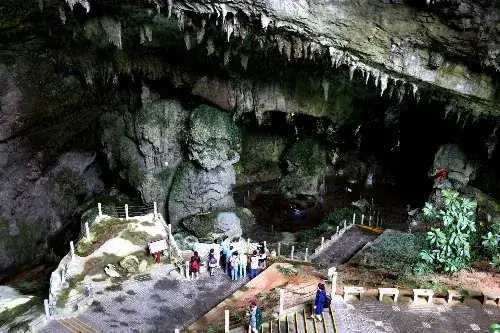
Malinghe Gorge: National 4A, 74.8 km long, 50–150 m wide, 280 m deep. "Earth's Most Beautiful Scar" with 100+ waterfalls and 3 million m² travertine.
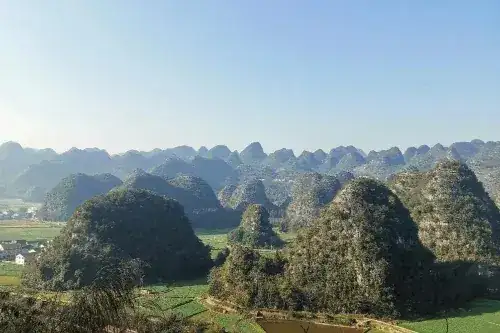
Wanfenglin: National 5A, 200+ km², China's largest and most typical karst peak forest. Xu Xiake praised: "Of all the world's peaks, only here do peaks form a forest."
Wanfeng Lake: National 4A, part of Malinghe scenic area. Important "West-to-East Power Transmission" base and Pearl River Delta water source. 80+ islands, 50+ bays.
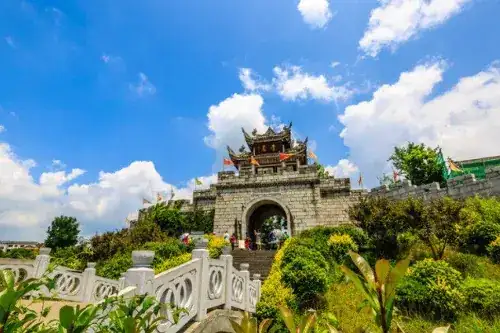
Anlong Zhaodi Scenic Area: 18.39 km², featuring lotus ponds, green lake, and Southern Ming cultural sites.
Ming Eighteen Gentlemen's Tomb: Joint burial of 18 Southern Ming officials (1652).
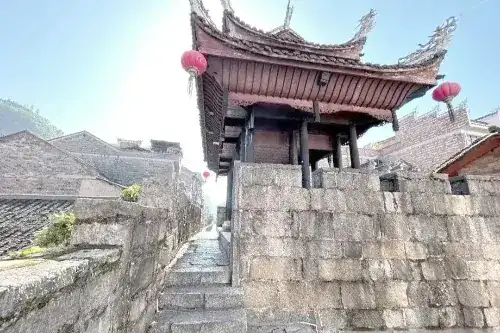
Xingyi Prefecture Examination Hall: Built 1842 by Zhang Ying (father of Zhang Zhidong), with Zhuquan Academy.
Qinglong "24 Turns": WWII Burma Road landmark, protected since 1988.
Local Specialties
Baiceng fruit sugarcane (century-old history, crisp, thin-skinned, juicy), Zhenfeng preserved egg (Mingu Town specialty, unique flavor from local duck eggs), Anlong rice cake bar (traditional Spring Festival food), and Zhenfeng layered cake (5-layer festival food symbolizing "sesame flowers blooming higher each year").
Honorary Titles
National water civilization construction pilot city (2018). China Summer Resort Famous City (2020). National Double Support Model City (2020, 2025). Blood Donation Advanced City (2020). National Anti-Drug Demonstration City (2021). National Youth Development City pilot (2022).
Travel information can change. Check current opening hours, reservations and entry requirements before you travel.
Traveller discussion
Start the conversation with a helpful tip or a question.