
Tongren City
Tongren CityTongren City is a prefecture-level city under Guizhou Province, located in northeastern Guizhou in the heart of the Wuling Mountain area. It borders Hunan's Huaihua to the east and Chongqing to the north. The terrain is higher i
Tongren City
Tongren City is a prefecture-level city under Guizhou Province, located in northeastern Guizhou in the heart of the Wuling Mountain area. It borders Hunan's Huaihua to the east and Chongqing to the north. The terrain is higher in the northwest and lower in the southeast, predominantly mountainous, with a central subtropical humid monsoon climate. Total area: 18,003 square kilometers. As of 2025: 2 districts, 8 counties. As of end 2025: 4,475,000 registered population, 3,136,700 permanent residents. Tongren is a convergence of Huxiang, Jingchu, Bashu, and Central Plains cultures. It has the World Natural Heritage Fanjingshan (Mount Fanjing), the best-preserved primeval forest at its latitude. It is a National Hygienic City, National Forest City, and national smart city pilot. In 2025, the gross regional product was 172.266 billion yuan, up 5.6%.
History
Tongren's history traces to the Neolithic Age. During the Spring and Autumn to Qin period, it belonged to Qianzhong and Ba commanderies and Yelang. Under the Qin Dynasty (221–206 BC), it was in the heart of Qianzhong Commandery. During the Han (202 BC–220 AD), it was under Wuling Commandery. During the Tang (618–907), Wan'an County was established, later renamed Changfeng. During the Song-Yuan transition, Sinan and Sinan pacification offices were established. Legend says a fisherman found three bronze figures at Tongyan, giving rise to the name "Tongren" (Bronze People). In 1413, the Ming Dynasty (1368–1644) established Tongren, Sinan, Shiqian, and Wuluo prefectures under Guizhou Province. In 1438, Wuluo was merged into Tongren. In 2011, prefecture-level Tongren City was established with Bijiang District and Wanshan District.
Administrative Divisions
As of 2025: 2 districts (Bijiang, Wanshan) and 8 counties (Songtao Miao Autonomous, Yuping Dong Autonomous, Yinjiang Tujia-Miao Autonomous, Yanhe Tujia Autonomous, Jiangkou, Shiqian, Sinan, Dejiang), plus Guizhou Dalong Economic Development Zone and Guizhou Tongren High-Tech Industrial Development Zone. 181 township-level units, 338 communities, 2,610 villages. The City People's Government is at No. 8 Huaguoshan Middle Road, Hexi Subdistrict, Bijiang District.
Geographical Environment
Location
Northeastern Guizhou, between 107°45'–109°39' east longitude and 27°07'–29°05' north latitude. Borders Hunan (Xiangxi and Huaihua) to the east, Zunyi to the west, Qiandongnan to the south, and Chongqing to the north. Spans 106 km east-west and 210 km north-south. Total area: 18,003 square kilometers.
Topography
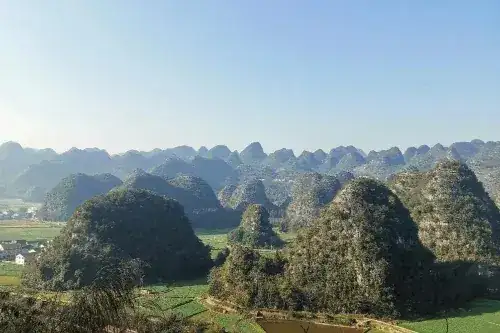
Transition zone from Yunnan-Guizhou Plateau to western Hunan hills. Northwest high, southeast low. Mountains: 67.8% of area; hills: 28.3%; basins and other: 3.9%. The Wuling Mountains, with Fanjingshan as the main peak, form the east-west divide. Highest: 2,572 m (Fanjingshan). Lowest: 205 m. Karst landforms are well-developed. The Fanjingshan dome uplift creates the central divide: eastern waters flow to the Yuanjiang/Dongting Lake system (low hills, shallow valleys), while western waters flow to the Wujiang/Yangtze system (karst plateau, deep gorges, 600–800 m relative elevation difference).
Climate
Central subtropical humid climate. Spring: variable temperatures, frequent rain; summer: hot, abundant sunshine; autumn: rapid cooling, cloudy and rainy; winter: mild, long frost-free period. Annual average: ~18°C. January: 2–6°C; July: 24–28°C. Western areas warmer than eastern at same elevation. Annual precipitation: 1,100–1,400 mm (60–65% in April–August). Annual sunshine: 1,250 hours.
Hydrology
Abundant rainfall with dense river networks. Divided by the Fanjingshan-Fodingshan range into two systems: eastern Yuanjiang system (Jinjiang, Songtao, Cheba rivers) and western Wujiang system (Liuchi, Shiqian, Yinjiang, Mati, Batuo, Hongdu rivers). 221 rivers over 10 km and 20 km² drainage area (103 Yuanjiang, 118 Wujiang). Eastern areas receive 1,300+ mm precipitation; western areas below 1,200 mm.
Natural Resources
Water Resources
Annual runoff: ~12.8 billion m³ (surface 9.56 billion, groundwater 3.23 billion). Per capita: 3,671 m³ (first in Guizhou). Transit water: ~32.8 billion m³ annually. Theoretical hydropower: 937,000 kW (developable: 399,700 kW, 42.6%). Including Wujiang cascade: 2.0374 million kW theoretical, 584,300 kW developable. Per capita developable: 430 watts (above national and provincial averages).
Land Resources
Total: 18,003 km². Cultivated: 4,658.89 km² (25.87%). Forest: 8,211.19 km² (45.61%). Grassland: 1,906.52 km² (10.59%). Construction: 603.34 km² (3.35%). Water: 221.55 km² (1.23%). Unused: 1,200.67 km² (6.67%).
Plant Resources
627 tree species (89 families, 283 genera). Nationally protected: Class I (dove tree, purple crape myrtle), Class II (Bretschneidera, Katsura, Liriodendron), Class III (Amentotaxus, Magnolia, Magnolia officinalis, Pterocarpus, Nanmu, Pterostyrax, hemlock). 160 forage species (74 grasses, 16 legumes). 500+ medicinal plants (413 identified species in 100 families). 151 macrofungi species (21 medicinal, 12 anti-cancer, 30 edible delicacies). 812 crop varieties (594 grain, 11 oilseed, 53 cash crop, 154 vegetable). Wild fruits: kiwi, Rosa roxburghii, August melon.
Animal Resources
~400 wildlife species: ~60 mammals (Class I: Guizhou snub-nosed monkey, black leaf monkey; Class II: bear macaque, red-faced macaque; Class III: musk deer, tufted deer, pangolin). 93 fish species (5 orders, 16 families). 40+ amphibians (including giant salamander - Class II protected, main production area). ~50+ reptiles (32 snakes, 7 venomous). ~200+ birds (65% breeding, 35% non-breeding). 4 protected birds (mandarin duck, pheasant, white-crowned long-tailed pheasant, golden pheasant).
Mineral Resources
59 mineral types: 22 metallic (mercury, manganese, gold, silver, tungsten, tin, copper, iron, lead, zinc, vanadium, molybdenum, platinum, nickel, etc.), 3 energy (coal, uranium, geothermal), 32 non-metallic (limestone, dolomite, barite, fluorite, marble, etc.), 2 water-gas. Mercury (Wanshan, Bijiang, Songtao) and manganese (Songtao, Bijiang, 37 million tons proven, 3rd nationally, 100+ million tons potential) are the signature minerals. Coal: 300 million tons. Iron: 72.49 million tons. Phosphorus: 400,000 tons. Geothermal water: 58.45–62.4 L/s (mainly in Shiqian). Potassium shale: 100+ million tons. Pyrite: 228.73 million tons.
Population
According to the Seventh Census (November 1, 2020): 3,298,468. As of end 2025: 4,475,000 registered, 3,136,700 permanent. Registered birth rate: 9.25 per mille; death rate: 11.07 per mille.
Ethnic Composition
Historically a minority settlement area, formerly "Qianzhong Man," "Wuling Man," "Wuxi Man." 42 ethnic groups including Tujia, Miao, Dong, Gelao, Qiang, Mongolian, Yao, Hui, and others. Tujia distributed in Yanhe, Dejiang, Sinan, Yinjiang, Jiangkou, Tongren. Miao in Songtao, Sinan, Tongren, Jiangkou, Yinjiang, Shiqian (mostly "Red Miao"). Dong in Yuping, Wanshan, Tongren, Jiangkou, Shiqian. Gelao in Shiqian, Sinan, Jiangkou, Songtao. ~30,000 Miao still maintain language and traditional dress.
Politics
Economy
Overview
In 2025, the gross regional product was 172.266 billion yuan, up 5.6%. By industry: primary 35.338 billion (20.5%), secondary 40.15 billion (23.3%, industrial 15.8%), tertiary 96.779 billion (56.2%). Per capita GDP: 54,703 yuan, up 6.9%. Total fiscal revenue: 13.206 billion, up 4.8%. General public budget revenue: 7.703 billion, up 3.3%. General public budget expenditure: 50.486 billion, up 0.7%. Fixed-asset investment (5 million+ yuan): up 18.9% (industrial up 26.3%, high-tech up 41.9%, infrastructure up 41.3%, private up 11.8%). Urban disposable income: 43,193 yuan, up 3.9%. Rural: 16,231 yuan, up 6.2%.
Primary Industry
Total agricultural output: 61.459 billion yuan, up 5.7%. Grain area: 3.8802 million mu. Grain output: 1.1771 million tons, up 1.6% (rice 579,200 tons; oilseed 175,200 tons; vegetables 3.1016 million tons; tea 66,300 tons; fruit 873,600 tons). Meat: 339,600 tons, up 6.0%. Aquatic: 61,200 tons, up 4.2%. Eggs: 107,100 tons, up 18.5%. Pig inventory: 2,202,300, up 3.6%.
Secondary Industry
Industrial added value: 27.192 billion yuan, up 10.6%. Above-scale industrial added value up 16.8% (light industry up 16.3%; heavy industry up 17.0%). Mining up 20.8%; manufacturing up 20.7%; electricity/heat/gas/water up 4.5%. Manganese ore: 835,800 tons (up 185.5%). Bottled water: 962,000 tons. Refined tea: 15,902.17 tons (up 55.1%). Cement: 3.8966 million tons. Cigarettes: 8.5 billion sticks. Power generation: 12.591 billion kWh. Above-scale revenue: 48.9 billion, up 18.5%. Profits: 2.59 billion, up 78.6%. Construction added value: 12.974 billion, up 7.8%.
Tertiary Industry
Total retail sales: up 2.3%. Foreign trade: 3.175 billion yuan, up 74% (exports 1.746 billion, up 28.7%; imports 1.429 billion, up 205.1%). CPI: 99.4% (down 0.6%). Real estate investment: down 16.2%. Total deposits: 222.101 billion, up 6.4%. Total loans: 291.28 billion, up 6.0%. Postal deliveries: 97.8969 million items. Telecom: 3.876 billion yuan, up 10.7%. 4.1474 million phone users. 1.6567 million broadband users. 3.6533 million mobile internet users. Phone penetration: 129.05/100 people.
Social Affairs
Education
757 primary (308,800 students), 207 junior high (181,900), 48 high schools (109,200), 20 secondary vocational (38,000), 6 universities (58,700). Universities: Tongren University, Tongren Vocational Technical College, Tongren Preschool Education College.
Culture
11 cultural centers, 11 libraries. 21 broadcasting/TV stations. Radio and TV coverage: 99.8%.
Healthcare
3,664 health institutions: 137 hospitals, 144 health centers, 32 professional public health (11 CDCs). 27,202 beds (22,555 hospitals, 3,856 grassroots, 791 public health). 31,778 health workers (11,058 physicians, 14,030 nurses).
Social Security
41,400 new urban jobs (down 6.2%). 18,000 vocational training. 801,300 rural labor transferred to other provinces. Enterprise pension: 266,800, up 1.3%. Government pension: 156,200, up 1.6%. Urban-rural pension: 2,065,800, down 1.0%. Unemployment: 224,400, up 7.5%. Work injury: 437,400, down 8.9%. Employee medical: 270,600, up 3.2%. Urban-rural medical: 3,695,000, down 2.2%. Maternity: 202,000, up 3.5%. Minimum living: 105,900 households, 262,600 people (urban 62,700; rural 199,900). 3 children's welfare homes (600 beds, 379 children). 80 elderly care institutions (6,453 beds, 3,970 residents).
Environmental Protection
154 sewage treatment plants (410,300 m³/day capacity). 87.8726 million m³ treated in 2025. 2,630.46 km of sewage pipes laid.
Transportation
Highways
Total mileage: 34,692 km (1,027 km expressway). Expressways: G60 Hukun, G56 Hangrui, S15 Tongda, Sijian (Sinan-Jianhe), and Songtong. 964,000 motor vehicles (514,000 cars, 459,000 motorcycles).
Railways
2 operating railways (118 km total): Xiangqian double-track and Yuhuai. Hukun HSR (36.65 km, 350 km/h). Tongren-Yuping railway (47.7 km, 200 km/h).
Aviation
Tongren Fenghuang Airport: Originally Daxing Civil Airport (2001), renamed 2009. Routes to Guiyang, Changsha, Chongqing, Guangzhou, Shanghai, Beijing, Shenzhen, Guilin. Joined Capital Airport Group. 2018: 13,446 flights, 1.2766 million passengers, 173.85 tons cargo. 2025: 338.88 tons cargo (up 193.6%), 604,900 passengers (down 24%).
History and Culture
Intangible Cultural Heritage
Gelao "Hair Dragon" (Shiqian, Lantern Festival, national heritage 2005), Shiqian Puppet Opera (400+ years, national heritage 2005), Dejiang Nuo Opera (comprehensive ritual art, national heritage 2005), Sinan Flower Lantern (eastern Guizhou representative, national heritage 2005), Yuping Flute and Xiao Making (400+ years, national heritage 2005, gold medal at 1915 Panama Expo), Shiqian "Speaking Spring" (UNESCO 24 Solar Terms heritage, 2016), Tongren Dragon Boat Racing (national heritage 2011).
Cultural Relics
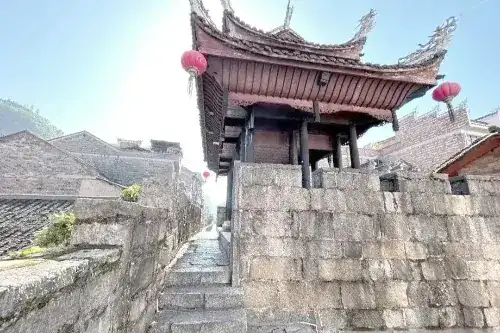
Zhongnanmen Ancient City (Ming-Qing architecture, national protected), Ming Dynasty residential complex at Jiangkou Liujia Dayuan (400+ years), Wanshan Mercury Mine Site (national protected 2006), Sinan Wanshou Palace (national protected 2006).
Literature and Arts
Folk literature: Tujia wedding lament, work songs; Miao ancient songs, love songs; Dong tea-picking songs, wedding songs; Gelao ancient songs. Folk arts: long trumpet shawm, dragon lantern, flower lantern, lion dance, Nuo opera, work chants. Tujia hand-waving dance, "meat lotus"; Miao flower drum dance, sword mountain/fire sea acrobatics; Dong mountain songs; Gelao courtyard dance. Miao acrobatics performed in 20+ countries. Tujia hand-waving dance won national minority sports gold twice. Nuo opera called "living fossil of Chinese drama."
Scenic Spots
Fanjingshan: World Natural Heritage (2018), 5A scenic area. Wuling Mountains main peak, 402.75 km² heritage area. 10–14 billion year old geological history, the oldest platform south of the Yellow River. National nature reserve since 1978. Features Guizhou snub-nosed monkey, dove tree, and Fanjingshan fir. Best-preserved subtropical primeval ecosystem.
Sinan Stone Forest: 4A scenic area, 4.9 km², showing all stages of stone tooth development.
Shiqian Hot Spring Group: National scenic area (2009), 4A (2016), China's only scenic area named after hot springs.
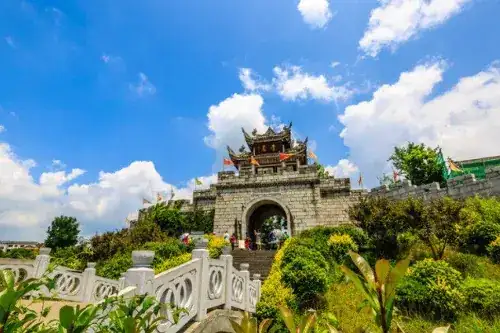
Daming Border City: 4A scenic area, Ming Dynasty cultural theme park with 8 experience zones.
Local Specialties
Tujia malt sugar wine (20% ABV, golden), Gastrodia elata (medicinal), Nuo masks (wood carving), Sizhou stone inkstone (one of China's "Eight Famous Inkstones"), Zipayudaidai (precious multi-colored stone from Fanjingshan area), Shiqian moss tea (Zhou Enlai inscribed "Tea production, boundless prospects" in 1958), Shiqian mung bean noodles (centuries-old traditional food), Yuping flute and xiao (imperial tribute since 1573, Panama Expo gold 1915, national heritage 2006, China famous trademark 2018).
Famous People
Tian Qiu (Ming Dynasty, petitioned for provincial examinations in Guizhou, approved 1535), Li Wei (Ming Dynasty, military and civil official), Yang Fang (Qing Dynasty, Sichuan/Guangxi/Hunan military commander), Wu Jizhao (Qing Dynasty, Red Banner Army leader), Yan Yinliang (Qing Dynasty, calligrapher, wrote the plaque for Beijing's Summer Palace), Zhou Yiqun (proletarian revolutionary, Xiang-Exi Red Army founder, one of "100 Heroes of New China"),Kuang Jixun (revolutionary martyr), Dai Bing (State Councilor, former Foreign Vice Minister), Liao Xilong (General, former Director of PLA General Logistics Department, 15th-17th Central Committee member).
Honorary Titles
China Characteristic Charm City TOP 200 (2017), China Green Competitiveness TOP 100 (ranked 92, 2019), China Top 10 Business Environment Benchmark City (2019), Rural Road Management Pilot (2020), Blood Donation Advanced City (2020), National Hygienic City (2021), "Four Good Rural Roads" Demonstration (2021), Ping'an China Construction Demonstration City (2021), National Forest City (2022), Top 10 Meteorological Tourism City (2023), 11th batch National Ethnic Unity and Progress Demonstration (2024).
Travel information can change. Check current opening hours, reservations and entry requirements before you travel.
Traveller discussion
Start the conversation with a helpful tip or a question.