
Bijie City
Bijie CityBijie City is a prefecture-level city under Guizhou Province, located in northwestern Guizhou, between 26°21'–27°46' north latitude and 103°36'–106°43' east longitude, with a total area of 26,900 square kilometers. Most areas have
Bijie City
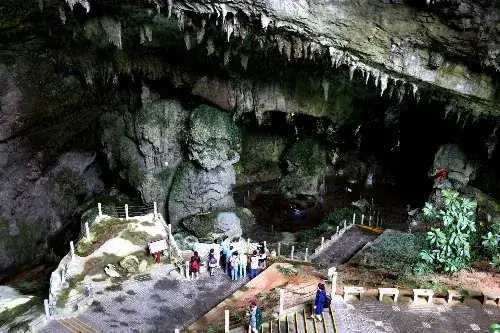
Bijie City is a prefecture-level city under Guizhou Province, located in northwestern Guizhou, between 26°21'–27°46' north latitude and 103°36'–106°43' east longitude, with a total area of 26,900 square kilometers. Most areas have a subtropical humid climate. As of March 2025: 1 district, 6 counties, 1 county-level city. As of end 2024: 6,621,600 permanent residents. The name "Bijie" derives from "Pingyi" and the Yi language "Biji." Bijie was established as a county in 1687, became a special district in 1949, and was upgraded to a prefecture-level city in 2011. It is a regional comprehensive transportation hub in Southwest China, with national highways, expressways, railways, and an airport. It has 5A scenic areas Baili Rhododendron and Zhijin Cave (Guizhou's only Global Geopark). Known as "Southwest Coal Sea," "Natural Medicine Garden," and hometowns of Chinese lacquer, bamboo fungus, Gastrodia elata, and walnuts. In 2025, the gross regional product was 254.114 billion yuan, up 4.9%.
History
Paleolithic human activity has been found. During the Yao-Shun era, it was the vassal state of Youbi. During the Xia Dynasty (2070–1600 BC), it was the southern domain of Liangzhou. During the Western Han (202 BC–220 AD), Qianwei Commandery was established in 135 BC. In 311, Pingyi Commandery was established. During the Tang (618–907), various tributary prefectures were set up. During the Yuan Dynasty (1271–1368), the Wusa and Yixibuxue pacification offices were established. During the Ming (1368–1644), Bijie Guard was established in 1383. In 1666, the Qing Dynasty (1644–1912) established Dading, Qianxi, Pingyuan, and Weining prefectures. In 1949, Bijie Special District was established. In 2011, it became a prefecture-level city.
Administrative Divisions
Division Details
As of March 2025: 1 district (Qixingguan), 6 counties (Dafang, Qianxi [county-level city since 2021], Jinsha, Zhijin, Nayong, Hezhang, and Weining Yi-Hui-Miao Autonomous County), and 1 county-level city (Qianxi), with 135 towns, 91 townships (72 ethnic), and 53 subdistricts. The City People's Government is at No. 518 Biyang Avenue, Qixingguan District.
Geographical Environment
Location
Northwestern Guizhou, at the junction of Sichuan, Yunnan, and Guizhou provinces. Total area: 26,900 square kilometers. Borders Guiyang and Zunyi to the east, Anshun and Liupanshui to the south, Yunnan to the west, and Sichuan to the north.
Geology
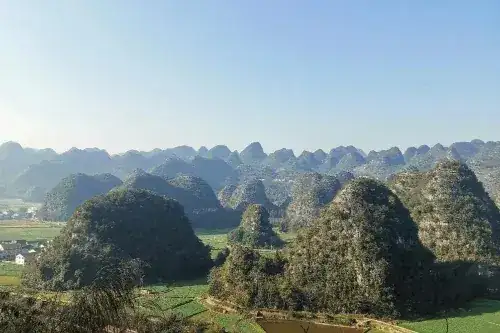
Complex geological structure with well-developed folds and faults. Diverse karst landforms from east (peak forests, valleys) to west (plateau karst, basins).
Topography
Higher in the west. Average elevation: 1,600 m. Highest: Xiao Jiucaiping at 2,900.6 m (Hezhang County). Lowest: 457 m at the Chishui River valley. Three elevation steps: 2,000–2,400 m (western plateau), 1,400–1,800 m (central mountains), 1,000–1,400 m (eastern low mountains and hills).
Hydrology
193 rivers over 10 km, flowing into 4 major systems: Wujiang, Chishui, Beipanjiang, and Jinsha River. Yangtze basin: 95.39% of area; Pearl River basin: 4.61%.
Climate
Subtropical monsoon humid climate. No extreme summer heat or winter cold. Annual average temperature: 10–15°C. Annual sunshine: 1,096–1,769 hours. Frost-free period: 245–290 days. Annual precipitation: 849–1,399 mm.
Natural Resources
Land Resources
Cultivated: 814,056 hectares (96.94% dryland). Forest: 1,390,714 hectares. Grassland: 31,286 hectares. Wetland: 914 hectares.
Water Resources
Annual precipitation: 27.796 billion cubic meters. Annual river runoff: ~13 billion cubic meters. Theoretical hydropower potential: 2.2121 million kilowatts (developable: 1.61 million kW, 70.2%).
Biological Resources
~100 moss species, 130 ferns, 22 gymnosperms, 1,809 angiosperms. 1,000+ medicinal plants (Pinellia, Gastrodia, Poria, codonopsis). 6.2 million mu of natural grassland with 378 wild forage species. Forest coverage: 44.06%. 74 fish species, 387 vertebrate species. Black-necked crane and white crane are nationally protected.
Mineral Resources
40 mineral types. Coal: 32.553 billion tons (first in Guizhou). Iron: 756 million tons (60.48% of provincial reserves). Lead: 1.2698 million tons (58.03%). Zinc: 3.5109 million tons (38.07%). Pyrite: 270 million tons (26.97%). Phosphorus: 1.709 billion tons (34.79%, Zhijin is one of Guizhou's 4 phosphorus bases).
Population
As of end 2024: 6,621,600 (down 110,200). 54 ethnic groups including Han, Yi, Miao, Bai, Hui, Buyei, Gelao, Mongolian, and Manchu. 1 autonomous county and 72 ethnic townships.
Ethnic Composition
Multi-ethnic area with large scattered and small clustered settlements. 1 autonomous county (Weining Yi-Hui-Miao), 72 ethnic townships, 54 ethnic groups.
Politics
Economy
Overview
In 2024, the gross regional product was 245.759 billion yuan, up 4.3%. By industry: primary 56.644 billion (23.0%), secondary 64.786 billion (26.4%), tertiary 124.33 billion (50.6%). Per capita GDP: 36,809 yuan. Fixed-asset investment up 12.3%. Total fiscal revenue: 42.26 billion, down 2.5%. General public budget revenue: 13.45 billion, up 3.7%. General public budget expenditure: 75.42 billion, up 6.5%.
Primary Industry
Known as "China's Lacquer Hometown," "Bamboo Fungus Hometown," "Gastrodia Hometown," and "High-Altitude Organic Tea Hometown." 1,672 medicinal plant species (most in Guizhou). Total agricultural output: 95.275 billion yuan, up 3.7%. Grain area: 11.3 million mu. Grain output: 2.568 million tons. Pig inventory: 3.2163 million. Meat: 472,600 tons.
Secondary Industry
Focus on energy and coal chemical industries. Also developing new energy equipment, physical energy storage, and lithium batteries. Industrial added value: 54.86 billion yuan, up 5.1%. Above-scale industrial added value up 4.6% (mining up 9.1%; manufacturing up 2.8%; electricity/gas/water down 0.9%). Coal output up 12.3%. Construction output up 23.0%.
Tertiary Industry
Wholesale/retail: 22.906 billion, up 5.0%. Transportation: 6.305 billion, up 9.4%. Accommodation/catering: 5.547 billion, up 11.1%. Finance: 11.31 billion, up 3.6%. IT: 3.976 billion, up 6.6%. Total retail sales: up 3.9%. Postal revenue: 1.348 billion, up 13.2%. Telecom: 6.294 billion, up 15.4%. Foreign trade: 640 million yuan, up 16.1%. Insurance premiums: 4.658 billion, up 5.7%. Tourist arrivals: up 10.1%. Tourism revenue: up 12.6%.
Social Affairs
Education
Preschool enrollment: 94.08%. Primary enrollment: 99.87%. Junior high enrollment: 115.69%. High school enrollment: 94.24%. Compulsory education consolidation: 96.9%. Higher education: Bijie Radio and Television University.
Science and Technology
10 provincial and municipal innovation platforms. 62 high-tech enterprises, 83 technology-based SMEs.
Culture
4 art troupes, 17 museums, 9 public libraries, 289 cultural centers/stations. Radio coverage: 99.66%, TV coverage: 99.74%.
Sports
383 awards (3 world champions, 3 Asian champions). 4 world golds, 6 Asian golds, 25 national golds, 110 provincial golds. 19,600 sports venues (1,482.27 million m², 2.2 m² per capita).
Healthcare
6,239 health institutions: 587 hospitals and health centers (346 hospitals, 241 health centers), 28 professional public health (10 CDCs). 54,740 beds. 55,300 health workers (19,700 physicians, 27,200 nurses).
Social Security
69,600 new urban jobs. Urban minimum living: 107,600 people (767.56 yuan/month). Rural minimum living: 569,100 people (6,814.67 yuan/year). Urban disposable income: 42,383 yuan, up 4.2%. Rural: 15,381 yuan, up 7.3%. Employee pension: 700,800, up 3.91%. Unemployment: 357,000. Work injury: 858,000. 136 registered social service institutions (124 elderly care, 8 child welfare).
Environmental Protection
Sewage treatment rate: 98.46%. Air quality excellent: 99.3%. Waste harmless treatment: 100%. Drinking water compliance: 100%. 11 nature reserves (2 national), covering 12,400 hectares.
Transportation
Overview
Regional comprehensive transportation hub. 1 hour to central Guizhou economic circle, 2 hours to Chengdu-Chongqing, 5 hours to Greater Bay Area. 1,385,100 civilian vehicles (1,353,400 private, 22,900 new energy).
Highways
Total mileage: 36,689.94 km. Expressways: 1,231 km. National highways: G212, G246, G56 (Hangzhou-Ruili), G76 (Xiamen-Chengdu), G7611 (Duyun-Xiangshan), plus multiple provincial highways and expressways (Bijie-Weining, Bijie-Zhenxiong, Qianxi-Dafang, Guijin, Baiqian, Naqing).
Railways
Zhibi, Chengdu-Guiyang, Longhuang, Zhaoqian, Bishuixing intercity, and Xubi railways. Major stations: Bijie HSR Hub Center, Dafang HSR Station, Qianxi HSR Station. Railway freight: 4.632 million tons (up 802,000 tons). Seamless HSR-bus transfer achieved.
Aviation
Bijie Feixiong Airport: Opened June 16, 2013. 17 direct routes to cities including Beijing, Shanghai, Guangzhou, and Hangzhou. 6.74 million cumulative passengers. 1 hour to Chengdu-Chongqing, central Yunnan, and central Guizhou economic circles.
Water Transport
Cargo turnover: 40.63 million ton-km. "5G + Smart Water Transport" safety platform covers 5 reservoirs, 9 large docks, 38 ferry crossings, 14 water transport enterprises, and 104 vessels. Total navigable mileage: 399 km (388 km classified).
Public Transportation
1.285 billion annual trips. 15 bus companies, 117 routes, 935 buses (38 rural routes with 256 buses). Intercity bus-to-public transit conversion on multiple routes. "Campus customized" routes serving 100+ schools. Qianxi's rural "passenger-freight-postal" integration pilot selected as provincial demonstration.
History and Culture
Intangible Cultural Heritage
74 national and provincial items (8 national, 66 provincial, 91 municipal), covering literature, folk customs, dance, music, drama, art, sports, medicine, and crafts.
Religion
Five major religions: Buddhism, Taoism, Islam, Catholicism, and Christianity. 559 registered religious venues (55 Buddhist, 2 Taoist, 150 Islamic, 7 Catholic, 345 Christian). 900+ registered clergy. 4 municipal religious organizations.
Scenic Spots
2 5A scenic areas (Baili Rhododendron, Zhijin Cave World Geopark), 11 4A areas. Key attractions: Caohai National Nature Reserve, Nine Cave Heaven (4A), Gonglongping (4A), Xiaohe (3A), Zhiga Alu Lake, and Hezhang Jiucaiping (Guizhou's highest peak scenic area).
Local Specialties
Weining ham, Yi rice wine, cold cake, Weining buckwheat pastry, Qianxi yellow cake, Mianyuhe four-gill fish, Bapu Miao rice wine, Jinsha Huisha liquor, Kele pig, Jinsha tribute tea, Dafang wrinkled pepper, Zhijin Polygonum, Zhijin Dipsacus, Xiongtai pickled vegetables, Nayong Yi Rosa roxburghii wine, Hezhang Pinellia, Dafang Gastrodia, Weining codonopsis, Hezhang walnuts, and many more. 10 national geographic indication products including "Zhijin Bamboo Fungus," "Dafang Gastrodia," and "Weining Potato."
Famous People
Li Xuhua, Lin Qing, Ding Daoheng, Li Youlin, Zhou Suyuan, Yu Ruochang, Ding Baozhen, Li Shijie, and Chen Yiqin (female, Bai ethnicity, former Secretary of the CPC Guizhou Provincial Committee).
Honorary Titles
National Ethnic Unity and Progress Demonstration City, National Double Support Model City (2020, 2025), National Hygienic City (2021), National Forest City pilot (2022), National Go Hometown (2022), China's Most Beautiful City (2018, 2019), National Green Competitiveness TOP 100 (ranked 69th, 2019), China Summer Resort Famous City (2020).
Travel information can change. Check current opening hours, reservations and entry requirements before you travel.
Traveller discussion
Start the conversation with a helpful tip or a question.