
Anshun City
Anshun CityAnshun City is a prefecture-level city under Guizhou Province, located in central-western Guizhou, on the divide between the Yangtze (Wujiang) and Pearl River (Beipanjiang) basins. The terrain is higher in the center and northwes
Anshun City
Anshun City is a prefecture-level city under Guizhou Province, located in central-western Guizhou, on the divide between the Yangtze (Wujiang) and Pearl River (Beipanjiang) basins. The terrain is higher in the center and northwest, lower in the south and southeast. It is a world-class karst landscape concentration area with a highland humid subtropical monsoon climate. Total area: 9,267 square kilometers. As of February 2024: 2 districts, 4 counties. As of end 2023: 2,459,200 permanent residents. Anshun is known as "Belly of Guizhou, Throat of Yunnan, Teeth and Lips of Sichuan and Guangdong." It is a national historical and cultural city with unique heritage including Chuandong culture, Yelang culture, Zangke culture, and Tunpu culture. Scenic areas cover 12%+ of the territory. It has 5A scenic areas Huangguoshu Falls and Longgong (Dragon Palace). In 2025, the gross regional product was 123.235 billion yuan, up 4.9%.
History
During the Spring and Autumn period, the area belonged to the Zangke Kingdom. During the Warring States period, it was Yelang territory. Under the Qin Dynasty (221–206 BC), it was part of Xiang Commandery. In the Western Han (202 BC–220 AD), Zangke Commandery was established in 111 BC. During the Three Kingdoms, it belonged to Shu Han. During the Jin Dynasty (265–420), it was divided among several counties. During the Sui (581–618), it was under Zangzhou. During the Tang (618–907), various tributary states were established. During the Yuan Dynasty (1271–1368), Puding Route was established. In 1382, the Ming Dynasty (1368–1644) built Anshun city and established Puding Guard. In 1602, Anshun was upgraded to a military-civilian prefecture. During the Qing (1644–1912), the jurisdiction was reorganized multiple times. In 1949, Anshun was liberated. In 2000, prefecture-level Anshun City was established with Xixiu District.
Administrative Divisions
Division Details
As of February 2024: 2 districts (Xixiu, Pingba) and 4 counties (Puding, Zhenning Buyei-Miao Autonomous, Guanling Buyei-Miao Autonomous, Ziyun Miao-Buyei Autonomous), plus Anshun Economic and Technological Development Zone and Huangguoshu Tourism Area. The City People's Government is in Xixiu District.
Geographical Environment
Location
Central-western Guizhou, between 105°15'–106°35' east longitude and 25°21'–26°38' north latitude. 90 km from Guiyang. Total area: 9,267 square kilometers. Borders Guiyang and Qiannan to the east, Liupanshui to the west, Qianxinan to the south, and Bijie to the north.
Topography
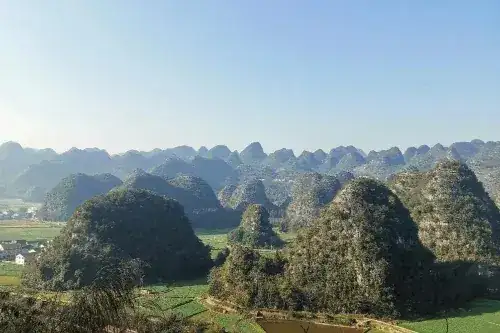
Average elevation: 1,219 m. On the western section of the Miaoling Range, the divide between Wujiang and Beipanjiang systems. Center high, north-south low; northwest high, southeast low. Highest: 1,874 m (Guanling Yongning). Lowest: 359 m (Zhenning Beipanjiang exit). Typical karst landscape.
Climate
Highland humid subtropical monsoon climate. No extreme winter cold or summer heat. Comfortable period: 10 months/year. Annual average: 12.7–16.2°C. January: 3–6°C; July: 22.3–23.6°C. Extreme minimum: -7.6°C; maximum: 34.3°C (both rare). Annual sunshine: 1,593.8 hours. Annual precipitation: 1,160–1,397 mm (mostly nighttime rain). Frost-free: 188–263 days above 10°C.
Hydrology
Yangtze basin: 2,794 km² (30.15%); Pearl River basin: 6,473 km² (69.85%). 102 rivers over 10 km or 20 km² drainage area. 70 rivers over 50 km² (3,427 km total). 39 rivers over 100 km² (2,906 km). 7 rivers over 1,000 km² (1,710 km). 1 river over 10,000 km² (456 km).
Natural Resources
Water Resources
Surface water: calcium carbonate type, pH 7.0–8.9, hardness 40–150. Groundwater: mostly calcium carbonate, pH 6.8–7.8, less polluted than surface. 160 reservoirs over 100,000 m³ (total capacity 1.288 billion m³). Theoretical hydropower: 4.507 million kilowatts (developable: 2.959 million kW).
Biological Resources
1,874 medicinal plant species (43.7% of Guizhou's 4,290). 406 of 456 nationally surveyed key medicinal materials (89%). 80+ commonly used, 50+ with development value including yam, Eucommia, Pinellia, Coix, Phellodendron, Gastrodia, and Ganoderma. Local livestock breeds: Guanling cattle, Guanling pig, Zongdi spotted pig, Pingba grey goose, Puding tall chicken, Huohua pony.
Mineral Resources
Proven and developed minerals: coal, geothermal water, lead-zinc, iron, bauxite, antimony, decorative stone (marble), barite, calcite, cement silica, chemical limestone, cement limestone, brick shale, and construction sand. Stone resources: theoretical 37.6 billion m³, potential 7.5 billion m³, recently developable 698 million m³.
Population
According to the Seventh Census (November 1, 2020): 2,470,630 (up 7.54% from 2010). As of end 2023: 2,459,200. 45 ethnic groups (44 minorities), minorities at 41.9% of registered population.
Politics
Economy
Overview
In 2024, the gross regional product was 118.611 billion yuan, up 4.0%. By industry: primary 20.8 billion, up 3.9%; secondary 32.783 billion, up 4.9%; tertiary 65.028 billion, up 3.5%. In 2025: 123.235 billion yuan, up 4.9%.
Primary Industry
2023 grain output: 642,700 tons, up 0.2% (summer 79,700; autumn 563,000). Vegetables: 3,250,300 tons, up 4.3%. Rapeseed: 105,900 tons, up 1.9%. Flue-cured tobacco: 4,600 tons, up 6.2%. Meat: 172,200 tons, up 4.6%. Pig sales: 1,314,100, up 5.3%. Aquatic products: 31,721 tons, up 3.9%.
Secondary Industry
Above-scale industrial added value up 1.7% in 2023. Light industry up 25.4%; heavy industry down 7.9%. Pharmaceuticals up 48.3%; food manufacturing up 23.2%; electricity/heat up 16.9%. Chinese patent medicine up 44.0%; alcoholic beverages up 36.0%; synthetic detergent up 19.8%.
Tertiary Industry
Total retail sales: up 5.1%. Foreign trade: 1.245 billion yuan, up 38.4% (exports 778 million, up 42.3%; imports 467 million, up 32.5%). CPI: down 0.8%. Total deposits: 143.057 billion, up 10.5%. Total loans: 171.799 billion, up 11.3%. Insurance premiums: 2.245 billion, up 8.0%.
Social Affairs
Education
3 universities (29,590 students), 10 secondary vocational (21,081), 121 junior high (131,925), 33 high schools (52,900), 403 primary (253,971), 6 special education (1,051).
Science and Technology
29 new national high-tech enterprises, 130 national technology-based SMEs. 4 new provincial innovation platforms, 12 municipal key laboratories.
Culture
7 cultural centers, 6 public libraries. 6 TV relay stations, 5 FM relay stations. TV coverage: 99.63%. Radio coverage: 99.49%. 395,000 cable TV households.
Healthcare
2,028 health institutions: 85 hospitals, 83 health centers, 67 community health centers, 7 CDCs, 7 maternal/child centers. 17,932 beds. 18,420 health workers (6,601 physicians, 8,081 nurses).
Sports
3 new 3-on-3 basketball courts/fitness trails at resettlement sites. 2 fitness trail projects. 43 gold medals at provincial youth championships.
Social Security
44,460 new urban jobs. 8,413 reemployed. 81,884 rural labor transfers. Urban disposable income: 40,155 yuan, up 3.9%. Rural: 14,920 yuan, up 8.0%. Urban minimum living: 17,551 households, 37,728 people (213.86 million yuan). Rural: 42,052 households, 94,032 people (407.56 million yuan).
Transportation
Overview
90 km from Guiyang. Hukun Expressway traverses east-west; county-to-county expressway and township-to-township asphalt road achieved. Guikun Railway and Hukun HSR (3 stations: Pingba South, Anshun West, Guanling). Huangguoshu Airport serves multiple cities. Bacao wharf on Beipanjiang connects to the sea.
Highways
Total mileage: 13,516.542 km (density 139.8 km/100 km²). 15 national/provincial highways (1,726.593 km). Expressways: Guihuang, Qinghuang, Hukun, Hua'an.
Railways
Guikun Railway, Zhuliu double-track, Hukun HSR. Stations: Anshun, Anshun West, Guanling.
Water Transport
Bacao Wharf: On the middle-lower Beipanjiang left bank, Zhenning County. 97 km by road to Zhenning, 11 km by water to downstream Baiceng, 97 km to Guangxi Liangjiangkou, 1,018 km to Guangxi Wuzhou, 1,366 km to Guangzhou Modaomen. Guizhou's nearest southward sea-access port.
History and Culture
Dialect
Anshun dialect belongs to the central Guizhou sub-dialect of Southwestern Mandarin, formed during the Ming-Qing period.
Crafts
Anshun Batik: Known as "Number One Dye of the East," listed as national intangible cultural heritage. Over 2,000 years of history, divided into Miao and Buyei batik. "Ice crack" pattern is the hallmark. Process: select fabric - paste cloth - melt wax and paint - dye - dewax - rinse and dry.
Tunpu Huadeng (Flower Lantern): Local opera popular in Tunpu villages, a seasonal entertainment ("rice flower lantern" in July, "spring welcoming lantern" in January). Paired with Dixi opera: "Dixi by day, Huadeng by night."
Also: Anshun Miao clothing, Buyei clothing, wood carving, stone carving, and rattan armor.
Performing Arts
Anshun Dixi: Called the "living fossil of drama." National intangible cultural heritage (2006). Formed in early Ming Dynasty, a masked folk drama unique to Tunpu people.
Tunpu Mountain Song: Folk oral literature with Hui-mode melodies, 7-character 4-line verses. Provincial intangible cultural heritage (2007).
Also: King Yalu, Bronze Drum Twelve Tunes, Miao Lusheng Dance, Buyei Leyou, Ziyun acrobatics.
Folk Customs
Flower Jumping Festival (Miao, January), April 8th (multi-ethnic), June 6th (Buyei "minor New Year"), New Crop Festival (Gelao, Miao, Buyei, July 7th), Sedan Carrying (Tunpu, for Wang Gong's birthday), Dragon Boat "Wandering Away Illness," Eid al-Fitr (Hui), Yelang Bamboo King Worship (Miao, provincial heritage), and River Lantern Floating (July 15th, honoring ancestors).
Origin of the Name
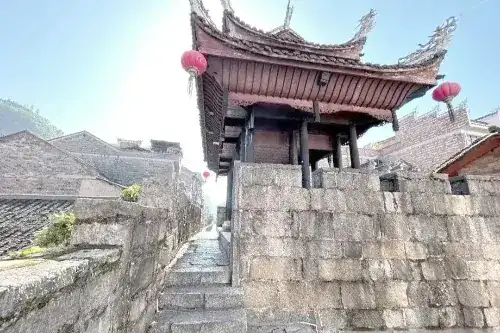
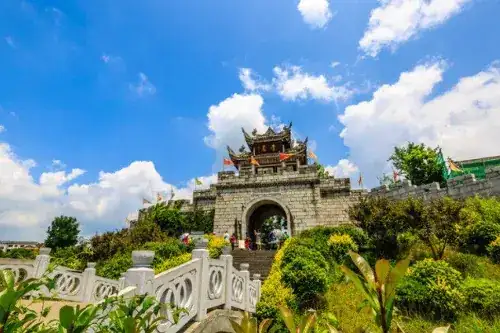
Before Qin: Guifang. Spring and Autumn/Warring States: Yelang. Han: Julan. Sui: Binhua. Tang: Wangjiang. Yuan (1305): Puding Route with Xi'an Zhou. Ming (1382): Anshun Military-Civilian Prefecture formally established at Adabu Village by General Wu Fu, chosen for its strategic position as "southwest gateway, throat of Yi and Han, deep soil and abundant water, rivers winding and peaks arrayed."
Regional Culture
Three Kingdoms Culture: Zhuge Liang's southern campaign (225 AD) and "seven captures of Meng Huuo" passed through the area. Guanling (Guan Suo Ridge) named after Guan Yu's son Guan Suo who stationed troops there. Ancient post road with 600+ years of history, with the famous "Red Cliff Inscription."
Tunpu Culture: Originated from Zhu Yuanzhang's 1381 southern campaign with 300,000 troops who settled as military farmers. Tunpu culture preserves Ming Dynasty Jiangnan customs while developing local characteristics through centuries of farming and military life.
Chuandong Paleolithic Culture: Puding Chuandong site (10,000+ years old), called "Lamp of Asian Civilization," national protected site since 1988. Zangke Culture: The ancient Zangke Kingdom and its river system spanning Yunnan, Guizhou, Guangxi, and Guangdong.
Cultural Heritage Sites
Scenic Spots
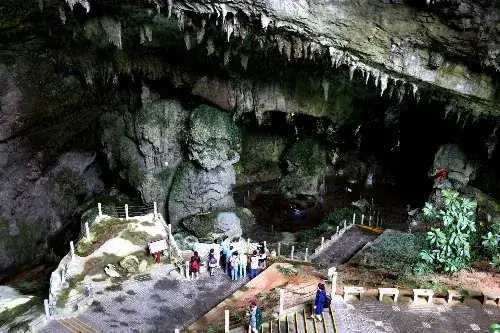
One of China's earliest Class A tourism cities. Scenic area: 12% of total territory (vs. 1% national, 4.2% provincial average). 5 national scenic areas (Huangguoshu, Longgong, Yelang Cave, Getu River, Hongfeng Lake), 1 national forest park (Jiulongshan), 1 national geopark (Guanling fossil group), 3 provincial scenic areas, 3 municipal scenic areas. 2 5A areas (Huangguoshu, Longgong), 2 4A areas (Yelang Cave, Hongfeng Lake), 2 3A areas (Getu River, Jiulongshan).
Local Specialties
Jiuzhou chicken chili, vegetarian rice noodles, dried chicken noodles, song cake rice flour, five-grain steamed cake, spring rolls, crispy buns, tofu balls, small-pot cold noodles, sugar dumplings, crystal jelly noodles, skewers, cured meat with blood tofu, buckwheat cold noodles, Anjiu liquor. Bobo candy. Buyei carpets, Dixi masks, stone/wood carvings, Anshun three knives, and batik.
Famous People
Chen Fa (Qing Dynasty scholar and water control expert), Wang Ruofei (early CPC revolutionary, 1896-1946), Chen Zenggu (provincial leader), Huang Qisheng ("April 8th Martyr"), Gu Zhenglun/Gu Zhengding/Gu Zhenggang ("three KMT central committee members from one family"), Ren Kecheng (education pioneer), Chen Yunyu (war hero, died 1938 Battle of Xuzhou), Yuan Xiaocen (sculptor), Xiao Xuchang (CAS academician, structural geologist), Liu Gangji (philosophy professor), Yuan Xikun (sculptor with most international awards), Ren Zhengfei (founder of Huawei Technologies).
Honorary Titles
National Garden City (2017), China Excellent Tourist City (2007), China Top 10 Leisure Cities (2009), National Hygienic City (2022), National Double Support Model City (2020, 2025), National Water-Saving City (2021), National Anti-Drug Demonstration City (2021), National Ethnic Unity and Progress Demonstration (2021), National Culture and Tourism Consumption Pilot City (2021), "Zero-Waste City" (2022), Sponge City Demonstration (2022).
Sister Cities
Travel information can change. Check current opening hours, reservations and entry requirements before you travel.
Traveller discussion
Start the conversation with a helpful tip or a question.