
Liupanshui City
Liupanshui CityLiupanshui City, also known as "China's Cool City," is a prefecture-level city under Guizhou Province, located in the Wumeng Mountain area of western Guizhou, at the junction of Yunnan and Guizhou. It borders Anshun to the ea
Liupanshui City
Liupanshui City, also known as "China's Cool City," is a prefecture-level city under Guizhou Province, located in the Wumeng Mountain area of western Guizhou, at the junction of Yunnan and Guizhou. It borders Anshun to the east, Qianxinan to the south, Qujing (Yunnan) to the west, and Bijie to the north. Subtropical monsoon humid climate. Total area: 9,914 square kilometers. As of June 2026: 2 districts, 1 special district, 1 county-level city. As of end 2025: 3,034,700 permanent residents. Liupanshui has a long history, with the Spring and Autumn period as Zangke territory. The "Third Front" construction period created "Third Front" culture. In 1978, Liupanshui City was established. The "Panxian Dadong Man" fossils (200,000+ years old) represent Guizhou's earliest Homo sapiens, rated as the top national archaeological discovery. Known as the "Four-Province Overpass." In 2025, the gross regional product was 177.775 billion yuan, up 5.2%.
History
Prehistoric human remains include "Dadong Man" (200,000+ years), "Shuicheng Man" (80,000 years), and "Taohuadong Man" (10,000+ years). During the Spring and Autumn period, it was Zangke territory. During the Warring States period, it was Yelang territory. After Qin unification, it was under Ba Commandery. During the Han Dynasty (202 BC–220 AD), commanderies and counties were established. During the Tang (618–907), tributary prefectures were set up. During the Ming (1368–1644), "replacing chieftains with officials" was implemented. During the Qing (1644–1912), Shuicheng, Langdai, and Pu'an subprefectures were established. In 1964, the Central Committee decided to build a key coal base in Liuzhi, Panxian, and Shuicheng. In 1965, the Southwest Coal Mine Construction Headquarters was established. In 1966, three special districts were established. In 1970, the three special districts merged with their respective counties. In 1978, Liupanshui City was established. In 1987, Shuicheng Special District was divided into Zhongshan District and Shuicheng County. In 2017, Panxian became county-level Panshi City. In 2020, Shuicheng County became Shuicheng District.
Administrative Divisions
As of June 2026: 2 districts (Zhongshan, Shuicheng), 1 special district (Liuzhi), and 1 county-level city (Panshi), with 92 township-level units (27 subdistricts, 39 towns, 1 township, 25 ethnic townships) and 1,152 communities/villages. The City People's Government is at No. 47 Zhongshan West Road, Zhongshan District.
Geographical Environment
Location
Western Guizhou, on the Yunnan-Guizhou Plateau slope, between 25°19'44"–26°55'33" north latitude and 104°18'20"–105°42'50" east longitude. Equidistant (~300–500 km) from Kunming, Chengdu, Chongqing, Guiyang, and Nanning. Total area: 9,914 square kilometers.
Geology
9 major soil types (24 subtypes, 74 genera, 141 species). Yellow soil is the zonal type (50.62% of soil area). Tectonically on the Yangtze Paraplatform's upper Yangtze fold belt.
Topography
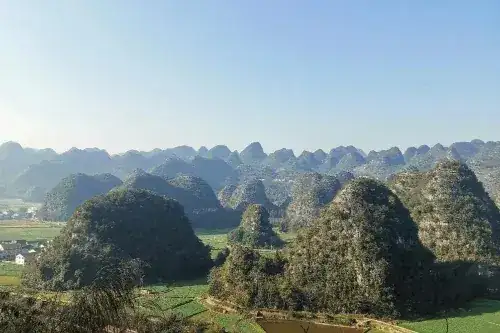
Northwest higher, southeast lower. Most areas 1,400–1,900 m elevation. Highest: Jiucaiping at 2,900.6 m (also Guizhou's highest point). Lowest: Beipanjiang River valley at 586 m. Relative elevation difference: 2,314.3 m. Mainly karst mountains and hills, with basins, plateaus, and canyons.
Climate
Subtropical monsoon humid climate. Low latitude + high altitude = warm winters, cool summers. Annual average: 15°C. January: 3–6.3°C; July: 19.8–22°C. "China's Cool City" designation. Annual precipitation: 1,200–1,500 mm. Frost-free period: 200–300 days. Total water volume: ~14.218 billion cubic meters.
Hydrology
On the divide between the Yangtze (Wujiang) and Pearl River (Beipanjiang) basins. 43 rivers over 10 km (9 Yangtze, 34 Pearl River). Rivers feature deeply incised valleys, narrow beds, swift currents, and large drops.
Natural Resources
Water Resources
Surface water: 8.149 billion m³. Groundwater: 2.261 billion m³. Total: 8.149 billion m³ (overlap deducted). Transit water: 3.65 billion m³. Theoretical hydropower potential: 1.1665 million kilowatts (developable: 706,800 kW, 59.84%).
Plant Resources
Diverse wild plants: 514 forage species (40 families, 192 genera), 700+ medicinal species (195 main), wild fruits (Rosa roxburghii, kiwi, hawthorn, cherry, grape), and other useful plants. 223 tree and bamboo species (62 families, 140 genera). Nationally protected species: dawn redwood, umbrella tree, dove tree, Ginkgo, Eucommia, yew, and others. Main crops: corn (largest), rice, potato, wheat, soybean, buckwheat.
Animal Resources
35 fish species (4 orders, 8 families), 18 amphibians (including giant salamander - Class III protected), 33 reptiles (8 families), 50+ common bird species (13 orders, 21 families), 52 mammals (8 orders, 23 families). Class I protected: South China tiger (extinct in wild), black leaf monkey, leopard, clouded leopard, goral, serow. Class II: macaque, pangolin, forest musk deer. Class III: black bear, large civet, small civet, leopard cat.
Mineral Resources
30+ mineral types: coal, iron, lead, zinc, copper, antimony, nickel, uranium, cobalt, silver, pyrite, silica, limestone, dolomite, marble, fluorite, calcite, iceland spar, barite, sepiolite, germanium, cadmium, gallium, indium, iridium, lanthanum, arsenic, crystal, oil shale, gypsum, and cement clay. Coal resources: 24.528 billion tons (5.289 billion tons reserves). Coalbed methane: 142 trillion cubic meters (45% of provincial total).
Population
As of end 2025: 3,034,700 (down 2,300). Urban: 1,632,000 (53.78%). Birth rate: 9.92 per mille; death rate: 7.29 per mille; natural growth rate: 2.64 per mille. 50 ethnic groups (49 minorities). 7 minorities with 10,000+ population: Yi, Miao, Buyei, Bai, Hui, Gelao, and Shui.
Ethnic Composition
50 ethnic groups (49 minorities). 7 main minority groups with 10,000+ population each: Yi, Miao, Buyei, Bai, Hui, Gelao, and Shui.
Politics
Economy
Overview
In 2025, the gross regional product was 177.775 billion yuan, up 5.2%. By industry: primary 19.249 billion (10.8%), secondary 73.365 billion (41.3%), tertiary 85.161 billion (47.9%). Per capita GDP: 58,558 yuan. Fixed-asset investment up 3.3% (industrial up 27.3%, high-tech up 75.8%, private up 2.4%). Total fiscal revenue: 17.628 billion, up 0.6%. General public budget revenue: 11.743 billion, up 0.1%. General public budget expenditure: 36.311 billion, up 3.3%. Urban disposable income: 44,841 yuan (up 4.3%). Rural: 17,437 yuan (up 5.8%).
Primary Industry
Grain area: 2.75 million mu. Grain output: 686,100 tons, up 2.2% (corn 346,100 tons; rice 62,800 tons; potato 187,800 tons). Meat: 154,500 tons, up 3.5% (pork 121,500 tons; beef 14,300 tons). Eggs: 49,100 tons. Pig inventory: 1,138,600, up 15.7%. Aquaculture: 3,100 tons, up 15.8%. 108 million mu of high-standard farmland cumulative. Agricultural machinery: 1.673 million kilowatts.
Secondary Industry
Industrial added value: 67.808 billion yuan, up 7.6%. Above-scale industrial added value up 10.3% (mining up 10.1%; manufacturing up 20.1%; electricity/heat/gas/water up 2.2%). Coal mining up 10.5%; beverages up 35.3%; petroleum/coal processing up 53.7%; non-ferrous smelting up 38.0%; electronics up 187.9%. Revenue: 107.07 billion, down 3.4%. Profits: 2.962 billion, up 67.5%. Total installed power capacity: 17.3921 million kilowatts (thermal 10.76 million; hydro 1.3644 million; wind 601,900; solar 3.6134 million, up 92.6%). Construction added value: 5.803 billion, down 1.4%.
Tertiary Industry
Wholesale/retail: 14.173 billion, up 5.5%. Transportation: 10.371 billion, up 2.8%. Accommodation/catering: 5.321 billion, up 7.0%. Finance: 7.911 billion, up 1.4%. Real estate: 6.828 billion, up 3.3%. Postal volume: 848 million yuan, up 16.4%. Telecom: 3.677 billion, up 13.6%. 3.7931 million mobile users. 15,400 5G base stations. Total retail sales: up 2.2%. Foreign trade: 1.726 billion yuan, up 15.3%. Total deposits: 198.888 billion, up 3.6%. Total loans: 276.569 billion, up 7.6%. Insurance premiums: 3.413 billion, down 5.3%. Tourist arrivals: up 13.1%. Tourism revenue: up 10.7%.
Social Affairs
Education
422 primary (349,900), 168 junior high (178,900), 44 high schools (78,400), 13 vocational (74,700), 3 universities (25,500).
Science and Technology
527 valid invention patents (up 5.6%). 764 technology contracts worth 5.36 billion yuan (up 15.5%).
Culture
34 art troupes, 7 museums, 5 public libraries, 97 cultural centers/stations, 3 national protected sites. Radio and TV coverage: 100%. National Class I library: Liupanshui Library. 909 copyright registrations (up 26.8%).
Healthcare
2,227 health institutions (233 hospitals). 23,862 beds (22,626 in hospitals). 27,070 health workers (9,647 physicians, 12,640 nurses).
Sports
6,482 sports venues, 8.0191 million m² (2.64 m² per capita). 134 gold, 130 silver, 148 bronze medals. 2 world champions, 11 national-level golds.
Social Security
Employee pension: 564,600, up 2.0%. Urban-rural pension: 1,424,200, down 0.5%. Medical insurance: 3,190,500, down 1.1%. Unemployment: 276,800, up 0.7%. Work injury: 455,200, up 5.0%. Maternity: 258,500, up 1.5%. Urban minimum living: 62,760 (452.25 yuan/month). Rural: 119,402 (352.69 yuan/month). 52 social service institutions (40 elderly care, 6 child welfare) with 4,980 beds.
Transportation
Overview
"Four-Province Overpass" at the junction of Sichuan, Yunnan, Guizhou, and Guangxi. 66 regional circulation node cities and 196 highway hub cities in national planning. 4 railways converge; HSR and intercity railways cover all counties ("county-to-county HSR" first in Guizhou). 5 expressways pass through. Liupanshui Yuezhao Airport serves 11+ cities. Total highway mileage: 16,283 km (548 km expressway, up 17.1%).
Highways
"Three horizontal, one vertical, one ring" expressway backbone. 5 national expressways (Hukun 67 km, Duxiang 145 km, Hangrui 65 km, Naxing 60 km under construction, Anpan 98 km planned). 4 provincial expressways. Total expressway: 440 km completed, targeting 640 km in 14th Five-Year Plan, eventual 770 km.
Railways
6 conventional railways (670 km) and 2 HSR lines (172 km). Network density: 84.9 km/10,000 km², the most developed in Guizhou. Shanghai-Kunming HSR opened December 2016. Anshun-Liupanshui intercity opened July 8, 2020, achieving "county-to-county HSR." Panxian-Xingyi railway under construction. Future cross-hub connecting Chengdu-Chongqing, Beibu Gulf, central Guizhou, and central Yunnan economic circles.
Water Transport
On the Yangtze-Pearl River divide. Beipanjiang and Sanchahe systems. Navigable: 381.7 km (26.8 km Class IV, 12 km Class V, 56.2 km Class VI, 130.6 km Class VII, 156.1 km unclassified). 902 vessels. Beipanjiang connects to the West River trunk, serving as the central channel for Southwest China's sea access. All waters are reservoirs from cascade hydropower development without ship locks.
Aviation
Liupanshui Yuezhao Airport: 4C-level, opened November 28, 2014. 2,800 m runway, designed for 250,000 annual passengers and 1,250 tons cargo. 11 routes to Beijing, Shanghai, Guangzhou, Hangzhou, Chongqing, Chengdu, Haikou, Xi'an, Changsha, Wuhan, and Guiyang. 2025: 61,400 passengers (down 32.5%).
Panshi Guanshan Airport: Planned 4C-level domestic branch airport in Panshi City, 3,000 m runway, 6 C-class stands, 8,000 m² terminal. Total investment: 2.054 billion yuan. Under NDRC review.
History and Culture
Origin of the Name
"Liupanshui" combines the first characters of Liuzhi, Panxian, and Shuicheng—the three counties where coal bases were established in 1964 for Third Front construction.
Third Front Culture
Liupanshui was born from "Third Front" construction—the massive 1964+ industrial migration to China's interior for national defense. The "Third Front Spirit" is the city's soul. Without Third Front construction, there would be no Liupanshui.
Cultural Heritage Sites
Intangible Cultural Heritage
Ethnic Culture
Folk Opera
Two main categories: locally developed forms (Liuzhi Dixi opera, Shuicheng/Panshi Nuo opera, Yi pansong performance, and huadeng) and imported forms (Wenqin seated singing, Daoqing, and daodao).
Scenic Spots
Overview
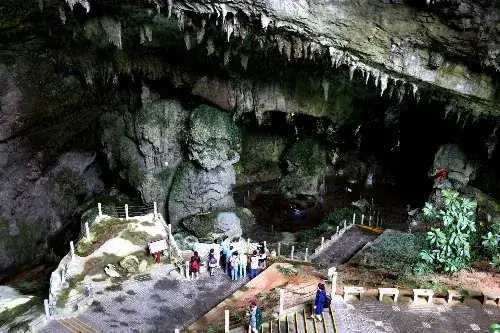
Highest elevation: 2,845.7 m; lowest: 586 m. Typical karst landscape. Wumeng Mountain National Geopark (380+ km²) features the world's "largest sinkhole," "deepest vertical shaft," and "highest natural highway bridge," plus Beipanjiang Grand Canyon, underground caves, plateau Buddha light, karst stone forests, ancient reptile fossils, and Paleolithic sites. Also: Yuses National Forest Park, ski resort, Yeyuhai, Ye Zhong black leaf monkey reserve, Panxian Dadong archaeological site, Tuole ancient ginkgo forest, Dadong bamboo sea, and grasslands.
Main Scenic Spots
Local Specialties
Dietary culture with strong regional characteristics. Famous snacks: Shuicheng grilled pot, Shuicheng mutton noodle, steamed cake, Langdai sauce, and lotus leaf glutinous rice chicken.
Famous People
Honorary Titles
National youth campus football reform zone (2018). "Four Good Rural Roads" demonstration (2021). Ninth batch National Ethnic Unity and Progress Demonstration (2021). Health City Construction Model (2020). National Food Safety Demonstration City (2023). National Double Support Model City (2025).
External Exchange
Travel information can change. Check current opening hours, reservations and entry requirements before you travel.
Traveller discussion
Start the conversation with a helpful tip or a question.